
Vous êtes ici
Agrégateur de flux
Quand Michel Barnier songeait à devenir maire de Paris
RÉCIT - En bonne voie pour devenir député LR de la capitale, Michel Barnier a réfléchi à ravir la mairie en vue des élections de 2008. Au point de laisser ses conseillers étudier brièvement ce scénario, quand il était ministre des Affaires étrangères, avant d’y renoncer.
Catégories: Europäische Union, France
La politique énergétique à la merci d’un décret fantôme
DÉCRYPTAGE - Les entreprises du secteur rêvent d’une programmation pluriannuelle qui n’arrive pas.
Catégories: Europäische Union, France
WHO Warns of Global NCD Crisis, Calls for Urgent Investment to Save 12 Million Lives By 2030
Nepal’s urbanization has contributed to a growing prevalence of ultra-processed food, which in turn has led to an increase in noncommunicable diseases among children. A family in Nepal picks out fresh produce at a vegetable market in an effort to promote healthy diets. Credit: UNICEF/Bishal Bisht
By Oritro Karim
UNITED NATIONS, Sep 22 2025 (IPS)
The World Health Organization (WHO) is urging global efforts to address and invest in tackling non-communicable diseases, and that by doing so, can yield economic benefits of up to USD 1 trillion by 2030.
Ahead of the upcoming United Nations (UN) General Assembly High-Level Meeting on the prevention of Noncommunicable Diseases (NCDs) on September 25, WHO released their newest report, Saving Lives, Spending Less: The Global Investment Case for Noncommunicable Diseases, during a virtual press conference on September 18. The report highlighted the global state of physical and mental health, calling for cost-effective interventions to reduce preventable deaths, accelerate progress toward the Sustainable Development Goals (SDGs), and strengthen health systems worldwide.
According to the report, NCDs—which include cancer, diabetes, and cardiovascular and lung diseases—are the leading causes of death in most countries, claiming over 43 million lives each year, including 18 million premature deaths. WHO further notes that hundreds of millions of people are currently living with at least one NCD, which significantly reduces both quality of life and lifespan.
Despite 82 percent of countries achieving reductions in NCD mortality between 2010 and 2019, the rate of progress has stalled significantly in the 2020s, with many countries recording higher numbers of NCD-related deaths post-pandemic. This is particularly dire for low-and middle-income countries, where the inadequate access to healthcare costs roughly 32 million lives each year. It is projected that over 150 million people could die prematurely from NCDs unless effective global action is taken.
“There is no country on earth that isn’t now, and in the coming years is going to be challenged by the issues of NCDs and mental health,” said Jeremy Farrar, a medical researcher and the Chief Scientist at WHO. “Demographic shifts, multimorbidity—where people have more than one condition—are going to be an issue for health systems all around the world, including for the richest countries in the world.”
WHO Director-General Tedros Adhanom Ghebreyesus noted that over three million people die each year due to unsafe or inequitable access to healthcare. He further highlighted that more than one billion people face mental challenges worldwide, with suicide remaining one of the leading causes of death among young people.
“Noncommunicable diseases and mental health conditions are silent killers, robbing us of lives and innovation,” said Ghebreyesus. “We have the tools to save lives and reduce suffering. Countries like Denmark, South Korea, and Moldova are leading the way, while others are stalling. Investing in the fight against NCDs isn’t just smart economics—it’s an urgent necessity for thriving societies.”
Global exposure to preventable risk factors — such as tobacco and alcohol use, unhealthy diets, excessive consumption of sugary beverages, and physical inactivity — kills more than 10 million people each year and continues to exacerbate health issues worldwide. WHO further attributes the proliferation of NCDs and mental health challenges to demographic shifts such as rapid urbanization, which has left many countries grappling with rising debt, economic pressures, and limited fiscal space—factors that hinder effective investment in sustainable development and healthcare.
“When we talk about NCDs, it is very important to recognize that we are going against very strong financial interests,” said Etienne Krug, WHO Director for health determinants, promotion, and prevention. “There are a whole series of unhealthy products on the market right now, ranging from tobacco, unhealthy foods, alcohol, etcetera. Acting against the interests of some of these powerful companies is not always approached with the same energy from different governments. Unless we do take action to promote healthy products and limit the sale of unhealthy products, we will not make progress in tackling NCDs — and not fast enough.”
WHO estimates that implementing relatively low-cost policies could yield significant returns, accelerating progress toward the SDGs while improving public health. According to the report, if every person invested just USD 3 per year, up to 12 million lives could be saved between 2025 and 2030—equivalent to roughly 150 million healthy life years. Economically, this could generate up to USD 1 trillion in benefits worldwide, representing a four-to-one return on investment. By 2035, these gains are estimated to grow even further, with every dollar invested yielding up to seven dollars in economic benefits.
Numerous low- and middle-income countries have reported significant gains in public health and the economy after implementing policy changes on access to unhealthy substances. In 2018, Brazil went from being the nation with the sixth-cheapest cigarettes in the world to implementing the highest tobacco tax rate in the Americas, leading to significant reductions in nationwide smoking rates.
Numerous low- and middle-income countries have reported significant public health and economic gains after implementing policies to limit access to unhealthy substances. In 2018, Brazil shifted from having the sixth-cheapest cigarettes in the world to imposing the highest tobacco tax rate in the Americas, resulting in a significant nationwide decline in smoking rates, saving hundreds of thousands of lives.
Similarly, the integration of hypertension control services into primary care in Bangladesh, Ethiopia, and the Philippines has allowed millions of people with hypertension to manage their blood pressure. The most notable gains were recorded in the Philippines, where approximately 80 percent of patients have achieved controlled blood pressure since the implementation of these practices.
Despite these global gains, the United States continues to fall short in addressing the rise of NCDs. It is among the most NCD-affected countries in the world, with rates of obesity being particularly pronounced. Despite the U.S. allocating a disproportionately high expenditure for healthcare in comparison to other countries, its approach remains largely ineffective in maximizing public health outcomes. Ghebreyesus stated that investing in policies that promote healthy practices and disease prevention would address the root cause of NCDs, and possibly save millions of lives.
Ghebreyesus also expressed concern during the panel over the U.S.’s planned withdrawal from WHO next year, noting that the country has historically been the organization’s largest contributor and warning of the significant losses in public health that can be expected. According to Ghebreyesus, the new amendment to WHO’s policies includes critical information on global weaknesses that have been identified during the COVID-19 pandemic, which will prove to be crucial in tackling NCDs moving forward.
IPS UN Bureau Report
Follow @IPSNewsUNBureau
!function(d,s,id){var js,fjs=d.getElementsByTagName(s)[0],p=/^http:/.test(d.location)?'http':'https';if(!d.getElementById(id)){js=d.createElement(s);js.id=id;js.src=p+'://platform.twitter.com/widgets.js';fjs.parentNode.insertBefore(js,fjs);}}(document, 'script', 'twitter-wjs');
Catégories: Africa
Décès de Samuel W. Chris OUEDRAOGO dit Samy : Remerciements et faire-part
31/07/2017 au 13/09/2025
« 1 Thessaloniciens, 5:18 Rendez grâces en toutes choses, car c`est à votre égard la volonté de Dieu en Jésus Christ. »
Les Grandes Familles OUEDRAOGO et LENGA à Ouagadougou, Bobo-djoulasso, Ouahigouya, Kodtengaye ;
Les familles alliées, SAWADOGO, LENGA ;
Monsieur OUEDRAOGO Daouda et Madame OUEDRAOGO/LENGA Simone ;
Les Frères et Sœurs : David, Naomie, Elidad ;
Très touchés par les nombreux témoignages de sympathie et de solidarité, expriment leurs sincères gratitudes à tous ceux qui, de près ou de loin, ont manifesté leur vive compassion et soutien inestimable à travers leurs nombreuses actions multiformes lors du rappel à Dieu et de l'inhumation le Dimanche 14 Septembre 2025 de leur fils, frère
Samuel OUEDRAOGO dit Samy.
Que l'unique Dieu de toute grâce parfaite, vous comble de ses multiples bienfaits au nom de notre Seigneur Jésus-Christ.
Catégories: Afrique
127/2025 : 22. September 2025 - Informationen
Neue Zusammensetzung der Kammern des Gerichts der Europäischen Union
Catégories: Europäische Union
127/2025 : 22 September 2025 - Information
New composition of the Chambers of the General Court of the European Union
Catégories: European Union
127/2025 : 2025. szeptember 22. - Információ
Az Európai Unió Törvényszéke tanácsainak új összetétele
Catégories: Európai Unió : hírek magyarul
127/2025 : 22 septembre 2025 - Informations
Nouvelle composition des chambres du Tribunal de l’Union européenne
Catégories: Union européenne
Vital Kamerhe démissionne de la présidence de l'Assemblée nationale
Vital Kamerhe a démissionné de son poste de Président de l’Assemblée nationale, ce lundi 22 septembre après-midi. Selon plusieurs sources à la chambre basse du Parlement, dont des députés contactés par Radio Okapi, il a déposé sa démission devant la conférence des présidents.
Catégories: Afrique
Japan’s Ruling LDP Pursues Unity Ahead of Leadership Race
The top contenders, including Koizumi Shinjiro and Takaichi Sanae, have moderated their positions since the 2024 race.
Présidentielle en Côte d'Ivoire : Quatre candidats pour défier le président sortant Ouattara
La campagne pour l'élection présidentielle en Côte d'Ivoire débutera le 10 octobre dans un climat politique tendu. Cinq candidats ont été autorisés à se présenter à l'élection d'octobre 2025.
Catégories: Afrique
À Paris, le musée Pompidou ferme ses portes pour cinq ans
Le Centre Pompidou, bâtiment parisien iconique à l'architecture tubulaire multicolore qui abrite le plus important musée d'art moderne au monde avec le MoMA à New York, a fermé ses portes lundi pour cinq ans de rénovation.
Catégories: France, Határon túli magyar portálok összesített hírei
La Norvège confirme la commande de 24 canons automoteurs sud-coréens K9 supplémentaires
En 2017, après avoir annulé l’achat de vingt-quatre canons automoteurs sur roues « Archer » auprès de BAE System Bofors en pointant leur « manque de mobilité », la Norvège fit savoir qu’elle allait commander autant de K9 « Thunder » [chenillés] produits par le sud-coréen Hanwha Aerospace [ex-Hanwha Land Systems] pour remplacer ses M109A3GN. D’un montant de 215 millions de...
Cet article La Norvège confirme la commande de 24 canons automoteurs sud-coréens K9 supplémentaires est apparu en premier sur Zone Militaire.
Catégories: Défense
En Chine, la classe moyenne a besoin d'être rassurée
À l'aube du XXe Congrès du Parti communiste chinois, une ombre plane au-dessus de la Chine : celle de la classe moyenne. Cette dernière fut au cœur du grand virage amorcé dans les années 1990 et elle reste au centre des défis actuels. / Chine, Économie, Éducation, Inégalités, Logement, Mutation, (...)
/ Chine, Économie, Éducation, Inégalités, Logement, Mutation, Société, Ville - 2022/10
Catégories: Diplomacy & Crisis News
Course à l'atome au Proche-Orient
Malgré leur reprise après l'élection de Joseph Biden aux États-Unis, les négociations entre les pays occidentaux et Téhéran au sujet du nucléaire iranien n'ont guère progressé. Persuadés que la République islamique cherche à se doter de la bombe, les pays de la région, Arabie saoudite en tête, développent (...)
/ Arabie saoudite, Émirats arabes unis, Golfe, Irak, Iran, Israël, Proche-Orient, Armement, Nucléaire militaire, Désarmement, Énergie, Nucléaire civil - 2022/10
Catégories: Diplomacy & Crisis News
In an ‘America First’ Era, Taiwan Gains Ground in Congress
An analysis of 20 years of congressional speeches shows that support for Taiwan is increasingly a central pillar in the U.S. competition with China.
L'enclavement du Nord du Maniema pénalise les agriculteurs locaux
Les agriculteurs du Nord du Maniema sont confrontés à plusieurs difficultés, dont l'enclavement. Ces derniers l'ont fait savoir samedi 19 septembre à l'autorité provinciale et au Programme d'appui au développement rural inclusif et résilient (PADRIR).
Catégories: Afrique
Pendant la reconnaissance, les massacres continuent
La quatre-vingtième session de l'Assemblée générale des Nations unies doit marquer la relance d'une « solution à deux États » au Proche-Orient. La reconnaissance officielle de l'État de Palestine par plusieurs pays occidentaux, dont le Royaume-Uni et la France, vise à donner un élan à ce sommet mondial. (...)
/ France, Diplomatie, Palestine - La valise diplomatique
Catégories: Diplomacy & Crisis News
Burkina/Football : Match opposant les chefs coutumiers aux prêtres, un duel sacré sur une pelouse bénie
À l'occasion du centenaire du petit séminaire Saint-François-de-Sales de Pabré, un match amical a réuni les prêtres de l'archidiocèse de Ouagadougou et les chefs coutumiers. Cet affrontement entre religieux et traditionnalistes s'est déroulé le dimanche 21 septembre 2025, au collège Jean-Baptiste-de-la-Salle à Ouagadougou.
Il était 16 h au terrain du collège Jean-Baptiste-de-la-Salle de Ouagadougou, lorsque les crampons des traditionalistes et des religieux ont pris contact avec la pelouse pour écrire un nouveau chapitre. Entre incantations à l'échauffement, et bénédictions au coup d'envoi, le terrain était aussi spirituel que sportif.
Les prêtres en maillots blancs, contre l'équipe des chefs coutumiers en bleu. Après les encouragements des chefs coutumiers aux joueurs devant les représenter, place au début du match.
Du côté des prêtres, l'abbé David Ilboudo gardait les buts. Ce match, dont le score était de 0-0 à la pause, a pris une autre tournure à la seconde période. En effet, les chefs coutumiers ont vite ouvert le score dès leur retour de la pause, en inscrivant le 1ᵉʳ but. Un 2ᵉ but ne s'est pas non plus fait attendre, grâce à un « tir ancestral » du nᵒ 2. Les chefs coutumiers inscriront ensuite un 3e but.
L'abbé Valéry Sakougri, curé de la paroisse Saint-Marc de Nagrin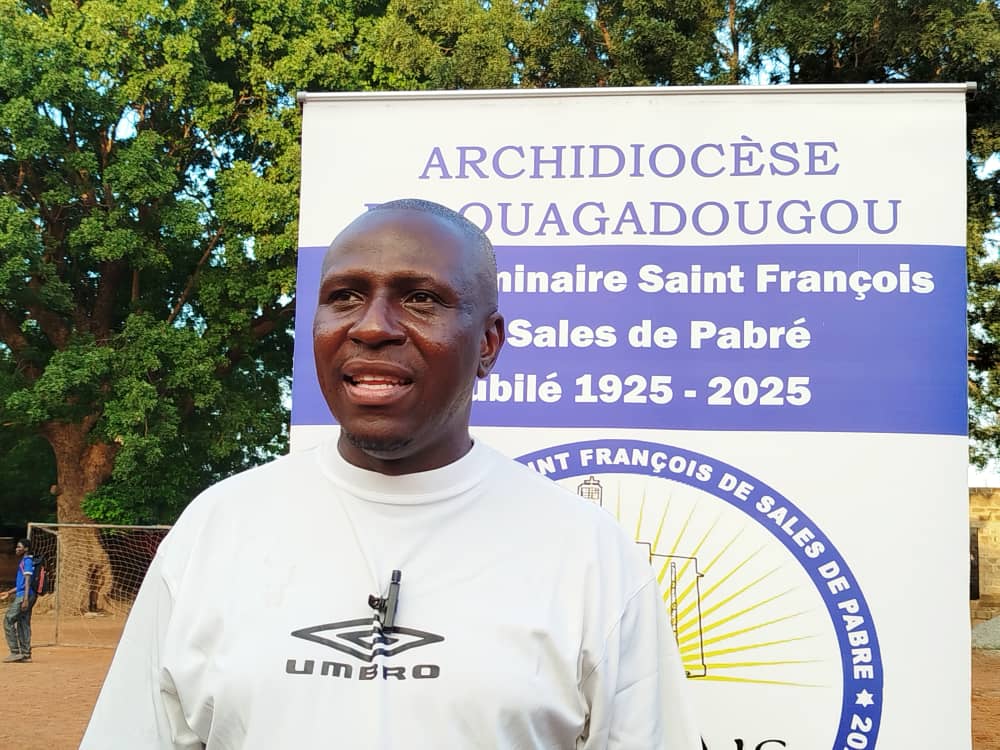
Cependant, les prêtres ne se sont pas laissés faire. Dans les dernières minutes du jeu, l'abbé Alain Grégoire Nikièma bénéficie d'un penalty et marque le premier but en faveur des religieux. C'est d'ailleurs son tir qui a bouclé le match.
Pour l'abbé Valéry Sakougri, curé de la paroisse Saint-Marc de Nagrin, la défaite des prêtres n'est pas un souci, car c'est la fraternité qui gagne. « Le match était très bien dans l'ensemble, mais nous n'avons pas vu le jeu des “nanamsé” proprement dit. Nous avons vu le jeu de leurs délégués et ce n'est pas grave. Notre défaite n'est pas un problème, car c'est la fraternité qui gagne », s'est-il exprimé.
Ce duel serré entre religieux et traditionnalistes s'est terminé sur un score de 3-1 en faveur des chefs coutumiers. Le Wayalghin Naaba Tanga, le coordonnateur de l'équipe de sport de sa majesté Moogho Naaba, confie que son équipe ne s'était pas préparée pour ce match. Mais la détermination des joueurs leur a valu cette victoire.
Le Wayalghin Naaba Tanga, le coordonnateur de l'équipe de sport de sa Majesté Moogho Naaba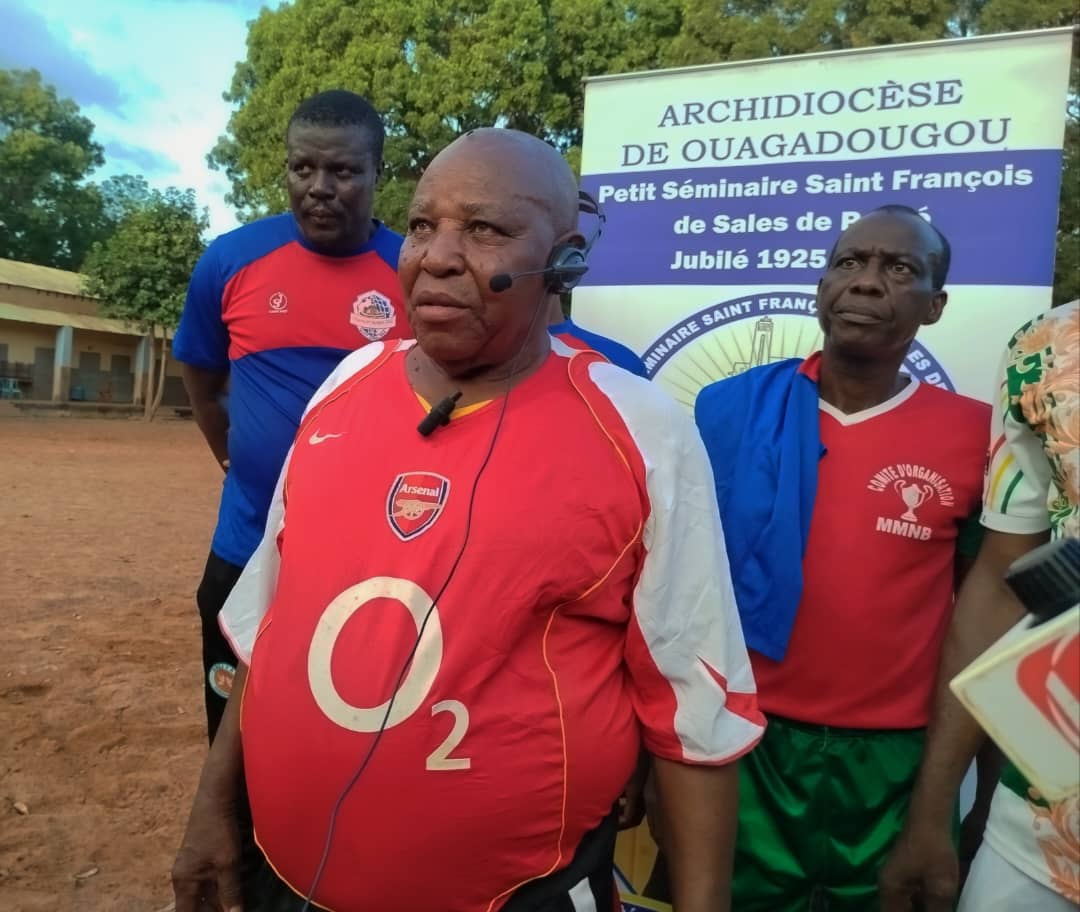
« Ce n'était pas du tout un match facile. Nous avons même cru au début que les prêtres allaient nous battre. Car, c'est juste le vendredi que le Moogho Naaba nous a passé l'information. Donc, il n'y a pas eu d'entraînement. Mais les joueurs ont donné le meilleur d'eux-mêmes, et nous avons finalement été les vainqueurs », a-t-il confié.
Il n'a pas manqué de souligner que cette victoire leur appartient autant qu'aux prêtres. Il remercie Dieu pour ce siècle d'existence du petit séminaire de Pabré et souhaite vivement que cette cohésion sociale perdure.
Du reste, Tanga Joseph Tapsoba, président du comité de pilotage des 100 ans du petit séminaire de Pabré, a fait comprendre que ce match, organisé pour célébrer le centenaire du petit séminaire de Pabré, est un symbole de la cohésion sociale. Il démontre que malgré les difficultés que traverse le pays, les communautés peuvent toujours vivre en parfaite harmonie.
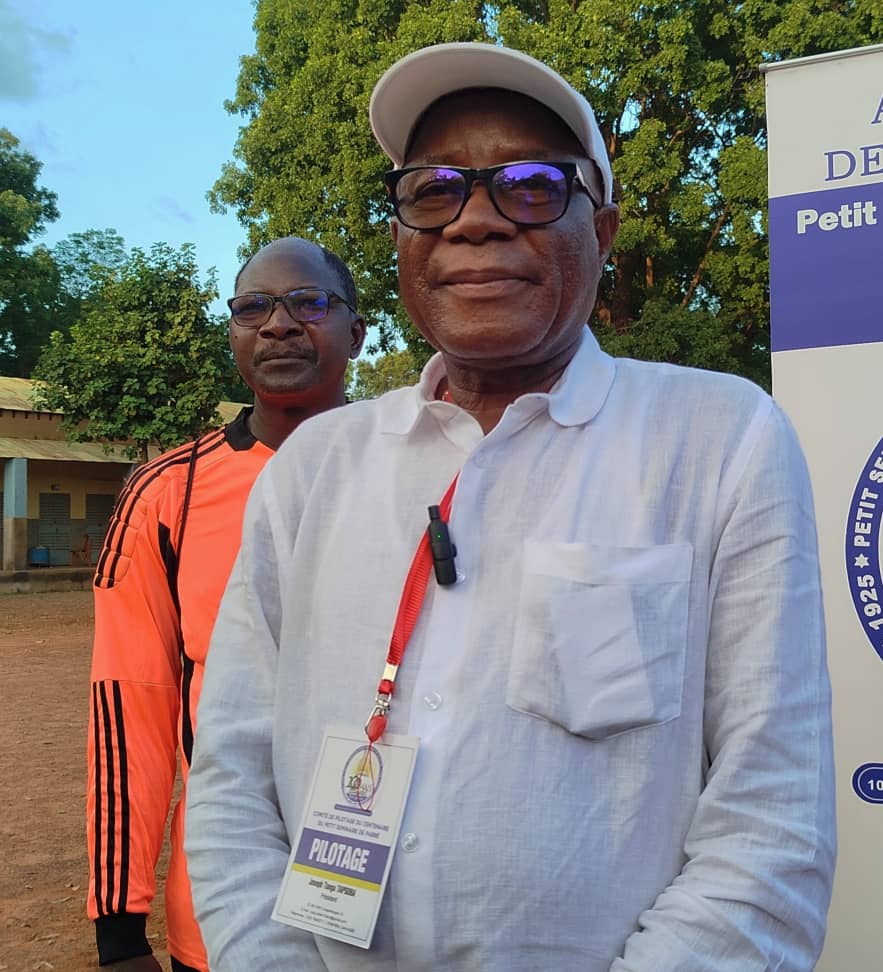
« Comme le dit Lucky Dube, différentes couleurs, un peuple. Dans le contexte actuel du Burkina, où nous vivons l'insécurité et où la cohésion sociale est mise à mal, nous avons apporté la preuve à travers ce qui vient de se passer ce soir que nous pouvons vivre ensemble, en bonne intelligence. Parce que notre richesse et notre force, c'est notre diversité », a-t-il expliqué.
L'événement s'est déroulé dans une ambiance conviviale, renforçant les liens entre les différentes communautés.
Pour mémoire, le petit séminaire Saint-François-de-Sales de Pabré a été créé en 1925 par Monseigneur Joanny Thévenoud pour le service pastoral. Le séminaire a contribué à former des prêtres comme des laïcs, servant aujourd'hui dans différentes sphères de la société burkinabè.
Muriel Dominique Ouédraogo (stagiaire)
Lefaso.net
Catégories: Afrique
Shall We Play A Game…
The escalation of the War in Ukraine came about in a significant manner recently when several Iranian designed attack drones entered Polish airspace from Belarus and Russia. While Ukraine has been the front lines in defending itself and access points into NATO territory, the border between NATO and the East is the Polish border. Poland has been equipping itself and readying its people to defend the nation from any possible threats to its integrity and sovereignty. Poland has been the strongest ally in NATO against threats from Russia, and has taken a generational approach to its own defense and that of NATO as a whole. Not only did Poland rapidly displace its old Warsaw Pact equipment with more modern NATO tanks and systems, but Poland has taken to establishing South Korean military equipment production in Poland, producing some of the best weapons systems in the world in local facilities. Poland is due to become one of the strongest militaries in the world, and it has now faced its first direct assault from Russia.
While the attack was significant as an act of war, it was not a serious threat to the integrity of Poland, its defenses, or its people. The reasoning behind the drone incursion into Poland is not known, but there are many suspected reasons behind it, none accepting the act as one taken in error. The debate currently going on in Poland and NATO is whether a strong response is required, and what proportional act of force is reasonable, if any at all. Suspected reasons for the incursion could be a show of force by Russia soon after China revealed its new missile force to the world. This might not be the case as Russia has its own significant missile force, and it has not been used against Poland and has been challenged in Ukraine. Drone usage often is accompanied by a swarm tactic using such systems mixed with higher end ballistic missiles, but that did not take place in the attack. Beyond a show of force against Poland, the drones could have been used to reveal the defensive capabilities of Poland against Russian weapons, as Polish defenses and NATO support all scrambled in response from the Netherlands, Italy, France, and local neighbours. What is clear however is that another possible escalation in the future is probable.
The lingering response of NATO and its allies to possible future threats has done nothing but made the conflict more robust and more likely to spiral out of control. The lack of solid coordination in displacing the purchase of Russian oil and gas until 2025, and those funds not only propping up the Rouble, but funding Russian war production does nothing more but extend the war and drain funds. The dedication to the war effort was ever diminishing when public funds in the billions from Ukraine’s allies contradict national energy policies in many of those same nations. It is suspect that since 2022, North American energy policy did not move to assist Europe in their fight, and in 2025 Canada has yet to adjust its energy policy towards assisting its allies currently in conflict in Europe. To add to these policies, the complete avoidance of targeting or eliminating the production of terror weapons, namely the drone production facilities in Iran, allowed those civilian murdering weapons to spring up in Kurdish lands, Poland and Venezuela. To end the war, it is best to start by actively preventing further conflict.
It is not known if the acts against Poland will trigger a wider conflict between NATO and Russia, but the manner the West and NATO treats its natural allies is as much of a challenge in this policy environment as Russian incursions. Rewarding Russian allies and Russian acts does more to turn the tide against NATO and its allies than to end the war with acceptable results. The narrative of a united front will never succeed as simple prose, as actions are needed in this wider war to end a Third World War. Responses in 2025 is the junction point between the end of war in Europe, or the spread of this war globally. It is that significant, and will start in the skies over Poland.
Catégories: Diplomacy & Crisis News
Pages


© 2012-2018 Europa Varietas Foundation © 2015-2018 Europa Varietas Association
www.europavarietas.org | info(@)europavarietas(dot)org | Switzerland
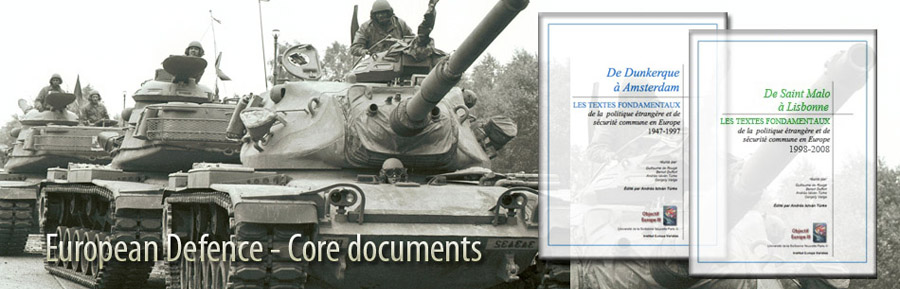
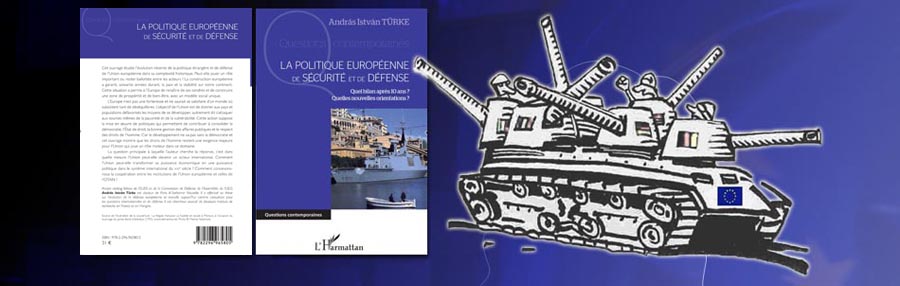
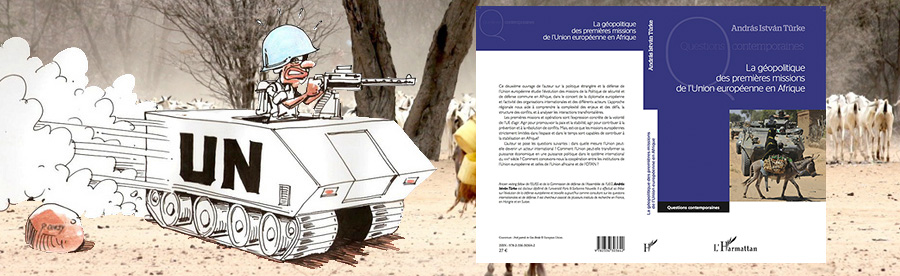
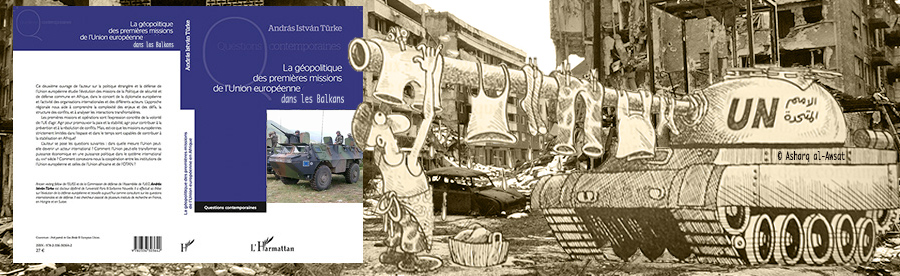
We are looking for sponsors for the English translation of these books, please contact turkeandras(at)gmail(dot)com