
Vous êtes ici
Agrégateur de flux
Qu'est-ce que la « ville auto-suffisante » d'Elon Musk, qu'il prévoit de construire sur la Lune plutôt que sur Mars ?
Le patron de X, Tesla et SpaceX, qui est aussi l'homme le plus riche du monde, a déclaré qu'une ville lunaire pourrait voir le jour « en moins de 10 ans ». Mais est-ce réaliste ?
Catégories: Afrique, Defence`s Feeds
Décès de Willy Ngoma, porte-parole de l’AFC/M23 à Rubaya
Willy Ngoma, porte-parole du groupe armé AFC/M23, est décédé ce mardi 24 février, rapportent plusieurs médias locaux et internationaux. L'information est également confirmée par d'autres sources locales.
Le porte-parole du groupe armé AFC/M23 a été mortellement touché à la suite de frappes aériennes qui seraient menées par les Forces armées de la République démocratique du Congo (FARDC) à Rubaya, dans la province du Nord-Kivu, selon plusieurs sources.
Sichere Außengrenzen der EU
Die politische Debatte über Schwächen des EU-Außengrenzschutzes verengt sich auf quantitative Indikatoren wie die Zahl irregulärer Grenzübertritte. Diese Kennzahlen sind interpretationsbedürftig und blenden den rechtlichen Rahmen aus, der auch bei irregulärer Einreise den Zugang zum Asylverfahren garantiert. Als primärer Maßstab für die Funktionalität des Grenzmanagements sind sie daher ungeeignet. Die wissenschaftliche Forschungslage zeigt keine eindeutige Abschreckungswirkung verschärfter Grenzkontrollen. Rückgänge auf einzelnen Routen durch Vorverlagerung gehen häufig mit Ausweichbewegungen, einer Anpassung bzw. Professionalisierung des Schleuserwesens und höheren Risiken für Schutzsuchende einher. Von weiteren Verschärfungen der Grenzsicherung ist kein linearer Nutzen zu erwarten. Mit dem Europäischen Integrierten Grenzmanagement (EIBM) und dem Schengen-Aufsichtsverfahren verfügt die EU bereits über einen anspruchsvollen Maßstab für Grenzkontrollen, der mehr politische Aufmerksamkeit verdient. Die Umsetzung ist in allen Mitgliedstaaten stärker voranzutreiben; die derzeitigen Defizite rechtfertigen jedoch keine andauernden Binnengrenzkontrollen. Das Europäische Grenzmanagement wird kontinuierlich entlang der Achsen Externalisierung, Zentralisierung und Technologisierung ausgebaut. Zusätzliche Forderungen, etwa nach erneutem Ausbau von Frontex oder Aufbau von Drohnenkapazitäten, sind in diesem Kontext genau und sorgfältig auf Mehrwert und Machbarkeit zu prüfen. Eine harte Versicherheitlichung, der zufolge Grenzen primär als Verteidigungslinien definiert sind, würde einen Paradigmenwechsel mit hohen Rechts- und Legitimationskosten einleiten. Die Berufung auf hybride Bedrohungen oder nationale Notlagen als Rechtfertigung dafür, östliche EU-Außengrenzen zu schließen und das Asylrecht dort auszusetzen, taugt langfristig jedoch nicht als Maßstab zur Bewertung des regulären europäischen Grenzmanagements.
MEPs launch push for €1bn EU exposome research mission
New initiative would track lifetime exposures affecting human health
Catégories: European Union, Union européenne
The ‘Resting’ Generation and South Korea’s Youth Recession
As entry-level jobs contract and firms prioritize experience, a growing number of young South Koreans have given up on looking for work altogether.
Catégories: Diplomacy & Crisis News, European Union
EU completes controversial rollback of corporate sustainability laws
But environmental activists warn the changes could increase legal risks
Catégories: European Union, Union européenne
AUKUS Quietly Moving Ahead With Arrival of British Sub in Australia
By integrating industrial bases and operational practices, Australia and the U.K. are signalling that their partnership is not a relic of history but central to their contemporary strategies.
Catégories: Diplomacy & Crisis News, European Union
Au Sénégal, le premier ministre veut durcir les peines contre l’homosexualité avec un nouveau projet de loi
Le projet de loi d’Ousmane Sonko, qui prévoit aussi de punir l’apologie de l’homosexualité de trois à sept ans de prison, devra ensuite être soumis au vote des députés à une date non précisée.
Catégories: Afrique
Hindutva Groups in India Effectively Outlawed Valentine’s Day
Using vigilante violence, these militant organizations are forging a new form of law and order that conforms to their strict religious beliefs.
Catégories: Diplomacy & Crisis News, European Union
Old pesticide laws are stalling farmers’ drone tech use, says CropLife leader [Advocacy Lab]
Europe risks missing out on the next wave of precision agriculture because its pesticide rules were written for a pre-drone era, the chair of CropLife Europe, Jens Hartmann, has warned
Catégories: European Union, Union européenne
The UN’s moral collapse on Iran
By hosting Tehran’s officials after a brutal crackdown, the UN Human Rights Council has forfeited its moral authority
Catégories: European Union, Union européenne
L'entrée au FInAB est gratuite ce mardi 24 février
Le Festival international des arts du Bénin (FInAB), grand évènement culturel et artistique se poursuit au Family Beach de Cotonou. La participation ce mardi 24 février 2026, est totalement gratuite.
Ce mardi 24 février 2026, le FInAB s'offre gratuitement au public. Les tickets d'entrée selon les organisateurs, sont offerts par NSIA Banque, l'un des partenaires de l'évènement. Conférences débats, divers jeux et animations, vernissage, Chill & Showtimes DJ, et plusieurs autres activités vont rythmer cette journée spéciale. Seul ou entre amis, c'est le moment parfait pour découvrir la richesse des talents, soutenir les artistes, capturer du contenu incroyable et vibrer au rythme de l'art béninois.
Démarré vendredi 20 février 2026, le FInAB se poursuit jusqu'au 1er mars prochain.
F. A. A.
New Dutch health minister’s mission impossible, improving care while cutting costs [Advocacy Lab]
Dutch Health Minister Sophie Hermans is tasked with building “the healthiest generation ever” while slashing billions from the healthcare budget
Catégories: European Union, Union européenne
The EU’s Enlargement policy navigating a strategic tension – ELIAMEP’s experts share their views
Panagiota Manoli, Senior Research Fellow, ELIAMEP; Associate Professor at the University of the Peloponnese
Despite the recent revival of EU’s enlargement policy as a result of the EU’s geopolitical awakening of 2022, elites in candidate countries still perceive accession as a perpetual goal. The continually evolving accession conditions and extended candidacy periods have weakened the policy’s predictability and credibility. A survey conducted within the framework of the Geo-Power-EU project (2025)* showed the gap between the declared objectives of the EU’s enlargement policy and the perceptions held by the elites of the candidate countries.
On the EU side, enlargement is viewed as progressively advancing through partial integration mechanisms. EU policymakers, emphasize gradual integration through the single market, Growth Plans, Association Agreements, and DCFTAs as evidence of steady progress, viewing progress as dependent on the candidates’ commitment to reform. On the contrary many candidate-country elites, especially among long-standing candidates, see limited progress toward full membership. Elites in the Western Balkans, report that accession conditions have continually shifted (e.g. ICTY cooperation, regional relations) or taken hostage of bilateral disputes (e.g. most recently between Bulgaria and North Macedonia) creating a perception of deferral rather than progression, undermining confidence in the process. Accession process is commonly described as stagnation and technical engagement without political certainty. One of the most significant negative developments is that prolonged candidacy has contributed to public fatigue, rising Euroscepticism, and disincentives for reform. Among the new EU candidates in eastern European neigbourhood, Moldova and Ukraine (except for Georgia) exhibit cautious optimism following their fast track candidate status (2023) and technical progress, though it is acknowledged that security challenges necessitate flexible accession models.
Most EU elites are more concerned about the Union’s own capacity to absorb new members, arguing that enlargement must be matched by internal reforms to safeguard effective governance and institutional resilience. While geopolitical pressures—particularly related to security and stability—are widely acknowledged, they are also seen as pushing the EU toward enlargement decisions that may exceed its institutional limits. Fast-tracked or expedited accession processes are mostly dismissed, as they risk overstretching EU institutions, financial resources, and policy frameworks, ultimately undermining the effectiveness of the Union.
As the European Union weighs expansion to include the Western Balkans and eastern neighbours like Ukraine and Moldova, it must navigate a strategic tension: how to reconcile the principle of merit-based accession with geopolitical urgency, without undermining the deepening and cohesion of integration itself.
*Note: The results of an elite survey conducted in all 9 candidate countries in Spring 2025 within the framework of the Geo-Power-EU project (funded Horizon Europe and coordinated by the University of the Peloponnese) are presented in Deliverable D2.1. “Discerning the perceptual gap between the EU policies and the countries’ expectations and needs”.
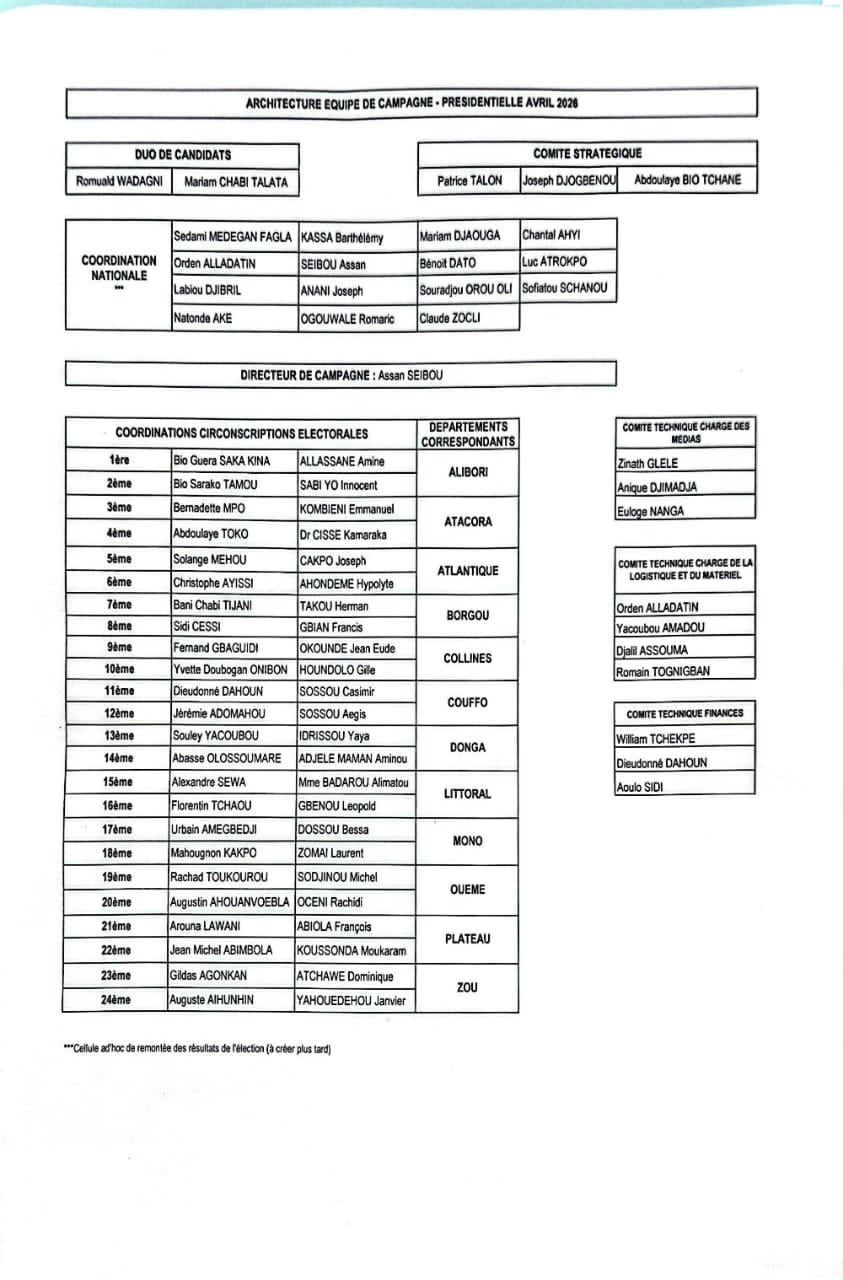
Talon dans le Comité de campagne du duo Wadagni-Talata
À moins de deux mois de l'élection présidentielle du 12 avril 2026, la mouvance présidentielle béninoise a rendu publique la liste des membres de l'équipe de campagne du duo de candidats formé par Romuald Wadagni et Mariam Chabi Talata.
Le pilotage de la campagne du duo de candidats Romuald Wadagni et Mariam Chabi Talata à la présidentielle du 12 avril prochain est confié à un Comité Stratégique composé des figures de proue de la majorité.
On y retrouve notamment le Président Patrice Talon ; Joseph Djogbénou, président de l'Union Progressiste le Renouveau (UP-R) et président de l'Assemblée nationale ; Abdoulaye Bio Tchané, secrétaire national du Bloc Républicain (BR).
Au poste de Directeur de Campagne, le député Assan Seibou sera assisté d'une équipe de coordination nationale incluant des ministres en exercice et des députés influents. Il s'agit des députés Orden Alladatin ; Aké Natondé ; Sofiath Schanou ; Barthélemy Kassa ; Joseph Anani ; Chantal Ahyi et le ministre des sports Bénoît Dato.
Un maillage territorial des 24 Circonscriptions Electorales
La stratégie repose sur un quadrillage des 24 Circonscriptions Electorales. Pour chacune d'elles, des binômes de responsables ont été désignés afin d'assurer l'animation et la mobilisation locales.
Dans le nord, des responsables comme Bio Guera Saka Kina et Bani Chabi Tijani sont chargés de coordonner les activités de campagne.
Dans le sud, le député et maire honoraire de Cotonou, Luc Atrokpo, le député et ex ministre du Tourisme, de la Culture et des Arts, Jean-Michel Abimbola, figurent parmi les personnalités mobilisées.
Pour encadrer la campagne, plusieurs comités spécialisés ont été mis en place, notamment un comité des finances, placé sous la responsabilité de William Tchékpé ; un comité technique chargé des médias, ainsi qu'un comité logistique en charge de l'organisation des déplacements et des rassemblements. Le comité chargé des médias est composé de Zinath Glèlè ; Anique Djimadja et Euloge Nanga.
Le tandem Wadagni-Talata se présente comme le garant de la poursuite des réformes engagées ces dernières années sous le leadership du président sortant Patrice Talon.
Talján jellegű játékok
A helyszínen gyűjtött élményeket mixeltük a statisztikákkal és sporttörténeti adalékokkal a Tetőteraszon. Kádár Zoltán és Boros Miklós értékelte a vasárnap zárult milánói-cortinai világversenyt. Házigazda: Rostás-Péter István
Articolul Talján jellegű játékok apare prima dată în Kolozsvári Rádió Románia.
Catégories: Afrique, Határon túli magyar portálok összesített hírei
Que sait-on de l'opération qui a conduit à la mort d'"El Mencho", le trafiquant de drogue le plus recherché par le Mexique et les États-Unis ?
Les forces armées mexicaines ont mené une opération dans le sud de l'État de Jalisco qui a abouti à la capture et à la mort de Nemesio Oseguera, alias "El Mencho", le baron de la drogue le plus recherché par le Mexique et les États-Unis.
Que sait-on de l'opération qui a conduit à la mort d'"El Mencho", le trafiquant de drogue le plus recherché par le Mexique et les États-Unis ?
Les forces armées mexicaines ont mené une opération dans le sud de l'État de Jalisco qui a abouti à la capture et à la mort de Nemesio Oseguera, alias "El Mencho", le baron de la drogue le plus recherché par le Mexique et les États-Unis.
Catégories: Afrique, Defence`s Feeds
Matapan 01.
Ahogy látszólag elég illogikus volt Olaszország első világháborúba való belépése korábbi szövetségesei ellen, ugyanolyan érthetetlennek tűnik, hogy 1940-ben annak az országnak az oldalán léptek ismét háborúba, melyet Mussolini alig öt évvel korábban még „a gyilkosok és a pederaszták országának” nevezett, uralkodó ideológiájáról pedig kijelentette, hogy az „az őserdei germán törzsek forradalma Róma latin civilizációja ellen”.
Az események ilyetén alakulása ezúttal nem csupán a Duce ideológiai flexibilitásának volt köszönhető, hanem az angol külpolitika ostobaságának is. Nagyrészt az ő szűklátókörűségük és beképzeltségük sodorta át Mussolinit annak az embernek az oldalára, akit nem sokkal korábban még „borzalmas szexuális degeneráltnak” minősített, és akit 1934-es találkozójuk után röviden így jellemzett: „Micsoda bohóc!”
Akármennyire is megvetette Hitlert, Mussolini mindig is elismerte az első világháború utáni békeszerződések igazságtalanságát, és szorgalmazta azok revízióját, már csak azért is, hogy Németország jogos követeléseit legalább részben kielégítve kihúzzák a német nacionalizmus és revansizmus méregfogát. 1933-ban egy négyhatalmi konferencia összehívását javasolta, melyen Anglia, Franciaország, Olaszország és Németország részvételével megvitatták volna a békeszerződések felülvizsgálatát, és békés korrekcióját. A javaslatot, melyhez a Duce nagy reményeket fűzött, Anglia és Franciaország azonnal elutasította, és élénken tiltakoztak ellene a háború legnagyobb nyertesei, a puszta létezésüket is a versaillesi szerződéseknek köszönhető kisantant államok is.
Catégories: Biztonságpolitika, Europäische Union
Revision of CO2 emission performance standards for new light-duty vehicles and vehicle labelling [EU Legislation in Progress]
Written by Juan Fernando López Hernández
CONTEXTThe Commission is proposing to revise CO2 emission performance standards for new cars and vans. The amendments aim to introduce flexibilities and enhance technology neutrality to achieve the related targets. The proposal also establishes a new labelling system based on CO2 emission performance classes, with the aim of facilitating the purchase of electric vehicles and harmonising labelling across the EU. The proposal builds on feedback from the 2025 strategic dialogue on the future of the automotive industry, which sought to address challenges in the sector. It forms part of the automotive package for a clean and competitive European automotive sector.
Legislative proposal2025/0420(COD) – Proposal for a Regulation of the of the European Parliament and of the Council amending Regulation (EU) 2019/631 as regards CO2 emission performance standards for new light duty vehicles and vehicle labelling and repealing Directive 1999/94/EC – COM(2025)995 final, 16.12.2025.
NEXT STEPS IN THE EUROPEAN PARLIAMENTThe latest developments in the legislative procedure can be followed via the Legislative Train Schedule: 2025/0420 (COD).
Read the complete briefing on ‘Revision of CO2 emission performance standards for new light-duty vehicles and vehicle labelling‘ in the Think Tank pages of the European Parliament.
Catégories: Europäische Union, European Union
Pages



© 2012-2018 Europa Varietas Foundation © 2015-2018 Europa Varietas Association
www.europavarietas.org | info(@)europavarietas(dot)org | Switzerland




We are looking for sponsors for the English translation of these books, please contact turkeandras(at)gmail(dot)com