
You are here
Afrique
Judo – RDC : la Ligue de la Tshopo reçoit son premier tatami professionnel après plus de 20 ans d’existence
La Ligue de judo de la Tshopo dispose désormais d’un nouveau tatami professionnel de 14 mètres carrés, qui a été réceptionné dimanche 30 août 2026. Il s’agit d’un don de la Dynamique des jeunes unis de la Tshopo, qui devrait contribuer à la professionnalisation de cette discipline dans la province.
Categories: Afrique
Ebola en RDC : l’épidémie dépasse les 6 000 cas confirmés et les 2 900 morts, annoncent les autorités
Déclarée au mois de mai, la flambée actuelle est la pire de l’histoire du pays. Elle est causée par le variant Bundibugyo, contre laquelle il n’existe ni vaccin ni traitement.
Categories: Afrique
Mutinerie au Niger : un nouveau test pour la junte militaire - Analyse
Les autorités affirment avoir repris le contrôle après une tentative de mutinerie, sans préciser le nombre de victimes ni l’identité des militaires impliqués. Le général Abdourahamane Tiani ne s’est pas exprimé sur ces événements.
Categories: Afrique
Le président algérien requiert la peine de mort pour les incendiaires après les incendies de forêt meurtriers
Le président Abdelmadjid Tebboune a déclaré qu'il n'excluait pas la possibilité d'un acte criminel après le recensement de 100 feux de forêt.
Categories: Afrique
« On réinstaure la condamnation à mort » : en Algérie, le président veut faire appliquer la peine de mort pour les pyromanes
Après les incendies meurtriers qui ont ravagé l’est et le nord du pays, Abdelmadjid Tebboune a annoncé vouloir rétablir l’application de la peine de mort contre les pyromanes.
Categories: Afrique
En Algérie, face à des incendies d’une ampleur exceptionnelle, la très grande discrétion des autorités
A Jijel et Béjaïa, des incendies d’une violence inédite ont balayé montagnes et littoraux, faisant plus de 200 victimes. Alors que beaucoup s’interrogent sur le niveau d’impréparation de l’Etat, l’exécutif souligne le caractère criminel de certains feux et exige un durcissement de la réponse judiciaire.
Categories: Afrique
In memoriam : Mme Bado/DAHANY Jeanne
Categories: Afrique
In memoriam : Mme Bado/DAHANY Jeanne
Categories: Afrique
Décès de SANGLA RIMSIGDA SALIF : Doua de 7e jour le dimanche 6 septembre 2026 à MANGANA (DÉDOUGOU)
إِنَّا لِلَّهِ وَإِنَّا إِلَيْهِ رَاجِعُونَ
"Certes, nous appartenons à Allah et c'est vers Lui que nous retournerons."
Sa Majesté Naaba Yemdé, Chef coutumier de Kalla, commune de Bagaré, province du Passoré ;
La grande famille SANGLA, à Poundou (Mangana), Kalla-Yako, Ouagadougou et Bobo-Dioulasso ;
Les familles alliées ;
Le frère du défunt, SANGLA Salam, commerçant à Mangana ;
Les veuves :
• KIEBRE Guétibsom Fati ;
• TOUGMA Téné ;
Les enfants :
• SANGLA Mahamadi, Inspecteur des impôts à Ouagadougou ;
• SANGLA Karim, cultivateur à Mangana ;
• SANGLA Adama, Professeur certifié des lycées et collèges ;
• SANGLA Bassirou, cultivateur à Mangana ;
• SANGLA Maminata, ménagère ;
• SANGLA Salimata, ménagère ;
• SANGLA Hamidou, chargé de communication ;
• SANGLA Rasmata, ménagère ;
• SANGLA Abdoulaye, cultivateur ;
• SANGLA Nemata, étudiante ;
• SANGLA Zakaria, électricien ;
Les petits-enfants,
ont la profonde douleur de vous annoncer le rappel à Dieu de leur père, grand-père et parent, SANGLA Rimsigda Salif
Décès survenu à Dédougou, le 27 août 2026, à l'âge de 75 ans, à la suite d'une longue maladie. L'inhumation a eu lieu le même jour à Mangana.
Ils expriment leur profonde gratitude au chef de terre de Poundou (Mangana), à la Communauté musulmane de Mangana et à celle du secteur 3 de Dédougou, aux fidèles catholiques et protestants de Mangana, ainsi qu'aux collègues, amis et connaissances des enfants et du défunt.
Ils adressent également leurs sincères remerciements au personnel soignant du CHR de Dédougou, à celui de la Clinique Zéphirin TOÉ, ainsi qu'à toutes les personnes qui, par leurs prières et soutiens multiformes, les ont accompagnés et soutenus durant cette douloureuse épreuve.
Ils informent par ailleurs que la prière (Doua) du 7ᵉ jour aura lieu dimanche 6 Septembre 2026 à 08 Heures à Mangana.
Qu'Allah, dans Son infinie miséricorde, lui pardonne ses péchés, accepte ses bonnes œuvres et lui accorde le Paradis.
Paix à son âme.
Categories: Afrique

Népal : Le bilan des inondations atteint 903 morts et 4 247 disparus
Le bilan des inondations et glissements de terrain qui frappent le Népal s'est alourdi à 903 morts et 4 247 disparus, selon la dernière mise à jour de la National disaster risk reduction and management authority (NDRRMA), publiée ce lundi 31 août 2026 à 9 heures. Les secours ont déjà permis de sauver 10 451 personnes, tandis que 267 autres ont été blessées.
Les opérations de recherche, de sauvetage et de secours se poursuivent dans les zones les plus durement touchées. Plus de 20 800 membres des forces de sécurité sont mobilisés pour retrouver les personnes portées disparues, porter assistance aux sinistrés et sécuriser les secteurs affectés.
Les secours ont notamment recours aux moyens aériens pour évacuer les populations en difficulté. À ce stade, 411 vols d'hélicoptères ont été effectués dans les zones sinistrées, dont 17 rien que ce lundi. L'armée népalaise a notamment procédé à l'évacuation aérienne de plusieurs milliers de personnes.
La situation demeure particulièrement préoccupante autour de certains projets hydroélectriques. Les autorités recensent notamment 933 personnes portées disparues sur des sites hydroélectriques, alors que les équipes de secours poursuivent leurs recherches dans des tunnels et des zones rendues difficiles d'accès par les boues et les débris.
Le nombre de blessés s'établit à 267, dont une partie a déjà pu quitter les établissements de santé. Des équipes médicales ont également été déployées dans les secteurs affectés pour renforcer la prise en charge des victimes.
L'évaluation globale des dégâts matériels se poursuit encore. Les opérations restent centrées sur la recherche des disparus, l'évacuation des populations et l'acheminement de l'aide, alors que plusieurs secteurs demeurent difficiles d'accès.
Avec 903 morts et plus de 4 200 personnes toujours portées disparues, le Népal fait face à une catastrophe majeure. Les autorités poursuivent les opérations de secours avec l'appui de moyens nationaux et de spécialistes étrangers, tandis que l'ampleur exacte des pertes humaines et matérielles continue d'être évaluée.
Lefaso.net
Source : National disaster risk reduction and management authority
Categories: Afrique
Journée internationale des personnes d'ascendance africaine : António Guterres appelle à combattre le racisme systémique
Le secrétaire général de l'ONU, António Guterres, appelle à renforcer la lutte contre le racisme systémique et les discriminations à l'occasion de la Journée internationale des personnes d'ascendance africaine, célébrée ce 31 août 2026. Il plaide pour davantage d'égalité, de justice et de changements concrets afin de garantir la pleine jouissance des droits humains aux personnes d'ascendance africaine.
António Guterres salue d'abord les contributions considérables des personnes d'ascendance africaine dans de nombreux domaines, notamment la politique, les sciences, les arts, la culture, l'innovation, le sport et les affaires. Mais il souligne que ces avancées ne doivent pas masquer les obstacles qui persistent à l'exercice plein et effectif de leurs droits.
Le secrétaire général des Nations unies dénonce notamment la résurgence de récits qu'il qualifie de mensongers, qui tendent à minimiser les réalités vécues par les personnes d'ascendance africaine et à effacer leur histoire. Il pointe également la persistance du racisme systémique, des inégalités sociales, des discours de haine et de la fracture numérique, qu'il relie aux survivances de l'idéologie suprématiste blanche.
Pour António Guterres, la lutte contre ces injustices doit notamment passer par la reconnaissance des faits historiques et des conséquences persistantes de l'esclavage et du colonialisme, en particulier celles liées à la traite transatlantique. Il appelle également à lever les barrières qui empêchent encore de nombreuses personnes d'ascendance africaine d'exercer pleinement leurs droits et de réaliser leur potentiel.
Le secrétaire général relève par ailleurs la montée des appels en faveur de la justice réparatrice et de la réparation des injustices historiques. Il considère la deuxième décennie internationale des personnes d'ascendance africaine (2025-2034) comme une nouvelle occasion d'obtenir des avancées significatives. L'ONU inscrit cette décennie autour des enjeux de reconnaissance, de justice et de développement.
Pour rappel, instituée par l'Assemblée générale des Nations unies, la Journée internationale des personnes d'ascendance africaine est célébrée chaque 31 août. Elle vise notamment à promouvoir une meilleure reconnaissance du patrimoine, de la culture et des contributions des personnes d'ascendance africaine, ainsi que le respect de leurs droits humains et libertés fondamentales.
Lefaso.net
Source : Nations unies
Categories: Afrique, Diplomacy & Crisis News
Des coupures d'électricité annoncées dans plusieurs localités ce mardi
La fourniture d'électricité sera perturbée ce mardi 1er septembre 2026 dans plusieurs localités du Bénin en raison de travaux de maintenance.
La Société Béninoise d'Energie Electrique (SBEE) et ses partenaires procéderont à des interventions destinées à améliorer la qualité du service. Des interruptions sont annoncées dans ce cadre dans plusieurs départements ce mardi 1er septembre 2026.
Les localités concernées dans la zone du Grand-Nokoué sont : Gbodjè, Lobozounkpa, Cocotomey, Zounga, Hèdomey, Dèkoungbé, Togbin, Ayimèvo, Salamey, Akogbato et environs. La maintenance est prévue de 10h à 15h dans ces localités.
Dans les Collines, les travaux concerneront Dassa-ville et ses environs, de 10h à 15h.
Dans le Borgou, les localités de Boko, Sirarou, N'Dali, Nikki, Kalalé, Boukoa et Dounkassa sont concernées sur la même plage horaire.
Dans la Donga, plusieurs zones de Djougou, notamment Dèwa, Sérou, Vanhoui, Patargo, Onclou, Daringa, Bakou, Wêwê et Soubroukou, connaîtront également des interruptions de 11h à 15h.
Les travaux toucheront aussi Kouandé, Péhunco et Kérou dans l'Atacora, ainsi que Kassakou, Borodarou, Gounarou, Gogounou, Sori Wara, Bagou et Tankongou dans l'Alibori.
Dans l'Atlantique, Kpomassè, Tokpadomè et Avakpa sont concernés.
A Abomey, dans le Zou, les interventions s'étendront de 9h à 17h dans plusieurs secteurs, dont Adandokpodji, Mougnon, Agounnan, la Préfecture, le Tribunal et la mairie.
Dans le Mono, Hillacondji, Agoué, Ayiginnou, Ewécondji et Grand-Popo connaîtront des perturbations de 10h à 15h.
La SBEE invite les usagers concernés à prendre leurs dispositions et à considérer les installations électriques comme sous tension pendant toute la durée des travaux.
M. M.
Categories: Afrique
La DGI/Bunia veut renforcer la mobilisation des recettes malgré la guerre et Ebola
Le nouveau responsable de la Direction générale des impôts (DGI) à Bunia, en Ituri s'engage à renforcer la mobilisation des recettes publiques et à améliorer l'encadrement des contribuables, malgré l’insécurité et l’épidémie d’Ebola. Cette réorganisation s'accompagne également d'une nouvelle répartition des responsabilités au sein des Centres des impôts synthétiques (CIS).
Cet engagement a été pris mercredi 26 aout 2026, à l'occasion de la cérémonie de remise et reprise organisée au siège de la DGI à Bunia.
Categories: Afrique
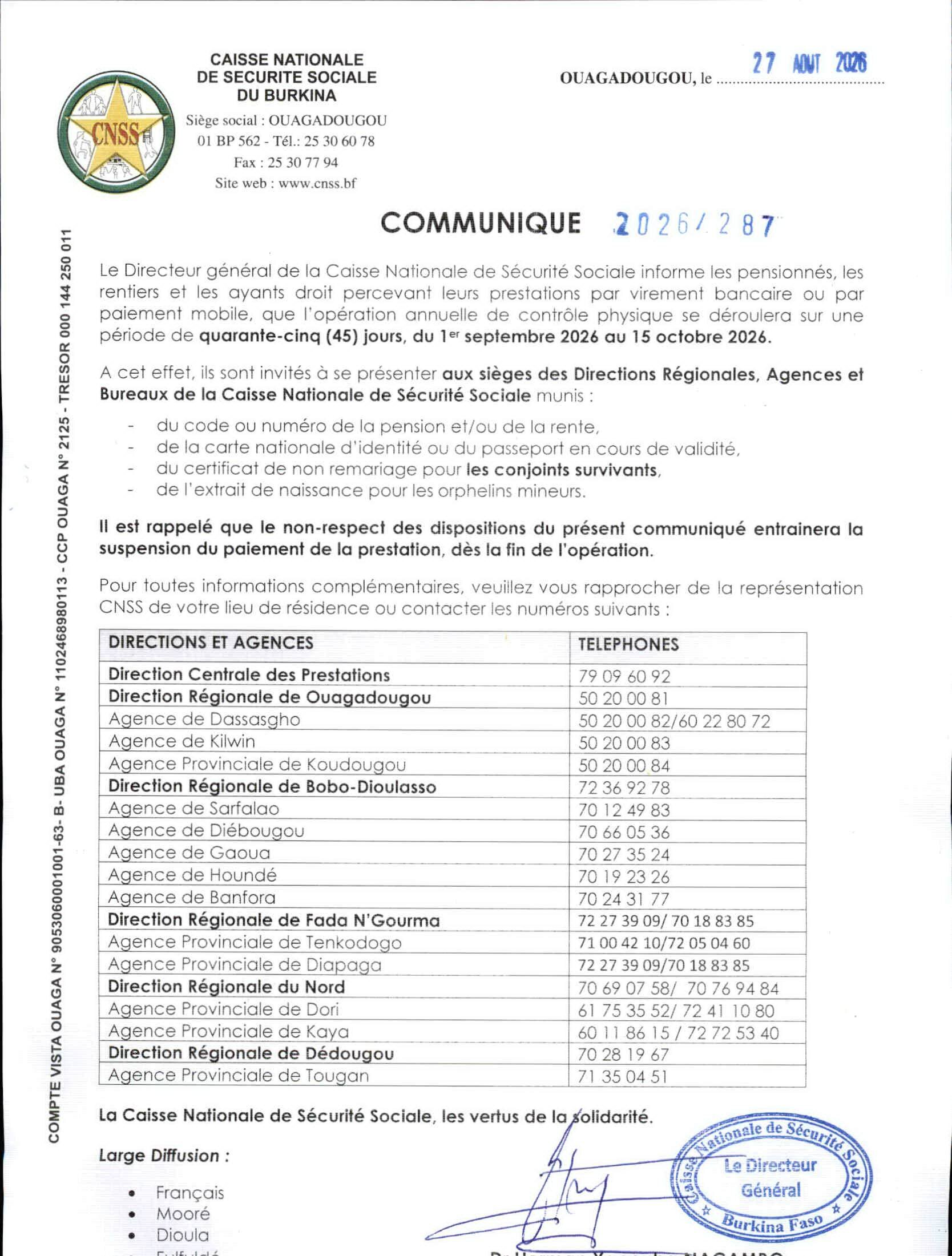
Burkina/CNSS : Le contrôle physique des pensionnés, rentiers et ayants droit prévu du 1er septembre au 15 octobre 2026
Categories: Afrique
Raïssa Malu annonce 78 cantines scolaires pilotes pour la rentrée 2026-2027 en RDC
La ministre de l’Éducation nationale, Raïssa Malu, a annoncé lundi 31 août, plusieurs mesures destinées à améliorer les conditions d’apprentissage et à renforcer l’encadrement des élèves, à l’occasion de la rentrée scolaire 2026-2027, prévue ce mardi 1er septembre.
Categories: Afrique
Vincent Bolloré dépose plainte pour « association de malfaiteurs » contre des magistrats, après son renvoi devant le tribunal pour corruption
Dans une ultime tentative d’obtenir le renvoi de son procès pour corruption au Togo, prévu du 7 au 17 décembre au tribunal judiciaire de Paris, le milliardaire a déposé plainte, en mai, contre des magistrats, pour « entrave à l’exercice de la justice ».
Categories: Afrique
Décès de l'Abbé Apollinaire ZOMBRE : Faire-part
Son Excellence Monseigneur Prosper KONTIEBO, Archevêque Métropolitain de Ouagadougou, en communion avec Son Éminence le Cardinal Philippe OUEDRAOGO, Archevêque Émérite, unis au Presbyterium et à la famille diocésaine,
Sa Majesté Naaba Sanem de Ouargaye
les grandes familles ZOMBRE et KIEMA à Ouargaye, Tibga, Diabo et Ouagadougou, dans la foi et l'espérance, vous font part du retour à Dieu de Monsieur l'Abbé Apollinaire ZOMBRE,
prêtre de l'Archidiocèse de Ouagadougou,
décès survenu le jeudi 27 août 2026 à l'Hôpital Saint Camille de Ouagadougou, dans sa 55e année de vie et 22e de son presbytérat.
Programme des obsèques :
Mardi 1er Septembre 2026 :
– 20h00 : Veillée de prière à la Paroisse Notre Dame de Fatima de Dassasgho
Mercredi 2 Septembre 2026 :
– 6h30 : Levée du corps à la Morgue de l'Hôpital de Bogodogo et suivie du transfert à la Paroisse Notre Dame de Fatima de Dassasgho
– 8h20 : Office des défunts
– 9h00 : Messe de funérailles suivie de l'inhumation au Petit Séminaire de Pabré.
Que le Christ Ressuscité et Vainqueur de la mort accueille auprès de lui son serviteur Monsieur l'Abbé Apollinaire ZOMBRE dans la Paix et la Joie éternelle de son Royaume.
Requiescat in pace !
Ouagadougou, le 28 Août 2026
Pour son Excellence Monseigneur Prosper KONTIEBO
Abbé Alfred OUEDRAOGO
Vicaire Général
Nota bene :
Lundi, 31 août à 18h30 : Prière au Sanctuaire Notre Dame de Yagma à l'intention de l'Abbé Apollinaire ZOMBRÉ
Categories: Afrique
Les 10 numéros de la Double Chance 14 H
LES RÉSULTATS DOUBLE CHANCE SONT LÀ !
LOTO FORTUNE Tirage N°139
Lundi 31 Août 2026 (14H)
– Zone A (5 premiers numéros) :
68 • 83 • 47 • 05 • 73
– Zone B (5 derniers numéros) :
50 • 24 • 12 • 26 • 01

Félicitations aux heureux gagnants.
Pas encore cette fois ? Gardez le sourire !
Rendez-vous à 18H pour le prochain tirage.
Jouez avecmodération et responsabilité. Le jeu doit rester un plaisir.
Categories: Afrique
67 enfants orphelins et vulnérables reçoivent des kits scolaires pour la rentrée à Nyiragongo
67 enfants orphelins et vulnérables du territoire de Nyiragongo, au Nord-Kivu, ont reçu des fournitures scolaires. L’assistance leur a été remise samedi 29 août par l’ONG locale Jirani Msaada, à la veille de la rentrée scolaire 2026-2027, prévue le 1er septembre en RDC.
Categories: Afrique
Pages



© 2012-2018 Europa Varietas Foundation © 2015-2018 Europa Varietas Association
www.europavarietas.org | info(@)europavarietas(dot)org | Switzerland




We are looking for sponsors for the English translation of these books, please contact turkeandras(at)gmail(dot)com