
You are here
Feed aggregator
When an Ally Becomes a Liability
U.S. and Israeli army officers talk in front a US Patriot missile defense system. Credit: Jack Guez/Getty Images Source: Council on Foreign Relations
By Alon Ben-Meir
NEW YORK, Jul 3 2026 (IPS)
For a generation, no foreign leader bet more heavily on a single American president than Benjamin Netanyahu bet on Donald Trump. Trump moved the US embassy to Jerusalem, tore up the 2015 nuclear accord with Iran, recognized Israeli sovereignty over the Golan Heights, and in February 2026 joined Israel in the opening strikes of a war against Iran that Netanyahu had spent three decades urging Washington to wage.
The partnership looked unbreakable. It was, in fact, conditional—and the condition was that their interests never diverge. In June 2026 they diverged completely, and the rupture has exposed a truth Netanyahu has spent his career denying: when Israeli security and the prime minister’s political survival point in opposite directions, he chooses himself.
The break came over a single document. On June 17, Trump signed a Memorandum of Understanding with Iran—the Islamabad Memorandum, brokered by Pakistan—formally ending the war he had pushed to start. The 14-point framework in the memorandum declares a permanent halt to hostilities on all fronts, including Lebanon, reopens the Strait of Hormuz, lifts the U.S. naval blockade of Iranian ports, and waives sanctions on Iran’s oil exports. It also commits the United States and regional partners to assemble a $300 billion reconstruction fund and to negotiate the gradual release of Iran’s frozen assets worldwide.
What it does not do is what Israel went to war to achieve. The framework deferred the negotiation over Iran’s nuclear program to a later date, and it says nothing about Iran’s ballistic missiles or its regional proxies. Essentially, Trump wanted a short war that would compel Iran to come to the negotiating table. Netanyahu, on the other hand, wanted Iran permanently broken as a regional power. Those two visions could coexist while the fighting continued, but could not survive peace.
Thus, Netanyahu set out to wreck it. Israel’s Finance Minister Bezalel Smotrich branded the agreement bad for Israel and for the free world. National Security Minister Itamar Ben-Gvir declared that Trump’s deal “does not bind us” and that Israel “is not subject to the United States.” And Israeli jets kept hitting Lebanon. On June 14, with the signing supposedly hours away, Israel struck Beirut. Trump erupted publicly, then telephoned Netanyahu.
The call was not diplomatic. In a telephone call by Trump to Netanyahu, he said, ”Bibi, you better be careful, or you will be on your own very soon.” In a subsequent call with Netanyahu, there was an even angrier exchange: Trump called the Israeli leader “crazy,” accused him of ingratitude, and—according to US officials briefed on the call—reminded him bluntly: “You’d be in prison if it weren’t for me.”
That last line is the key to everything. Netanyahu has one political lifeline left: the war. As long as Israel is fighting, there will be no elections; as long as there are no elections, he stays in office, and as long as he stays in office, he can postpone the corruption trials, waiting for the moment he loses power. For Netanyahu, peace is not merely inconvenient—it is politically existential.
The US intelligence community reportedly warned the White House that Netanyahu was actively working to blow up Trump’s Iran deal, and analysts said plainly that Trump would have to play the middle man against his own ally. The man who lobbied for the war had become the chief obstacle to the peace.
Then came the moment the world was meant to absorb. On June 18, Vice President JD Vance stood at a White House podium and delivered a rebuke unlike any an American administration has aimed at Israel in living memory. “Donald J. Trump is the only head of state in the entire world who is sympathetic to the nation of Israel at this moment in time,” he said. “If I was in the cabinet of the Israeli government, I might not be attacking the only powerful ally I have left.”
Then the reminder that doubled as a threat: “Over the last three months, two-thirds of the defensive weapons that have protected your homeland have been built by American hands and paid for by American tax dollars.” Anyone in Israel who thinks their problem is Trump, Vance added, needs to “wake up and smell the reality.” He was basically warning Israel and reminding it who arms its skies to protect the peace deal with Iran.
The warning has not been heeded, and the cost is mounting. The first round of US-Iran technical talks was set for Switzerland’s Birkenstock resort on June 19. The night before, Israeli airstrikes across southern Lebanon killed 47 people, by the Lebanese health ministry’s count, and wounded scores more. Iran demanded a guarantee that the fighting would stop before it would sit down. Vance canceled his trip; the talks collapsed.
On June 20, Iran announced it was closing the Strait of Hormuz again, citing Israel’s strikes as a violation of the agreement. Vance worked to salvage the deal; Smotrich went public: Israel will stay in southern Lebanon “for as many years as necessary,” until Hezbollah disarms, and will not withdraw—adding that the prime minister agrees. It was a statement engineered to sabotage a peace Israel’s closest patron was risking its credibility to build.
This is the heart of the matter, and it is the part Netanyahu, Smotrich, and Ben Gvir refuse to grasp: Israel is almost wholly dependent on the United States—financially, militarily, and diplomatically. Washington is the shield that absorbs global outrage, vetoes resolutions, and replenishes arsenals. Openly defying a deal Trump personally signed is not bold statecraft. It is a slap in the face of the one ally Israel cannot afford to lose, delivered by a government that has confused its own survival with the nation’s.
The damage will outlast this episode. America’s interest now is a stable region, open shipping lanes, and a managed diplomacy with Iran rather than perpetual war. Netanyahu’s interest is the war itself. Those are not tactical differences to be smoothed over; they are structurally opposed, and they will keep colliding for as long as Netanyahu is in power.
The relationship that defined Israeli security for decades has been quietly inverted—the enemy has become the deal partner, and the indispensable ally has become the liability. It will not be repaired by reassurances or photo opportunities. It will be repaired only when Israel has a leader whose political life does not depend on keeping the country at war.
Until then, the rupture is not a crisis to be weathered. It is the new baseline. Netanyahu’s arrogance (chutzpah) will finally come back to haunt him.
Dr Alon Ben-Meir is President of the Institute for Humanitarian Conflict Resolution
IPS UN Bureau
Follow @IPSNewsUNBureau
!function(d,s,id){var js,fjs=d.getElementsByTagName(s)[0],p=/^http:/.test(d.location)?'http':'https';if(!d.getElementById(id)){js=d.createElement(s);js.id=id;js.src=p+'://platform.twitter.com/widgets.js';fjs.parentNode.insertBefore(js,fjs);}}(document, 'script', 'twitter-wjs');
Categories: Africa
With Laos Trip, Min Aung Hlaing Drives a Wedge Into ASEAN
Myanmar’s “president” is embarking on his first official visit to an ASEAN country since his appointment in April.
Categories: Diplomacy & Crisis News
Indonesia Recovers Body of American Pilot Killed by Papuan Separatists
The West Papua National Liberation Army has a history of targeting aircraft servicing remote parts of the Papuan highlands.
Categories: Diplomacy & Crisis News
Yemen : Behind the launch of the new Houthi militia styled after Iran's Basij
To stem simmering discontent among their ranks, the Houthis announced the launch on 24 June of a new internal body, [...]
Categories: Defence`s Feeds
France : Pro-Russian officer names himself head of France's army history centre
There is some confusion within the French military. The French army is in the middle of reorganising its historical research [...]
Categories: Defence`s Feeds
Australia/China : Canberra reviews funding for defence think-tank ASPI, Beijing's bête noire
Intelligence Online has gained insights into the consequences of the Australian defence ministry's funding review for leading defence think-tank Australian [...]
Categories: Defence`s Feeds
United States : Joshua Rudd, US special forces officer nursing NSA back to health
Since taking up his posts as both head of the National Security Agency (NSA) and of the US Cyber Command [...]
Categories: Defence`s Feeds
France : Head of PM's military cabinet set for General Inspectorate of the Armed Forces?
General Jean-Christophe Béchon, head of the French Prime Minister Sébastien Lecornu’s military cabinet is widely tipped to be appointed to the General Inspectorate of the Armed Forces (IGA).
Categories: Defence`s Feeds
The Strong Do What They Can—and Suffer What They Must
What Thucydides really thought about power.
Categories: Diplomacy & Crisis News
The Military and the Republic
What America’s armed forces can—and cannot—do for democracy.
Categories: Diplomacy & Crisis News
Myanmar to Push Ahead With Suspended Myitsone Dam Project, Officials Say
China's government is pushing hard for the resumption of the $3.6 billion project, which was suspended in 2011 amid widespread public opposition.
Categories: Diplomacy & Crisis News
A-10 Takes Part in Final Public Range Day in Arizona
Airmen and the local community gathered as Davis-Monthan hosted the final public A-10 Range Day at the Barry M. Goldwater Range.
Davis-Monthan Air Force Base hosted at the Barry M. Goldwater Range near Gila Bend, Arizona, the last public Range Day with the A-10C Thunderbolt II on Jun. 24, 2026 held its last Range Day. The announcement comes as the type inches towards its imminent retirement, despite Congressional approval to save the iconic aircraft.
“As the A-10C Thunderbolt II made one of its final passes over the Barry M. Goldwater Range near Gila Bend, Arizona, Airmen assigned to the 355th Wing, community members, and civic leaders gathered to witness the familiar roar that had echoed across Tucson’s skies for nearly five decades, marking one of the aircraft’s final range days,” said the press release.
For the sake of clarity, it should be noted, that while the press release mentioned “one of the aircraft’s final range days,” the title and the caption explicitly mentioned it “was the final A-10 Range Day.”
The Range Days are a traditional U.S. Air Force event held almost every other month at the Barry M. Goldwater Range by the 355th Wing. These events see the A-10C execute a live-fire demonstration of its combat mission, enthralling both public, Airmen, serving members and their families alike.
A U.S. Airman photographs two A-10C Thunderbolt II aircraft as they release flares on Jun. 25, 2026 at the Barry M. Goldwater range. | Source: U.S. Air Force photo by Airman Najzee Kuzu Imminent retirement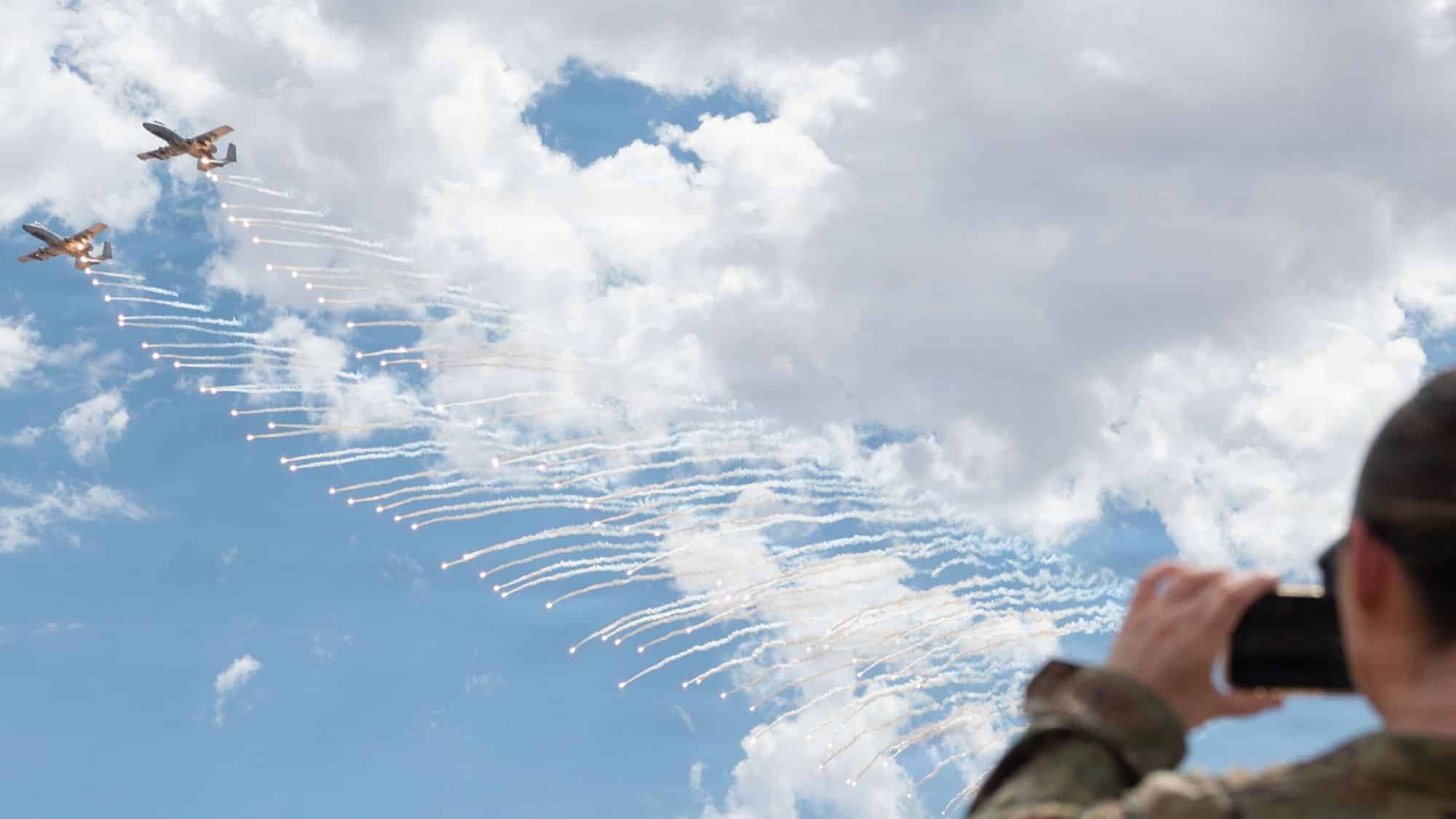
The A-10C, better known as Warthog, was earmarked for retirement by the end of 2026, however it will now remain in service at least until the 2030s. The U.S. Congress is in fact resisting attempts to fully retire the attack aircraft without a replacement.
The jets have seen considerable action against Iran during Operation Epic Fury, carrying a new refueling probe on the nose and electronic warfare pods, and returning with kill markings depicting bombs and Iranian naval vessels. The run up to the type’s eventual sundown has also seen the Air Force deactivate other associated units and activities.
This includes the shuttering of the 40th Test Flight Test Squadron’s Detachment 1 in December 2025, a geographically separate unit at Davis-Monthan AFB that executed A-10 developmental test operations. On Apr. 3, 2026, the U.S. Air Force also ended the training of the A-10C when the 357th Fighter Squadron graduated the last batch of student pilots at Davis-Monthan AFB.
Final Range DayDescribing the final Range Day as “powerful and precise,” the service said this was “a living, breathing demonstration of everything the A-10 mission represented; discipline, dedication and an unwavering commitment to those on the ground watching.”
Among the spectators was also retired U.S. Air Force Lt. Gen. Glen “Wally” Moorhead, who has witnessed the A-10 over 38 years of service. Moorhead delivered the first A-10 to Davis-Monthan nearly five decades ago, and was also one of the first pilots of the A-10C variant.
U.S. Air Force Col. Jose Cabrera, 355th Wing Commander, watches an A-10C Thunderbolt II perform. | Source: U.S. Air Force photo by Airman Najzee Kuzu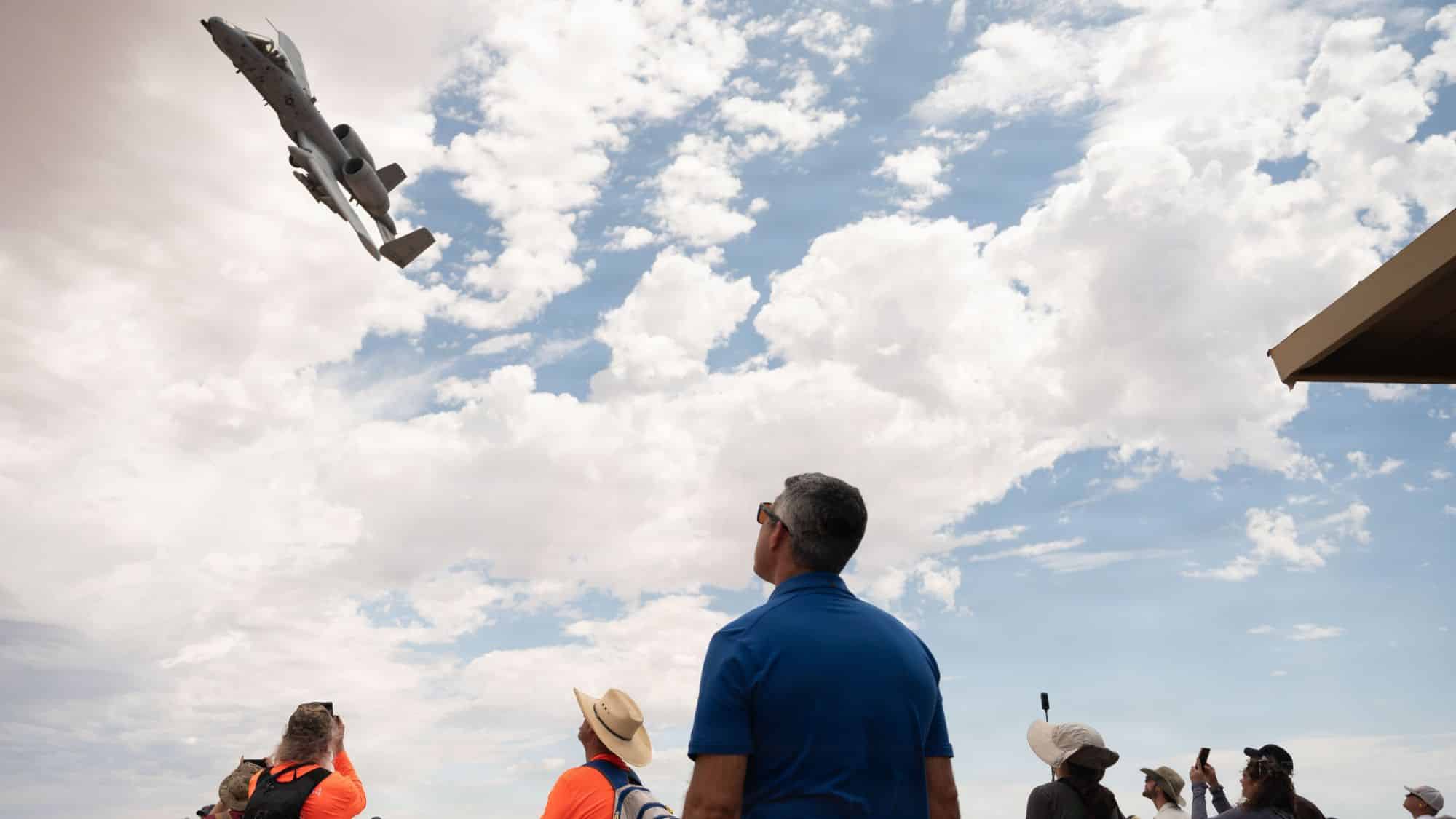
“The culture of attack is a special culture inside the United States Air Force,” reflected Moorhead. “The people flying the airplanes, the people working on them, loading them, making them work, that culture of mission is just strong, it’s extremely strong. And it’s always been a pride of mine.”
Tucson natives meanwhile have come to view the Range Days as more than just aerobatic and live-fire demonstrations. “The growl of the gatling gun, and the sight of a warthog in the clouds above have become a message from the base to the city that supports it; a message that says, without words, that the people inside that fence are mission ready constantly,” said the release.
Retired Air Force Col. Bill Pitts, who flew the A-10 for more than 14 years in his 26-year career, reflected on the community ties the event: “The attitude, the atmosphere around the A-10 is special. The pilots grow to love each other, and the attack community is a unique bunch.”
A U.S. Air Force A-10C Thunderbolt II aircraft assigned to the 357th Fighter Generation Squadron demonstrates live fire at the Barry M. Goldwater Range near Gila Bend, Arizona, June 11, 2026. | Source: U.S. Air Force photo by Senior Airman Christopher Ornelas Jr. Other recent Range Days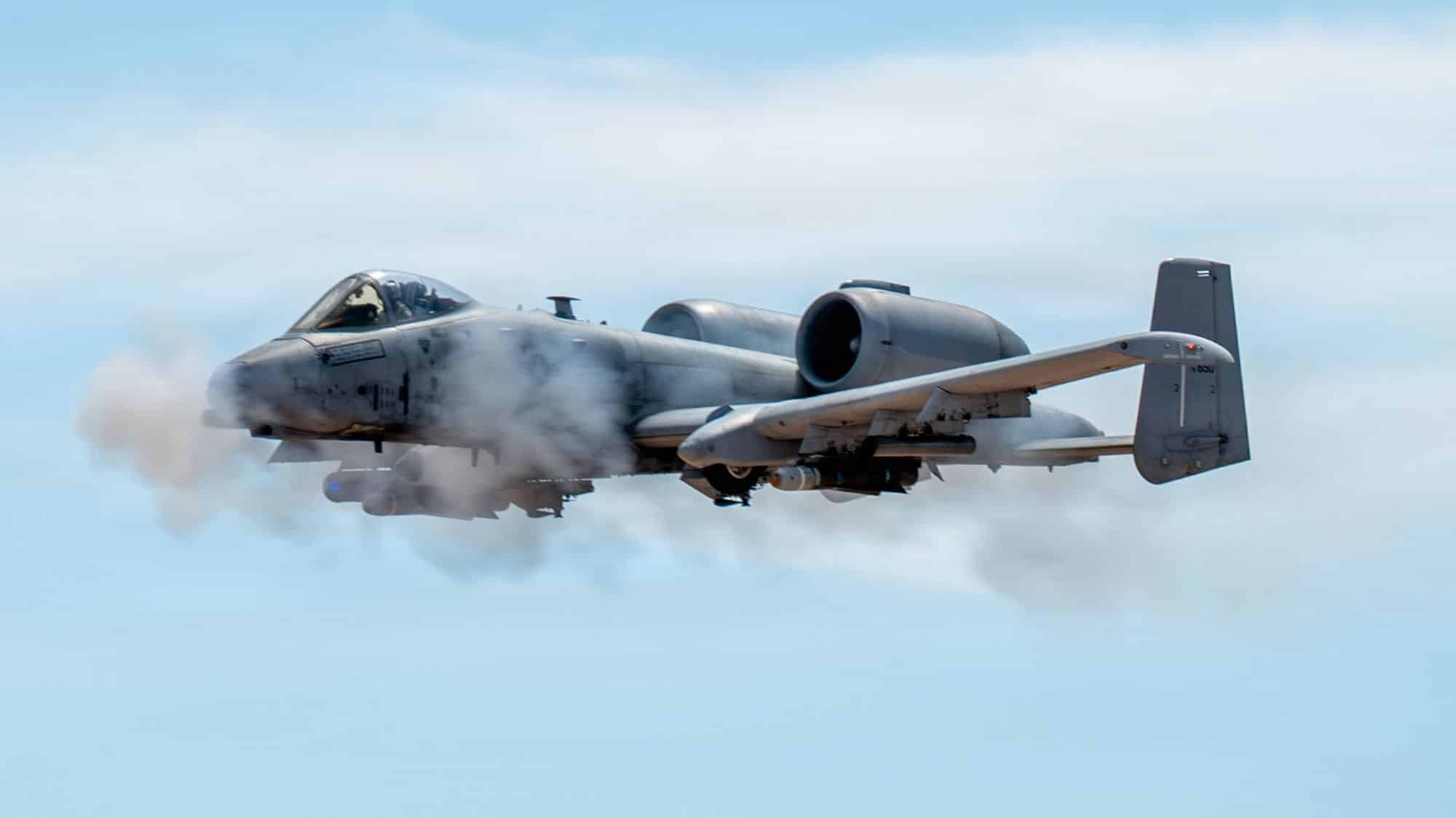
The recent Range Days before the final one at Gila Bend were held from the beginning of the year on Mar. 27, 2026, May 1, May 28 and Jun. 11. Hosted by the 357th Fighter Generation Squadron (357th FGS), Range Days are attended by Airmen, civic leaders, Civil Air Patrol cadets and Junior Reserve Officers’ Training Corps Cadets where they witness the “installation’s rescue and attack mission.”
A-10 Warthog strafing run! I think it was about 107°F up there on the range tower.
I had to keep my phone and camera in the shade between passes so that it wouldn’t overheat and not be able to record! pic.twitter.com/TbJOgVJr1w
— Andrew Kelly (@andrewkphotos) June 30, 2026
Attending Airmen “recognized as top performers had the opportunity to participate in an A-10 range day to see the mission their work supports.” As for the A-10, one image caption said the range day “demonstrated the aircraft’s speed and maneuverability while supporting pilot proficiency in dynamic training environments.”
Categories: Defence`s Feeds
A Parliament Sullied
Due to Government policy, Canada experiencing little needed economic relief, despite having one of the world’s largest oil reserves and high international oil and gas prices in 2026.
The existence of democracies in human civilisations is not something that came about by accident or is naturally occurring in most parts of the globe. On many occasions, Ancient Greek civilisations who established complex and meaningful measures to balance the powers of their societies lost their democratic traditions to despots, warlords, and foreign empires. Democracy can take generations to form, requires much evolution to become fair and just, and can be extinguished in less than one generation.
The Greek democratic idealists are the progenitors of modern Western civilisations, enshrining a heritage that continuously challenges limitations present in establishing a true government for the people. What still exists as part of many Constitutions of Commonwealth nations is the Magna Carta. The existence of this foundational document of British style democracy limited the power of the King/Queen to take the property of a citizen without just cause as far back as the 1200s. Property rights enabled citizens to hold wealth and legal title, a means to defends ones interests as a legal defense could now be funded. These rights were specific to defend a lone citizen’s interests, even against agents of the King or an oppressive state Government. The challenge the Royals had over generations of British history was to maintain and further entrench their power to rule, giving way to government mechanisms and institutions that were designed and effective in keeping absolute power away from the King in the form of representative Parliaments and independent courts. While the King is now more of a formal title and is limited by informal Customary Laws on their power over Government, they still maintain the legal authority to rule as one, while the legal customs and traditions ensure that no despotic rule should come to the realm, be it a King, Queen, Prime Minister or General.
A shameful revelation has recently come upon the legal and customary traditions of rule in the Parliamentary system in Canada. While much scandal has been brought to the Parliament in England, Canada had the unfortunate fate of taking on a seasoned political class that had contributed a great deal to the current state of affairs in the United Kingdom. The recent act by a Minority Government, one that did not earn enough votes to have a Majority claim in Parliament, was to offer political and possibly other tokens to Opposition Members of Parliament in order to claim an unelected Majority Government. While technically an MP is permitted to cross to another party for reasons of Conscious moral objections, using the claim that recent voter support wished the MP to leave to another party is an insult to 800 years of Parliamentary Democracy.
The leader of the Governing party, a seasoned political agent and dual national of the British Government for many years, likely knew or should have known of the traditions of the British Parliamentary Democracy inherited by all Commonwealth nations. Starting with the Magna Carta and evolving into modern Constitutional Law, the British Constitution is a collection of Acts, Human Rights Legislation, and Customary Norms and Practices that establish fairness in society. In this tradition, most Commonwealth countries are formed on the Customary Laws and Traditions of their Parliamentary heritage, with the Customs and Traditions being the Constitutional norms that maintain liberty, freedom and equity among all citizens in the Parliament’s realm. When your vote is simply traded away for personal gains by a sitting MP a year after an election, it is an offense to the Constitutional norms since Magna Carta, norms which were fought over for generations as the Crown tried to re-establish absolutist power. Using a new 1982 Constitution as a means to remove Customary Laws has ill effect, as it has just enshrined discrimination to the gain of political elites, and could serve to open Parliamentarians to outside influences by foreign entities harmful to Canadian society. When those actions give a Government Majority power, without the votes supporting the Prime Minister or their party, its offensive to the traditions of fairness and equity in the realm and sullies Parliament with a Dirty Majority Government that citizens have no confidence will be limited in its reach. While Canada always had a Monarch, there is no appetite for rulers without earned votes, as that is more of a tradition that ended democratic rule in ancient Greece than something formed in a modern Parliamentary system.
A unique feature of the British Parliamentary tradition and the English Courts that are designed to limit despotic power is the use of Laws of Equity in the legal system, a prized value system from their heritage. While Customary Laws can be abused, and look to have been in this recent case, a legal precedent of applying hard laws with fairness and justice in mind is often applied in the Courts. Taking the Government to court and applying the Law of Equity over the manner in which a Government Majority was manipulated away from voters is an important case that needs to be brought to justice, not just in the case of Canada, but in similar political examples throughout the English Courts as well.
Despite 800 years of challenges to despotic powers against Kings and Queens being the British tradition, a Prime Minister with a Majority Government has more official power than any President in Republican systems in the Americas and Europe. It is the duty of every Parliamentarian and every Commonwealth citizen to honour Parliament by fighting for its democratic traditions, even when a party and Minister has dishonoured the Customary Laws of the country. That is the tradition of the British in Europe, of Canada, and of all rulers since the Magna Carta in 1215. If they can take your vote, knowingly take away Equity established since 1215, they will surely go as far as taking your other rights as well, even your Property. This Tyranny of a Political Majority is all that can come from Canada’s Dirty Parliamentary Majority Government. As it has always been, a community can only thrive when their votes matter.
Categories: Diplomacy & Crisis News
Despite Chinese Mediation Efforts, Taliban-Pakistan Conflict Continues With New Strikes
The rupture between Afghanistan’s Taliban and their erstwhile allies in Pakistan continues to cause suffering on both sides of the border.
Categories: Diplomacy & Crisis News
Czech-Taiwan Ties Are Cooling in Rhetoric, Not Reality
Czechia’s new government has changed its tone on Taiwan, but left most of the substance of the relationship intact.
Categories: Diplomacy & Crisis News
Un fossile resté dans un tiroir pendant des décennies s'avère être la plus ancienne découverte d'un dinosaure en Antarctique
Un fossile d'apparence banale, resté oublié dans un tiroir pendant 40 ans, s'est avéré être le premier os de dinosaure jamais découvert en Antarctique.
Categories: Afrique
Pour enfin mieux aimer
Comment résumer un livre qui semble avoir été écrit dans le but même d'en rendre impossible tout résumé ou de rendre caduc tout point de vue surplombant sur la vie ? Nos vies ne sont-elles pas faites d'une tout autre matière — vertige et mémoire ? « Pittsburgh, 1939-1942… Descendant dans la rue (…)
/ Roumanie, Littérature, Autobiographie, Fiction
Categories: Diplomacy & Crisis News
Respect Strength, Question Power: Reflections from the 2026 Digital Rights Asia-Pacific Assembly
Collective care should not be reduced to practices that merely keep us strong enough to survive hostile conditions. Collective care should also make us question, resist, and transform the very systems of power that generate harm. Credit: Humanis
By Nisrina Nadhifah Rahman
Jul 2 2026 (IPS)
“To respect strength, never power” is one of my favorite quotes from the acclaimed writer and activist, Arundhati Roy. For years, this quote has stayed with me. It encourages a way of life grounded in compassion rather than dominance.
It was particularly on my mind as I returned from the June 2026 Digital Rights Asia-Pacific Assembly (DRAPAC26) in Manila, an annual forum organized by EngageMedia. Co-hosted by local partners, the Foundation for Media Alternatives (FMA) and DAKILA, it brought together more than 800 digital rights practitioners, researchers, funders, journalists, technologists, and activists from across the Asia-Pacific region.
But my participation in DRAPAC started long before I arrived in Manila. Throughout the first half of 2026, through the Connect, Defend, Act! program, I had been engaging with civil society actors at workshops held across different regions.
Moving in harmony with one anotherDuring a session on collective care at one of them, we asked if abstract principles like human rights, solidarity, resilience, and collective care could be translated into concrete care practices. If so, what would that look like?
One group responded with a local expression: “Na Pada Ajong Ta.” It means to move in harmony with one another, walking side by side and sharing a common rhythm.
I was instantly struck by the phrase.
AI outputs are shaped not only by data, but also by the social, political, and economic structures that determine whose knowledge is collected, whose views and experiences are prioritized, and whose realities are ignored
We are constantly being told to “unite” by both figures of authority and agents of change. But what they want is us to move in the same direction, at the same pace, and with the same voice. Yet perhaps what we need is something closer to “Na Pada Ajong Ta,” walking side by side without marching in lockstep.
The DRAPAC Assembly took me back to these questions about power, accountability, humanity, and collective care, especially in the discussions on how we frame activists and human rights defenders.
An important discussion revolved around the growing glorification of the “resilience” of activists and human rights defenders. Stories of sacrifice, adaptation, and perseverance are often presented as inspiring accounts of brave individuals fighting for justice in increasingly challenging environments.
Yet I found myself wondering: What happens when resilience becomes an unquestioned virtue? What if our admiration for people’s endurance blinds us to the systems that oppress them? Or traps us in a worldview that celebrates those strong enough to endure, while those who struggle or fall behind are quietly left to fend for themselves?
So, interrogating power in conversations about resilience also means challenging a narrow understanding of collective care. It should not be reduced to practices that merely keep us strong enough to survive hostile conditions. Collective care should also make us question, resist, and transform the very systems of power that generate harm.
AI (just like any other technology) is never neutralThroughout DRAPAC, countless sessions explored different dimensions of Artificial Intelligence (AI). For me, the most interesting ones treated AI as a political development.
One recurring insight was that AI outputs are shaped by far more than users’ prompts. They are also influenced by invisible system prompts, training datasets, institutional priorities, commercial interests, and political decisions embedded within the technology itself.
In other words, AI reflects the values, assumptions, and most importantly, the power relations built into it.
One of the most well-known principles in computer programming is the phrase “Garbage In, Garbage Out” (GIGO). At its simplest, the principle suggests that the quality of an output depends on the quality of the input.
But after the discussions at DRAPAC, I have come to see GIGO as more than a technical principle. It is also a political one. “Garbage In, Garbage Out” is ultimately a question of power. AI outputs are shaped not only by data, but also by the social, political, and economic structures that determine whose knowledge is collected, whose views and experiences are prioritized, and whose realities are ignored.
The power of the attention economyWriter and scholar Alfie Bown’s 2022 book, Dream Lovers: The Gamification of Relationships, explores how human desires are increasingly shaped to suit certain economic and political agendas, creating a profound dependency on algorithm-driven technology.
At DRAPAC’s “Algorithm Anonymous” session, we also explored how digital platforms are actually systems of control designed to both capture attention and influence habits, desires, and emotional attachments.
We started off by acknowledging that our choices, behaviors, and things we pay attention to online are often shaped by algorithms. And we examined the deceptive design tricks used by websites and apps that get users to do things they hadn’t planned to, like buying something, sharing more data, or signing up for services.
Then we reflected on how social media, fitness applications, and health platforms create validation loops that encourage continuous engagement, often treating privacy and user agency as an afterthought.
The many forms power takesAs I left DRAPAC, I couldn’t help but think that Arundhati Roy’s reminder to “respect strength, never power,” is perhaps not enough. Because strength, much like power, also has layers that need to be scrutinized and questioned. And while doing so, we also need to re-examine our own roles and individual social and political identities.
We must be clear on where we stand in relation to the systems and structures around us. That doesn’t mean to stop questioning power, but to remain curious about the many forms it takes, including those we may have internalized without realizing it.
Nisrina Nadhifah Rahman is the Indonesia country-level Lead for the Connect, Defend, Act! program at Humanis.
Categories: Africa
Understanding China’s Party-State Intelligence System
It’s not “whole of society” – and calling it that risks discrimination against ethnic Chinese.
Categories: Diplomacy & Crisis News
Difficile d'habiter ce monde
Voici l'histoire d'un retour. Un retour au Kosovo, à deux moments très différents. Le narrateur, tout jeune, y retourne avec ses parents en 1996 — deux ans avant le conflit armé. Adulte, c'est dans le Kosovo d'après-guerre qu'il revient, en compagnie de sa mère. Petit, il n'avait pas de souvenir (…)
/ Kosovo, Littérature, Migrations, Violence
Categories: Diplomacy & Crisis News
Pages



© 2012-2018 Europa Varietas Foundation © 2015-2018 Europa Varietas Association
www.europavarietas.org | info(@)europavarietas(dot)org | Switzerland




We are looking for sponsors for the English translation of these books, please contact turkeandras(at)gmail(dot)com