
You are here
The Aviationist Blog


Inside the MAGTF: Exclusive Interview with Marine F-35B Demo Pilot on Expeditionary Aviation Operations
During the 2026 MCAS Cherry Point Air Show, The Aviationist interviewed F-35B pilot Major William Horn about expeditionary operations within the Marine Air-Ground Task Force and the demo for the public.
The 2026 MCAS Cherry Point Air Show featured a large-scale Marine Air-Ground Task Force (MAGTF) demonstration built around the current structure of Marine Corps expeditionary aviation. Rather than centering on a single tactical aircraft, the demonstration incorporated multiple aviation and ground elements operating together within the broader MAGTF framework that supports Marine Corps operational doctrine.
The MAGTF combines command, aviation combat, ground combat, and logistics combat elements into a single integrated force designed to operate rapidly from forward and austere locations. The aerial demonstration at the 2026 MCAS Cherry Point Open House put this integrated structure on direct display.
Participating aircraft included two F-35Bs from VMFAT-501 at MCAS Beaufort, South Carolina; two AV-8B Harriers from VMA-223 at MCAS Cherry Point; two MV-22 Ospreys from VMMT-204 at MCAS New River; two CH-53E Super Stallions from HMH-464 at MCAS New River; an AH-1Z Viper and UH-1Y Venom from HMLA-167 at MCAS New River; and a KC-130J Hercules from VMGR-252 at MCAS Cherry Point. The sheer scale of the lineup proved that Marine aviation relies on collective, expeditionary operations rather than individual aircraft performance.
From the crowd line, the MAGTF demonstration looks like a sequential series of events. Operationally, the concept is far more compressed. Assault support, aerial refueling, tactical strikes, rotary-wing attacks, and ground maneuvers converge simultaneously, with each element adapting as conditions evolve. This tight coordination proved vital during both the rehearsal and public demonstrations at Cherry Point, where aircraft timing and sequencing shifted rapidly within seconds.
AV-8B Harrier in hi-viz CAG markings from VMA-223 Bulldogs performs a photo-pass during the solo Harrier demonstration at MCAS Cherry Point Air show. | Source: Howard German
One of the more historically significant features of this year’s demonstration was pairing the legacy AV-8B Harrier alongside its successor, the F-35B. With the Harrier scheduled to retire from active Marine Corps service on June 3, 2026, MCAS Cherry Point marked the final public MAGTF appearance for the iconic jet.
Sharing the flight line with the F-35B highlighted the generational leap in technology currently transforming Marine tactical aviation. Yet, despite decades of engineering differences, both platforms share the same DNA, an uncompromising Marine Corps requirement to operate from short decks, expeditionary strips, and remote island bases.
Major William Horn piloted the F-35B during the MAGTF demonstration and performed the aircraft’s solo tactical display over the weekend. In addition to observing and photographing the action during rehearsal and public demonstrations, The Aviationist spoke with Major Horn regarding the role of the F-35B within the MAGTF framework, the coordination required between participating elements, and the continuing transition from the AV-8B Harrier to the F-35B Lightning II.
Interview with Major William Horn Left to right, Major William “Braankles” Horn, VMFAT-501, F-35B solo demonstration pilot and MAGTF demonstration pilot, and Major Connor “TOPO” Sherin, VMFAT-501, MAGTF demonstration pilot 2. | Source: Howard German Question: Please tell us a little bit about yourself. Starting with your name, where you are from, where did you go to school, what made you choose a career as a USMC Pilot, and how many total hours in front line jets and total hours in the F-35.
Major William T. “Braankles” Horn, from Rochester, NY. Attended the University of Rochester, Class of 2014 (Biochemistry/Psychology double major).
I originally learned of the option of being a Marine Corps pilot growing up in Rochester – my neighbor’s two oldest sisters both married Marine Corps Cobra pilots, around that time I thought that seemed like a pretty cool gig. Before graduating high school, I went to a recruiter about flying for the Marines, and long story short he recommended doing the college/OSO route if I was dead-set on being a Marine Corps pilot.
My sophomore year at UofR, the Buffalo OSO set up a station and we chatted about exactly that, and I spent about 4 years afterwards at the Buffalo OSO (year off after college for a LASIK waiver where I was working on a commercial fishing boat in Alaska) before getting selected on a pilot slot for OCS, which I attended in June of 2015.
Major William “Braankles” Horn and Major Connor “TOPO” Sherin, from VMFAT-501 piloting the 2 F-35B’s participating in the MAGTF demonstration. The F-35B serves as the stealthy, 5th Generation, multi-role component of the Aviation Combat Element (ACE). | Source: Howard German
I have about 900 total military hours, including about 27 in the F/A-18 Hornet before getting redesignated to F-35B, and about 650 in the F-35B.
In the MAGTF demonstration at Cherry Point, what is your specific role as the F-35B pilot, and where does your piece fit within the broader arrangement the audience sees?As an F-35 pilot, we generally see the (literal and metaphorical) high-altitude picture – our aircraft has extremely advanced sensors and datalinks, providing full battlefield situational awareness and provides us the ability to oversee a mission and influence its success by moving the individual parts around as needed.
We also provide the first-strike capability which you will see over the weekend, in which we are able to get farther into adversary territory and execute attacks that other platforms cannot. Our first-strikes are tailored toward opening the ability for other Marine Corps platforms and ground elements to conduct the main mission.
A MV-22 from VMMT-204, MCAS New River, NC, providing primary assault support and rapid deployment during the MAGTF demonstration. In the background, note a AH-1Z Viper and a UH-1Y Venom operating as an integrated team showcasing tactical mobility and coordinated close-air support. | Source: Howard German What is the MAGTF demonstration designed to communicate to the public that a traditional single aircraft demo cannot, and why is that important to show?
What the Marine Corps does better than anyone else is our ability to conduct a mission incorporating all aspects from air and on ground. We offer a full package to conduct a mission ourselves, where, if the Marines were not involved, would offer multiple elements from multiple branches of the military.
What you’ll see during the MAGTF demo is every aspect of Marine Corps power from air attack, refueling, to ground support and ground forces all working together to achieve a common goal. All of these elements being inherent to the MAGTF allow fast, effective response to nearly any contingency or provide rapid-response, all over the world on a moment’s notice.
What do people tend to misunderstand when they watch the MAGTF demo, and what’s actually happening in those moments?During the demo, you are going to see each of our elements operating sequentially to allow each individual element to show off their inherent capabilities. Realistically, all of our elements are executing our missions nearly simultaneously to present our adversaries an unsolvable problem before they even know they have one.
Major Horn and Major Sherin line up their respective F-35s with a KC-130J from VMGR-252 to perform an aerial refueling demonstration during the MAGTF display. | Source: Howard German
We also can’t forget the days, sometimes months of planning, and years of training going into what you’re seeing, to enable to present such a formidable force to our adversaries.
From your cockpit, where are the critical coordination points with the ground and aviation elements during the demo, and where does timing become unforgiving?We coordinate all aspects down to the second – if I were to drop my bomb 30 seconds too late, other friendly forces may have moved to a position in which they are at risk of being negatively impacted by my ordnance. We require strict coordination on timing and rapid communication of any delays or setbacks, so that each element can adjust accordingly and still execute the mission.
Sometimes things don’t go according to our plan, and that communication aspect allows us to be flexible and adapt to a rapidly changing problem. Even in the event of communications loss, each element of the MAGTF has a set of go/no-go criteria they can self-assess, so that each individual in charge of an element has the ability to assess when is right to continue to the next step, and how to adjust their own element’s posture to still allow our mission success.
Two AV-8B Harriers from VMA-223 join up together and ingress to the target area to perform a simulated strafing run, during the MAGTF demonstration. | Source: Howard German How much of what you’re showing in the MAGTF demo is a compressed version of real operations, and where does it differ most from how you would actually employ the aircraft in a real-world scenario?
The MAGTF demo is designed to be a snippet of real-world operations to show off some of our capabilities and show how we work together. In reality, each ground or air element has a much broader range of capabilities and missions, and there likely would be significantly more players in a real-world operation.
For F-35B specifically, you would expect 4-8 F-35B or more, executing battlefield preparation and follow-on in-close operations like you see here, operating in such a way to remain unobserved by our adversary until there is nothing they can do to mitigate our attacks.
What does the preparation look like leading into a show like Cherry Point? How many repetitions are typical, and what are you actually refining from one rehearsal to the next?Similar to real life, we generate a tentative mission concept, break out into individual element planning cells, and come back together at various meetings (normally over the course of 1-2 days for a real mission). At these meetings we refine the plan together and make any necessary changes as new problems or issues with coordination pop up.
CH-53E Super Stallion from HMH-464 Condors, MCAS New River, NC, in CAG markings, executing heavy-lift operations (insertion of combat troops) during the MAGTF demonstration. | Source: Howard German
While many of us have executed this demo before, we will practice 1-2 times prior to the demo. Each of us would be prepared to execute without a rehearsal after our final mission confirmation brief if it came down to it!
Which part of the demo has the least margin for error, and what specifically makes it difficult to execute consistently?The coordination/communication piece is always relevant; each player needs to either make their times, or communicate otherwise so that all other players can adjust accordingly, and so that the mission commander can adjust the mission thereafter as required.
Within the MAGTF framework, what does the F-35B bring that actually changes how the team operates, even if that isn’t obvious to the audience?The F-35 offers a unique first-strike capability in austere locations deep into enemy territory that few other platforms can provide. Since we are also Marines, when things don’t go according to plan, we know what the ground guys need for mission success and we can adjust our gameplan so that they can still accomplish their own mission.
Major William Horn from VMFAT-501, MCAS Beaufort SC, performing high speed photo pass during F-35B solo demonstration, on rehearsal day. | Source: Howard German
Since we operate from the same few ships together while deployed on a MAGTF, we can also meet face to face, assess the presented problems to mission success, and identify how we can use our aircraft to allow the guys on the ground to accomplish the mission. No where else in the military is there the ability to get such close coordination during mission planning, where each player presents their needs and the other players can assess how their capabilities can solve the others’ problems.
How does the short takeoff and vertical landing capability factor into the demo sequence, and how closely does that reflect how the aircraft would be used operationally?While it does not dramatically affect the MAGTF demo, it is critically important to be able to execute STOVL ops as part of the MAGTF. We can take off and land on an extremely short strip prepared by the Marines in austere territory, and also from Navy ships such as LHDs/LHAs, positioning us closer to the action and providing us with unique options. There is nothing quite like being able to move your airport to where you need it to allow for the mission to succeed.
You’re not flying a solo profile here. Therefore, what changes for you, practically, when you’re part of a MAGTF demonstration, instead of a solo aircraft demo?Everything we do as Marines is about executing our role on the team to the best of our ability. As one of many participants, I know that I need to execute my role to the best of my ability so that others can be freed up to do the same. Individual execution leads to overall team success.
UH-1Y Venom from Marine Light Attack Helicopter Squadron HMLA-167, MCAS New River, NC performing low pass during the MAGTF demonstration. The HMLA’s provide a wide range of capabilities, such as assault support, close air support, electronic warfare, forward air control. | Source: Howard German What’s something about participating in the MAGTF demo that surprised you, even after your operational experience?
I wouldn’t say surprising, since the MAGTF demo is a microcosm of the Marine Corps’ capabilities, but we have a certain way of doing things in the Marine Corps that is thoroughly trained into us from initial training all the way through fleet training and operational experience. With that training and experience, it is refreshing to see how all the players are on the same page without having to discuss tactics.
The MAGTF demo consists of professionals who are able to inspire confidence from the whole team by speaking intelligently and concisely to how each of us can use our platform to the full extent of its capabilities to ensure overall mission success.
With the AV-8B Harrier retiring in June from USMC service, the MAGTF demonstration offers a final opportunity to see both the Harrier and F-35B operating within the same Marine Air-Ground Task Force framework. From your perspective, what does that transition represent for Marine aviation?The transition is both a continuation of Marine Corps TACAIR’s ability to conduct expeditionary operations, but also a leap forward in the capabilities we are providing for our fellow Marines. Each aircraft expanded the envelope technologically, and having the ability to operate from those same austere locations with 5th generation capabilities allows us to change how we conduct warfare on our terms.
The 250th Anniversary of the U.S. Marine Corps is displayed on this special heritage paint scheme AV-8B, flown by the VMA-223 Bulldogs, serial number 165427. | Source: Howard German
The Harrier has served admirably for over four decades and countless Marines made it home thanks to its unique ability to operate from forward locations. The F-35B is well-suited to fill that gap in a continually evolving battlespace, where we are able to operate forward in a contested battlespace that no one else can.
When the demo ends and the crowd walks away, what do you want them to understand about Marine aviation and the MAGTF that they likely didn’t appreciate before they arrived?The participants of the MAGTF demo aren’t dedicated demo personnel – these are active-duty Marines executing a mission set forth by our leadership, and the preparation and planning is no different than it would be for any operational mission.
Major Horn stepping out of the F-35B cockpit and waving to the crowd, upon returning from a solo demonstration. | Source: Howard German
The Aviationist would like to send out thanks to Capt. Jacob Ballard – Deputy Director, COMMSTRAT, 2nd MAW, Captain Alessandro Rossi – Deputy Director, COMMSTRAT, MCAS Cherry Point, NC, and Chrystal Smith – Director, COMMSTRAT, MCAS Cherry Point, NC.
In addition, a very special thanks to Major William “Braankles” Horn, VMFAT-501, MCAS Beaufort, South Carolina, and Major Connor “TOPO” Sherin, VMFAT-501, MCAS Beaufort, South Carolina.
Categories: Defence`s Feeds, Union européenne
New Photos Show Lakenheath’s Camo F-15E Tooled Up With Practice Bomb Load
The F-15E Strike Eagle from the 48th Fighter Wing, recently painted to commemorate Operation El Dorado Canyon’s 40th anniversary, took off on May. 7, 2026 with a heavy load of inert training rounds.
F-15E Strike Eagle 93-0311’s new camouflage paint scheme was officially unveiled on Apr. 28, 2026 to mark forty years since RAF Lakenheath took part in Operation El Dorado Canyon. The scheme is representative of the one worn by the F-111 Aardvarks employed on the long-range strike mission against Libya, with a special tribute paid to KARMA 52 – the only F-111 lost during the raid, resulting in the deaths of pilot Captain Fernando L. Ribas-Dominicci and weapon systems officer (WSO) Captain Paul F. Lorence.
91-0311 departing RAF Lakenheath on May. 7. | Source: Stewart Jack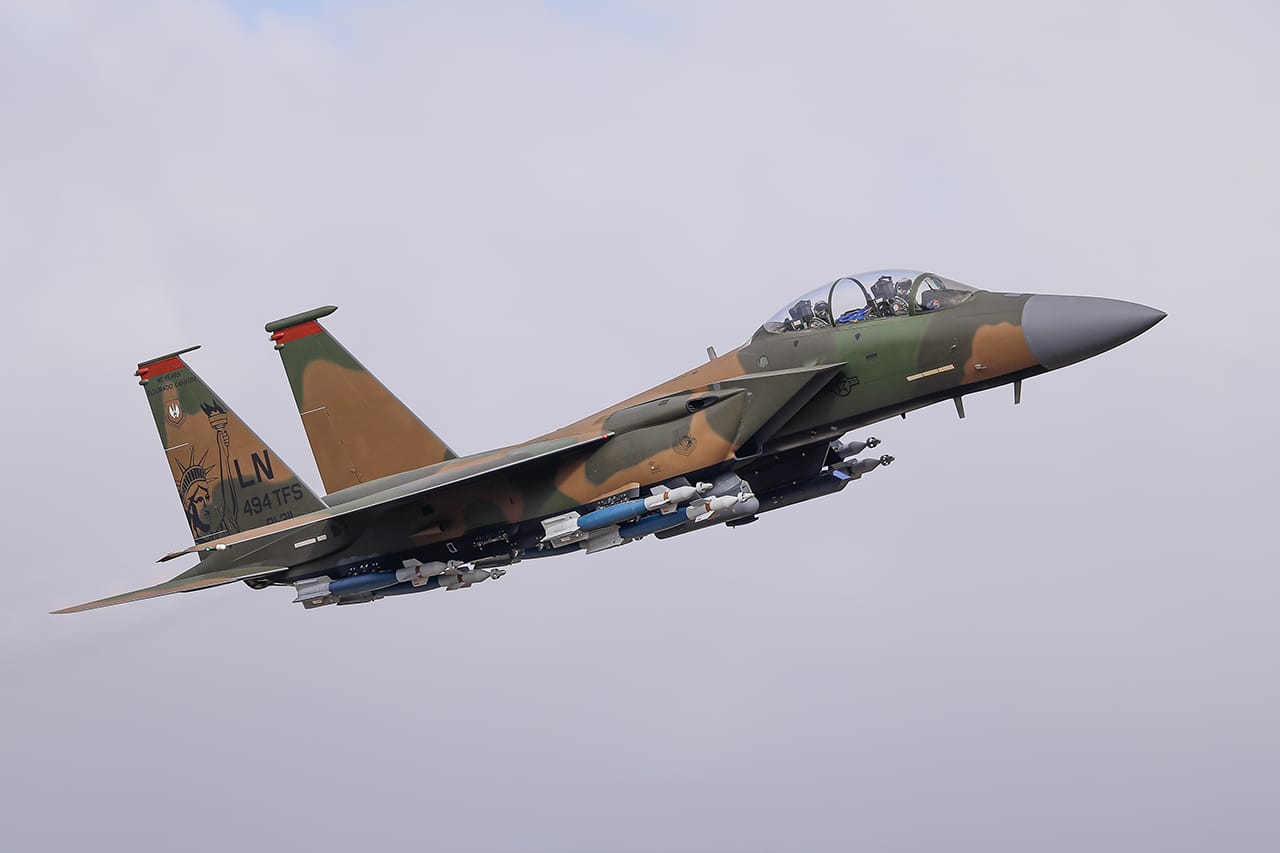
Our friend, aviation photographer Stewart Jack, captured these images of 93-0311 as it took off on a training sortie on May. 7, flying under the callsign EAGLE 31. Notably, the jet was seen to be carrying eight inert versions of the GBU-12 Paveway II guided bomb, distinguishable by solid blue casings.
EAGLE 31 took off from Lakenheath with wingman EAGLE 32 shortly after 08:30 local time (07:30 UTC), and began their sortie by meeting with a KC-135 Stratotanker to take on fuel before heading to the low flying areas of North Wales. After finishing up the low flying segment of their sortie, EAGLE flight headed for the Holbeach Air Weapons Range on the coast north of RAF Lakenheath where the entire payload was dropped.
This essentially simulates a real world strike mission, with a low-level ingress through the Welsh Valleys before setting up for weapon employment at the range simulating the target.
91-0311 departing RAF Lakenheath on May. 7. | Source: Stewart Jack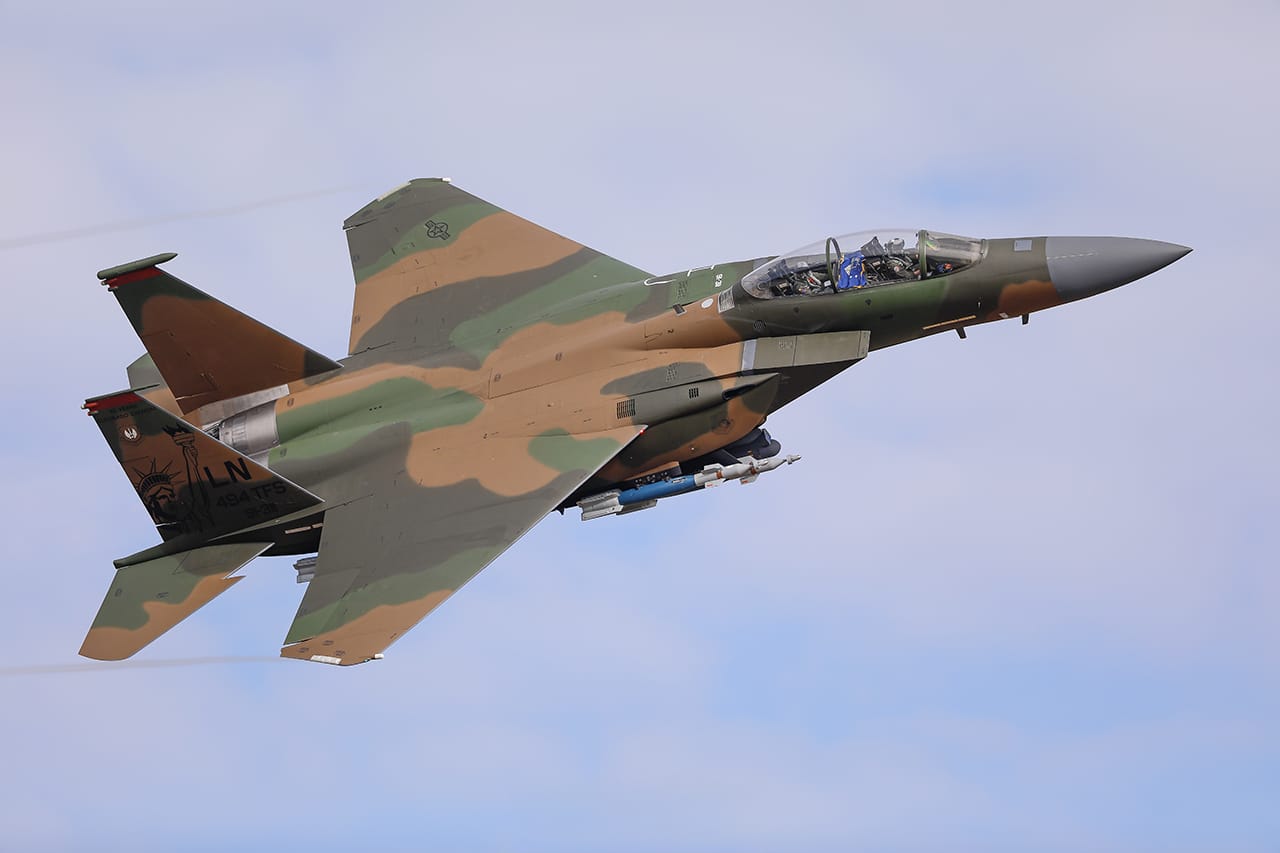
The GBU-12 is one of the most commonly seen variants from the Paveway series, and equips a 500 lb Mark 82 bomb with a nose-mounted laser seeker unit and deployable tail guidance fins. These fins have an ‘on/off’ style of operation – known in the industry as bang-bang guidance – where the control surfaces can only deflect at the maximum amount, with no fine adjustment. The bomb’s guidance system accounts for this by over-correcting for any course adjustments then immediately deflecting in the opposite way to align with the intended trajectory. This method allows for simpler mechanics and electronics, lowering the overall cost for the single-use system.
Being able to easily carry such a large number of these munitions is one of the F-15E’s biggest strengths. In the images we can see that even with such a load, the jet’s wing hardpoints are still empty and would be available for external fuel tanks and/or air to air weaponry. All of the air to ground munitions are carried on fuselage stations, with the additional mounting points on the aircraft’s conformal fuel tanks (CFT) – fitted on each side of the aircraft, outboard of the air intakes – providing significant extra capacity.
A U.S. Air Force F-15E Strike Eagle conducts a combat air patrol in the U.S. Central Command area of responsibility, May 7, 2025. | Source: U.S. Air Force Photo by Staff Sgt. John C.B. Ennis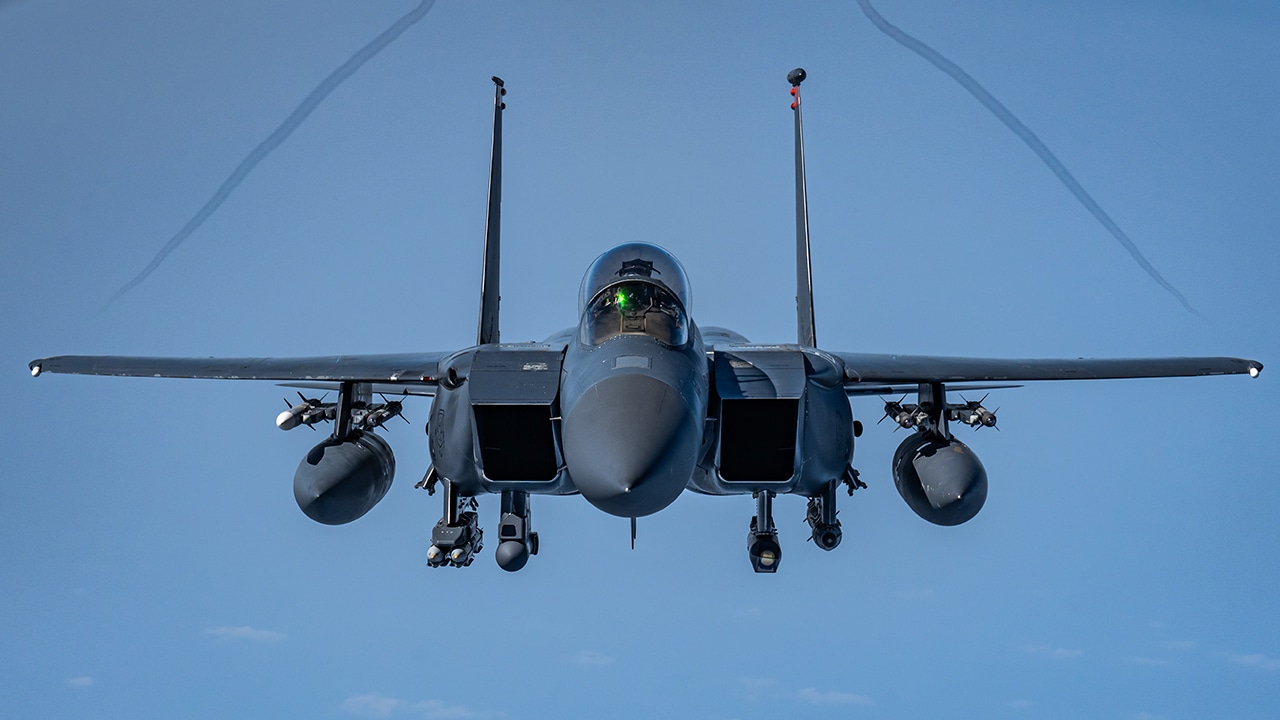
On the F-15, these CFTs are also known as ‘FAST Packs’ – Fuel and Sensor, Tactical – and were initially developed for the air to air focused F-15C. In U.S. service, these have almost exclusively been associated with the Strike Eagle, and these darker-colored Eagles are rarely seen without them. The main U.S. Air Force F-15Cs seen to regularly carry them were those based with the 57th Fighter Interceptor Squadron (FIS) at Keflavik, Iceland.
Watch them fly bayou!
Louisiana’s 159th Fighter Wing #Boeing F-15Cs take flight with new conformal fuel tanks – increasing #USAF range and homeland defense capability! #F15 #AirNatGuard pic.twitter.com/qjrRNblIQC
— Boeing Defense (@BoeingDefense) February 5, 2018
Since the CFTs cannot be jettisoned in flight to gain extra speed and maneuverability, the air-to-air focused pilots of the F-15C have preferred to use more traditional drop tanks. For the F-15E’s strike mission, the permanent impact to the aircraft’s flight characteristics are a worthy trade-off for the additional range and payload options they offer.
The U.S. has said it doesn’t plan to operate its F-15EX Eagle IIs with CFTs, although this may be reconsidered with the expansion of the F-15EX order and the prospect of them replacing older F-15E Strike Eagles in the coming years.
Many thanks as always to Stewart Jack for contributing these images, you can find him on Facebook and Instagram.
Categories: Afrique, Defence`s Feeds
A U.S. Navy F-14D Tomcat Might Return to the Skies Thanks to Congress’ “Maverick Act”
Three U.S. Navy F-14D Tomcats would be transferred to the U.S. Space and Rocket Center Commission in Huntsville, Alabama, and one might be made flyable again, following the approval of the “Maverick Act.”
The U.S. Congress is voting on a new bill which might see a F-14D Tomcat return to the skies 20 years after it was retired. The bill, notably called the “Maverick Act,” was introduced by Senator Tim Sheehy, co-sponsored by Sen. Mark Kelly, on Mar. 23, 2026.
Maverick ActThe bill passed Senate by Unanimous Consent on Apr. 28, 2026, and is now in line for voting at the House, with the latest update on May 4. Should the bill also pass the House, it would authorize the transfer by the Secretary of the Navy to the U.S. Space and Rocket Center Commission in Huntsville, Alabama, of three F-14D Tomcats.
The bill still needs to pass the house.
— OSINTtechnical (@Osinttechnical) May 7, 2026
The Commission directs the U.S. Space & Rocket Center, the space-dedicated museum established by the government of Alabama in 1970 and sometimes referred to “Earth’s largest space museum.” According to the text of the bill, it appears that the three aircraft have already been identified with the Bureau Numbers 164341, 164602, 159437.
The document specifies that the aircraft “do not have any capability for use as a platform for launching or releasing munitions or any other combat capability that it was designed to have.” A set of conditions is then listed, with the Secretary of the Navy not required to repair or alter the condition of the aircraft before conveying its ownership but providing any maintenance and operations manuals and excess spare parts.
An F-14D Tomcat pulls up after performing a fly-by past the aircraft carrier USS Dwight D. Eisenhower (CVN 69) as the ship operates in the Atlantic Ocean on June 19, 2006. | Source: U.S. Navy photo by Petty Officer 2nd Class Miguel A. Contreras
The latter is where things gets interesting, mentioning for the first time a possible return to the skies of the Tomcat:
“The Secretary shall provide excess spare parts to make one of the F–14D aircraft flyable or able to complete a static display, provided that any part transferred is from existing Navy stock, with no items being procured on behalf of the Commission.”
However, the activities required to make this happen will be the sole responsibility of the Commission:
“The Secretary will not be responsible for transferring any additional parts or providing any additional support beyond what is stated in this section, during or after the conveyance of the aircraft.”
The Commission will be able to obtain qualified support outside of the Department of the Navy, something similar to what the Collings Foundation did with the F-4D Phantom, the type’s only flying example in the U.S.:
“The Secretary may authorize the Commission to enter into agreements with qualified nonprofit organizations for the purpose of restoring and operating the aircraft transferred under subsection for public display, airshows, and commemorative events to preserve naval aviation heritage.”
The document also specifies that the transfer will be made at no cost to the government. “Any costs associated with such conveyance, costs of determining compliance with terms of the conveyance, and costs of operation and maintenance of the aircraft conveyed shall be borne by the Commission,” mentions the bill.
An F-14B Tomcat assigned to VF-103 ‘Jolly Rogers’ flies over the Croatian coastline near Pula. | Source: United States Navy photo by Capt. Dana Potts Feasibility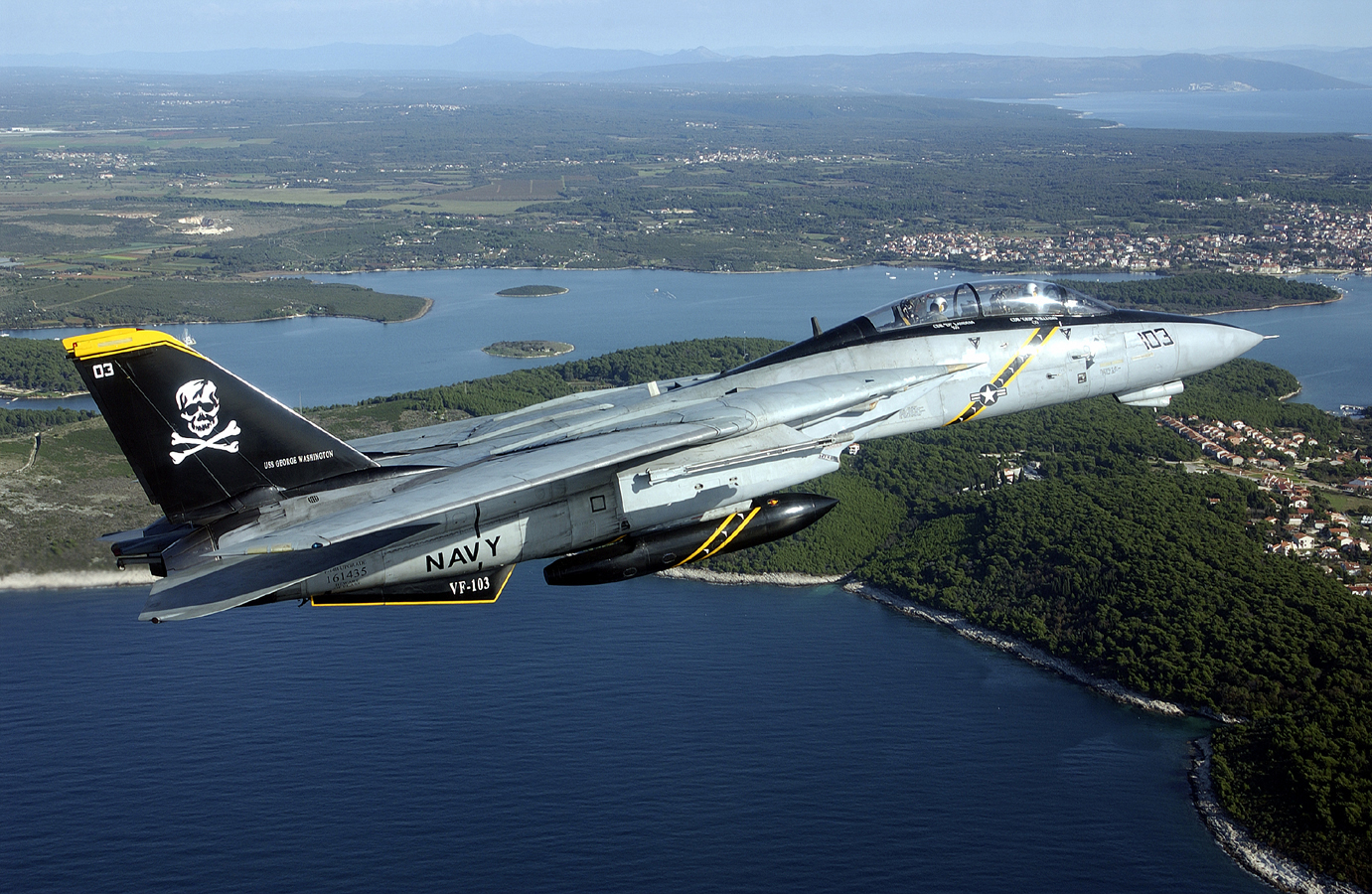
The U.S. has been historically extremely restrictive regarding the access to the retired F-14 airframes. In fact, access to spare parts was tightly controlled to avoid any possibility of smuggling toward Iran, which was the type’s only operator after the U.S. Navy retired its Tomcats in 2006.
Many parts were also destroyed, which would make difficult the procurement of the required components to make the aircraft flyable again. It should be noted that, upon retirement, many components were removed from the aircraft, before they were parked in the desert.
Before returning to flight, the F-14D would need deep inspections, both for the airframe’s structure and the systems. After that, work would be done in order to make the aircraft compliant with the requirements for the certification by the Federal Aviation Administration.
This process is expected to be highly expensive, mainly due to among of work after the aircraft sat in the desert for 20 years and the lack of supply chain. The Tomcat was also known for its high operating costs, which would make sustained airshow operations unlikely.
However, limited flight demonstrations and heritage events might be more likely. The timeline is another unknown aspect, and the possible return to flight might take years before materializing.
Categories: Afrique, Defence`s Feeds
CENTCOM Releases Images of Apaches ‘Over’ Strait of Hormuz as Iran Reimposes Restrictions
U.S. CENTCOM released some interesting photos of the AH-64 gunships allegedly patrolling the Strait just as Iran moved to restrict traffic through the narrow waterway once again.
Iranian Revolutionary Guards Corps (IRGC) gunboats reportedly fired on a tanker transiting the Strait of Hormuz on Saturday, according to an advisory released by the UK Maritime Trade Operations (UKMTO), on Saturday Apr. 18, 2026.
The warning said the organization had received a direct notification from the ship’s master, who reported being approached by two IRGC gunboats some 20 nautical miles off the coast of Oman. No radio warning was said to have been issued before the tanker, whose identity was not disclosed, came under fire.
UKMTO WARNING 037-26 – ATTACK Report Date:18 Apr 2026 Report Time: 0920UTC Issue Date:18 Apr 2026 Source: Master UKMTO has received a report of an incident 20NM northeast of OMAN. The Master of a Tanker reports being approached by 2 IRGC gun boats, no VHF challenge that then fired upon the tanker. Tanker and crew are reported safe. Authorities are investigating.
During today’s attack agaisnt an Indian tanker by Iran in the Strait of Hormuz, it seems though the vessel was initially heading outbound, but was refused by the IRGC. The vessel is then seen heading inbound towards the Gulf again, but then turns off AIS and makes a run for it… pic.twitter.com/EK5pQaJvwm
— Martin Kelly (@_MartinKelly_) April 18, 2026
The episode comes as Tehran has reimposed tight restrictions on shipping through the Strait, after U.S. President Donald Trump said on Friday Apr. 17, 2026 that the U.S. blockade on vessels using Iranian ports would continue. According to CENTCOM, 23 ships were forced to turn back since the blockade was enforced.
Littoral combat ship USS Canberra (LCS 30) patrols the Arabian Sea during the U.S. blockade. Since commencement of the blockade, 23 ships have complied with direction from U.S. forces to turn around. American forces are enforcing a maritime blockade against ships entering or… pic.twitter.com/PMIBOoeJXS
— U.S. Central Command (@CENTCOM) April 18, 2026
In a post on Saturday, the official X account of the IRGC Navy Command said that “Every breach of promise by America will be met with a fitting response. As long as the passage of vessels from Iranian origin to Iranian destination remains under threat, the status of the Strait of Hormuz will remain in its previous state. By the will of Allah.”
هر نقض عهدی از سوی امریکا، پاسخی شایسته دارد.
تا زمانی که تردد شناورها از مبدأ ایران و به مقصد ایران مورد تهدید باشد، وضعیت تنگه هرمز به حالت قبلی باقی میماند. باذن الله
— فرماندهی نیروی دریایی سپاه (@niroo_daryayi) April 18, 2026
The statement capped a confused 24 hours in which Tehran first said the Strait of Hormuz had reopened and then moved to reimpose restrictions that effectively closed it again.
As the news of attacks on vessels in the Strait started to circulate (two Indian vessels were fired upon by IRGC Navy watercraft in the Strait and forced to turn back), U.S. Central Command released some interesting shots of U.S. Army AH-64 Apache helicopters patrolling the waterway (actually the photos were probably taken as the aircraft were inbound the area rather than above it, somewhere off the coast of Oman or UAE).
AH-64 Apaches fly above the Strait of Hormuz during a patrol, April 17. U.S. Army Soldiers are flying in and around the strait providing a visible presence in support of freedom of navigation. pic.twitter.com/6K6cuCoqq2
— U.S. Central Command (@CENTCOM) April 18, 2026
On Mar. 19, 2026, during a Pentagon press briefing, General Dan Caine, Chairman of the Joint Chiefs of Staff, announced that U.S. Air Force A-10 Thunderbolt II jets supporting Operation Epic Fury had begun operating on the southern flank, targeting fast attack craft in the Strait of Hormuz. He also said that AH-64 Apache gunships were hunting one-way attack drones in the same area.
Alongside fast jets, the AH-64 is very well suited for such maritime patrol missions as it a platform combining persistence, precise sensors and a flexible weapons mix that allow the gunship helicopter to counter fast watercraft as well as OWA drones that might be launched against oil tankers and ships in a crowded littoral environment. As recent U.S. Army counter-UAS demonstrations have shown, the AH-64E can detect, track and defeat drones with multiple weapons, including the 30 mm M230 chain gun, APKWS-guided 70 mm rockets, HELLFIRE variants and even JAGM, offering crews scalable options depending on range, target size and collateral-risk considerations.
The helicopter is also well equipped on the sensor side, pairing electro-optical and infrared sights with the mast-mounted AN/APG-78 Longbow radar, which is designed to rapidly detect, classify and prioritize large numbers of contacts. In the Strait of Hormuz, where threats may include small one-way attack drones, fast attack craft and other fleeting, hard-to-sort targets, that combination makes the Apache a credible hunter-killer platform: it can build situational awareness, share data across networks, and engage everything from low, slow aerial threats to small hostile boats with direct fire, guided rockets or heavier missiles, depending on the tactical picture.
Categories: Defence`s Feeds, European Union
Paramount Confirms Top Gun 3 with Tom Cruise Returning as Pete Mitchell
A new sequel will see Pete “Maverick” Mitchell’s return in Top Gun 3, with producer Jerry Bruckheimer saying Tom Cruise had liked a proposed storyline for the new film.
After reports said that a third installation in the Top Gun saga is in the works, following 2022’s hugely successful Top Gun: Maverick, that project is now confirmed, along with Tom Cruise returning as Pete “Maverick” Mitchell, Variety reported along with other publications. Paramount studios made the official announcement during the annual CinemaCon presentation, with Jerry Bruckheimer also back as producer.
Bruckheimer previously said in 2024 that Tom Cruise liked the storyline that was being prepared for the next one. “We pitched Tom a story he liked. But he’s a very in-demand actor and he’s got a lot of movies lined up, so we have to wait and see,” said Bruckheimer.
Top Gun: Maverick also featured among the new characters Bradley “Rooster” Bradshaw (Miles Teller), the son of Maverick’s Radar Intercept Officer (RIO) and best friend Nick “Goose” Bradshaw. In the story, Maverick had returned to the famous Naval Air Station (NAS) North Island to school a bunch of young fighter pilots for a daring mission.
‘Top Gun 3’ Officially in the Works With Tom Cruise Returning https://t.co/0sTeLBQMZ3
— Variety (@Variety) April 16, 2026
These pilots are training for an upcoming mission to destroy a Uranium enrichment plant in a foreign country, defended by “fifth gen fighters” represented by Su-57s. Top Gun: Maverick grossed $1.5 billion at the global box office, against a $170 million budget for the production.
Top Gun’s realismU.S. and Western war movies are largely realistic in terms of equipment, setting and art direction, primarily owing to the close ties between the military, industry and movie makers. This allows permissions to shoot on and use actual military equipment like jets, tanks, warships, military bases and aircraft carriers to be acquired easily.
Second is the lead in graphic design, computer technology and overall financial resources, bringing them closer to real-world military affairs. However, as is the norm about symbiotic relationship between a film industry and national politics, both the Top Gun movies had their share of propaganda, and invariably some technical errors/inauthencies, which one might not expect in a film created in cooperation with the U.S. Navy.
A still from Top Gun: Maverick showing F/A-18 Super Hornet flying at low altitude. | Source: Paramount
Some of the inaccuracies were listed in a 2019 article titled “79 Cringeworthy Errors in ‘Top Gun’” for Military.com by former F-14 RIO and journalist Ward Carrol. Among them was the famous fly-by with Maverick buzzing the air traffic control tower, which in real life would have likely resulted in immediate revocation of his flight status.
Another major one was using F-5 Tigers to represent Russian MiGs, which can however be justified as access to the legendary fighters was not possible with the Cold War still three years away from ending. It’s a different matter that the U.S. military got Su-27s and MiG-29s from former Soviet countries, Ukraine being one of them.
Other technical flaws ranged from rank insignia on uniforms inconsistent with officers’ billets and class to instrumentation and cockpit layout in the pilot and RIO seats. Some maneuvers were also not accurate, particularly the inverted photo of the MiG as the design of the F-14 wouldn’t have allowed that in the first place. For instance, its vertical stabilizers would have stabbed into the MiG’s top fuselage, given how close the cockpits were.
The F-14 Tomcat and the 5th gen fighter, the Su-57, in Top Gun: Maverick. | Source: Paramount Top Gun: Maverick and Top Gun 3
Top Gun: Maverick was a box office hit, resoundingly receiving the stamp of approval from fans of the original film. Particularly, the makers incorporated the late Val Kilmer’s real-life cancer into his character Tom “Iceman” Kazansky, and his relationship with Maverick evolving into mutual respect, professional and personal, hit closer to home.
The biggest fictional element was the Darkstar Hypersonic Aircraft, which was specifically designed by Lockheed Martin’s Skunk Works division for the film. As the original one, this movie too could not escape some technical inaccuracies.
Among them is the final strike mission, showing the site defended by Cold War-era S125 Neva/Pechora (SA-3 Goa) missiles despite the presence of 5th gen fighters. A location like that would have a layered integrated air defense, like S-300s and Buk-M1s (for medium range) and S-400s as a long-range theater-level anti-air battery.
Film director Joseph Kosinski poses with the Darkstar mockup, with Tom Cruise inside the cockpit. | Source: Lockheed Martin
We are far from knowing what real-world adversary aircraft will be incorporated in Top Gun 3. Inaccuracies aside, the movie is sure to be an exciting watch, for pilots, audiences, and aviation nerds alike.
Lt. Pete Mitchell was a Navy Captain in Top Gun: Maverick. Time will tell which new role he will assume in the new film, maybe finally getting promoted to a Rear Admiral and passing the torch to “Rooster.”
Categories: Defence`s Feeds, European Union
Skunk Works Is Looking for a U-2 Pilot
Despite being one of the oldest aircraft still flying in U.S. service, the U-2 remains relevant enough for Skunk Works to seek a qualified pilot in Palmdale.
Skunk Works, the legendary Lockheed Martin’s secretive advanced projects division, is hiring a U-2 pilot in Palmdale, California.
The job posting, that you can find here, calls for an onsite, full-time, first-shift position in Test Engineering for an experienced professional pilot, with a 4x10h schedule and possible relocation, and it is clearly framed as a test-oriented role rather than routine operational flying: according to the listing, the pilot would conduct engineering flight tests, production-acceptance flights, and flight-test support, help verify aircraft compliance and operational suitability, coordinate flight-operations efforts, approve cockpit configuration, and, if needed, perform demonstration flights for customers and government officials.
The ad, published on Apr. 6, 2026, says applicants must be no more than two years outside qualification on the U-2S Dragon Lady, hold a current FAA Class I or II medical, and possess either a suitable FAA Commercial Pilot certificate for multi-engine land and instrument airplane or an ATP (Airline Transport Pilot), while also being willing to travel, holding a valid U.S. passport, and arriving with an active Top Secret clearance.
Among the desired qualifications are 1,000 flight hours, graduation from a formal Test Pilot School, background in flight-test disciplines such as weapons, avionics and flight sciences, as well as instructor/training, communication, organizational and leadership or program-integration experience.
The posted compensation is a California salary range of $156,400 to $275,655 outside most major metro areas and $179,800 to $311,650 in most major metro areas, although the final offer depends on factors such as experience, training, skills, scope and business considerations; listed benefits include medical, dental, vision, life insurance, short- and long-term disability, flexible spending accounts, parental leave, paid time off, holidays, education assistance, and incentive-plan eligibility.
U-2 pilot. | Source: USAF
The emergence of the job posting is quite interesting, considering the iconic Dragon Lady was slated for retirement from U.S. Air Force service this year. However, while some U-2s have already been withdrawn from active service, the aircraft’s retirement date is far from settled, and the sundown of the type remains under intense congressional scrutiny.
In fact, U-2s are still flying active intelligence, surveillance, and reconnaissance (ISR) missions on a daily basis from forward operating locations, and there is little sign of that activity slowing down at least for now. USAF U-2s are home based at the 9th Reconnaissance Wing, Beale Air Force Base, California, but are rotated to operational detachments worldwide, including RAF Fairford, UK; Osan Air Base, South Korea, and RAF Akrotiri, Cyprus. The latter sustained damage from an Iranian kamikaze drone launched in retaliation for the U.S. and Israeli air strikes, last month.
In line with such continuous postponement of its retirement, in 2023 Lockheed Martin announced the first flight of the U-2 Avionics Tech Refresh (ATR), carried out by Skunk Works in partnership with the U.S. Air Force. The company said the flight tested an updated avionics suite, new cockpit displays and a mission computer designed to the Air Force’s open mission systems standard, with further testing planned to mature the software baseline before more mission systems were added.
More recently, BAE Systems was awarded a contract to support and sustain the U-2’s AN/ALQ-221 Advanced Defensive System (ADS), another sign that the aircraft is still receiving updates and meaningful attention rather than simply being allowed to age out quietly.
As for Palmdale, Plant 42 remains a hub for major activity involving the type, and the job posting seems to suggest Lockheed Martin expects the Dragon Lady to continue generating the kind of work that may require highly specialized pilot support for quite some time.
A U-2 Dragon Lady takes off for the first flight of the Avionics Tech Refresh program in Palmdale, California. | Source: Lockheed Martin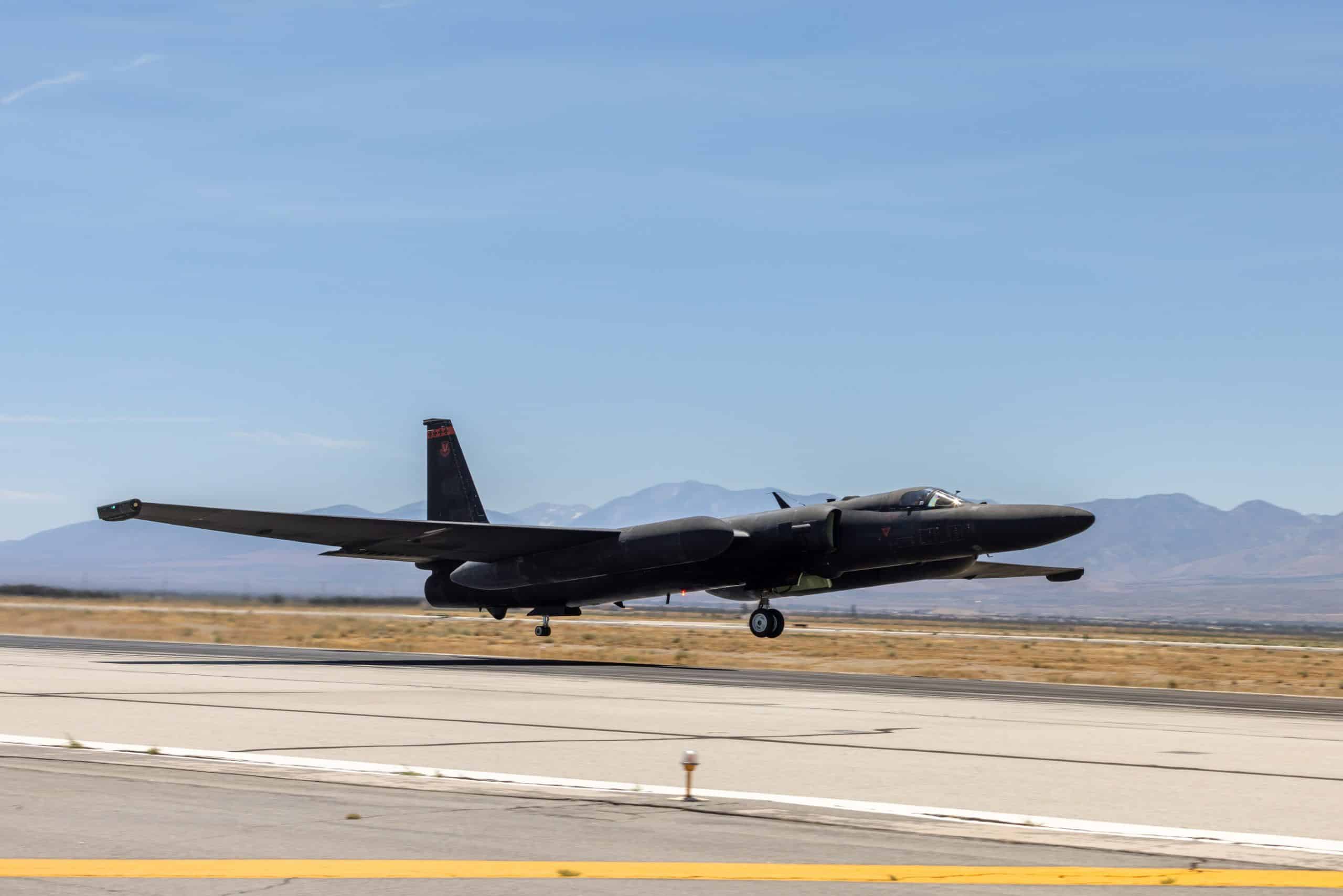
Eventually, it should not be forgotten that, beyond its operational role, the U-2 is still valued as a high-altitude testbed. Testing campaigns conducted over the last five years have leveraged the aircraft’s open architecture and its ability to integrate new technology quickly. The U-2 has been involved in containers and AI/ML experimentation, open-mission-systems integration, and gateway or data-sharing roles between different platforms. A Skunk Works pilot current on the U-2 would be useful if Lockheed is using the aircraft to trial payloads, communications systems, sensors, or battle-management concepts that may feed current and future programs.
Another (even more speculative) possibility is that Lockheed could employ a U-2 pilot as part of work on or around future classified ISR aircraft, using the Dragon Lady as a surrogate, a risk-reduction platform, or a bridge capability. With the RQ-180 spy drone slowly beginning to emerge from the shadows of black programs, there is a chance Skunk Works is maturing new manned or unmanned ISR concepts. In that context, having a U-2 pilot with a test background could make sense for comparative flying, sensor work, or manned-ISR experimentation.
Whatever, if you are interested and your profile fits the requirements, you’d better hurry: you have less than a month to apply, as the deadline is May 15, 2026.
Categories: Defence`s Feeds, European Union
Iran Fires Two Intermediate-Range Ballistic Missiles at Diego Garcia Base
The attempted strike on Diego Garcia would mark a major escalation, highlighting Tehran’s apparent ability to target the strategic U.S.-UK base deep in the Indian Ocean and potentially put parts of Europe within reach.
Iran has launched two missiles at the joint UK-U.S. base at Diego Garcia in the Indian Ocean, about 4,000 km away. Such a distance is well within the range separating Tehran from many European capitals. According to U.S. officials who talked to the Wall Street Journal, one ballistic missile reportedly failed because of a malfunction and did not reach the base, whilst the other was engaged by a U.S. destroyer utilizing an SM-3 interceptor.
Neither of the missiles hit the base, still, regardless of the outcome of the attack, the attempted strike with the IRBM, marks a potential turning point in the conflict. The choice of target, is a telling signal. The United Kingdom has just decided to grant the United States the use of its bases for the strikes, and British assets, as Iranian Foreign Minister Abbas Araghchi announced, have therefore become legitimate targets.
Until now, it had been believed that the intermediate-range missiles available to Tehran were capable of striking targets at a distance of up to 2,000 km. The decision to launch against the Diego Garcia base points to significantly greater capabilities in the weapons still available to the Islamic Republic.
The IRBMs, probably Khorramshahr-4s or another IRBM type, make not only Diego Garcia and other bases in the Middle East, but also many European capitals, potential targets within Tehran’s theoretical reach.
The Khorramshahr-4 is likely the intermediate-range ballistic missile that Iran used in the attempted attack on Diego Garcia, which analysts had previously assessed may have a range of +4,000km, though it had only been proven at between 2,000-3,000km. Such an attack would suggest… https://t.co/bLj7XzvKlz pic.twitter.com/fGMPtDs2Ih
— OSINTdefender (@sentdefender) March 21, 2026
U.S. and Israeli raids have significantly reduced Iran’s missile-launching capabilities. According to figures cited in recent days by U.S. President Donald Trump, Tehran has retained only 8% of its original capability. It is estimated that, before the conflict began, Tehran had at least 1,000 to 1,500 missiles. Among them, the Soumar has a range that is, in any case, below 3,000 km. Sejjil missiles can strike targets at a distance of 2,000 km. Shahed drones can also be used in medium- to long-range raids, considering that they can operate up to 1,700 km from their launch point. Still, despite being degraded, Iran continues to retain the ability to launch kamikaze drones and missiles, most likely relying on mobile launchers that are more difficult for U.S. and Israeli forces to detect and target, especially in dispersed areas in the eastern part of the country.
Although U.S. Chairman of the Joint Chiefs of Staff Gen. Dan Caine said during a briefing on Mar. 4, 2026, that ongoing operations against Iran were shifting from stand-off to stand-in strikes, using precision-guided bombs and shorter-range missiles, the continued use of AGM-158 JASSMs (Joint Air-to-Surface Standoff Missiles) observed on the external pylons of the B-52s departing RAF Fairford, U.K., on Mar. 20, 2026, suggests there is still a fairly significant requirement for stand-off munitions. Secretary of Defense Pete Hegseth claimed on Mar. 13 that only 1% of the munitions being used were stand-off weapons, while also stating that “Iran has no air defenses.”
Diego GarciaThough officially a British territory and British base, Diego Garcia is predominantly used by U.S. forces. Alongside communications and intelligence gathering facilities, both of which were major justifications for establishing this permanent military outpost in the Indian Ocean, Diego Garcia’s airfield is one of only three locations outside of the continental U.S. equipped with dedicated hangar facilities for the B-2 Spirit, and it can accommodate a vast number of strategic bombers, air to air refuelers, and intelligence gathering aircraft. In 2025, the base saw its first known fighter deployment of F-15E Strike Eagles.
The base has been at the center of dispute earlier this year, over a Diego Garcia Military Base and British Indian Ocean Territory Bill, which intended to formalise and, in essence, ratify the deal signed between the UK and Mauritius in May 2025 that would see sovereignty of the British Indian Ocean Territory (BIOT) ceded to Mauritius in return for a 99-year guaranteed lease of Diego Garcia for continued military use. Upon its expiration, this 99-year lease could be extended for up to 40 years.
Critics claimed that ceding sovereignty places the base at risk of foreign espionage and interference. Just as it was set to head into the final stages of debate, the bill was paused after an amendment by the UK opposition party called into question whether the bill’s effects are in breach of a still-in-effect 1966 agreement between the United States and the United Kingdom regarding military use of Diego Garcia. The first clause of this agreement states that “The Territory shall remain under United Kingdom sovereignty”.
Categories: Defence`s Feeds, European Union
Typhoon Spotted Loaded With Rocket Pods for the First Time
An RAF Typhoon was pictured at BAE Systems Warton carrying two seven round LAU-131 rocket pods, which can be used to fire APKWS guided munitions against surface and, importantly, air targets.
The images, taken by Tech Digital Photography, mark the first time that we’ve seen a Typhoon outfitted with a rocket pod in the flesh. While rocket pods were integrated with many aircraft that the Typhoon has ended up replacing, until relatively recently these were largely for unguided rockets in an air to surface role and deploying such a non-precision weapon from a fast jet no longer aligned with the operating practices of many air forces.
Now, though, the introduction of the BAE Systems Advanced Precision Kill Weapon System II (APKWS II) guidance kit for Hydra 70 rockets over the past decade has granted such munitions a new lease of life. Initially envisaged as a way to precisely strike softer targets, preserving larger munitions for more valuable, hardened targets, the APKWS kit has now been well proven in an anti-air capacity against the emerging threat of small, inexpensive uncrewed aerial systems (UAS).
A U.S. Air Force F-16 Fighting Falcon aircraft assigned to the 20th Fighter Wing, sits at the hot cargo pad after being loaded with rockets at Shaw Air Force Base, S.C., Jun. 11, 2025. (Image credit: USAF/ Airman 1st Class Nyanda Walker-Potts)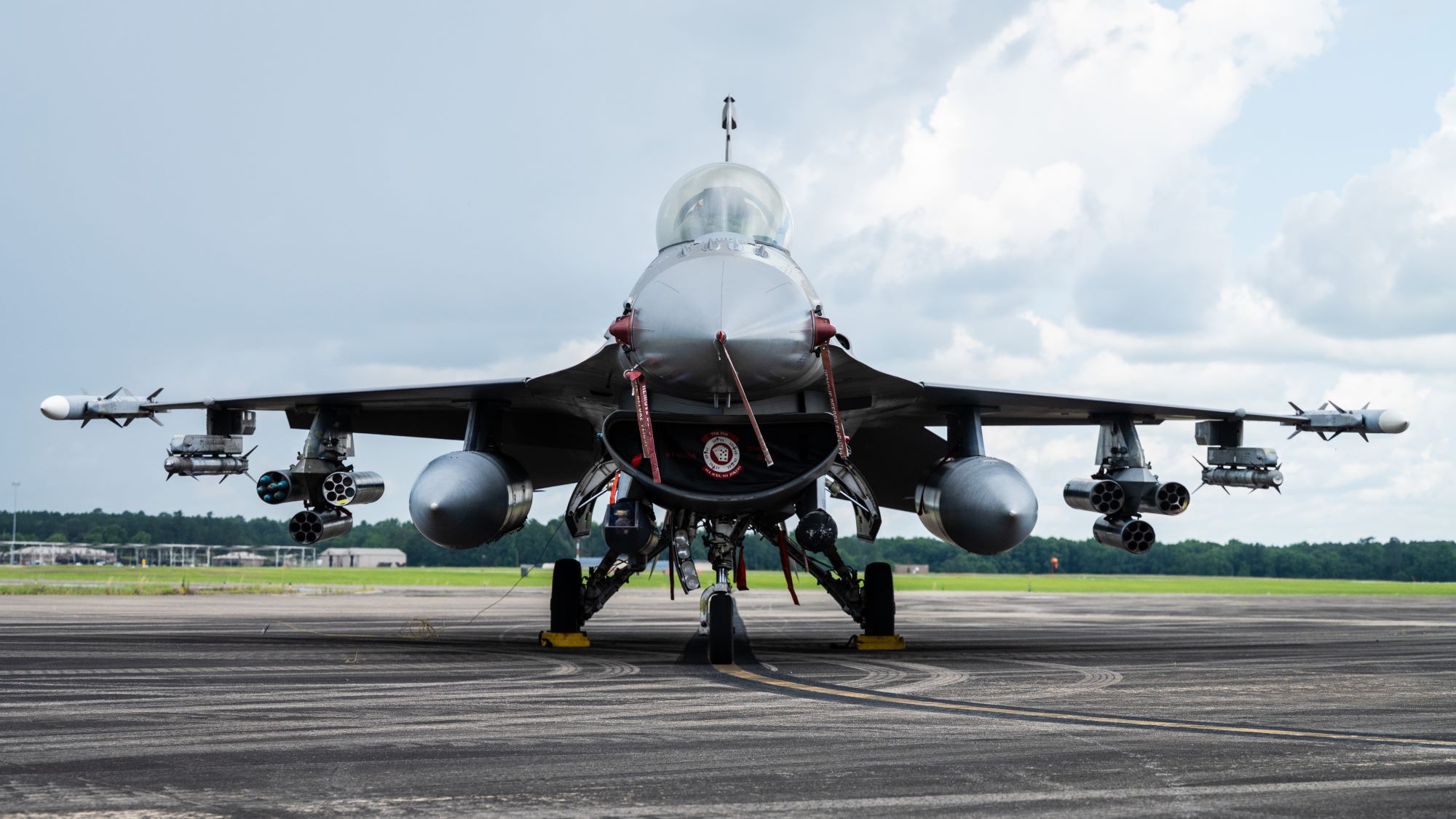
Recently integrated on mainline U.S. Air Force fighters like the F-16 Fighting Falcon and F-15E Strike Eagle, APKWS rocket pods are now very commonly seen carried by these aircraft into combat – including during the ongoing U.S. war with Iran. As well as being less expensive than dedicated air to air munitions like the AIM-9X Sidewinder, these rockets can also be carried in far greater quantities. This allows each aircraft to engage many more targets before needing to return to an airfield to be reloaded, an important factor when being faced with dozens or even hundreds of incoming drones.
BAE Systems has developed a dual mode laser/infrared seeker for APKWS for precisely this counter-UAS (C-UAS) purpose, which will eliminate the current need for continual lasing of the intended target.
With the UK Defence Investment Plan (#DIP) due Monday (or so I have been led to believe), we’re all expecting to be put out of our collective misery re #NMH. Another announcement I’ve been told to maybe expect is related to #APKWS rockets on the #Eurofighter Typhoon for low-cost… pic.twitter.com/RmAdpTWCQk
— Gareth Jennings (@GarethJennings3) December 12, 2025
The acquisition of APKWS II by the Royal Air Force for deployment from its Typhoon force has been strongly rumored in recent months, with anticipations that such a decision is due to be announced in the still heavily delayed Defence Investment Plan (DIP). The timely appearance of rocket pods on this Typhoon – marked with the insignia of the RAF’s 41 Test & Evaluation (TES) Squadron but thought to be in use directly by BAE Systems – should not be taken as a definitive confirmation of this plan, though, as BAE Systems already announced that integrating APKWS II was under consideration.
Any comment on the subject from the Royal Air Force itself has been tight-lipped.
Both UK and Germany tell me there are no current plans to equip @eurofighter #Typhoon with rockets for the counter-#drone mission, but not to say it won’t happen. Waiting to hear from Italy and Spain. 1/3 https://t.co/OSOKTcLKBT pic.twitter.com/EnXWFOYItJ
— Gareth Jennings (@GarethJennings3) June 25, 2025
These trials, then, may be BAE Systems getting out ahead of time with their anticipation of potential future orders by the RAF as well as overseas Typhoon operators. When any procurement decisions are then made, the weapon will be available for use far more quickly.
View this post on Instagram
A post shared by Tech_Photog (@tech_photog)
Tech Digital Photography’s images do in fact appear to show that live firing trials of some form have begun, with the Typhoon pictured on the ground with a single round carried in the starboard pod. When the jet is pictured on approach to the airfield, the same pod is empty.
View this post on Instagram
A post shared by Tech_Photog (@tech_photog)
Timely AppearanceThe debut of rocket pods for the Typhoon comes at a particularly coincidental time, given recent events in the Middle East. Of course, aircraft already integrated with APKWS II have been carrying these into combat amid the threat of Iranian drones, but RAF Typhoons flying from Qatar and RAF Akrotiri have instead had to rely solely on AIM-132 Advanced Short Range Air to Air Missiles (ASRAAMs) as their short-range infrared guided air to air missile.
USAF F-15E in full counter drone loadout for Epic Fury. 4 X AIM-120, 4X AIM-9, 28 FALCO APKWS laser-guided rockets + the 20mm. Jet is clean aside from that, so likely has nearby tanker support and can get to where it needs to go fast.
Image via CENTCOM screencap pic.twitter.com/kTvlQCNYBr
— Tyler Rogoway (@Aviation_Intel) March 4, 2026
Typhoons can carry only four ASRAAMs per sortie – the four partially recessed fuselage hardpoints being dedicated for larger radar-guided missiles like the AIM-120 AMRAAM or MBDA’s Meteor. With just two of the rocket pods, each Typhoon could carry 14 APKWS rockets into battle alongside two ASRAAM.
The massive cost of using ASRAAM in a C-UAS role has already been a point of criticism in the British press. While the cost calculations are not wrong – and the highly capable ASRAAM is indeed a massive overmatch for these low tier targets – this line of thinking does fail to consider the cost of not intercepting an incoming drone of missile, which could be far higher than the expense of an ASRAAM.
RAF Typhoon taxiing at RAF Akrotiri in recent days, loaded with four ASRAAM, plus Meteor missiles and a LITENING targeting pod. (Image credit: Crown Copyright)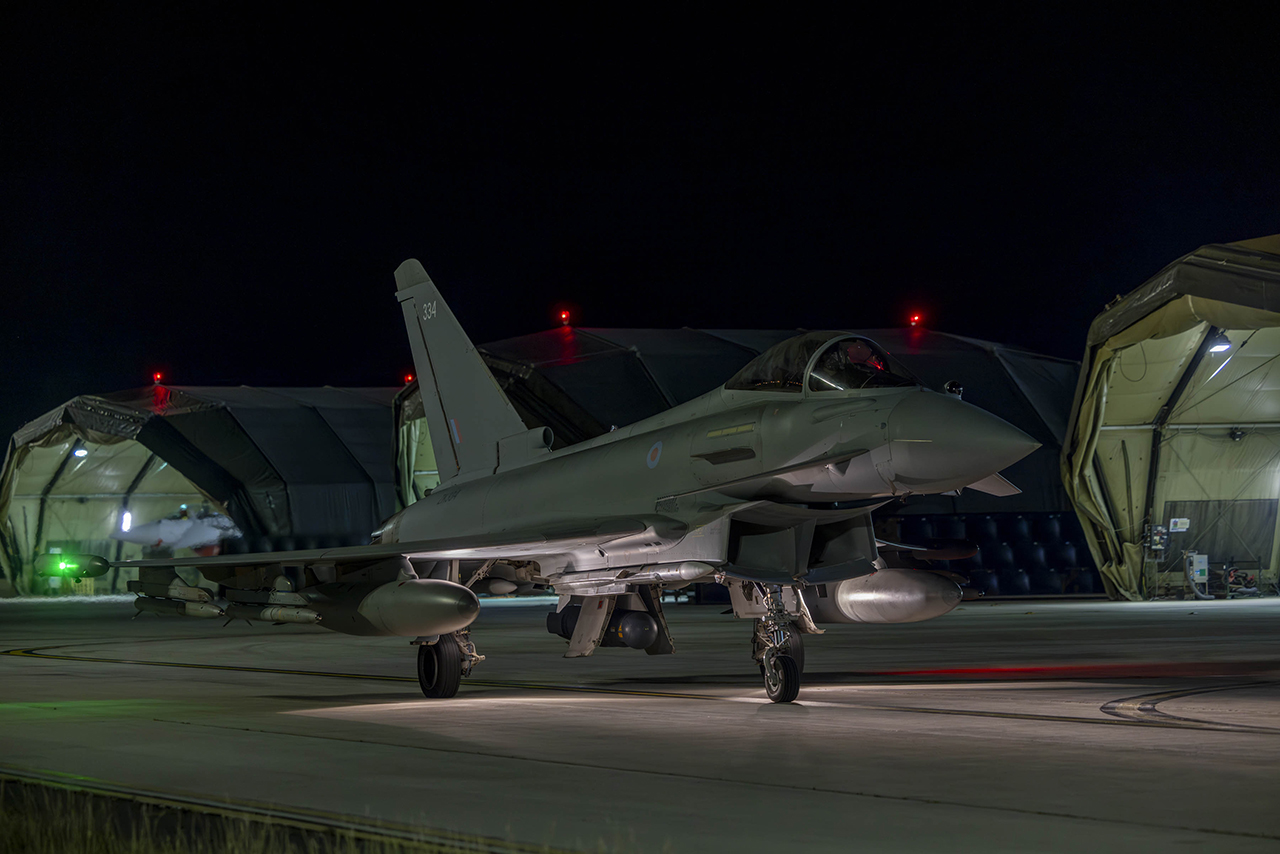
UK F-35Bs, which recently scored their first ever destruction of a hostile target when a Fleet Air Arm pilot destroyed an Iranian drone with an ASRAAM, would still have to use these higher tier missiles as rocket pods have not been integrated on this type. Theoretically, at the expense of full stealth characteristics (even more so than the already external carry only ASRAAM), there is no apparent reason why this integation could not take place, but it would have to be scheduled through the U.S. managed Integrated Test Force (ITF).
If the U.S. decides to follow this path, we may see this option emerge relatively quickly, but the UK is already plagued by delays to the integration of its weapons to the F-35B to such a point that the fleet’s only available air to ground weapon is the Paveway IV guided bomb.
On the Typhoon, as well as offering a new C-UAS option, integration of APKWS II adds another munition to its quiver for strike missions alongside the Paveway IV, Brimstone, and Storm Shadow cruise missile. Like with the earlier comparison to the AGM-114 Hellfire, softer targets like light-skinned vehicles, unprotected enemy emplacements, or even small boats can be targeted with APKWS without expending a valuable Brimestone or high-collateral Paveway IV. Many strikes of this nature have been carried out during Operation Shader in Iraq and Syria.
Many thanks to Tech Digital Photography for allowing the use of their images in this article. You can find them on Facebook and Instagram.
Categories: Defence`s Feeds, Swiss News
U.S. Air Force Releases Rendering of VC-25B in New VIP Livery
Despite being posted on Feb. 18 after news broke about the reversal to Trump’s preferred VIP livery design, the rendering is in fact identical to one that has been used by Boeing for some time. After a U.S. Air Force C-32A broke cover with a fresh paint scheme, replacing the traditional egg-blue and white livery, […]
Categories: Defence`s Feeds, Europäische Union
No, You Can’t Just ‘Jailbreak’ the F-35
Claims about modifying the F-35’s software raise legitimate sovereignty questions. But cybersecurity architecture, cryptography, and sustainment realities define strict limits on what can and cannot be done. As we reported in detail in a previous story, on Feb. 15, 2026, talking to the BNR Nieuwsradio Podcast, Dutch State Secretary for Defence Gijs Tuinman suggested that […]
Categories: Defence`s Feeds, Europäische Union
First U.S. Navy Aggressor F-16 Completes Structural Repair at FRCSW
The Navy has launched a Programmed Structural Sustainment Repair program for the dozens of F-16s acquired from the Air Force, which will allow them to fly through 2035. The U.S. Naval Air Systems Command (NAVAIR) announced last week two major milestones with its ex-U.S. Air Force F-16 jets used in the Adversary role. The Adversary […]
Categories: Defence`s Feeds, Europäische Union
Second and Third Prototypes of Turkey’s Kaan Fighter Have Emerged
The two new Kaan airframes are scheduled to begin testing in 2026, while Turkey is also developing its own engine to replace U.S.-made powerplants used by the prototypes. The second and third prototypes of Turkey’s Kaan fighter, named P1 and P2, have now been spotted in a recent official video covering the visit of Dr. […]
Categories: Defence`s Feeds, Europäische Union
First Look at USAF C-32 in New VIP Livery Destined for the VC-25B
A freshly repainted C-32A shows off the livery redesign long favored by President Donald Trump, which is also due to appear on the next generation of Presidential aircraft. Boeing C-32A 99-0003 was recently noted by aviation enthusiasts flying from Greenville Majors Airport (KGVT), where the fleet undergoes periodic maintenance overhauls and upgrades with L3Harris, in […]
Categories: Defence`s Feeds, Europäische Union
Middle East Buildup Continues as Six F-22 Raptors Stopover at RAF Lakenheath
The deployment of F-22s towards the Middle East has been considered by many to be one of the final pieces of the puzzle regarding U.S. preparations for potential offensive action against Iran. The Langley Air Force Base (AFB) jets landed at the UK base shortly before 1830 UTC, with their arrival well documented by local […]
Categories: Defence`s Feeds, Europäische Union
Japan’s EC-2 Stand-Off Jammer Aircraft Breaks Cover
The new EC-2 Stand-Off Jammer aircraft, based on the Kawasaki C-2 transport aircraft, will replace the unique EC-1 which has been in service since 1986. The latest in a number of Japanese aircraft with unusual modifications, the EC-2 Stand-Off Jammer (SOJ), just broke cover. The aircraft, which has been in development since 2021, has been […]
Categories: Defence`s Feeds, Europäische Union
U.S. and Dutch Pilots Allegedly Flying Ukrainian F-16s in Combat, Sources Say
Newly emerged reports claim a mixed squadron with Ukrainian, U.S. and Dutch pilots is flying combat missions on Ukrainian F-16s. New reports which are quickly going viral claim that Ukraine has stood up a new mixed squadron with Ukrainian, U.S. and Dutch pilots flying combat missions together un the country’s F-16s. The reports, which we […]
Categories: Defence`s Feeds, Europäische Union
India Greenlights Acquisition of 114 Rafales
India will acquire 114 additional Rafales as part of the Multi-Role Fighter Aircraft program, with 96 possibly produced locally. India’s Defence Acquisition Council (DAC) accorded on Feb. 12, 2026, an Acceptance of Necessity (AoN) for additional Dassault Rafale fighters as part of the Multi-Role Fighter Aircraft (MRFA) program, the Ministry of Defence announced. The […]
Categories: Defence`s Feeds, Europäische Union
Saudi Arabia to Acquire C-27J’s Maritime Patrol Aircraft Variant
The Royal Saudi Naval Force will receive four C-27Js in the new Maritime Patrol Variant, with deliveries expected to start in 2029. Leonardo has announced that it will supply four C-27Js in the new Maritime Patrol Aircraft (MPA) variant to Saudi Arabia’s Ministry of Defense. The aircraft will be operated by the Royal Saudi Naval […]
Categories: Defence`s Feeds, Europäische Union
Dutch Defence Secretary Boldly Claims F-35 Software Could Be ‘Jailbroken’
Addressing the F-35’s operational independence from the U.S. amid tensions between Europe and the Trump administration, Secretary Gijs Tuinman made the claim to Dutch radio station BNR Nieuwsradio. The bold claim, the veracity of which is unverifiable from an outside perspective, came as part of a wider dialogue over the operational independence of the F-35 […]
Categories: Defence`s Feeds, Europäische Union
GCAP Excalibur Testbed Breaks Cover with New Fighter-Style Nose
The Boeing 757 Excalibur Flight Test Aircraft began its latest series of test flights last week sporting a brand new radome grafted onto its nose, along with new fuselage fairings. The Boeing 757-200, formerly a passenger aircraft for a number of airlines, completed its first modification phase in late 2024 and undertook a short program […]
Categories: Defence`s Feeds, Europäische Union
Pages



© 2012-2018 Europa Varietas Foundation © 2015-2018 Europa Varietas Association
www.europavarietas.org | info(@)europavarietas(dot)org | Switzerland




We are looking for sponsors for the English translation of these books, please contact turkeandras(at)gmail(dot)com