
You are here
Kelet-Közép-Európa
A hagyományok tisztelete összeköt – a Geely a 201. Anna-bál mobilitási partnere
Categories: Kelet-Közép-Európa
Új időpontban érkezik a veszprémi filmes fesztivál: visszatér a Filmpiknik
Categories: Kelet-Közép-Európa
Elveszettnek hitt és újonnan azonosított Strobl-alkotások először a nagyközönség előtt
Categories: Kelet-Közép-Európa
A vízépítés a klímaalkalmazkodás egyik kulcsa: már nem csak elvezetni, megtartani is kell
Categories: Kelet-Közép-Európa
Communiqué de presse - De nouvelles techniques génomiques pour soutenir l’innovation dans l’agriculture durable
Le Parlement a adopté de nouvelles règles facilitant l’accès à de nouveaux végétaux résistants au climat et aux ravageurs, offrant un meilleur rendement et nécessitant moins de pesticides.
Commission de l'environnement, de la santé publique et de la sécurité alimentaire
Source : © Union européenne, 2026 - PE
Commission de l'environnement, de la santé publique et de la sécurité alimentaire
Source : © Union européenne, 2026 - PE
Categories: Kelet-Közép-Európa, Union européenne
Communiqué de presse - Nouveau système européen pour le retour des ressortissants de pays tiers en séjour irrégulier
Mercredi, les députés ont approuvé des modifications de la politique européenne en matière de retour des ressortissants de pays tiers en séjour irrégulier dans l'UE.
Commission des libertés civiles, de la justice et des affaires intérieures
Source : © Union européenne, 2026 - PE
Commission des libertés civiles, de la justice et des affaires intérieures
Source : © Union européenne, 2026 - PE
Categories: Kelet-Közép-Európa, Union européenne
Communiqué de presse - Le lauréat 2025 du Prix Sakharov, Andrzej Poczobut, reçoit son prix à Strasbourg
Le journaliste bélarusse avait été emprisonné dans son pays en 2021, avant d’être libéré fin avril. Il s’est adressé aux députés lors d’une séance solennelle mercredi.
Source : © Union européenne, 2026 - PE
Source : © Union européenne, 2026 - PE
Categories: Kelet-Közép-Európa, Union européenne
Press release - EP TODAY
Categories: Kelet-Közép-Európa, Union européenne
Press release - Chemicals: deal on simplification of cosmetics, fertiliser and labelling rules
The changes will introduce greater flexibility to chemicals rules while maintaining high levels of protection for human health and the environment.
Committee on the Environment, Public Health and Food Safety
Committee on the Internal Market and Consumer Protection
Source : © European Union, 2026 - EP
Committee on the Environment, Public Health and Food Safety
Committee on the Internal Market and Consumer Protection
Source : © European Union, 2026 - EP
Categories: Kelet-Közép-Európa, Union européenne
Communiqué de presse - Président Milatović: le Monténégro est prêt à devenir le prochain membre de l'UE
S'adressant aux députés mardi, le Président monténégrin Jakov Milatović a souligné que son pays était prêt à assumer les responsabilités d'un État membre de l'UE.
Source : © Union européenne, 2026 - PE
Source : © Union européenne, 2026 - PE
Communiqué de presse - Prix des engrais: les députés accélèrent les travaux sur le soutien aux agriculteurs
Mardi, le Parlement a accepté de recourir à la procédure d'urgence pour des mesures de soutien aux agriculteurs touchés par la hausse des prix des engrais.
Commission de l'agriculture et du développement rural
Source : © Union européenne, 2026 - PE
Commission de l'agriculture et du développement rural
Source : © Union européenne, 2026 - PE
Categories: Kelet-Közép-Európa, Union européenne
Al Ahly: l’international malien Aliou Dieng fait ses adieux dans un message émouvant
Mali Actu - maliactu.net - Mali Actualités, Les Actus et Informations sur le Mali
Mali Actu
Al Ahly: l’international malien Aliou Dieng fait ses adieux dans un message émouvant
L’international malien Aliou Dieng a adressé un message d’adieu touchant aux supporters d’Al Ahly, tournant une page marquante pour le football malien. Arrivé au Caire…
Al Ahly: l’international malien Aliou Dieng fait ses adieux dans un message émouvant
Mali Actu :
Al Ahly: l’international malien Aliou Dieng fait ses adieux dans un message émouvant
Categories: Afrique, Kelet-Közép-Európa
Diaspora malienne : Stratégies clés de l’API-Mali
Mali Actu - maliactu.net - Mali Actualités, Les Actus et Informations sur le Mali
Mali Actu
Diaspora malienne : Stratégies clés de l’API-Mali
Mobilisation de la Diaspora pour l’Investissement productif au Mali Loin de leur terre natale, les Maliens de la diaspora restent néanmoins très attachés à leur pays d’origine. Ce constat a conduit l’Agence pour la Promotion des Investissements au Mali (
Diaspora malienne : Stratégies clés de l’API-Mali
Mali Actu :
Diaspora malienne : Stratégies clés de l’API-Mali
Categories: Afrique, Kelet-Közép-Európa
Lockheed Martin assure pouvoir livrer des M142 HIMARS à la France 18 mois après la notification d’une commande
Fin février, évoquant le remplacement – urgent – des lance-roquettes unitaires de l’armée de Terre lors d’une audition au Sénat, le Délégué général pour l’armement, Patrick Pailloux, avait assuré que toutes les solutions possibles ou envisageables, avec leurs coûts et leurs délais de livraison, seraient présentées aux autorités politiques. Pour rappel, la Loi de programmation...
Cet article Lockheed Martin assure pouvoir livrer des M142 HIMARS à la France 18 mois après la notification d’une commande est apparu en premier sur Zone Militaire.
A Gorenje ismét a FIFA World Cup 2026 hivatalos partnere lesz
Categories: Diplomacy & Crisis News, Kelet-Közép-Európa
Több mint félszáz művész lesz látható az idei Óbudai Világzenei Héten
Categories: Afrique, Kelet-Közép-Európa
NASA’s X-59 QueSST Goes Supersonic
NASA’s X-59 QueSST flew faster than the speed of sound for the first time, expanding into the supersonic portion of its flight envelope.
NASA’s experimental X-59 QueSST (Quiet SuperSonic Technology) conducted its first supersonic flight on June 5, 2026, reaching a top speed of approximately Mach 1.1 (713 mph) and altitude of 43,400 feet. The milestone arrived as the aircraft continues to expand its flight envelope following the first flight in October 2025.
Going SupersonicFor this test flight, the aircraft was piloted by NASA test pilot Jim “Clue” Less. Less took off from Edwards Air Force Base, California, at 11:08 a.m. PDT, landing again after 81 minutes with new data on flying qualities at both subsonic and then supersonic speeds.
Step one: break the sound barrier.
The X-59 has officially flown at supersonic speeds for the first time, marking a major step forward on the path to quieting the sonic boom. Even faster and quieter flights are coming soon. pic.twitter.com/Ngia5oHXNn
— Lockheed Martin (@LockheedMartin) June 5, 2026
During the flight, the X-59 was supported by a NASA F-15 as safety chase aircraft. The agency said “the loud sonic booms from the F-15 obscured any sound made by the X-59,” which has been designed to create “only a quiet thump instead of a loud sonic boom” while flying at supersonic speed.
”X-59 is getting ready for its quiet supersonic debut,” said NASA Administrator Jared Isaacman. “Since the aircraft’s first flight on Oct. 28, 2025, the team has made tremendous progress, flying 16 times in the last 90 days and getting into a steady test rhythm. In the coming days, we expect to take the next step and push to Mach 1.4.”
JUST IN: The X-59 has gone supersonic!
The X-59 achieved supersonic speeds for the first time ever today — a major milestone for NASA’s Quesst mission and an important step toward upcoming flights that will demonstrate its quiet supersonic technology ahead of future… pic.twitter.com/mwblICs4vN
— NASA Aeronautics (@NASAaero) June 5, 2026
In the press release, NASA said this new milestone will be reached “in just days,” and it will be “even more critical to the mission.” In fact, this has been defined as a “mission conditions” flight, reaching a cruising speed of Mach 1.4 (925 mph) and altitude of approximately 55,000 feet.
These are the same conditions that will be used during the X-59 over several communities to gather data about how people may perceive its quiet thump. The data will be used to help regulators establish new noise standards in an effort to enable supersonic commercial flight over land.
Envelope ExpansionIn the last months, following the first flight on Oct. 28, 2025, the X-59 conducted a series of flight to expand the flight envelope, which saw the aircraft flying at a wide range of speeds and altitudes. NASA says the first phase of the X-59’s flight testing is dedicated to the envelope expansion, and upon completion it will move to the acoustic validation focused on the sound profile, aiming to complete it by the end of 2026.
NASA’s X-59 quiet supersonic research aircraft flies above Palmdale and Edwards, California, on its first flight Tuesday, Oct. 28, 2025, accompanied by a NASA F-18 research aircraft. | Source: NASA/Jim Ross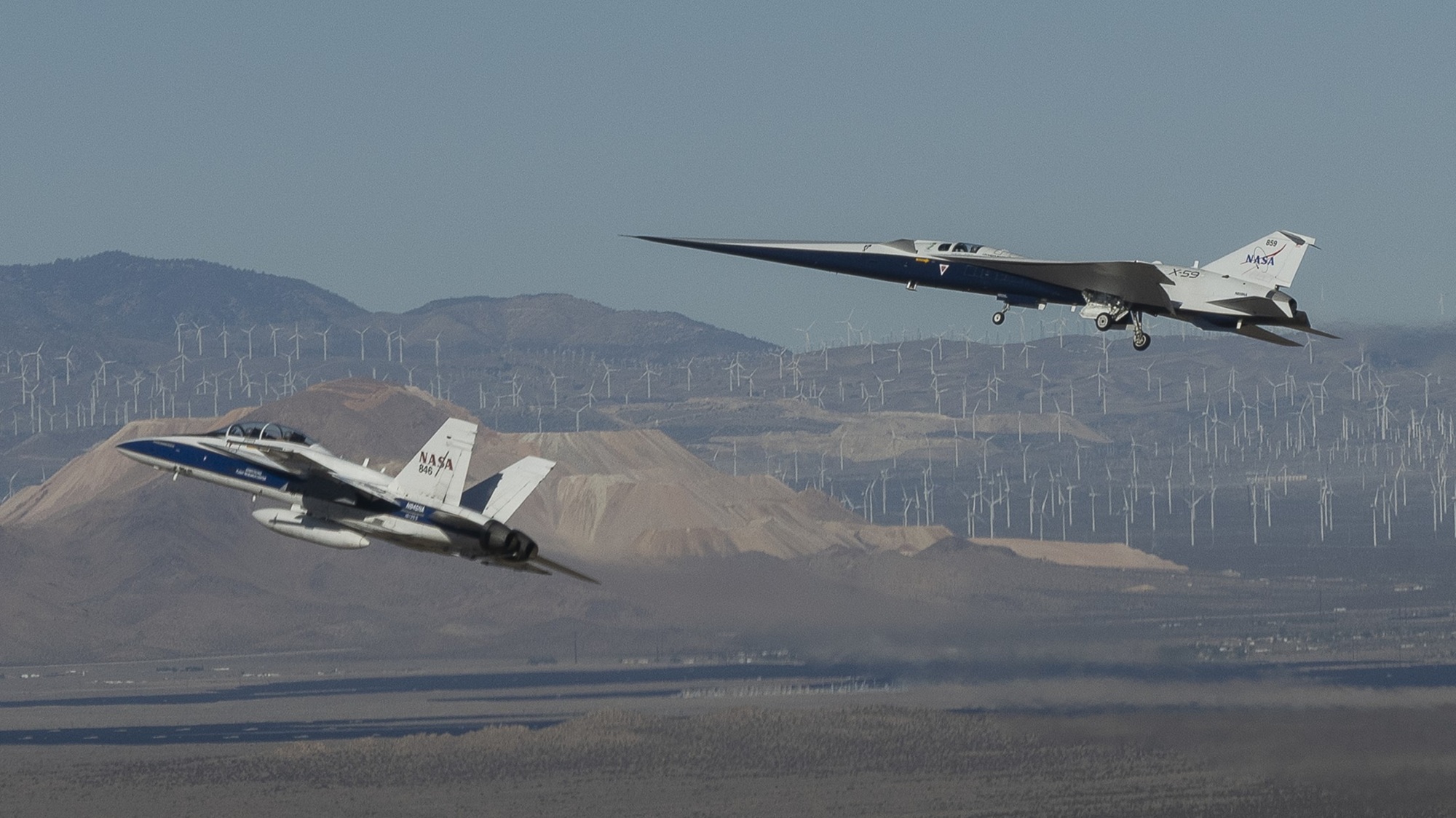
Other factors that are being looked at are the performance of its controls, loads and structural dynamics, and subsystems including hydraulics, fuel, avionics, landing gear, among the others. NASA additionally said it is monitoring the performance of the eXternal Vision System, the system of cameras which replaced the traditional forward windscreen because of the X-59’s long nose.
NASA also described some of the X-59’s maneuvers during its first block of test flights:
-
A rollercoaster maneuver involves a sequence of pitching the aircraft up and down to better understand aerodynamic forces and characterize stability and control.
-
A bank‑to‑bank maneuver is when an aircraft gently rolls from one side to the other, such as tipping its wings right, then smoothly rolling back through level and over to the left.
-
A flutter excitation maneuver introduces deliberate vibrations into the aircraft’s structure during flight to ensure the aircraft’s flutter boundaries are well understood and that its structure maintains safe margins across the flight envelope.
-
A wings-level push maneuver is a controlled, wings-level pitch-down movement used to evaluate the aircraft’s longitudinal stability, pitch response, and trim characteristics at a given test condition.
-
A gear-extend maneuver includes extending the aircraft’s landing gear at a controlled airspeed and configuration so engineers can measure the aerodynamic, structural, and handling qualities of the gear deployment, which can cause sudden changes in drag, pitch, vibration, and airflow. The landing gear retraction was tested as part of X-59’s first block of envelope expansion test flights.
The X-59 Quesst (Quiet SuperSonic Technology) is an experimental supersonic aircraft developed at Skunk Works for NASA’s Low-Boom Flight Demonstrator project. The technologies used on the jet are meant to influence future generations of quiet supersonic aircraft as part of the effort to reintroduce supersonic commercial flight.
The X-59 is, in fact, designed to generate a quieter sonic boom which should be within acceptable noise levels to help the FAA to lift the ban on commercial supersonic travel over land imposed in 1973. According to NASA, the sonic boom generated by the new aircraft will be less than 75 perceived dB on the ground, about a third less than the Concorde, which was reported around 100-110 dB.
A key feature of the aircraft which will allow to achieve this goal is the long tapered nose, which accounts for almost a third of the X-59’s length. The nose is designed to break up the shock waves that would ordinarily result in a supersonic aircraft causing a sonic boom.
NASA’s X-59 quiet supersonic research aircraft flies over the Mojave Desert in California on April 14, 2026. | Source: NASA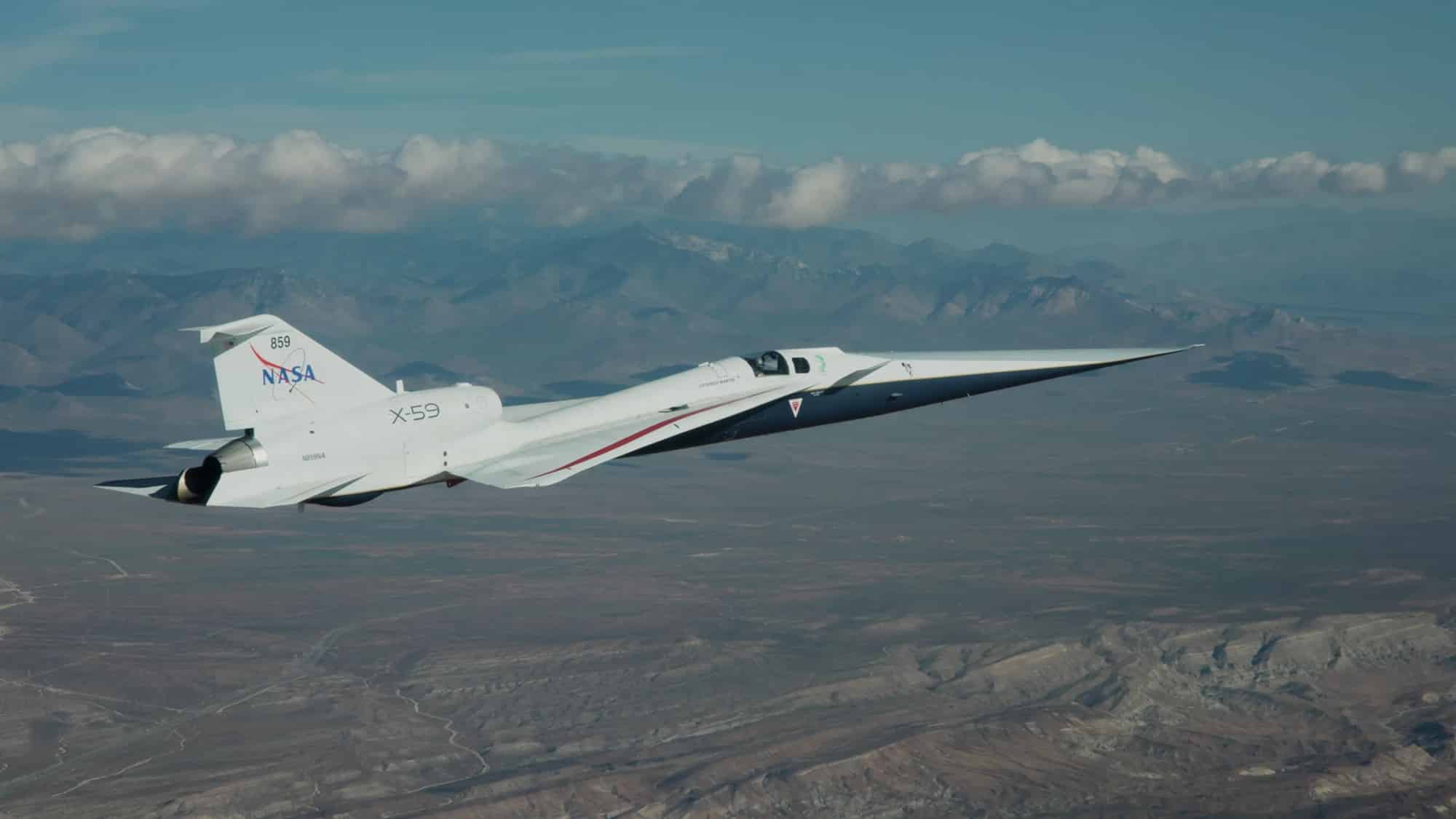
Due to this configuration, the cockpit is located almost halfway down the length of the aircraft, a solution which however does not allow the presence of a traditional windshield. Instead, NASA developed the eXternal Vision System, a series of high-resolution cameras feeding a 4K monitor in the cockpit.
The X-59 is powered by a F414-GE-100 engine with 22,000 pounds of thrust, modified from the F414 used by the F/A-18 Super Hornet. The engine is unusually placed on top of the aircraft to give it a smooth underside, which helps keep shockwaves from merging behind the aircraft and causing a sonic boom.
The X‑59 is equipped with multiple systems designed specifically to protect the pilot, including a life support system to deliver oxygen to the pilot while also powering the g‑suit. As another safety layer, the aircraft features an ejection seat and canopy adapted from a U.S. Air Force T‑38 trainer, outfitted with essentials such as a first aid kit, radio, and water.
Categories: Defence`s Feeds, Kelet-Közép-Európa
Pages


© 2012-2018 Europa Varietas Foundation © 2015-2018 Europa Varietas Association
www.europavarietas.org | info(@)europavarietas(dot)org | Switzerland


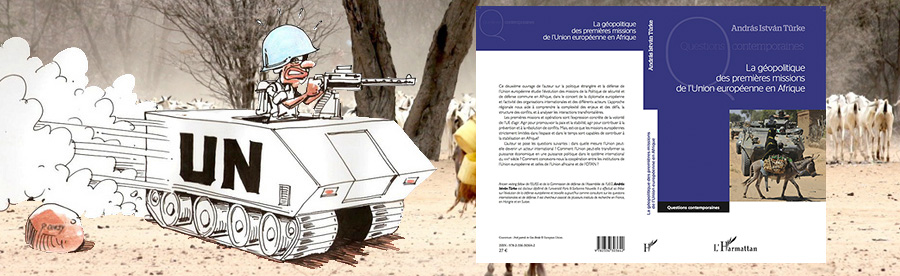

We are looking for sponsors for the English translation of these books, please contact turkeandras(at)gmail(dot)com