
You are here
Feed aggregator
Perspectives on Switzerland's net-negative target after 2050
Categories: Diplomacy & Defense Think Tank News
D'abord la CAN, puis la Coupe du monde : le Sénégal pris au piège dans « l'enfer du football »
L'année cauchemardesque du Sénégal se poursuit, avec un effondrement déchirant face à la Belgique, marqué par un penalty dramatique en fin de match qui rappelait étrangement les événements de la finale chaotique de la Coupe d'Afrique des nations de cette année.
Categories: Afrique
Schattenflotte: Warum Russland verstärkt auf eigene Flagge setzt
Russland will mehr Tanker unter eigener Flagge fahren lassen. Der Strategiewechsel ist eine Reaktion auf wachsenden internationalen Druck – und soll Festsetzungen erschweren. CDU und Grüne fordern stärkere Kontrollen, um gegen die Schattenflotte vorzugehen.
Categories: Diplomacy & Defense Think Tank News
Taiwan’s Drone Industry Takes Centerstage in Defense Spending Debate
Funding for drones became much more hotly discussed in the wake of KMT chair Cheng Li-wun’s trip to the United States last month.
Categories: Diplomacy & Crisis News
Where Do Japan and Vietnam Stand?
A look at the bilateral relationship, and its future direction.
Categories: Diplomacy & Crisis News
Why Corruption Persists in Uzbekistan’s Water Sector
Real reform in the water sector means building a system that makes corruption harder to commit, easier to detect, and less rewarding for those who might try.
Categories: Diplomacy & Crisis News
Reckoning With the Evolving China-Russia Threat
Don't underestimate the China-Russia partnership; Beijing and Moscow have already cooperated in ways that seemed unthinkable not long ago.
Categories: Diplomacy & Crisis News
The Cyprus Presidency of the Council of the EU : An Assessment in a Time of Geopolitical Turmoil
Cleopatra Kitti, Senior Policy Advisor to ELIAMEP and Founder of the Mediterranean Growth Initiative, offers a review of Cyprus’s Presidency of the Council of the European Union, which concluded a few days ago.
Read the ELIAMEP Explainer here.
Categories: Diplomacy & Defense Think Tank News
Inside the 20th Squadron, Italy’s Eurofighter Operational Conversion Unit
An exclusive look inside the Italian Air Force’s Typhoon Operational Conversion Unit, where pilots are trained through advanced simulation, live flying and progressive tactical training.
Grosseto Air Base has been the home of the Italian Air Force’s 4th Wing for more than 60 years, serving as one of the service’s most prestigious and operationally demanding fighter units. From this strategic base, located about 94 miles (151 km) to the northwest of Rome, the Italian Eurofighter Typhoons maintain round-the-clock Quick Reaction Alert (QRA) duties, ensuring the round-the-clock protection of both Italian and NATO airspace.
The base is also home to the 20th Squadron – Operational Conversion Unit (20° Gruppo OCU), where pilots complete the final phase of their training before joining frontline Eurofighter Typhoon squadrons. Equipped with advanced simulators and cutting-edge training technologies, the unit plays a fundamental role in preparing aircrews for the complex operational environment they will encounter.
We had the opportunity to visit both the 4th Wing and the 20th OCU, gaining first-hand insight into their daily activities and talk with instructors, pilots and support personnel. Our visit revealed how the M-346 Master (T-346 according to the ItAF designation) has fundamentally transformed the Italian Air Force’s fighter training system: rather than simply introducing a new advanced trainer, the aircraft has reshaped the entire training pipeline, allowing many tactical and operational skills to be acquired earlier in a pilot’s career.
The “twin-stick” Eurofighter during taxi before a training sortie at Grosseto Air Base. | Source: Nicolò Teta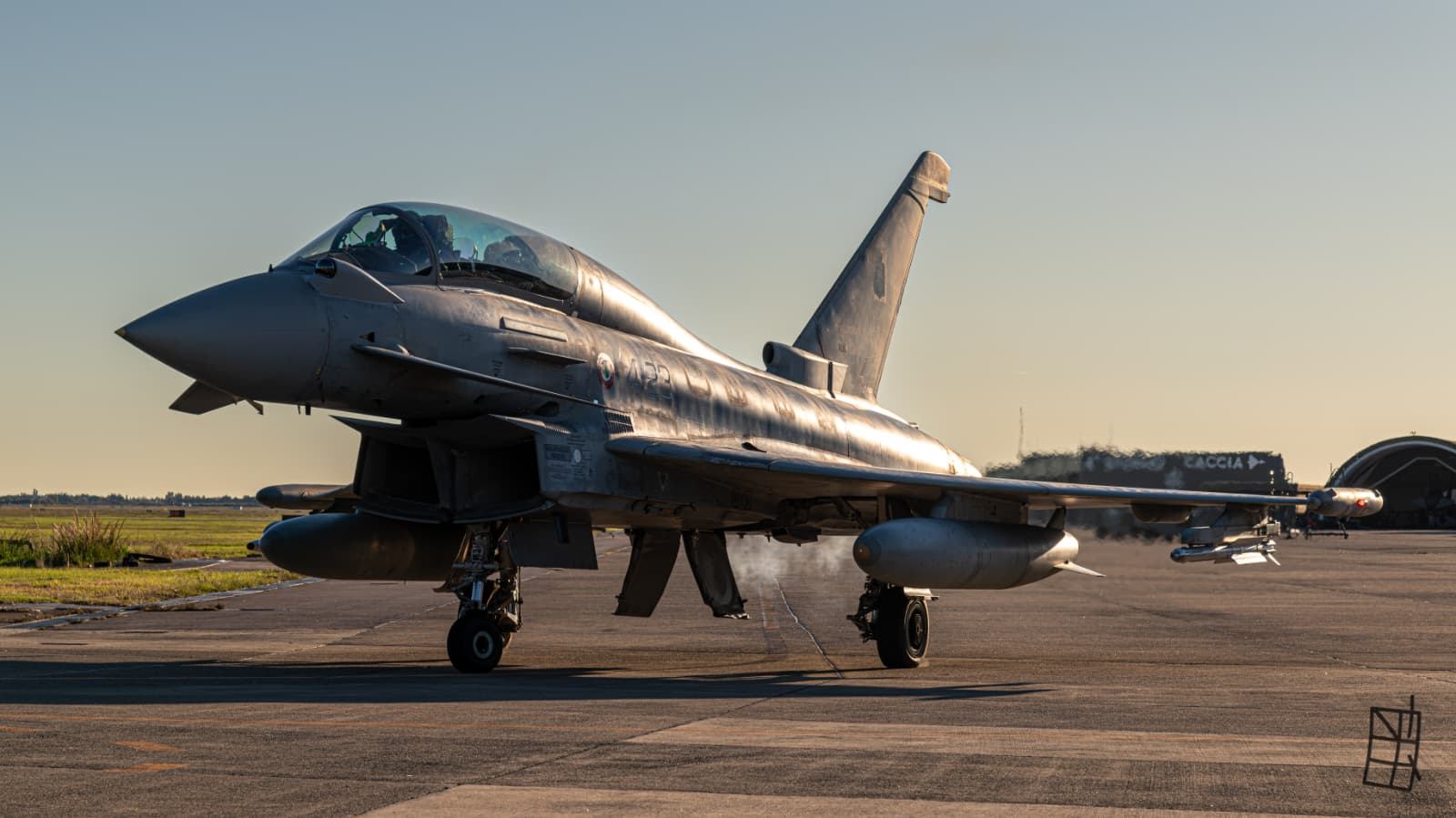
During our discussions with instructors and trainee pilots of the 20th OCU, we explored how this evolution has streamlined the transition to the Eurofighter Typhoon (F-2000A in accordance to Italy’s MoD Mission Design Series). By integrating advanced simulation, embedded training systems and a more progressive syllabus, today’s conversion course enables pilots to arrive on the frontline better prepared, making the transition to one of Europe’s most capable multirole fighters more effective than ever before.
Before the M-346: A Leap into the UnknownBefore the introduction of the M-346, pilots arrived at the 20th Squadron after completing advanced training on the MB-339CD or through international NATO programs such as the Euro NATO Joint Jet Pilot Training (ENJJPT).
An MB-339CD of the Italian Air Force, currently used for Phase III training by the 213th Squadron at Lecce Air Base. | Source: Italian Air Force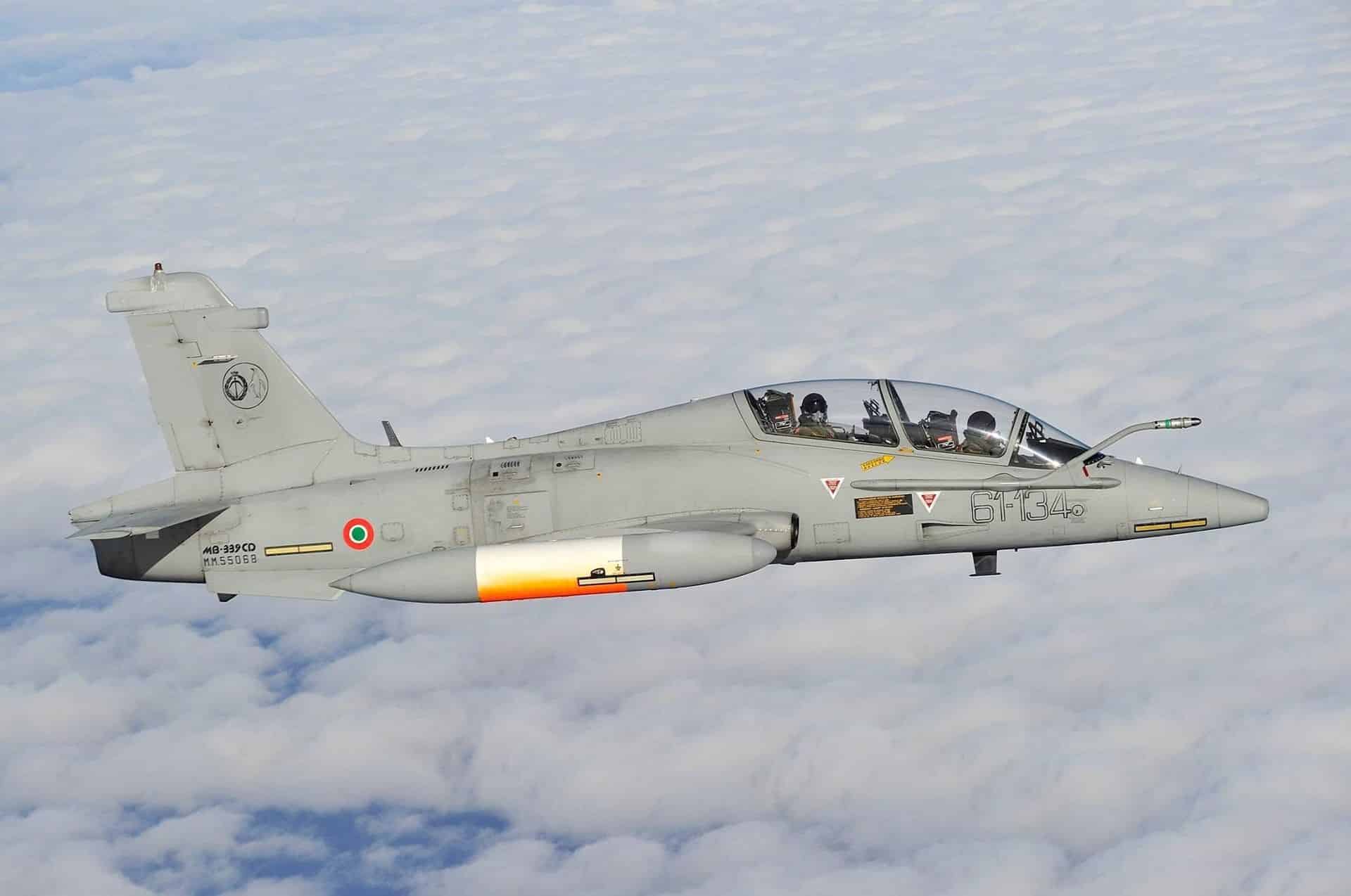
The greatest challenge was entering the world of modern combat systems. Radar operations, sensor management, tactical data fusion, and the interpretation of multifunction displays were entirely new concepts that had to be learned directly during operational conversion on the Eurofighter.
“Once pilots had mastered takeoffs and landings, the real challenge was learning to operate systems they had never encountered before,” explained an instructor.
As a result, numerous sorties were dedicated solely to learning procedures and familiarizing students with the aircraft’s onboard sensors, inevitably slowing progression toward more advanced tactical employment.
The LIFT RevolutionThe introduction of the M-346 and the Leading to Fighter Training (LIFT) concept has allowed the Italian Air Force to completely redesign its fighter training pipeline. Thanks to the aircraft’s capabilities and the seamless integration of advanced simulation with live flying, students now experience training events during their course at the 212th Squadron of the 61st Wing at Decimomannu Air Base that were once reserved exclusively for Eurofighter operational conversion.
An M-346A during a performance climb. | Source: Nicolò Teta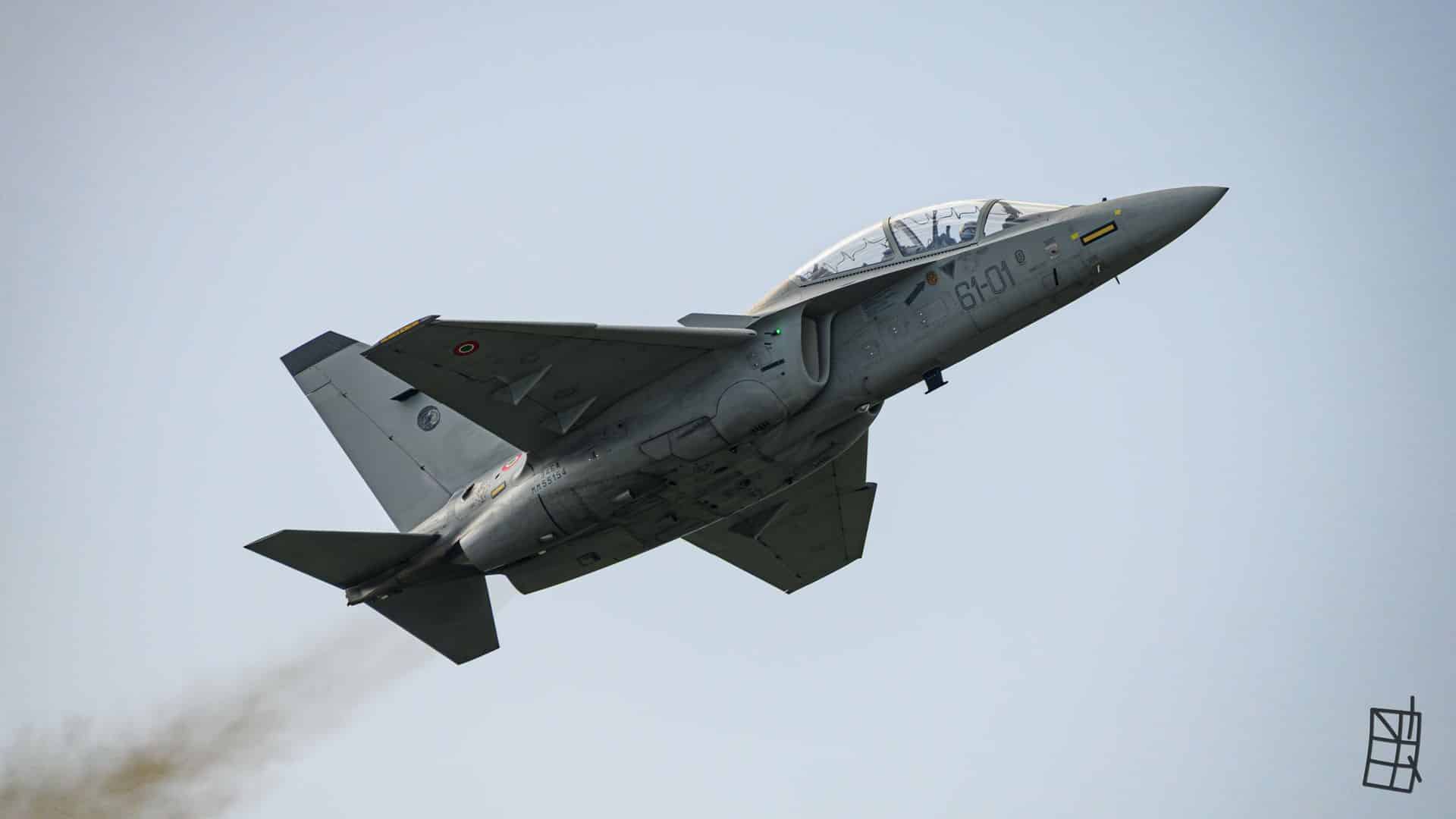
Radar intercepts, Beyond Visual Range (BVR) engagements, air-to-air combat, sensor management, simulated weapons employment, and tactical mission execution are now mastered well before pilots arrive at the OCU. The result has been a substantial shift of the training workload to earlier phases of pilot development.
“Today’s students arrive with a much stronger foundation than in the past,” the instructor explained. “This allows us to devote more time to advanced operational skills and the multirole capabilities that define today’s Typhoon.”
From Flight School to the Eurofighter: A Progressive Learning CurveFrom the students’ perspective, arriving at the 20th Squadron is no longer the dramatic leap it once was. By the time they begin OCU training, pilots already possess years of experience, hundreds of flight hours, and a solid aviation culture developed throughout their training career.
An Italian Air Force Eurofighter Typhoon begins its take-off roll at Grosseto Air Base. | Source: Nicolò Teta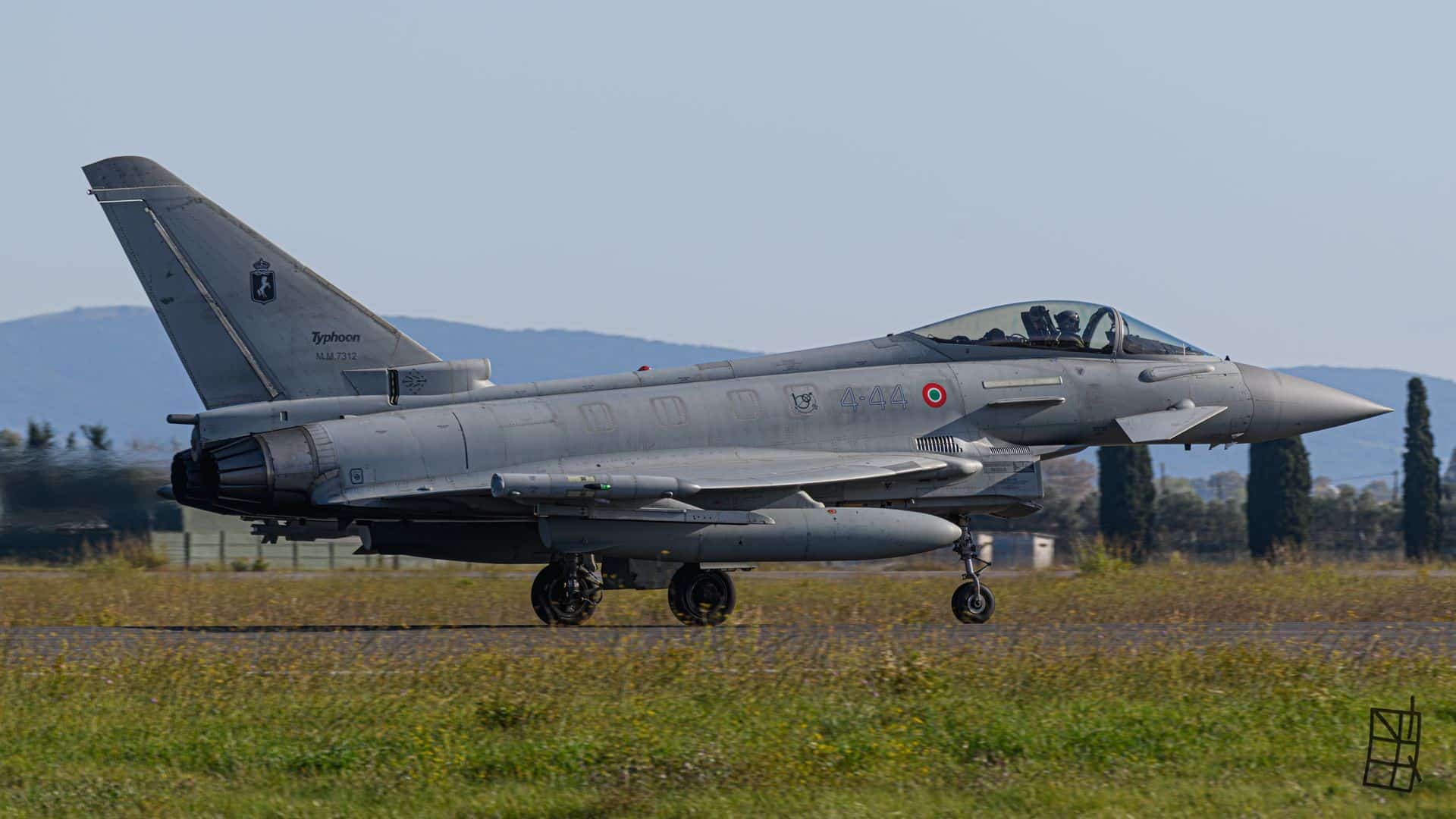
“The impact is certainly significant, but it’s no longer a leap into the unknown,” one trainee told us. “The fundamentals of airmanship and mission management have already been built over the previous years.”
The Eurofighter introduces higher levels of performance, more sophisticated systems, and greater responsibility, but many of the underlying concepts have already been assimilated during training on the M-346.
The Eurofighter Typhoon: From Air Superiority to Swing Role OperationsOriginally conceived as an air superiority fighter designed to defend national airspace, the Eurofighter Typhoon has progressively evolved into a swing role platform capable of switching between air-to-air and air-to-ground missions within the same sortie.
Two Eurofighter Typhoon aircraft from the Italian Air Force’s 4th Wing performing a high-performance manoeuvre with reheat selected. | Source: Leonardo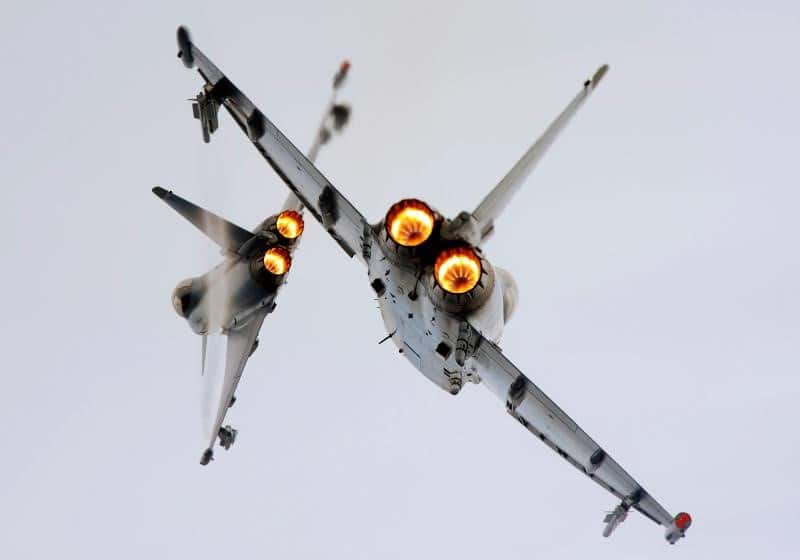
Powered by two Eurojet EJ200 afterburning engines, it can reach Mach 2 and sustain supersonic flight without afterburner in supercruise conditions. Its delta wing with canard foreplanes, combined with a fully digital fly-by-wire control system, provides exceptional agility and high-performance handling across the entire flight envelope.
With a length of 15.96 metres, a wingspan of 10.95 metres and a maximum take-off weight of 23,500 kilograms, the aircraft carries its weapon load on thirteen hardpoints, in addition to a 27 mm Mauser BK-27 internal cannon. Continuous upgrades in software, sensors and precision weapons have transformed the Typhoon into a true multirole combat system, capable of conducting air policing, strike missions and tactical reconnaissance with high effectiveness.
The twin-seat “Twin Stick” variant complements the operational fleet, playing a key role in training and conversion while retaining the majority of combat capabilities of the single-seat version.
Ground School: Building the FoundationThe course begins with an intensive Ground School phase. Days are filled with classroom instruction, individual study, and in-depth analysis of the aircraft’s technical documentation. Students spend countless hours learning the aircraft’s systems, procedures, and operational philosophy.
The entrance hall of the 20th Operational Conversion Unit, where the squadron’s heritage, from the iconic F-104 Starfighter to the Eurofighter Typhoon, is proudly preserved. | Source: Nicolò Cerantonio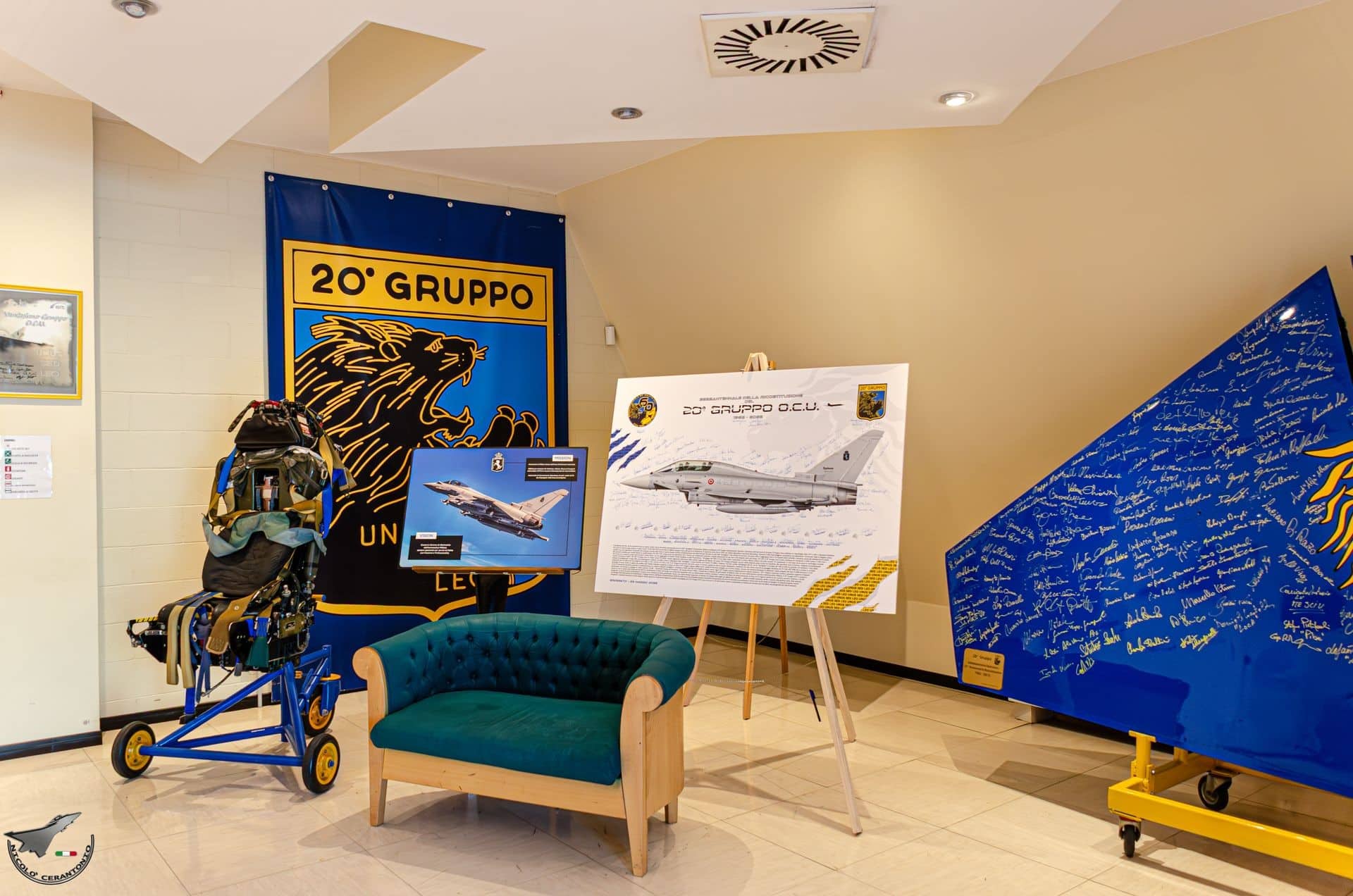
Throughout the academics, trainees are also supported by Leonardo’s instructor pilots and training personnel, who contribute to the Italian Air Force’s Eurofighter pilot programme. Working alongside the military instructional staff, they provide operational expertise and continuous guidance at every stage of the academic phase.
During this phase, instructors assess far more than technical knowledge. Professional attitude, discipline, commitment, motivation, and the ability to apply knowledge are considered just as important as technical competence.
According to the instructors, attitude is often every bit as important as technical ability.
The Gentex ACS (Aircrew Combat System) helmet with the iconic 20th Squadron helmet cover. | Source: Italian Air Force Simulation and Live Flying: An Essential Partnership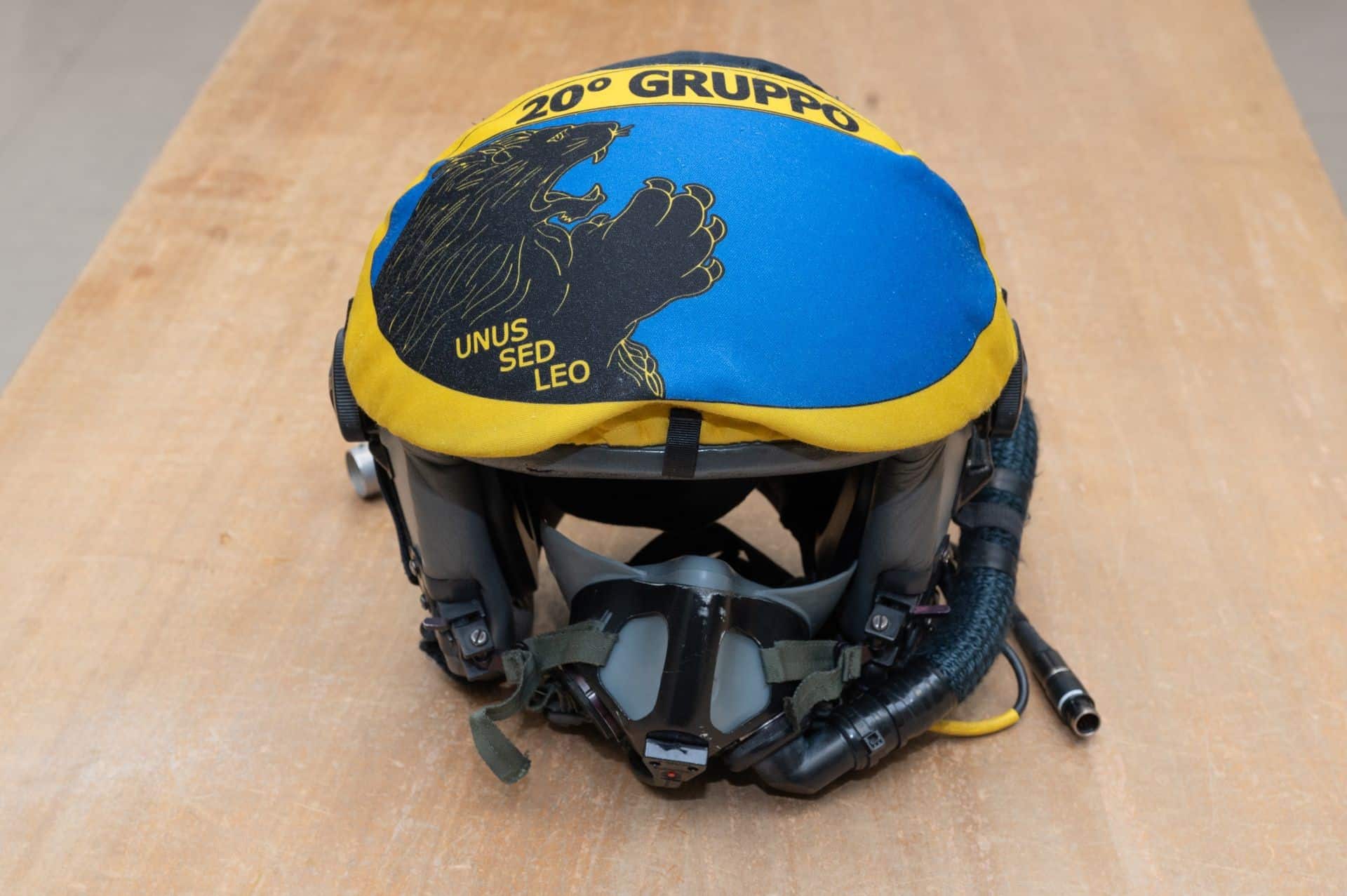
One of the cornerstones of modern fighter training is the simulator. Before ever flying the Eurofighter, students spend many hours in the Aircrew Synthetic Training Aids (ASTA) building at Grosseto Air Base, an integrated simulation environment that supports the Italian Air Force’s Eurofighter training programme.
The ASTA facility is co-located within the same building that also houses the 20th Operational Conversion Unit, ensuring full integration between simulator-based training and the operational conversion syllabus. The system employs three complementary simulator categories: the Cockpit Trainer (CT), the Full Mission Simulator (FMS), and the Enhanced Aircrew Cockpit Procedures Trainer (EACPT), each designed to progressively develop procedural knowledge, systems management, tactical awareness, and mission execution.
The importance of simulation within the training environment is also reflected in the motto displayed on the ASTA building at Grosseto Air Base: “Simulatione siderum tenus”, inspired by the traditional Air Force motto “Virtute siderum tenus”. The phrase encapsulates the role of simulation as a bridge between classroom learning and real-world operational readiness.
By the time they step into the real aircraft, the cockpit environment, procedures, and aircraft systems already feel familiar. However, even the most advanced simulator cannot fully reproduce every variable encountered in the real world.
Technical malfunctions, civilian air traffic, changing weather conditions, and the complexity of the operational environment demand decision-making skills that extend beyond simply following procedures. It is during this phase that a pilot’s professional maturity truly begins to emerge.
From Conventional Controls to Fly-by-WireAnother major evolution in training concerns digital flight control systems. The M-346 introduces students to fly-by-wire logic and Flight Control Computer management long before they transition to the Eurofighter.
“Students now arrive with a level of sensitivity that previous generations had to develop directly on the Typhoon,” said an instructor.
The advanced trainer’s performance also exposes students to high G-loads, rapid acceleration, and flight dynamics that closely resemble those of a modern frontline fighter.
Inside the cockpit of a Eurofighter Typhoon during a training sortie, showing the pilot’s in-flight working environment. (Image credit: Italian Air Force) | Source: Italian Air Force The Real Radar Remains One of the Greatest Challenges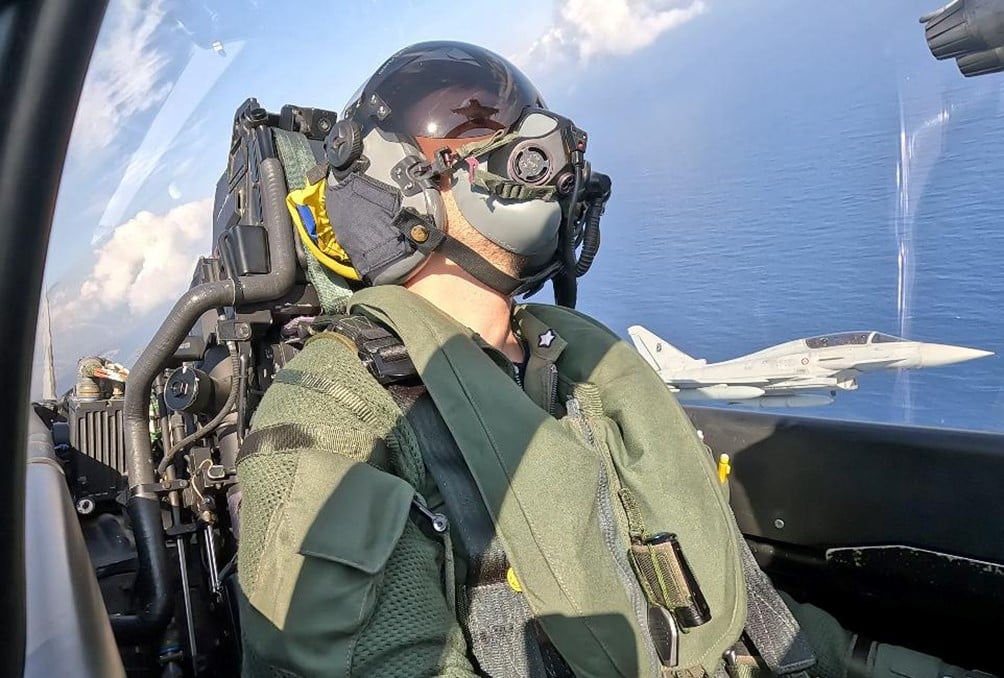
Despite remarkable advances in simulation, transitioning from a simulated radar to the real system remains one of the most demanding aspects of operational conversion.
Synthetic scenarios are carefully controlled and predictable. In the real operational environment, pilots must deal with a much larger volume of information and with phenomena that cannot be perfectly replicated.
Correctly interpreting radar returns, identifying contacts, and maintaining high levels of situational awareness remain among the most challenging elements of fighter conversion training.
[Read also: First hand account: Flying the Eurofighter Typhoon in the Aggressor role during supersonic air combat training]
From Instruction to IndependenceAs training progresses, the instructors’ role gradually evolves. Initially, they guide students step by step through every procedure.
Later, the emphasis shifts toward developing independent decision-making. Rather than simply evaluating whether a decision was correct, instructors seek to understand the student’s reasoning process, even when the outcome is less than perfect.
The objective is not to produce pilots who merely execute procedures, but professionals capable of analysing complex situations, accepting responsibility, and making sound decisions under pressure. Throughout this journey, the instructor-student relationship gradually develops into one of genuine professional mentorship.
A Eurofighter Typhoon executing a “gate climb” in QRA configuration. | Source: Nicolò Teta The Emotion of the First Solo Flight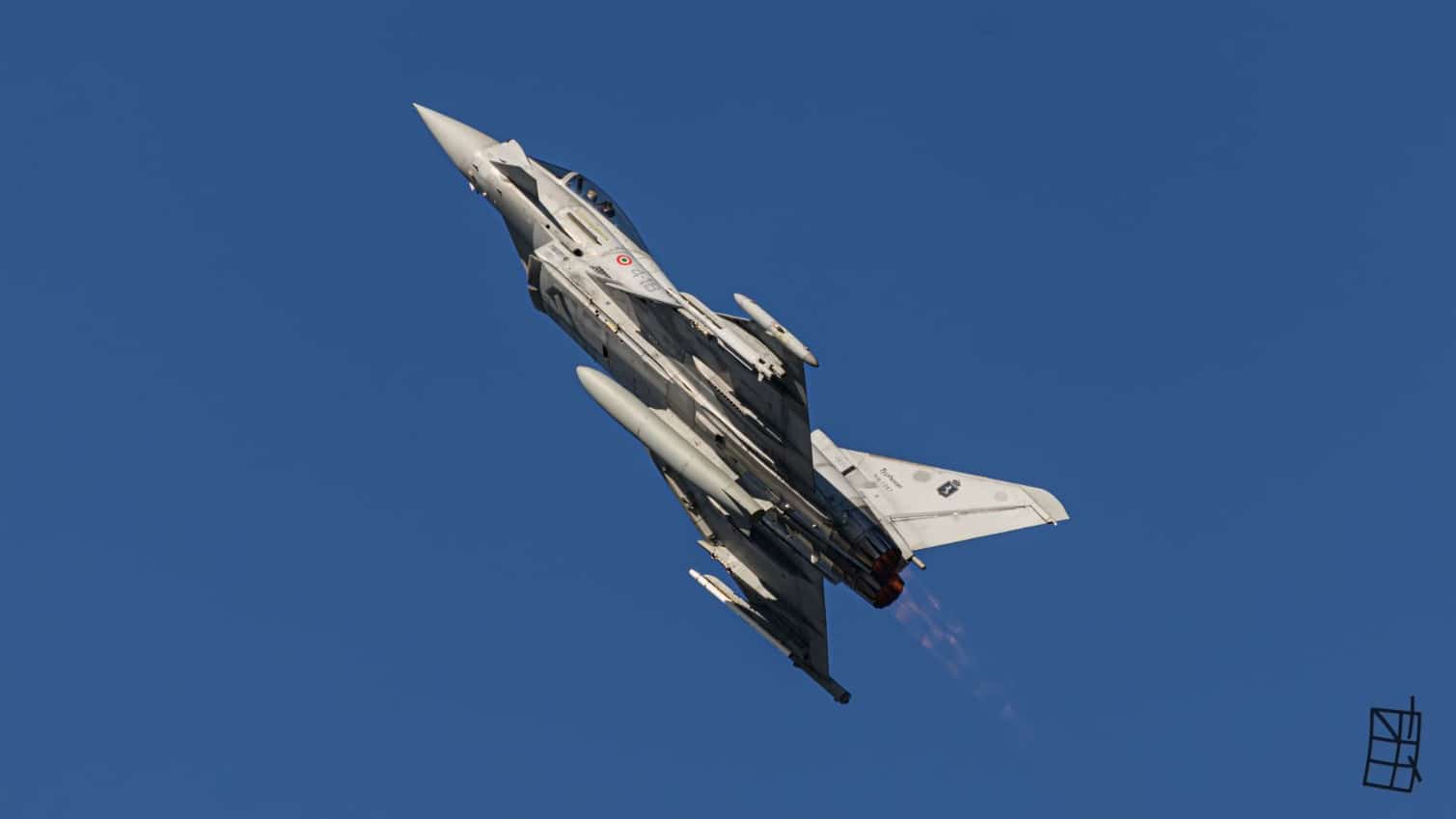
One of the defining moments of the entire training program is the first solo flight. After weeks of flying alongside instructors, students suddenly find themselves alone in the cockpit.
The initial tension is inevitable, but it quickly gives way to confidence. Everything that has been studied, rehearsed, and practiced in the simulator begins to feel natural.
Pilots gradually develop trust in their own abilities and build the confidence required for operational independence. For many, it becomes one of the most memorable and rewarding moments of their entire career.
Close Air Support and Joint OperationsAmong the most significant additions to the modern syllabus is Close Air Support (CAS) training. These missions are conducted in close cooperation with Joint Terminal Attack Controllers (JTACs) from both the Italian Army and the Italian Air Force.
A Joint Terminal Attack Controller (JTAC) coordinates a Close Air Support (CAS) mission, likely transmitting a Nine-Line brief to the supporting aircraft. | Source: Italian Air Force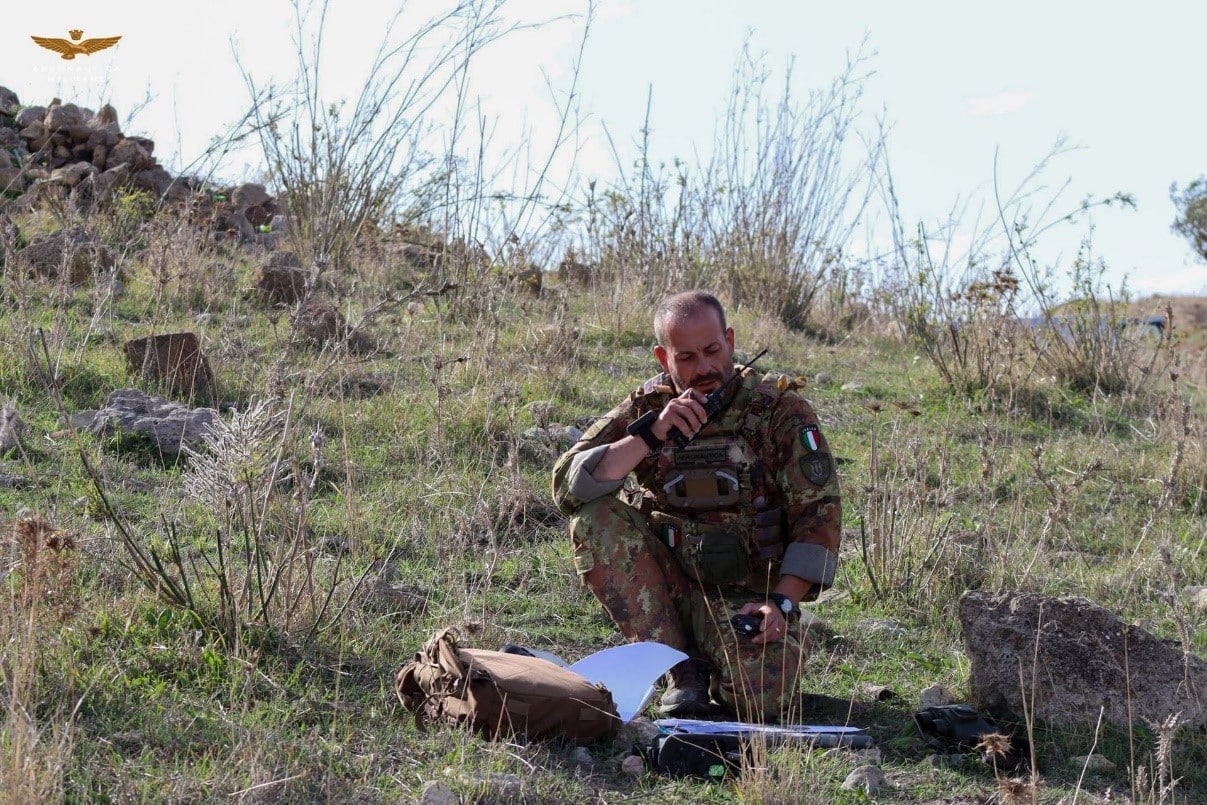
This allows future fighter pilots to better understand the needs of ground forces while developing a broader perspective of the modern battlefield. “It’s essential to understand what the personnel on the ground see, while also helping them understand how we interpret the situation from the air,” said an instructor.
This approach strengthens interoperability among the different services and enhances overall operational effectiveness.
Learning from MistakesNot every challenge encountered during training is technical. Many young fighter pilots are highly self-critical after a mission that falls short of perfection.
For this reason, learning how to deal constructively with mistakes forms an essential part of the training process. Mission debriefings analyse every detail of the sortie, allowing students to understand what happened and identify opportunities for improvement.
“The ability to move forward after making a mistake is one of the most important qualities a military pilot can develop,” said an instructor. It is a lesson that proves invaluable not only in flight, but throughout an entire professional career.
The Fulfilment of a DreamThe ultimate goal of the course is achieving Limited Combat Readiness (LCR) qualification before joining an operational squadron. For every student, this represents the culmination of a journey that began many years earlier—a path built on study, sacrifice, determination, and continuous professional growth.
A Eurofighter Typhoon prepares for a training sortie at Grosseto Air Base, with the iconic hangar of the Italian Air Force 4th Wing (4° Stormo Caccia) visible behind. | Source: Nicolò Teta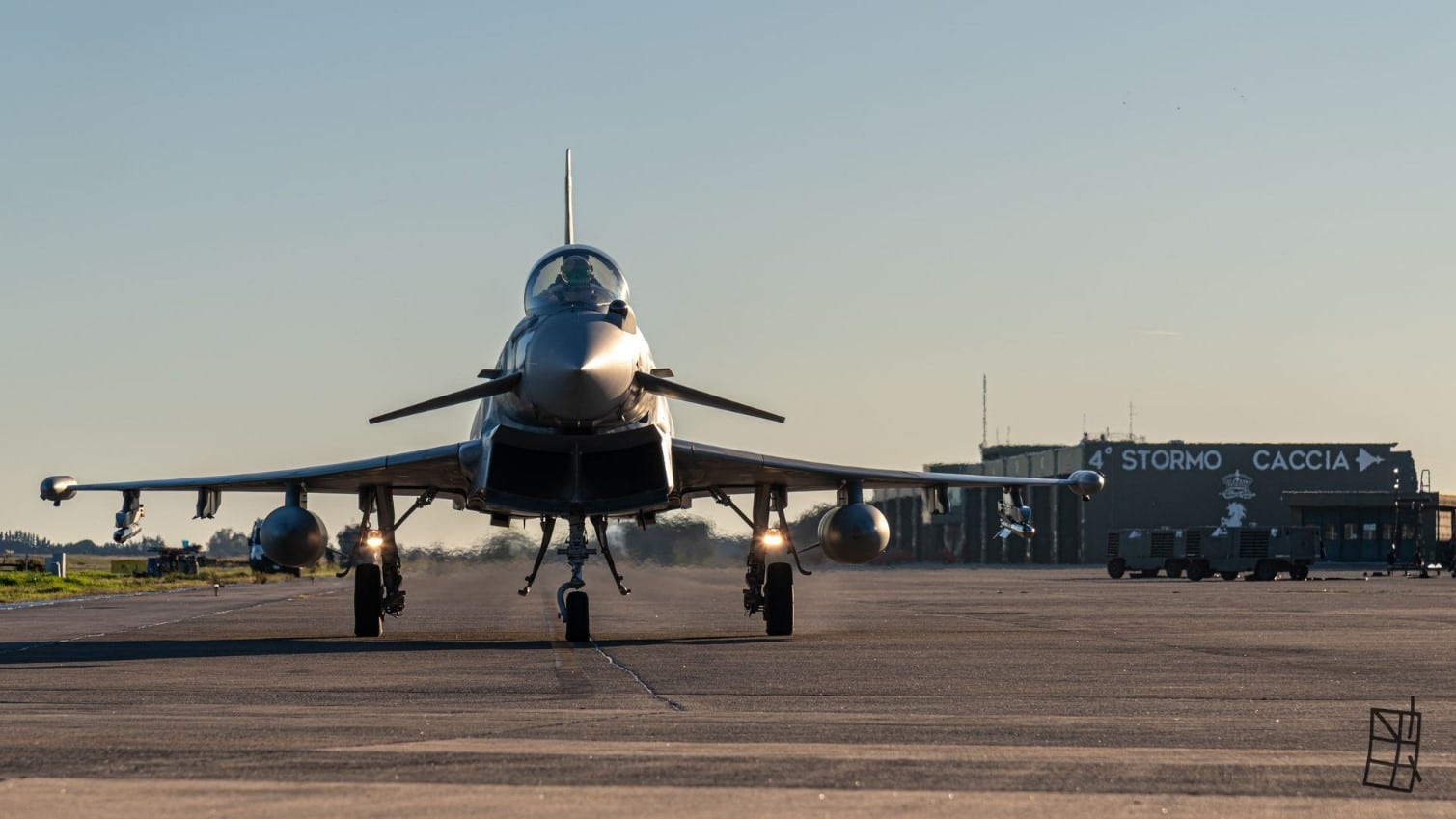
Looking back, many recognize that the course has transformed them not only as aviators but also as individuals. The Eurofighter represents the pinnacle of their training, yet it also marks the beginning of a new chapter.
Because becoming a fighter pilot is about far more than learning to fly a high-performance aircraft. It means joining a professional community entrusted every day with safeguarding national airspace through competence, responsibility, and a deep sense of service.
In an era where technology continues to evolve at an extraordinary pace, one element remains unchanged: the value of people. It is through the combination of innovation, the experience of instructors, and the determination of students that the next generation of Italian Air Force fighter pilots is being forged.
Categories: Defence`s Feeds
Mahrang Baloch’s Conviction is a Pyrrhic Victory for the Pakistani State
They may have locked up a popular and powerful activist. But this will only convince more Baloch that there is no space for political protest or dissent.
Categories: Diplomacy & Crisis News
UN Artificial Intelligence Panel Launches Report Ahead of Global Conference
UN Secretary-General António Guterres at the launch of the preliminary report from the UN Independent Panel on AI. Credit: UN Photo/Mark Garten
By Naureen Hossain
UNITED NATIONS, Jul 2 2026 (IPS)
The acceleration of artificial intelligence (AI) and its capabilities is far outpacing governments’ capacities to effectively regulate it. Without scientific evidence to inform their policies, countries will be left at a greater disadvantage, according to the UN’s independent panel on AI.
The UN Independent International Scientific Panel on Artificial Intelligence officially released its Preliminary Report on July 1. This is the Panel’s first global, independent scientific assessment on the opportunities, risks and impacts presented by AI. This early report work from the Panel is expected to provide a foundational evidence base to inform global policy ahead of its first comprehensive report in 2027.
The collaborative effort to build a shared understanding of AI has reached a crucial stage. Governments are making consequential decisions about AI under great uncertainty with rapidly changing, often conflicting sources of evidence and perspectives that do not necessarily reflect local realities. As AI capabilities continue to grow, the stakes for decisions made around the world are also increasing.
The preliminary report was produced by a panel composed of 40 leading experts from across multiple disciplines and every region of the world. Its members, which include the likes of computer scientists, economists, academics and human rights experts, serve in their personal capacity, independent of any government, company or institution. The report’s findings will be presented to governments at the inaugural UN Global Dialogue on AI Governance, convening in Geneva, Switzerland on 6 and 7 July.
The timing of the Panel’s report and the upcoming AI conference represents a turning point for where AI is at, according to Yoshua Bengio, one of the co-chairs of the Panel.
“It’s about the growing intelligence of machines,“ said Bengio, the renowned computer scientist who is the co-president of LawZero and founder of Mila. “You have to realise that intelligence gives power. As that power grows, it can unlock great benefits if we act wisely. But it can also lead to many perils.”
On July 1, Bengio and fellow co-chair of the panel Maria Ressa, journalist and Nobel Peace Prize winner, briefed reporters virtually on the report and the Panel’s work since it convened earlier this year. The co-chairs emphasised that the report does not give policy recommendations on the best practices for AI governance. Instead, Bengio said the policies should meet the “highest standards of scientific integrity.”
When asked about why the Panel could not make policy recommendations, Bengio remarked that their work would become very politicised and would “pollute” the Panel’s ability to “provide scientific evidence”.
Ressa added that while the differences were evident between the panel members, they found a shared language in pursuing the science behind AI. It was also where they could align in their work. “The tech has torn us apart in different realities. What the report will hopefully do for member countries of the UN is to come and bring us together to the same reality,” said Ressa.
Among the key takeaways from the report, what is clear is that in recent years, AI capabilities have accelerated, as has its adoption across multiple sectors and in societies. Currently, its advancements far outpace governments’ capacities to understand it, let alone regulate it. The decision-makers need scientific evidence to effectively govern AI, which should rise. Without this evidence, policy is weakened
The report states that AI holds “significant potential” to advance development across multiple sectors such as health, education and food production. To take advantage of that potential requires tailoring it to local contexts, institutions and user needs. The integration of AI in the health and agriculture sectors makes a case for its positive contributions, especially in the context of the Global South, where evidence has emerged of its use in these spaces. They are more effective when adapted to local contexts and when human workers are trained to use them.
With that said, countries vary in their adoption and usage of AI. The use and access of AI across the Global South lags behind the Global North, according to the report. 118 countries, predominantly in the Global South, are not engaged in major AI governance discussions, and less than one-third of developing countries have developed national AI strategies. The report warns that the Global South is disproportionately exposed to the misuse of AI due to limited capacity for mitigation and limited frameworks for influencing AI development and capacity building. The inputs and outcomes of AI also show linguistic unevenness. Existing AI model infrastructures train on only a fraction of the over 7,000 languages spoken around the world.
A select few countries concentrate AI development and computing capacity. The report shows that of the 500 largest-known public and private AI compute clusters, 75 percent were located in the United States, 15 percent in China, and 10 percent for the rest of the world. Much of the development of AI models is further concentrated in a handful of companies; 91 percent of notable AI models originated from the private sector. U.S. institutions produced 59 known AI models, compared to China’s 35 and an additional 13 from the rest of the world.
This is indicative of existing disparities when it comes to technological developments and may reinforce inequalities between developed and developing countries. This raises the risk for power to be concentrated to a select few individuals and states to shape the standards around AI. This concentration of power may then further affect economic power, military power and the power to influence public opinion.
“A handful of companies and a handful of countries are making the most consequential decisions about humanity’s future,” said Ressa.
On top of that, AI usage can challenge our shared reality. With the ease of generating and disseminating AI-generated textual and visual content, this blurs the line between what was manually created and what has been created with AI tools. This also presents complications when AI is used to create and spread deceptive, manipulated information intended to undermine institutions of information, which can have adverse effects on civic participation and democratic institutions. There is also demonstrable evidence that suggests that AI harms disproportionately affect minority communities due to limited frameworks around the training and application of AI systems.
Bengio noted that the report recognises multiple possibilities for where AI development could be headed due to the rapid acceleration and integration, although it is hard to predict where it will go. It may continue to grow exponentially, at which point it will exacerbate the gaps in AI’s capabilities and the societal risks without sufficient oversight or governance. Alternatively, AI capabilities could reach a plateau, according to Bengio, which would make AI less powerful and would give other countries more time to catch up with their expansions.
It is with these factors in mind, within the current AI landscape that begs urgent action, that governments will convene in Geneva next week for the Global Dialogue on AI Governance. There are steps that member states can take to close the gaps identified by the independent panel and other experts, not to mention a sense of urgency and duty to enact policies that will protect the human rights of their citizens. But it will require sustained commitments from member states.
“The more AI advances without shared rules, the less say governments and people will have in the outcome. So my message to governments is simple: Do not wait,” said UN Secretary-General António Guterres. “The Summit of the Future asked whether international cooperation could keep pace with the speed of technology. Today offers one answer. The science is here. We can no longer say we did not know. What we do with it is now up to all of us.”
IPS UN Bureau Report
Follow @IPSNewsUNBureau
!function(d,s,id){var js,fjs=d.getElementsByTagName(s)[0],p=/^http:/.test(d.location)?'http':'https';if(!d.getElementById(id)){js=d.createElement(s);js.id=id;js.src=p+'://platform.twitter.com/widgets.js';fjs.parentNode.insertBefore(js,fjs);}}(document, 'script', 'twitter-wjs');
Categories: Africa
What Presenting My First Empirical Chapter Taught Me
I presented at the Latin American Studies Association congress in Paris in May on a panel titled “Mexico in Global Competition.” LASA is the largest scholarly association in the world for the study of Latin America, with over 13,000 members and an annual congress running to several hundred sessions across disciplines working on the region. This was the first time I had attended a LASA Congress, though it was not my first conference, and the conference was exactly the mix I had hoped for: historians, political scientists, and practitioners, several career stages in the same panel slots, all genuinely curious about each other’s work rather than waiting their turn to speak.

Jess Gosling at LASA 2026
I had been planning for this moment for a while, So, rather than writing chapters in isolation and looking for conferences afterwards, I tried to align each chapter of my thesis with a conference, where I could test out the thesis of each chapter properly, in front of people who knew the region itself, rather than just the theory alone. My Mexico chapter is the first empirical chapter of my thesis, assembled from fieldwork completed at the British Embassy in Mexico City in July 2025. Paris was the first time I had presented a full empirical chapter, rather than a conceptual paper, outside that of my own seminar room.
My PhD chapter argues that UK soft power in Mexico operates through individuals and relationships rather than being driven by state projection: drawing on interviews with both British officials working in Mexico and locally employed Mexican staff from the embassy. A panel the day before mine had spent an hour on nineteenth-century postal diplomacy and contemporary trade negotiations with a level of regional expertise that sharpened my sense of what a rigorous account of Mexico would require. The questions after my own paper pushed in the same direction: people wanted to know more about how the Mexican staff I interviewed experienced these dynamics, and where the line sits between genuine co-production and something more asymmetric. Those are exactly the type of questions I wanted my chapter to be answering well and hearing them from people who study Latin America for a living informed me precisely where my argument still needed more weight.
What struck me the most was how supportive that scrutiny felt. Nobody was trying to catch me out. They treated a PhD chapter with just the same careful attention and worthiness as anyone’s else’s paper, with several people, among the audience being academics from Mexico, Argentina, and Spain, who all stayed afterwards to talk through specific points with me, and asked about the comparative chapters still to come on South Korea and Poland. I left with a growing list of people whose work I now wish to follow, contacts who feel less like networking and more like the start of an actual research community.

Jess Gosling Presenting at LASA
My paper itself was in English (as was my presentation), but the corridor conversations afterwards were not always, and that felt like its own small milestone, one I am still a little proud of. When I started the PhD, I could barely hold a conversation in Spanish. Talking through my own ideas in Spanish with some Portuguese with people I had met, even haltingly, mattered more to me than I expected.
The other community came from somewhere I had not planned for at all. I fell in, almost by accident, with a group of Brazilian PhD students on the first afternoon, and they adopted me for the rest of the week, talking me through the conference over dinner and breakfasts some mornings. Most of them were historians working on questions far from mine, but this did not matter.

Jess with PhD Students she met at LASA
I went on my own, out of curiosity. During gaps in my schedule, to panels on Brazil’s foreign policy and on Global South diplomacy, and one on Chile, Argentina, and Uruguay that ranged from feminist foreign policy to the social backgrounds of foreign ministers. There were a lot of Early Career Researchers (ECRs) , often putting arguments in front of people for the first time, and there was a real solidarity in that, regardless of which region or discipline any of us worked in.
If any of this is useful to other PhD students presenting an empirical chapter for the first time, here are a few things which might be useful to think about.
Firstly, align your chapters with conferences rather than the other way round. I chose LASA because it matched my Mexico chapter and the timeline, which meant I arrived with something ready for scrutiny with the right people to present it to.
Secondly, go to panels in the days before you need to present your own paper at your panel. Try to attend other panels in subfields which you do not work in. Some of the biggest insights and reflections on my own argument came from a session I attended the day before, out of curiosity, and the friendships that carried me through the week came from panels on Brazil that had nothing to do with my research.
Thirdly, let the gaps in your evidence stay visible in the Q&A rather than being managed away. I had written a line into my paper anticipating the obvious limitation, and answering the questions honestly told me more about where the chapter needed to go, than what a smoother performance would have taught me.
Finally, don’t be afraid to go out of your comfort zone, even when that means going it alone. I went to LASA without knowing a single person there and ended up befriending people who work in different fields entirely. The Brazilian cohort I fell in with made the week feel like a shared experience rather than something to get through alone.
The challenge was real. So was the welcome.
The post What Presenting My First Empirical Chapter Taught Me appeared first on Ideas on Europe.
Categories: European Union
U.S. Aid Withdrawal for HIV ‘Devastating’
A mobile clinic supported by the President's Emergency Plan for AIDS Relief (PEPFAR) in South Africa. The U.S. announced it would cut off funding for HIV projects in the country. Credit: Instagram
By Ed Holt
BRATISLAVA, Jul 2 2026 (IPS)
A U.S. decision to cut off funding for HIV projects in South Africa has been condemned amid warnings it could be “catastrophic” for efforts to control the disease in the country.
At the start of last year, the White House had announced massive cuts to U.S. foreign aid, including to South Africa, significantly impacting some HIV projects in the country.
But last month (June 2026), U.S. officials confirmed plans to begin a drawdown of what remaining financial support it was providing through the President’s Emergency Plan for AIDS Relief (PEPFAR), saying the money was no longer needed given South Africa’s wealth but also seemingly linking the move to the government’s failure to meet specific U.S. political demands.
HIV experts and activists have warned the abrupt ending to the funding – all financing is expected to end by early next year and funding for most projects is planned to be cut by the end of September this year, according to the U.S. State Department – could drive increased spread of the disease and many avoidable deaths in a country which already has the world’s highest HIV burden.
“The phased withdrawal of U.S. HIV funding from South Africa is likely to have significant implications for HIV prevention, treatment, and community health systems. The withdrawal of funding threatens a wide range of services, including community outreach programmes, HIV testing services, mobile clinics, data and monitoring systems, PrEP delivery, and targeted interventions for populations at highest risk of HIV acquisition,” Bruce Tushabe, an HIV activist and consultant with the South African Litigation Centre-SALC, told IPS.
For more than two decades, PEPFAR funding has been crucial to South Africa’s response to HIV and tuberculosis, providing around USD 8 billion since 2003 to civil society organisations, community health programmes, clinics, researchers, health worker salaries, and government institutions.
Data from PEPFAR itself shows that almost three quarters of people living with HIV in the country are on treatment with some form of support from the organisation.
PEPFAR’s funding is thought to have helped save millions of lives by strengthening and expanding access to prevention, treatment, care, and support services in South Africa.
While over the years HIV treatment has increasingly been covered by state funding – today the state procures 90% of Antiretrovirals (ARVs) using government funds, with the remaining 10% coming from the Global Fund to Fight AIDS, Tuberculosis and Malaria – PEPFAR money has remained essential for financing much prevention.
Activists say that the withdrawal of funding now, without a proper transition plan in place, could be devastating, especially given how hard prevention services have already been hit by the funding cuts announced in early 2025.
According to media reports in South Africa, thousands of jobs, including at frontline healthcare partners, have been lost because of those cuts.
Meanwhile, the Treatment Action Campaign (TAC), a South African HIV NGO, says community-led monitoring has shown that since the 2025 cuts, 82% of facility managers have reported staffing shortages, 15% of public healthcare users surveyed said waiting times were longer than usual, 30% of public healthcare users surveyed reported not being offered HIV testing when attending a health facility, and 28% of people said it took longer to collect ARVs.
“The withdrawal of this funding at this critical juncture, without an adequate transition plan, threatens to reverse hard-won gains in the fight against HIV and TB,” TAC said in a statement.
“These cuts are not abstract budget decisions. They have real consequences for people living with HIV, particularly adolescent girls and young women; sex workers; people who use drugs (PWUDs); transgender people; gay, bisexual and other men who have sex with men (GBMSM); migrants; and people living in poverty. Reduced access to testing, prevention, treatment adherence support, and community outreach will inevitably lead to increased HIV transmission, treatment interruptions, preventable illness, and avoidable deaths,” the group said.
Some studies have estimated a complete, unmanaged withdrawal of U.S. funding for HIV programmes could lead to as many as 296,000 additional HIV infections and up to 65,000 extra deaths by 2028.
Tushabe said there was particular concern over the impact of the funding withdrawal on key and vulnerable populations who often depend on community-led and network-based services that operate outside conventional healthcare facilities.
“Many of these services provide stigma-free, accessible, and trusted points of care that are not easily replaced within mainstream health systems,” he said.
The South African Department of Health has tried to play down the potential impact of the withdrawal of funding.
In a statement, it said that while the government had not officially been informed by the U.S. about the end of the funding, the move was not a surprise and that the Health Ministry has been working on a “self-reliance plan” to minimise the impact of funding withdrawal since the cuts to U.S. foreign aid last year.
“Thus, there is no need for the public to panic because the transition plan has long been developed, and the implementation has been ongoing,” the Department of Health said.
It added that while PEPFAR had supported the Department of Health in 27 HIV/AIDS ‘high burden’ districts out of 52 districts in the country in eight provinces, public health facilities remain accessible for clients, including those who used to receive health services from PEPFAR funded clinics.
But HIV experts say despite the government’s statements, the HIV response is going to inevitably suffer.
“This is serious,” Linda-Gail Bekker, Director of the Desmond Tutu HIV Centre, told IPS.
“Although the health ministry has publicly stated that we should be fine and it is business as usual, [the funding that is being withdrawn] was a large amount of money that supported some very key components of our HIV/TB response, especially primary prevention. Losing this must have significant impact. It may not directly impact the general treatment program, but I have no doubt it is having an immediate impact on many aspects of the HIV response,” she added.
HIV activists have called on the U.S. to rethink its decision.
Speaking ahead of the high-level UN conference on HIV/AIDS on June 22, Winnie Byanyima, Executive Director of UNAIDS, said, “Taking [the funding] away is taking away life-saving support from the most vulnerable people. So, that is sad. And I would ask the United States to reconsider their position.”
Other groups, such as TAC, called on the White House to “engage with affected governments, communities, and civil society organisations to mitigate the devastating consequences of the funding withdrawal”.
But amid the calls for a rethink on the move, there is also a deep anger among many activists over the reasons given for the decision.
Reports of the funding stop carried in U.S. media cited a U.S. State Department official saying the funding stop had come “following South Africa’s failure to make demonstrable progress on policy requests by the administration” and that South Africa “is a middle-income country and is more than capable of supporting its own health programs.”
The policy requests included that it pare back its partnership with Iran, end Black Economic Empowerment policies, and condemn race-based incitement to violence, including singing of “Kill the Boer”, an anti-apartheid liberation song. Some have interpreted the latter as a call for violence against Afrikaners.
This has left many activists incensed.
“This is a clear and unambiguous reflection of the U.S. government’s irrational foreign policy conflict with a sovereign country that it is seeking to bully but cannot. It makes a mockery of claims made by the U.S. embassy in South Africa that it is concerned about South Africans living with HIV, when really, this shows it is not,” Fatima Hassan of the Health Justice Initiative (HJI) told IPS.
“The U.S. State Department is claiming that because South Africa is a middle-income country, it should be able to pay for its own HIV response. South Africa is actually an upper-middle-income country, but South Africa pays more to its HIV response than any other non-OECD company, and the epidemiology [situation with HIV in South Africa] indicates that because South Africa’s HIV burden is so astronomically higher than any other country that [financial] solidarity is required,” Asia Russell, Executive Director of HIV advocacy group Health Gap, told IPS.
She said the other political reasons reportedly linked to the decision were indefensible and driven by anti-South African political policies based on utterly unfounded claims of, among other things, “the fiction of a white genocide in south Africa” being pushed by some people in the White House.
Meanwhile, those at the frontline of helping people with HIV and stopping the disease spreading say that politics must not get in the way of saving lives and that regardless of what happens with international funding, essential HIV services in South Africa must be ensured.
“The government must immediately assess the impact of funding losses, mobilise domestic resources where necessary, and ensure that no person is denied access to lifesaving healthcare because of donor withdrawal. The HIV epidemic has taught us a painful lesson: when political decisions undermine access to healthcare, people die. South Africa cannot afford a return to the devastating losses of the past, where we buried comrades every weekend. The gains achieved through decades of activism, scientific progress, and public investment must not be sacrificed,” TAC said.
IPS UN Bureau Report
Follow @IPSNewsUNBureau
!function(d,s,id){var js,fjs=d.getElementsByTagName(s)[0],p=/^http:/.test(d.location)?'http':'https';if(!d.getElementById(id)){js=d.createElement(s);js.id=id;js.src=p+'://platform.twitter.com/widgets.js';fjs.parentNode.insertBefore(js,fjs);}}(document, 'script', 'twitter-wjs');
Related Articles
Categories: Africa
Why Cities Are the Starting Point for Tackling the Global Cancer Crisis
By Isabel Mestres
GENEVA, Jul 2 2026 (IPS)
Anyone whose life has been touched by cancer knows that care is highly complex.
From first symptoms through diagnosis and treatment, patients may need multiple diagnostic tests, combinations of surgery, systemic therapy and radiotherapy, and input from several specialists, alongside support services such as financial counselling, psychological support and palliative care.
Such a complex chain is inherently vulnerable, with one weak link meaning that a vital referral is missed, test results not delivered, or a patient is lost in the system while awaiting follow-up.
As a chronic disease, cancer tests the full breadth of health systems like few other illnesses, exposing system-wide gaps that affect us all.
In low- and-middle income countries (LMICs), where more people are experiencing and dying from cancer, and resources are limited, the infrastructure that connects the elements of cancer care is often missing.
Health systems in cities offer a unique entry-point for building this connective tissue – for people with cancer and, ultimately, all others. Cities are close enough to patients to reveal the failures in care, and large enough to bring together the institutions, workforce, data and governance needed to fix it.
Cities are ground zero for closing the gap between cancer care policy and delivery in LMICs, which are projected to see cancer incidence rise 142 per cent by 2040 and represent more than half of new cancer cases and two-thirds of deaths by 2050.
Cities can offer the full range of health services that a patient needs: from primary care appointments to discuss initial symptoms to laboratory tests, imaging, surgery, chemotherapy and radiotherapy. These services are connected by a city governance architecture ensuring patients are referred from one institution to another, treatment is uninterrupted and services are financially accessible.
Cities also serve as referral and treatment hubs for surrounding areas, and even for neighbouring countries, meaning that developing stronger urban systems will undoubtedly create stronger national pathways of care, provided equity is designed in from the start.
This makes the city the most strategic starting point for closing the gap between cancer policy and delivery.
National cancer plans are essential, but they do not deliver care. Patient outcomes will only improve when these are actually implemented. And this requires policies being translated into time-bound, costed, funded programmes, and health authorities being given the governance structure, funding and authority to act earlier and more seamlessly to support better treatment and survival rates.
To transform this and turn policy into practice, governments and funders need to make at least two fundamental shifts.
First, they must move beyond externally designed interventions and invest in locally owned systems that can diagnose their own gaps, set priorities and sustain improvements over time.
Second, governments and funders need to stop treating national policy as proof of delivery and invest in the implementation mechanisms that make delivery possible and strengthen the systems at large.This means sustained investment in robust governance systems, defined referral pathways, sustainable financing and a trained and empowered health workforce.
At City Cancer Challenge (C/Can), we know this approach can work. We have seen how locally-led healthcare reform can ensure the fundamental processes and networks are in place to deliver long-lasting sustainable cancer care.
In Asunción, Paraguay, this approach showed what strengthening health systems means in practice. Improved diagnostic processes meant that women with suspected cancer were diagnosed earlier, started treatment sooner, and ultimately had better survival chances. It also meant that fewer women got lost along the pathway.
Asunción’s success came from coordinated action, not a single intervention. Laboratory quality improved, workforces were trained and empowered, protocols upgraded to international standards, and sample traceability strengthened across hospital services. Because these changes were locally owned and co-developed, they hold. This is what distinguishes real health system improvement from equipment that sits in a locked room, or protocols that disappear the moment external support does.
The value of this locally-owned model lies in its sustainability and scalability. Learnings from Asuncion can be used by other cities to identify bottlenecks in their own healthcare delivery, align institutions and build the local systems needed for better cancer care.
Cities have always been where health systems evolve, integrate and scale. And the impetus for strengthening LMIC health systems, starting in cities, is even greater to address the growing cancer crisis.
Where you live and who you are should not determine the quality of care you receive. Governments and funders should stop looking only at national cancer plans, protocols or new equipment. Instead, they should also ask whether local health systems can deliver timely, coordinated and equitable care, and invest accordingly.
Isabel Mestres, CEO, City Cancer Challenge (C/Can)
IPS UN Bureau
Follow @IPSNewsUNBureau
!function(d,s,id){var js,fjs=d.getElementsByTagName(s)[0],p=/^http:/.test(d.location)?'http':'https';if(!d.getElementById(id)){js=d.createElement(s);js.id=id;js.src=p+'://platform.twitter.com/widgets.js';fjs.parentNode.insertBefore(js,fjs);}}(document, 'script', 'twitter-wjs');
Categories: Africa
Marcel Fratzscher: „Das Reformpaket bleibt ein Kompromiss mit sozialer Schieflage“
Die Spitzen von Union und SPD haben sich auf ein Reformpaket für wirtschaftliches Wachstum und soziale Sicherheit verständigt. Es folgt eine Einordnung von Marcel Fratzscher, Präsident des Deutschen Instituts für Wirtschaftsforschung (DIW Berlin):
Die Einigung auf das Reformpaket beendet eine lange Hängepartie in der Bundesregierung. Sein Beitrag zur Lösung der strukturellen Probleme Deutschlands dürfte jedoch begrenzt bleiben. Das Paket enthält eine Reihe von guten und sinnvollen Elementen. Vor allem der Abbau von Bürokratie, die Ziele beim Wohnungsbau und die steuerliche Entlastung bis in die Mitte hinein sind positive Aspekte. Es ist aber nicht der große Wurf, sondern eher ein Symbolpaket. Es wird der deutschen Wirtschaft nicht den gewünschten Impuls für Wachstum und Wettbewerbsfähigkeit geben. Es handelt sich um einen politischen Kompromiss mit begrenzten Ambitionen, der die großen Differenzen innerhalb der Bundesregierung zeigt und drei Botschaften enthalten soll: die Entlastung der Mitte, die Flexibilisierung für Unternehmen und eine härtere Linie beim Sozialstaat.
Zudem mangelt es in dem Vorstoß an Gerechtigkeit. Es hat eine soziale Schieflage, da der Fokus auf der Entlastung von Unternehmen liegt, zum Teil zulasten der Beschäftigten. Die Ausweitung der sachgrundlosen Befristung und die teilweise Aufweichung des Kündigungsschutzes als großen Wurf zu verkaufen, ist nicht seriös. Auch durch die geplanten Reformen bei Rente, Gesundheit und Pflege werden vor allem Menschen mit wenig Einkommen und Ersparnissen harte Einschnitte erfahren. Die Begrenzung der Westbalkan-Regelung auf 25.000 Personen pro Jahr kann den Arbeitsmarkt in Engpassbranchen zusätzlich belasten. Unter dem Strich bedeutet das Reformpaket Einschnitte vor allem für Menschen mit geringen, aber auch mit mittleren Einkommen.
Die Steuerreform ist unambitioniert, nicht ausfinanziert und entlastet zwar auch Familien und mittlere Einkommen, aber in absoluten Euro-Beträgen profitieren vor allem höhere Erwerbseinkommen unterhalb der Reichensteuer-Schwelle. Eine echte Entlastung kleiner und mittlerer Einkommen müsste stärker bei Sozialabgaben, Transfers oder Erwerbstätigenzuschüssen ansetzen - dies fehlt jedoch größtenteils. Bei der Steuerreform hat sich die Union durchgesetzt, da die Erhöhung des Reichensteuersatzes ab 250.000 Euro Jahreseinkommen eher symbolisch ist und dem Staat nur geringe zusätzliche Einnahmen verschaffen wird. Der Steuerreform fehlt Ehrlichkeit, denn es gibt faktisch keine annähernd ausreichende Gegenfinanzierung. Dass der bayerische Ministerpräsident Söder die Verhinderung einer Kürzung des Dienstwagenprivilegs als großen Erfolg verkauft, spricht für sich.
Categories: Diplomacy & Defense Think Tank News
Press release - Electricity grids: MEPs back plans to accelerate energy project permit process
The proposal adopted on Thursday will allow faster permitting for electricity grids and renewables projects, to help cut energy prices through the domestic supply of clean energy.
Committee on Industry, Research and Energy
Source : © European Union, 2026 - EP
Committee on Industry, Research and Energy
Source : © European Union, 2026 - EP
Categories: European Union
MEXICO: ‘The World Cup Is an Opportunity to Raise Global Awareness of the Crisis of Enforced Disappearances’
By CIVICUS
Jul 2 2026 (IPS)
CIVICUS discusses Mexico’s enforced disappearance crisis with Angélica Orozco, a member of Fuerzas Unidas por Nuestros Desaparecidos en Nuevo León (FUNDENL), a collective of relatives of disappeared people and people who support them. Since 2012, FUNDENL has been searching for the disappeared and documenting the human rights crisis.
Angélica Orozco
As the 2026 World Cup kicked off in Mexico, thousands of families of the disappeared marched under the slogan ‘The ball is coming home – but when will our missing loved ones?’. The United Nations (UN) Committee on Enforced Disappearances has concluded that enforced disappearances in Mexico are a systematic and widespread practice that could constitute crimes against humanity. The state downplays the crisis and denies responsibility. For the families of the disappeared, the World Cup is an opportunity to raise awareness of their struggle.What are your demands?
There are over 133,000 people missing in Mexico. To put this into perspective, the disappeared would fill the stadium where four World Cup matches are being played in Monterrey almost two and a half times over. You could put together over 5,100 football teams, and it would take 107 World Cups to see them all play. The UN warns that only about two in 10 of these crimes are reported, so the actual figure could be much higher.
We have been searching by every means possible for nearly 15 years, with almost no support, using our own resources. We have written books, occupied public squares, organised protests and taken part in conferences. The World Cup is yet another opportunity to raise global awareness of the humanitarian crisis caused by enforced disappearances. As the world’s attention is now focused on Canada, Mexico and the USA, we want everyone to know about our struggle.
We are not against football. We are simply asking that the authorities search for our loved ones, bring them home and ensure that no one else is disappeared. For this to happen, prevention is key. When FUNDENL detects recurring cases in an area, we issue alerts to the public. It’s a simple step that the authorities, who have first-hand information, should be taking but are not. They should also enforce the laws and protocols we already have, thanks to the struggle of families and campaign groups. The law mandates a national register of missing persons, but the existing one is incomplete, with misspelt names and duplicate entries. The law also requires search and investigation plans to be drawn up, yet these do not exist.
We simply want the government to do its job. Instead, it’s investing millions in the World Cup to give the impression that everything is fine, while the search for the disappeared continues to receive neither the attention nor the necessary resources. It should work to find the disappeared with the same dedication it has put into organising this tournament.
To this end, we are holding various protests in the host cities. We have translated our slogan, ‘Where are they?’, into 10 languages: the eight languages of the countries visiting Monterrey, plus English and Chinese. Using AI, we have dressed 21 missing people in the Mexican national team’s shirt and called them ‘Mexico’s national team’, because that’s the team the authorities don’t want to see. We’ve also played street football matches in solidarity and put up over 150 photographs of missing people outside the stadium in Monterrey.
How have authorities responded?
The response has been deplorable. Instead of addressing our demands, the state criminalises and stigmatises victims. In Mexico City, there was a heavy police presence to contain the marches. The Secretary of the Interior cast doubt on the funding for the families’ journey from Jalisco to the capital and announced she would investigate the source of the funds. It was an absurd insinuation. We have always organised ourselves using our own resources, precisely because the state has never supported us.
President Claudia Sheinbaum also played down the significance of the protests. She even went so far as to say, amidst laughter, that there were more staff from the search commissions and victim support services than protesters. For us, it’s not about numbers, but about our 133,000 loved ones who are no longer with us. These are people with families, homes and lives that were snatched away from them.
We’d hoped that this government, which prided itself on being progressive, would be different. It wasn’t to be. The first sign was clear. In her inaugural speech, President Sheinbaum made no mention of the disappeared or their families. She’s said so herself: what’s not named doesn’t exist. She’s never met with the families. Like previous governments, it seems she prefers to ignore this humanitarian crisis.
The determination to conceal this reality is evident. Here in Nuevo León, the governor put up tarpaulins in poor neighbourhoods to hide the poverty. He placed giant planters in front of the Square of the Disappeared, which we occupied in 2014, so the faces of our loved ones couldn’t be seen from the street. We protested and stuck their photographs on the planters, and the next day we got the government to remove them.
On that square, we had written a sign on the pavement that read ‘130,000 disappeared’. Against the backdrop of the World Cup, we went back to refresh the paint and update the figure to include a further 3,000 who have gone missing since. The effect was immediate. Some people from Sweden who were visiting the city came over to ask us for more information.
What makes these enforced disappearances?
For a disappearance to be considered enforced, there must be state involvement, whether direct or indirect. And such involvement exists, even if Sheinbaum wishes to deny it.
There isn’t always a video proving it was a public official who took a person away, but there are omissions that prove it. An official who fails to request call records in time, for example, becomes an accomplice, because that information is key to the search, but it’s only kept for two years, and if it isn’t requested before the deadline, it’s lost forever.
In many cases, there’s direct involvement. There have been instances where men wearing municipal police vests have taken people away and cases where traffic police intervened in a road accident and the people involved subsequently disappeared. The constant is that the evidence implicating them always vanishes.
Added to this is the state’s refusal to acknowledge the crisis. It’s like with illnesses. If you don’t recognise you have one, you can’t cure it. That also makes them responsible.
We are not the only ones saying this. The UN Committee on Enforced Disappearances has recognised the gravity of the situation and referred the case to the General Assembly.
Who are the victims and who is responsible?
Anyone can be made to disappear, in everyday circumstances. Some people have disappeared on their way home, or while popping out for a soft drink, or following a road accident.
Nuevo León is the state with the fifth-highest number of missing persons in Mexico, with over 7,000. Between January and May this year, a further 433 people went missing – an average of three a day – and around 70 per cent have still not been found.
If we are disappeared, it’s because the conditions for this to happen exist. The main one is impunity. Out of over 133,000 missing people, only 3,869 have an investigation file open, according to government figures. That’s almost absolute impunity.
Nor are there any consequences for officials who fail to investigate. They are simply moved to a different post. The official who currently heads the Local Search Commission spent three decades in the public prosecutor’s office and is repeating the same practices in her new role. The current mayor of Monterrey was the state attorney-general during the most violent years. Instead of being punished for their failure to act, they appear to have been rewarded. The same applies to criminals. We have come across people responsible for crimes in 2010 and 2011 who are still at large and committing the same crimes years later.
As the state fails to take responsibility, we have taken it upon ourselves to search for our missing loved ones, and what we have found is appalling. In Nuevo León, we have reported the existence of 10 extermination camps. In one of them, Las Abejas, we found over 250,000 fragments of human remains and more than 100 DNA profiles. This means 100 people haven’t returned home. There are also over 3,000 unidentified bodies and remains in mass graves in Nuevo León and over 70,000 across Mexico. Figures like these cannot be reached without a system set up to make people disappear with the complicity of the authorities.
What are you asking of the international community?
We ask our international visitors to turn their attention to this crisis, learn about our missing loved ones, show solidarity and help us search for them, because we don’t know whether any of them have been taken out of the country. We also ask them to take this demand to their governments, so they can add to the pressure on the Mexican authorities.
Pressure matters. That’s why we welcome the decision of the UN Committee on Enforced Disappearances. When it was made public, the Mexican state rejected it and treated it as an attack, rather than engaging with it.
Enforced disappearance is a crime against humanity. When someone is disappeared, they are torn away from their family and their entire community. That’s why we appeal to humanity: no person, anywhere in the world, should be made to disappear. As long as disappearances continue, we will not live in complete peace or democracy.
CIVICUS interviews a wide range of civil society activists, experts and leaders to gather diverse perspectives on civil society action and current issues for publication on its CIVICUS Lens platform. The views expressed in interviews are the interviewees’ and do not necessarily reflect those of CIVICUS. Publication does not imply endorsement of interviewees or the organisations they represent.
GET IN TOUCH
Website
Facebook
Instagram
Twitter
YouTube
SEE ALSO
Solidarity World Cup CIVICUS
World Cup: ‘FIFA has placed itself on the side of the polluters, not the rest of the planet’ CIVICUS Lens | Interview with Frank Huisingh 15.Jun.2026
The disappeared: Mexico’s industrial-scale human rights crisis CIVICUS Lens 22.Apr.2025
Follow @IPSNewsUNBureau
!function(d,s,id){var js,fjs=d.getElementsByTagName(s)[0],p=/^http:/.test(d.location)?'http':'https';if(!d.getElementById(id)){js=d.createElement(s);js.id=id;js.src=p+'://platform.twitter.com/widgets.js';fjs.parentNode.insertBefore(js,fjs);}}(document, 'script', 'twitter-wjs');
Categories: Africa
Nuisances sonores, squats et corps en décomposition… À Paris, une soirée avec les agents de sécurité des HLM
Categories: France
« Le môme » de 33 ans et « le vieux » de 81 ans, l’étrange duo de trafiquants d’armes qui fournissait les dealers franciliens
Categories: France
Pages



© 2012-2018 Europa Varietas Foundation © 2015-2018 Europa Varietas Association
www.europavarietas.org | info(@)europavarietas(dot)org | Switzerland




We are looking for sponsors for the English translation of these books, please contact turkeandras(at)gmail(dot)com