
You are here
Feed aggregator
Tout démonter, même les amortisseurs
Jamais depuis une décennie il n'y avait eu autant de défaillances d'entreprises. En 2025, la France en a connu 70 000. Et la Cour des comptes préconise de rogner les droits des salariés qui subissent les liquidations plutôt que de mettre à contribution les employeurs. / Entreprise, France, (…)
/ Entreprise, France, Travail, Protection sociale
Categories: Diplomacy & Crisis News
Greek F-16 Crash Lands at Zakynthos Airport, Pilot Safe
Footage has emerged showing a Greek F-16 on fire after an emergency gear-up landing on the island of Zakynthos, commonly known as Zante. Officials have confirmed that the pilot is ‘in good health’.
Lieutenant Colonel Konstantinos Gravalos of the Hellenic Air Force told the media that the F-16C Fighting Falcon, one of over 100 operated by the Greek air arm, suffered an unspecified technical malfunction while on a training sortie on Jul. 9, 2026. The pilot elected to make an emergency landing at Zakynthos Airport, which is known to many as the popular tourist destination Zante.
Footage shows the F-16 on the airport tarmac on its belly, with flames erupting around the aircraft. Fire crews doused the flames with water and foam. It is clear that the pilot left the aircraft as normal, without ejecting, as the canopy and seat are still present on the jet.
Αναγκαστική προσγείωση F-16 στο αεροδρόμιο της Ζακύνθου pic.twitter.com/pbceDCzXuD
— Kathimerini_Web (@KathimeriniWeb) July 9, 2026
Other footage, taken as the aircraft approached the runway, confirms that the undercarriage was not deployed before landing.
Hellenic Air Force F-16 performed a gear-up landing at Dionysios Solomos (ZTH) airport on the Greek island of Zakynthos due to a landing gear malfunction today.
The F-16 caught fire on the ground and the pilot safely egressed without ejecting. pic.twitter.com/blKgZGseP2
— Thenewarea51 (@thenewarea51) July 9, 2026
Some initial reports claimed the jet belonged to the U.S. Air Force, but even before the Hellenic Air Force’s confirmation the Greek national markings and dark grey paint scheme clearly identified the operator.
Flights scheduled to arrive at the airport were diverted to a number of nearby locations, including Athens, Corfu, and Thessaloniki.
A British Airways flight to Zakynthos diverting to Athens. | Source: Flightradar24.com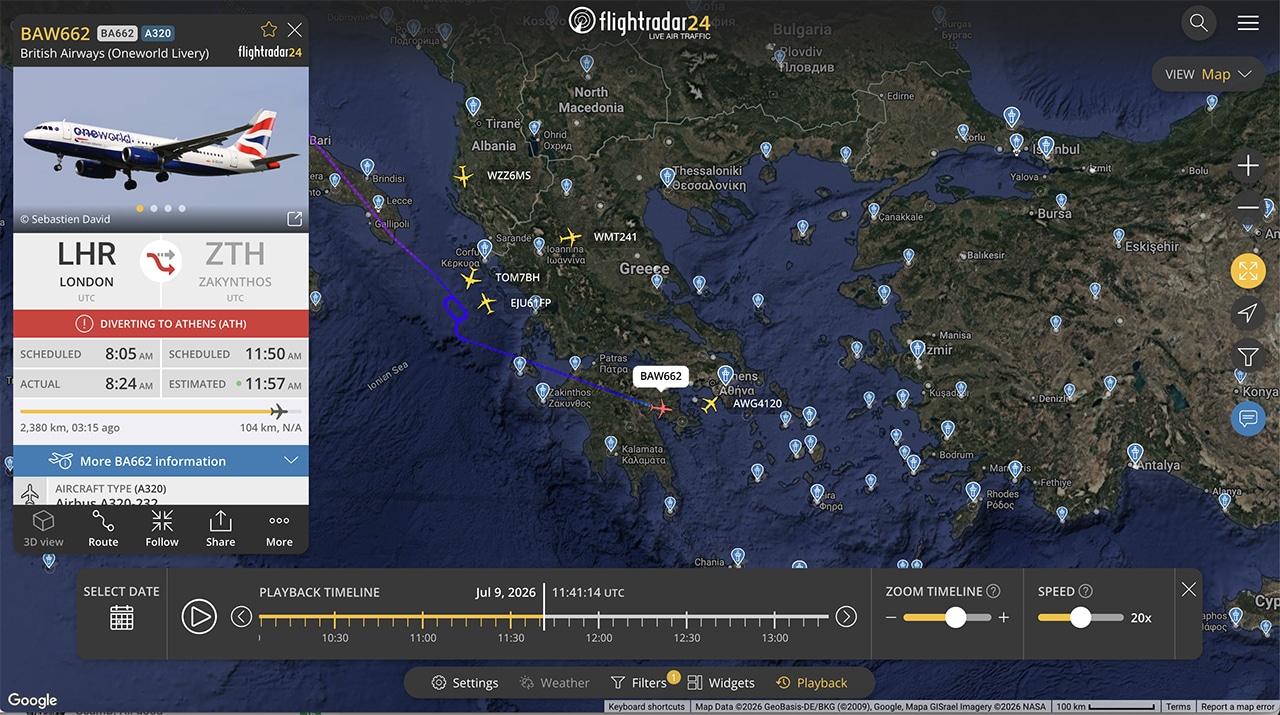
The Notice to Airmen/Aviation (NOTAM) closing Zakynthos’ runway to all but approved medical, government, and military helicopters was issued at 12:10 UTC.
Local media reports say the F-16 belongs to the 116th Combat Wing at Araxos Air Base in Eastern Greece. The wing is comprised of the 336th Bomber Squadron and 335th Squadron, both flying F-16s. They were notably the last unit in the world to operate the A-7 Corsair II, which retired in 2014.
This article concerns a developing news story and may be updated as new information becomes available.
Categories: Defence`s Feeds
A World on Fire Needs Australia’s Conflict Mediation Prowess
Australia can help itself and its region by burnishing its credentials as a trusted international mediator.
Categories: Diplomacy & Crisis News
Why Is the India-US Bilateral Trade Agreement Still On Hold?
Conflicting domestic economic policies, sudden judicial disruptions, and fresh American tariff investigations have upended the India-U.S. trade deal.
Categories: Diplomacy & Crisis News
Weg frei für den Importstopp
Die EU hält Israels Siedlungen für völkerrechtswidrig – importiert deren Produkte aber weiter. Deutschland sollte umsteuern.
Categories: Diplomacy & Defense Think Tank News
Tomaso Duso: „Wirtschaftspolitik muss sich stärker am Wettbewerb ausrichten“
Die Monopolkommission hat heute ihr 26. Hauptgutachten dem Bundeswirtschaftsministerium übergeben. Tomaso Duso, Leiter der Abteilung Unternehmen und Märkte im DIW Berlin und Vorsitzender der Monopolkommission, äußert sich dazu wie folgt:
Die Probleme der deutschen Industrie lassen sich nicht mit immer neuen Einzelmaßnahmen lösen. Viele staatliche Eingriffe sind teuer und oft wirkungslos. Stattdessen braucht es starken Wettbewerb und Rahmenbedingungen, die Innovation ermöglichen. Wettbewerb sollte der Kompass für die Wirtschaftspolitik sein – in der Energiepolitik, bei der Förderung von Künstlicher Intelligenz sowie bei anderen Standortfaktoren.
Deutschlands größte Industrieunternehmen wachsen, aber immer seltener in Deutschland. Besonders betroffen ist das verarbeitende Gewerbe. Dass große Industrieunternehmen ihre Wertschöpfung vermehrt im Ausland erzeugen und die Produktivität in Deutschland sinkt, ist ein Warnsignal. Deutschland muss als Standort wieder attraktiver werden. Dazu muss Wirtschaftspolitik Innovationen und neue Technologien fördern, statt auf überkommene Branchen zu setzen.
Die Monopolkommission empfiehlt den Abbau staatlich verursachter Energiekosten, die Stärkung des Technologietransfers aus der Forschung in die Anwendung und eine deutliche Entbürokratisierung. Subventionen für einzelne Branchen oder Unternehmen verzerren oft den Wettbewerb. Sie sollten nur dort eingesetzt werden, wo notwendige Investitionen sonst ausbleiben oder die Transformation der Wirtschaft nicht gelingt — und dann wettbewerbsoffen, transparent und befristet sein sowie regelmäßig evaluiert werden.
Deutschland hat etwa ein Labyrinth branchenspezifischer Stromhilfen aufgebaut: Strompreiskompensation, Industriestrompreissubventionen, Stromsteuersenkungen, Zuschüsse zu Netzentgelten. Es werden vor allem große Verbraucher begünstigt, während kleinere Unternehmen oft leer ausgehen. Die Monopolkommission empfiehlt stattdessen breite Entlastungen, etwa durch die Senkung staatlich geprägter Strompreisbestandteile und vor allem eine höhere Effizienz des gesamten Stromsystems. Hilfen für einzelne Branchen sollten auf eng begründete Ausnahmefälle beschränkt bleiben.
Auch die Anwendung von KI kommt in Deutschland nicht mit der notwendigen Schnelligkeit voran. Die Gründe sind vielfältig – von Trägheit in den Unternehmen über Rechtsunsicherheiten bis zu einem Regulierungsrahmen, der insbesondere kleinere Unternehmen und Start-ups belastet. Problematisch ist, dass im KI-Sektor nach wie vor große Abhängigkeiten von wenigen US-Unternehmen bestehen. Die Monopolkommission spricht sich daher für eine konsequente Durchsetzung des Wettbewerbsrechts und des europäischen Digital Markets Acts aus. Zudem sollte die Regulierung von KI verschlankt und Doppelregulierung vermieden werden.
Categories: Diplomacy & Defense Think Tank News
India’s Indo-Pacific Strategy Is a Search for Options, Not Substitutes
New Delhi wants more capitals it can call on, not fewer.
Categories: Diplomacy & Crisis News
Pressemitteilung - Bekämpfung sexuellen Kindesmissbrauchs: EP für enger gefasste Ausnahmeregelung
Am Donnerstag nahm das Parlament Änderungen an einer Ausnahmeregelung zum Datenschutz an, die es Diensteanbietern ermöglicht, Fälle von sexuellem Kindesmissbrauch freiwillig aufzudecken.
Ausschuss für bürgerliche Freiheiten, Justiz und Inneres
Quelle : © Europäische Union, 2026 - EP
Ausschuss für bürgerliche Freiheiten, Justiz und Inneres
Quelle : © Europäische Union, 2026 - EP
Categories: Europäische Union
Director General MI5 Welcomes New Legislation
Yesterday the National Security (State Threats) Bill received Royal Assent. The legislation will give the Home Secretary new powers to protect the public from individuals and groups carrying out hostile activity for foreign states, including their proxies.
Categories: Defence`s Feeds
Comment of the MFA of Ukraine on the Report by the Mission of Experts of the OSCE Moscow Mechanism regarding the Militarization and Indoctrination of Ukrainian Children by the Russian Federation
No description
Categories: Defence`s Feeds
NATO Summit in Ankara: $300 million for Patriot missiles for Ukraine and expanded defense cooperation with partners
Ukraine is expanding cooperation with partners on joint defense production, drone technologies, and financing for the defense industry.
Categories: Defence`s Feeds
Statement of the Resilience Council on Russian Disinformation Concerning the Volhynian Crime
An increasing number of disinformation and manipulative publications appearing in the Polish and international information space seek to deepen divisions between Poles and Ukrainians by exploiting the subject of the Volhynian crime.
Categories: Defence`s Feeds
Prime Minister Muhammad Shehbaz Sharif visited Quetta
Prime Minister Muhammad Shehbaz Sharif visited Quetta today along with Field Marshal Syed Asim Munir, NI(M), HJ, COAS & CDF, Minister for Economic Affairs Ahad Khan Cheema, Minister for Information and Broadcasting۔ Ataullah Tarar and Adviser to the Prime Minister on Political and Public Affairs Rana Sanaullah.
Categories: Defence`s Feeds
NSPA supports the Royal Netherlands Army during Exercise Fighter Lion
The NATO Support and Procurement Agency (NSPA) supported the Royal Netherlands Army (Koninklijke Landmacht, KL) during Exercise Fighter Lion, a large-scale military exercise that took place in the Bergen-Hohne Training Area in Germany from 12 to 25 June 2026.
Categories: Defence`s Feeds
Policy statement by the Federal Chancellor to the German Bundestag - "We are a strong country"
Policy statement by the Federal Chancellor to the German Bundestag
Categories: Defence`s Feeds
Communiqué de presse - Aide humanitaire: l’UE doit condamner les violations du droit international humanitaire
Jeudi, le Parlement a adopté une proposition de résolution sur la communication conjointe relative à l’aide humanitaire, récemment publiée.
Commission du développement
Source : © Union européenne, 2026 - PE
Commission du développement
Source : © Union européenne, 2026 - PE
Categories: Union européenne
Communiqué de presse - Lutte contre les abus sexuels sur mineurs en ligne: soutien d'une dérogation plus restreinte à la directive ePrivacy
Le PE a adopté des amendements à une dérogation à la directive sur la protection de la vie privée permettant la détection volontaire des abus sexuels commis sur mineurs en ligne.
Commission des libertés civiles, de la justice et des affaires intérieures
Source : © Union européenne, 2026 - PE
Commission des libertés civiles, de la justice et des affaires intérieures
Source : © Union européenne, 2026 - PE
Categories: Union européenne
Sajtóközlemény - Online gyermekbántalmazás: támogatás a korlátozott önkéntes felderítésnek
Csütörtökön a Parlament módosításokat fogadott el az adatvédelmi mentességre vonatkozóan, amely lehetővé tenné a szolgáltatóknak a gyermekek szexuális bántalmazásának önkéntes felderítését.
Állampolgári Jogi, Bel- és Igazságügyi Bizottság
Forrás : © Európai Unió, 2026 - EP
Állampolgári Jogi, Bel- és Igazságügyi Bizottság
Forrás : © Európai Unió, 2026 - EP
Categories: Európai Unió : hírek magyarul
Communiqué de presse - Violations des droits humains au Soudan, au Nigeria et au Pakistan
Jeudi, le Parlement a adopté trois résolutions d’urgence sur le Soudan, le Nigeria et le Pakistan.
Sous-commission "Droits de l'homme"
Source : © Union européenne, 2026 - PE
Sous-commission "Droits de l'homme"
Source : © Union européenne, 2026 - PE
Categories: Union européenne
Pages



© 2012-2018 Europa Varietas Foundation © 2015-2018 Europa Varietas Association
www.europavarietas.org | info(@)europavarietas(dot)org | Switzerland



We are looking for sponsors for the English translation of these books, please contact turkeandras(at)gmail(dot)com