
Vous êtes ici
Defence`s Feeds
South Central Louisiana got smashed
This is just regional news from my neck of the woods but South Central Louisiana got smashed by a weird, slow moving tropical storm.
My area was mostly spared. The earlier rans (lasted all week) were bad enough with flooding widespread. Some roads flooded but the damage was relatively (looking at it from the view of a person who's has was damaged) bearable.
Not the case for Avoyelles Parish. Its basically a farming community, with great hunting, fishing and the little festivals are freaking awesome. Plenty of bayous that are remarkably clear, quite scenic and make for a good sunday drive.
We're kinda different down here. Two lane roads are labeled as highways and for the most part well maintained.
The storm changed everything. You won't know the communities but I'll name them anyway. Cottonport was harmed with a couple of bayous rising so high that they flooded the highway leading there. Moreau had water so high (I never dreamed that it could flood to the extent that I saw) that the Sheriff's Dept was making water rescues in Air Boats and other watercraft. Marksville, the Parish Sea was basically shut down.
State Police, Game Wardens, Sheriff's Depts, Fire and other agencies stepped up hard and made a bad day somewhat better. Damage is widespread but I have yet to hear of loss of life.
Pray for all affected. Many are gonna have a hard time recovering.
Catégories: Defence`s Feeds
So Well Deserved! Major Capers & Colonel Ripley win the Medal Of Honor
President Trump awarded the Medal of Honor to retired Marine Maj. James Capers Jr. for extraordinary heroism during a four-day mission in Vietnam, where he continued leading his team despite severe wounds and heavy blood loss, refusing evacuation until every member of his patrol… pic.twitter.com/3DkJ8Slgaf
— Breaking911 (@Breaking911) June 18, 2026Today on June 18, President Trump awarded the Medal of Honor to Colonel John W. Ripley posthumously, for his heroism in destroying the Dong Ha Bridge to halt advancing North Vietnamese forces.
During the Easter Offensive, Ripley’s unit was ordered to “hold and die” against… pic.twitter.com/lefKhR2XJl
President Donald J. Trump awards the #MedalofHonor to #MarineCorps Maj. James Capers Jr. (Retired), and posthumously to Marine Corps Col. John W. Ripley (Retired) during a ceremony at the @WhiteHouse.
Capers received the nation’s highest military decoration after being upgraded… pic.twitter.com/e87gGeUs8o
Happening Now: President Donald J. Trump awards the Medal of Honor to Maj. Nicholas Dockery, U.S. Army, retired; Maj. James Capers Jr., U.S. Marine Corps, retired; and Col. John W. Ripley, U.S. Marine Corps, posthumously at the @WhiteHouse. https://t.co/R547saaZUc
— U.S. Army (@USArmy) June 18, 2026
Catégories: Defence`s Feeds
Draft agenda - Monday, 22 June 2026 - Tuesday, 23 June 2026 - PE789.939v02-00 - Committee on Security and Defence
Source : © European Union, 2026 - EP
Catégories: Defence`s Feeds, European Union
Guam’s RQ-4B Global Hawks Permanently Relocate to Yokota Air Base
The RQ-4Bs operated by the 4th Reconnaissance Squadron permanently relocated to Yokota AB, where they already deployed every year during the typhoon season.
The U.S. Air Force permanently relocated its RQ-4B Global Hawks from Andersen Air Force Base (AFB), Guam, to Yokota Air Base, Japan, the 374th Airlift Wing announced on Jun. 15, 2026. The aircraft are operated by the 4th Reconnaissance Squadron (4th RS), a geographically separated unit of the 319th Reconnaissance Wing (319th RW).
The aircraft moved there to Japan between May 25 and 27, based on the images released on the DVIDS network. The unit routinely conducted a summer move to Yokota to find more favorable weather during typhoon season, however this time it was decided to make the move permanent to offer a persistent in-theater Intelligence, Surveillance and Reconnaissance (ISR) support to U.S. and Allied forces in the region.
The 374th AW is the host unit at Yokota AB, which operates C-130J Super Hercules with the 36th Airlift Squadron and C-12J Huron with the 419th Airlift Squadron. The already oversees unmanned aircraft with the MQ-9 Reapers of the 319th Expeditionary Reconnaissance Squadron based at Kadena AB.
As mentioned earlier, the three RQ-4B Block 40 Global Hawks of the 4th RS are a well known presence at Yokota AB because of their summer deployments. The unit has also been conducting Agile Combat Employment (ACE) deployments to various locations throughout Japan, mentions the 4th RS official page.
U.S. Pacific Air Forces has permanently relocated the 4th Reconnaissance Squadron’s RQ-4 Global Hawks from Guam to Yokota Air Base. The move improves weather resiliency during typhoon season & enhances intelligence, surveillance & reconnaissance support across the Indo-Pacific. pic.twitter.com/OCZpVf0q5O
— Yokota Air Base (@TeamYokota) June 16, 2026
The latest press mentions that the relocation is timed with favorable weather in Japan’s Kanto region during the typhoon season, which affects Guam harder. Compared to Yokota, Andersen is further east into the western Pacific.
“This ensures persistent reconnaissance in a region where challenges to a free and open Indo-Pacific continue to increase,” the statement said, referring to the strategic confrontations with China. PLA Navy and PLA Air Force activity have largely concentrated in the First Island Chain right outside its shores around Japan, Taiwan, Vietnam and the Philippines with whom Beijing has several conflicting maritime claims.
RQ-4Bs in the PacificThe statement outlined the Global Hawk’s mission to support the broad range of ISR collection missions for American, friendly militaries and joint forces in “worldwide peacetime, contingency, and crisis operations.” Commander of the 4th RS Lt. Col. Adam Otten praised Yokota’s facilities for both the deployment and their families.
“Yokota Air Base is the right location to support current and future RQ-4 operations in the theater, while upholding the quality of life of our Airmen and families,” Otten said. He also thanked Guam and the Andersen AFB community for hosting the Global Hawk in the past sixteen years. “We are excited to be here, and we are confident that the unit will thrive alongside Team Yokota,” Otten added.
The release described the Global Hawk as a high-altitude, long-endurance (HALE)-class Remotely Piloted aerial reconnaissance system that provides “persistent, day and night, high resolution, all weather imagery of large geographic areas with an array of integrated sensors and cameras.”
An RQ-4B Global Hawk takes off on Andersen Air Force Base, Guam, Sep. 17, 2024. | Source: U.S. Air Force photo by Airmen 1st Class Manasseh Demissie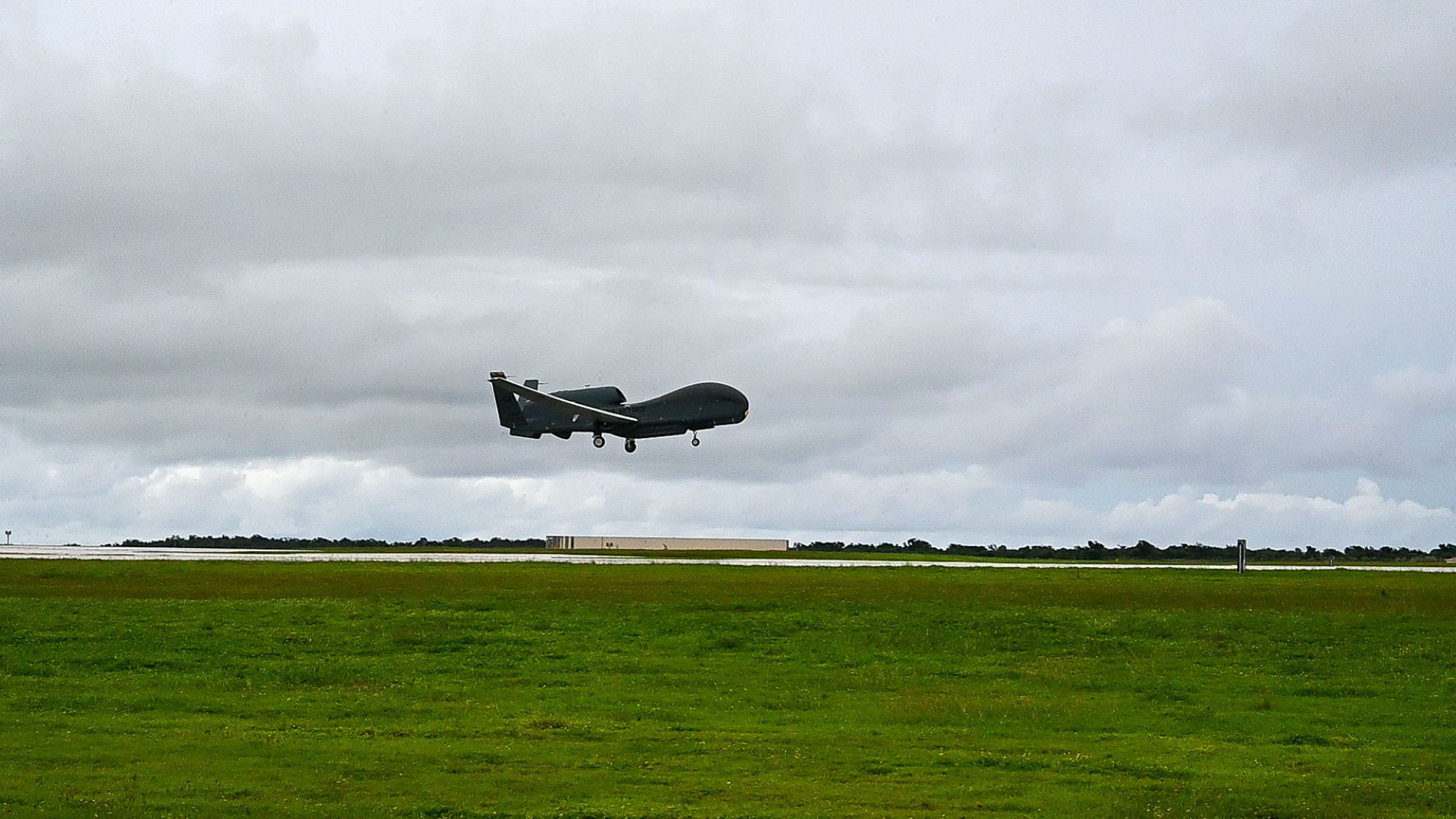
The aircraft can fly at an altitude of 60,000 feet for at least 24 hours and has Synthetic Aperture Radar (SAR) and Ground-Moving Target Indicator (GMTI) sensors to be used as an Intelligence, surveillance, target acquisition, and reconnaissance (ISTAR) platform. This is further enhanced by a satellite-enabled Beyond Line of Sight (BLOS) control link.
The 4th RS’s RQ-4Bs are controlled by the 319th Operations Group, home-based at Grand Forks AFB, North Dakota. The aircraft are launched and recovered by personnel at the deployed location, with mission control at Grand Forks taking over subsequently, the 319th OG had explained in a September 2024 release about RQ-4B operations from Andersen AFB.
The U.S. is not the only operator of the drone in the region, as the service also announced on Mar. 12, 2022, the first arrival of an RQ-4B at Japan’s Misawa Air Base, which was one of the three RQ-4B Block 30 acquired by the Japan Air Self-Defense Force (JASDF). “The addition of this aircraft to the Japan Air Self-Defense Force’s inventory directly supports the defense of Japan and peace and stability in the Indo-Pacific region,” said the service.
#KeenSword25 | Misawa Elephant Walk
Four USAF F-16 Fighting Falcons, four JASDF F-35A Lightning II Joint Strike Fighters, four JASDF F-2s, a JASDF E-2D Hawkeye, a JASDF RQ-4B Global Hawk, a U.S. Navy C-12 Huron, & a U.S. Navy P-8 Poseidon performed an Elephant Walk at Misawa AB. pic.twitter.com/CfANXoEb3G
— U.S. Forces Japan (@USForcesJapan) November 4, 2024
INDOPACOM becomes PACOM againInterestingly, the development comes as the Department of War announced the restoration of the Indo-Pacific Command (INDOPACOM) theater command’s original designation, the Pacific Command (PACOM). President Donald Trump’s first administration introduced the INDOPACOM designation in 2018, capturing India’s partnership in the overall confrontation with China and encompassing the Indian Ocean Region (IOR).
While the RQ-4B’s move to Yokota might just be coincidental, the reversal to the original designation is perceived as being influenced by the developments in the West Asia conflict. India’s subdued yet official protests over the death of its three merchant mariners aboard the MV Settebello in a U.S. strike marks a sudden tension in ties.
Department of War Restores U.S. Pacific Command Designation.
CAMP H.M. SMITH, Hawaii — The Department of War announced today that the U.S. Indo-Pacific Command (USINDOPACOM) will officially restore its name to the U.S. Pacific Command (USPACOM).
Originally established on… pic.twitter.com/ZL0EL3q6Ph
— U.S. Pacific Command (@USPACOM) June 16, 2026
The PACOM however mentioned India as one of the regions within its Area of Responsibility (AoR). “USPACOM’s vast area of responsibility – spanning from the waters off the West Coast of the United States to the western border of India – remains exactly the same. The command’s fundamental mission and its unwavering commitment to maintaining a free and open theater alongside regional allies and partners are unchanged,” said the Command said on X.
Catégories: Defence`s Feeds
Press release - Parliament condemns Russia’s drone incursions in the EU
The EU will not be intimidated by Russia's campaign of destabilisation and is determined to defend its security, MEPs say in a resolution adopted on Thursday.
Committee on Foreign Affairs
Committee on Security and Defence
Source : © European Union, 2026 - EP
Committee on Foreign Affairs
Committee on Security and Defence
Source : © European Union, 2026 - EP
Catégories: Defence`s Feeds, European Union
Minutes - Wednesday, 6 May 2026 - Thursday, 7 May 2026 - PE788.835v01-00 - Committee on Security and Defence
Source : © European Union, 2026 - EP
Catégories: Defence`s Feeds, European Union
Draft agenda - Wednesday, 24 June 2026 - PE790.028v01-00 - Committee on the Internal Market and Consumer Protection , Committee on Security and Defence
Source : © European Union, 2026 - EP
Catégories: Defence`s Feeds, European Union
A Madagascar, portraits d’une jeunesse au cœur battant qui a précipité la chute du président Andry Rajoelina
En 2025, la « gen Z » malgache s’est levée. C’est elle qui a porté la révolte d’octobre, exprimant une colère lucide face aux injustices et aux promesses non tenues. Six mois après les événements, dans une situation toujours fragile, le photographe Bertrand Vandeloise est parti à leur rencontre. Pour « Le Monde », il raconte.
Catégories: Afrique, Defence`s Feeds
Le Musée du quai Branly a 20 ans : retour sur une saga tumultueuse
L’établissement parisien célèbre son anniversaire en fanfare de vendredi à dimanche. Mais derrière les festivités, l’institution reste confrontée à de nombreux enjeux, notamment économiques.
Catégories: Afrique, Defence`s Feeds
UAE : US and UK consultants stranded in UAE for months amid money laundering probe
The Sharjah Public Prosecutor's office last month told more than 20 expatriate finance professionals named in a money laundering probe that they had no case to answer, prompting expectations that the investigation will be dropped, Intelligence Online has heard. It is [...]
Catégories: Afrique, Defence`s Feeds
Belgium/China/European Union : European Commission beefs up security in face of China threat
For regular visitors to the Berlaymont – the large, cross-shaped 60s building where the European Commission is headquartered in Brussels [...]
Catégories: Afrique, Defence`s Feeds
Ukraine/United States : AeroVironment puts new Switchblade drone to the test with SBU's Alpha unit
Teams from US drone manufacturer AeroVironment have for months been travelling to Ukraine to test their loitering munitions in the [...]
Catégories: Afrique, Defence`s Feeds
France : DGSE locks down top positions until presidential
Prime Minister Sébastien Lecornu once more hammered home the point when he met with French political parties on 11 June: [...]
Catégories: Afrique, Defence`s Feeds
China/Hungary/Serbia : Beijing's Belt and Road 'militias' to be deployed in Serbia, Hungary and Poland
After much planning, China is finally poised to deploy its long-planned New Silk Road ‘militias' (Belt & Road Initiative, BRI) [...]
Catégories: Afrique, Defence`s Feeds
United States : Tulsi Gabbard's ODNI cuts also targeted counternarcotics
The Office of the Director of National Intelligence (ODNI)'s Counternarcotics Executive (CE) role has been abolished as part of efforts [...]
Catégories: Afrique, Defence`s Feeds
Trouble in Whitehall: UK Armed Forces Chief Warns of Operational Cutbacks Without Additional Funding
Days after the high profile resignations from the Ministry of Defence’s political leadership, the professional head of the UK’s armed forces, Sir Rich Knighton, has said that without more funding the UK will need to ‘dial back’ both its military exercises and frontline operational activities.
The Royal Air Force Air Chief Marshal, who has served as Chief of the Defence Staff since September 2025, told the House of Lords International Relations and Defence Committee on Jun. 16, 2026, that the UK would need to “dial back our activities; our exercise, operational activity, if the level of resource funding that is available to us does not increase”.
“If you look back at the position 20 years ago, the split between resource spending and capital spending was about 80/20. Today it is about 60/40 – 60% on activity and resources, and 40% on capital. On the current projection, by the time we get to 2030 it will be 50/50.”
Rich Knighton, CDS freely saying to a House of Lord Committee that the DIP settlement that @JohnHealey_MP resigned over does not provide enough RDEL budget (day-to-day running expenses) for defence – operations and training will have to be cut.
If this is imposed, a resignation… pic.twitter.com/PJpbHeoHQ4
— Navy Lookout (@NavyLookout) June 16, 2026
Knighton here refers to what is known as the Ministry of Defence (MoD) RDEL (Resource Departmental Expenditure Limit) budget, which covers the day to day expenses of running the armed forces. Boosts to the MoD’s budget for capital expenditures, which cover the development and procurement of new equipment, have far outweighed any uplift of the RDEL budget.
This mismatch has partially resulted from several major, costly procurement programs currently ongoing – the Dreadnought class of ballistic missile submarines, the Global Combat Air Programme (GCAP) sixth generation fighter, the Type 26 frigates, and the problematic Ajax armored vehicle program to name just a few. These expensive programs have required large injections of funding into the MoD’s non-RDEL budget.
Why is the RDEL budget is critical for UK Defence?
The UK’s Ministry of Defence operates under two key funding streams: Resource DEL (RDEL) for day-to-day running costs — personnel pay, training, equipment support, operations, and maintenance — and Capital DEL (CDEL) for new… https://t.co/KOHoH9khlp
— Scotty (@scottyeders) June 17, 2026
Meanwhile, though, the RDEL costs themselves are facing major increases. Fuel costs have surged dramatically, while the MoD is simultaneously tasked to stretch itself wider than it has been at any time since the Cold War. A pivot back to Europe and the North Atlantic envisioned post-Afghanistan has been left in tatters following continual unrest in the Middle East, which has required the deployment of additional UK forces to protect national interests and support regional partners.
Ministerial ResignationsAn unavoidable backdrop to Knighton’s comments, the MoD itself has undergone a rapid, unplanned change with the departure of John Healey from the role of Secretary of State for Defence. Healey had held this role since the current government took office in 2024, having served in the shadow counterpart of the role in opposition since April 2020.
Joining Healey was the now former Under-Secretary of State for the Armed Forces Al Carns, who, until being elected to Parliament in 2024, previously served in the Royal Marines and attained the rank of Colonel. Though it has not been officially confirmed, it is an open secret in British political circles that Carns served as a senior officer in the elite Special Boat Service (SBS) and saw action in every major conflict the UK has been involved in for the last quarter of a century.
Al Carns (centre left), talking with Commander ARRC, Lieutenant General Mike Elviss (centre right). | Source: Crown Copyright 2026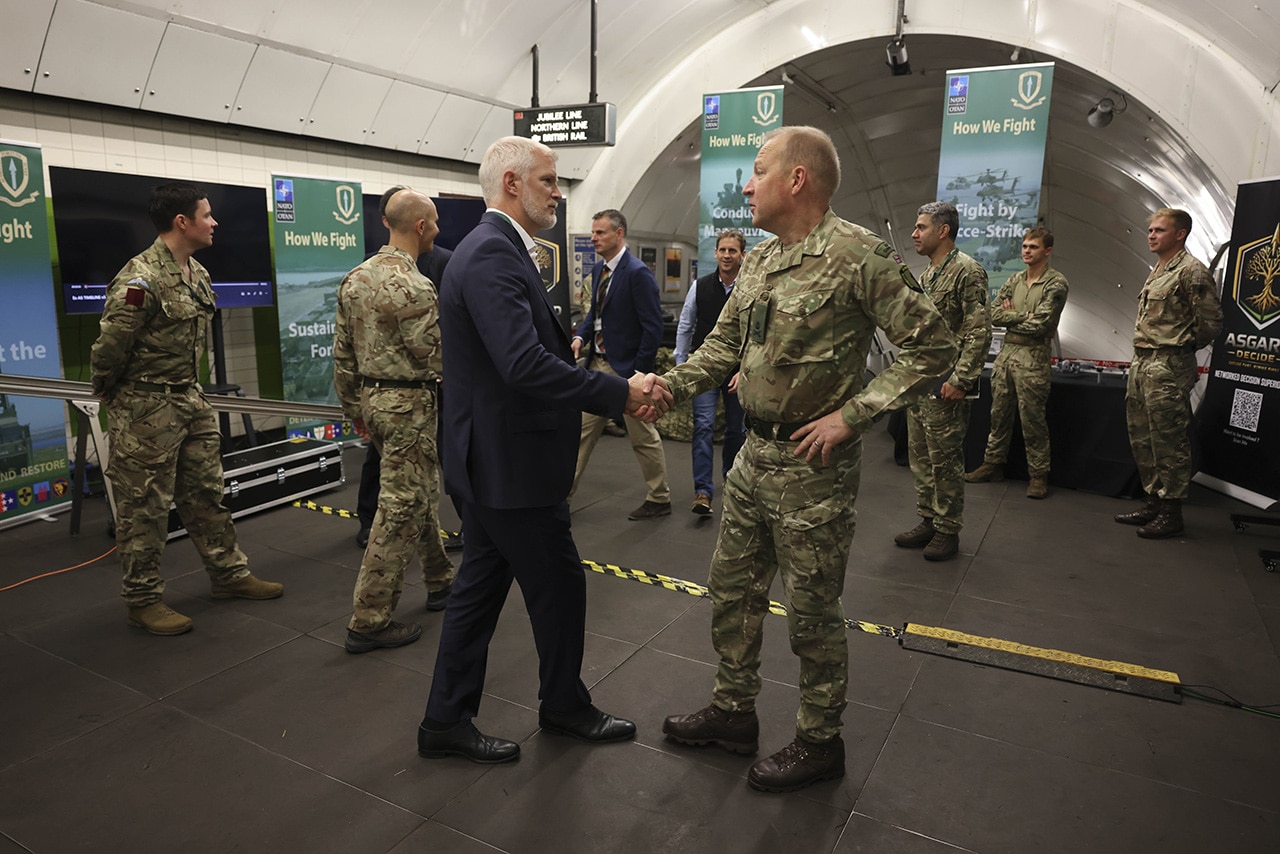
Healey’s bombshell resignation took aim at the heart of the Government he had loyally defended, accusing it and the Prime Minister of failing to “to commit the resources that the nation needs to defend the country at this time of rising threats”. Insiders have said that his resignation came as a shock to the entire cabinet, and one that worsens Keir Starmer’s position amid the still open threat of leadership challenges.
One of his main critiques revolves around the still-unpublished Defence Investment Plan (DIP), which was promised to follow last year’s Strategic Defence Review. Major procurement decisions have been delayed until the DIP is finalised, which has put immense strain on businesses waiting to be awarded significant defence contracts. In one noteworthy case, Aeralis, a firm that hoped to produce an all-British modular jet trainer, collapsed into administration.
Carns added fuel to the fire, claiming that even as a defence minister he had not been included in DIP discussions until two weeks before his resignation. He has since labelled it “not fit for purpose”.
“I haven’t been included in the defence investment plan from the start. I only got read into it two weeks ago.”
Al Carns shares what “ruffled [his] feathers” enough to prompt him to resign as armed forces minister and says that in the event of a leadership race, “if someone… pic.twitter.com/0gQDNYKpfO
— Times Radio (@TimesRadio) June 13, 2026
Speaking to The Guardian, Carns lambasted what he saw as excessive waste and bureaucracy within the ministry. “It is unbelievable. You turn a stone over and get another shock – how has that been allowed to go on? And you turn another stone over, and it is just layers of bureaucracy which now cost us more than the product you’re getting itself. I can’t describe the level of inefficiency in the system that we’ve been left with and we’re trying to unpeel. But it’s actually exceptionally difficult to do.”
The new Secretary of State for Defence is Dan Jarvis, who came to the role from the Home Office where he served as Minister of State for Security. Jarvis, like Carns, is a decorated military veteran. Serving in the British Army, he attained the rank of Major before leaving the forces in 2011 after 14 years.
The new Secretary of State for Defence, Dan Jarvis MBE MP. | Source: Crown Copyright 2026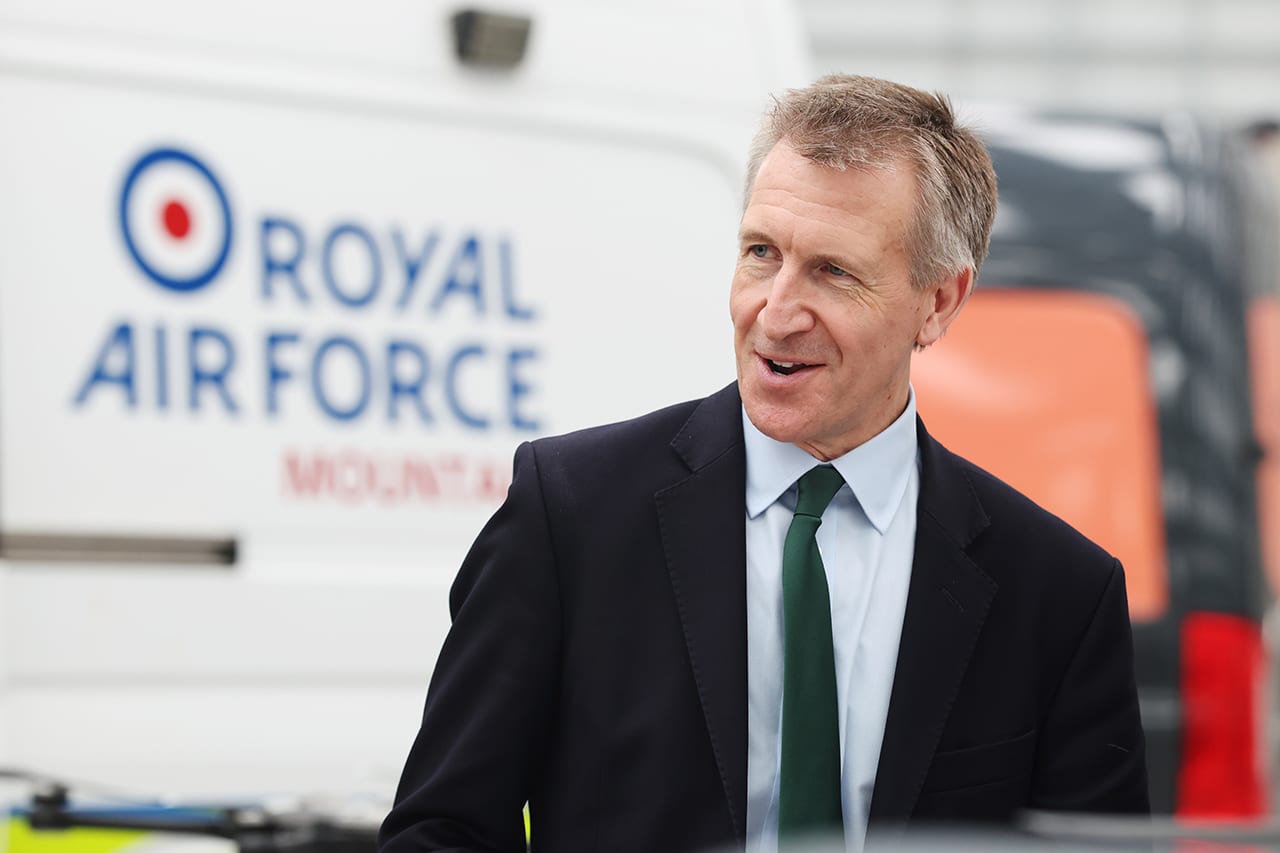
Jarvis notably served as staff officer to General Sir Mike Jackson in Kosovo when Jackson refused an order from Supreme Allied Commander Europe (SACEUR) General Wesley Clark (U.S. Army) to continue with a plan to seize Pristina International Airport despite it then being under the control of Russian forces. Best-selling singer James Blunt was also present for this affair, serving under Jackson as a Captain.
EXC: Dan Jarvis faces having to make “very significant cuts” inside the MoD if he cannot get more money.
– Options on the table last week included reducing investment in drones and artificial intelligence, cutting reserve days, and cutting exercises
– the £13.5 bn offer included…
— Larisa Brown (@larisamlbrown) June 16, 2026
Stuck between a rock and a hard place, the new secretary is said to be re-evaluating the DIP, now reportedly delayed until (at least) July. The loss of Healey and Carns is thought to have potentially swayed opinions within cabinet to back spending increases, which means Jarvis may have a smoother road. The fear of losing another defence secretary should they face a similar stumbling block will also force the hand of Starmer and the Treasury, headed by Chancellor Rachel Reeves.
Catégories: Defence`s Feeds
U.S. Air Force Awards CCA Production Contracts
The U.S. Air Force has awarded contracts for both the production of CCAs and the mission autonomy software as part of the program’s Increment 1.
The U.S. Air Force awarded several contracts for the Collaborative Combat Aircraft program, including production contracts for the Increment 1 aircraft as well as mission autonomy software. The move represents a further step forward in the service’s effort to rapidly field these advanced combat capabilities which would support crewed aircraft during missions.
The award of these contracts is also a part of the new acquisition transformation principles, which aim to decouple hardware from software. The service explained that treating mission autonomy as “software sold separately” allows to field “state-of-the-art physical platforms alongside agile, easily updatable software, effectively breaking traditional procurement molds.”
“Collaborative Combat Aircraft change how we project power and generate mass in highly contested environments,” said Air Force Chief of Staff Gen. Ken Wilsbach. “Delivering this capability to our warfighters faster ensures our forces maintain the tactical edge required to deter and, if necessary, defeat any adversary.”
The service further explained that CCA represent the next critical evolution of airpower, and are designed to seamlessly integrate with crewed fighters to extend reach, awareness and survivability in contested environments.
YFQ-42 aircraft sit on the flightline at a California test location as part of the Air Force’s Collaborative Combat Aircraft flight test campaign. | Source: Courtesy photo Hardware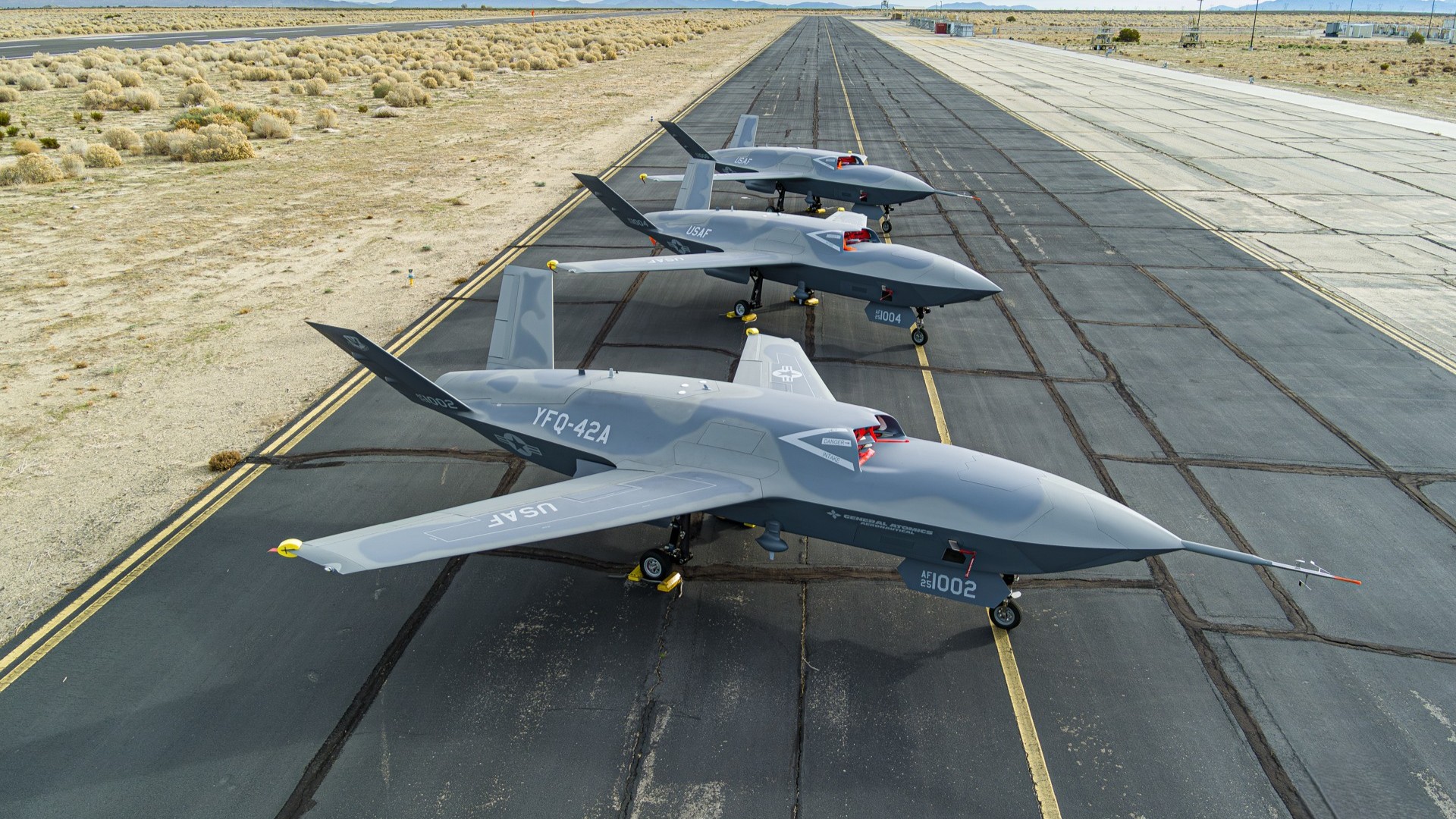
For the hardware-side of the program, the Air Force awarded engineering and manufacturing development and production contracts to both General Atomics Aeronautical Systems (GA-ASI) and Anduril for their FQ-42 and FQ-44, respectively. The service explained that the award arrived months ahead of scheduled because the two uncrewed assets already met rigorous mission requirements and are ready for full-scale manufacturing.
Notably, the two designs are now dropping the ‘Y’ designation which indicated prototypes, while maintaining the designation of UAVs (as denoted by the ‘Q’ vehicle type code) with the intended role as a fighter (indicated by the ‘F’ basic mission).
“By moving fast from competitive selection into full-scale manufacturing, we position ourselves to field highly credible and combat-ready semi-autonomous systems to stay ahead of the pacing challenge,” said Secretary of the Air Force Troy Meink. “These contracts reaffirm our confidence in the strategic path forward for the program to procure over 150 combat capable CCA by the end of the decade.”
The service intends to field approximately 1,000 combat-capable CCA throughout multiple Increments. Work is already ongoing for the Increment 2, which will build on the lessons from Increment 1.
A YFQ-44A takes off from the runway at Edwards Air Force Base, Calif., during a Collaborative Combat Aircraft exercise. | Source: U.S. Air Force photo by Ariana Ortega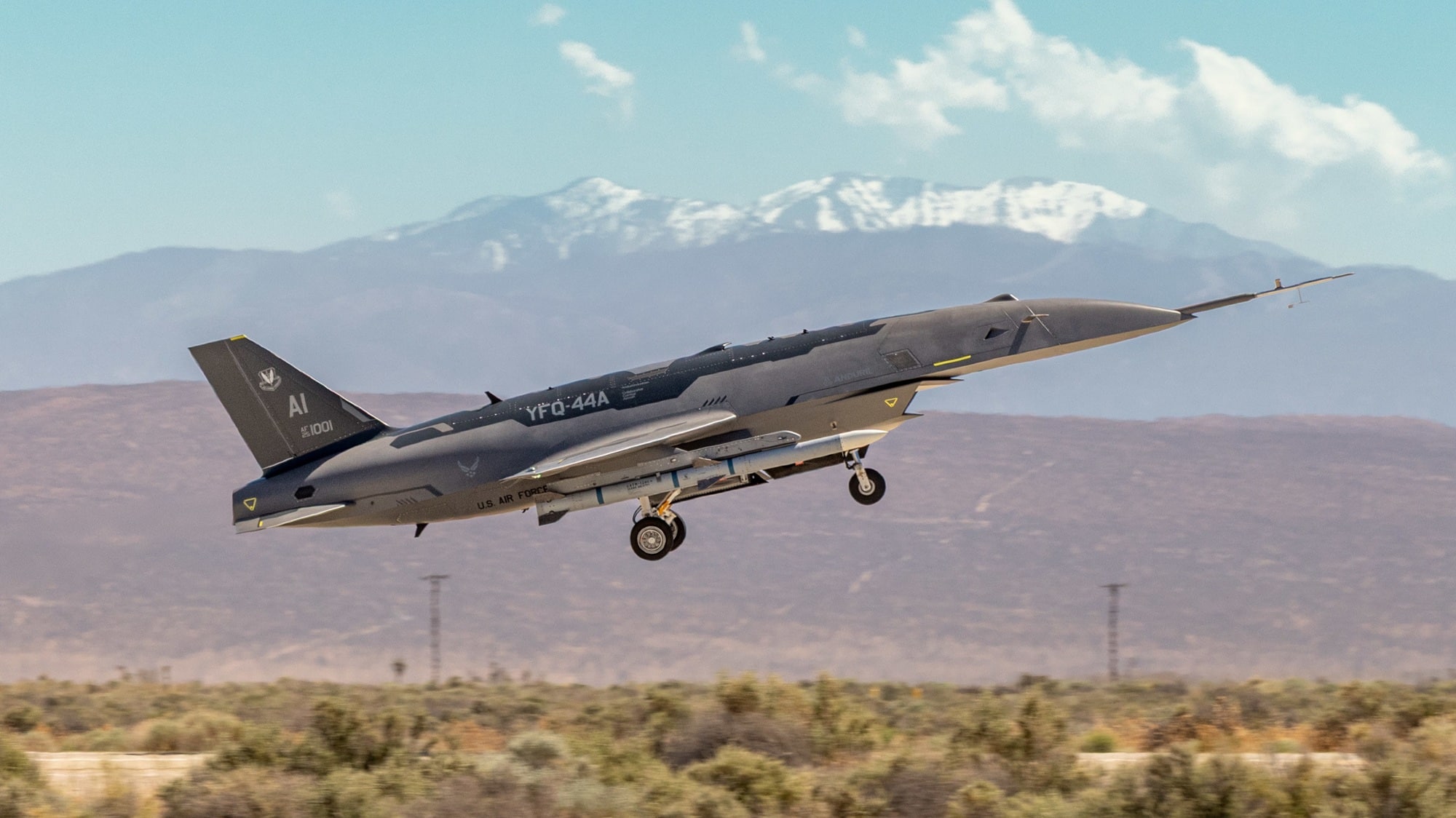
Both GA-ASI and Anduril are noting the speed of the program, which saw the move from prototype award to production in just two years. Anduril further noted that, unlike traditional fighters, CCAs can be built more quickly and with larger scales.
SoftwareFor the software, the Air Force awarded mission autonomy production contracts to a pool of six vendors, including Anduril, General Atomics, Lockheed Martin, Northrop Grumman, RTX Collins Aerospace and Shield AI. Each of them has been awarded a baseline six-year contract which provides the framework for continuous competition and rapid software development.
Additionally, Anduril, RTX Collins Aerospace, and Shield AI, have also received a competitive contract to accelerate the delivery of critical mission autonomy software. The service explained this will fund the first of two six-month competitive phases designed to speed the fielding of operational software to the warfighter.
Following this six-month period, the Air Force will evaluate the vendors’ progress and execute a second competitive award period, leading to the selection of a primary mission autonomy provider for CCA Increment 1 by summer 2027.
The second YFQ-42 in flight. | Source: GA-ASI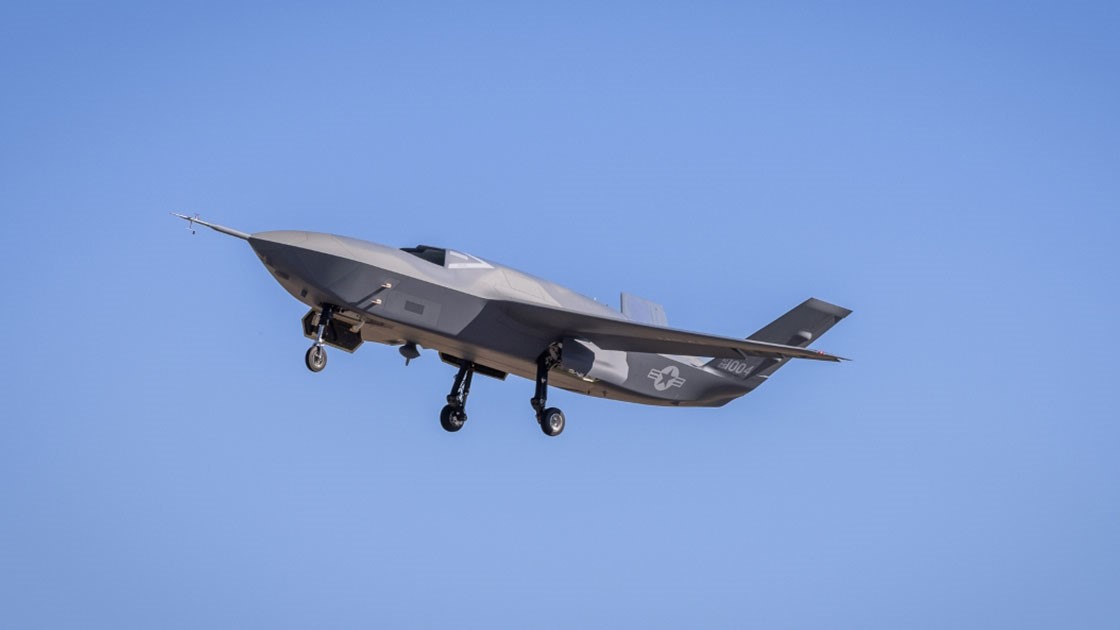
“Mission autonomy is the cornerstone of the CCA concept, and leveraging a competitive, multi-vendor environment ensures we capture the latest technology,” Meink said. “This approach guarantees our Airmen are equipped with state-of-the-art capabilities today but keeps the door open for the breakthroughs necessary to maintain air superiority.”
The service is also adopting a licensing approach which would allow to award licenses to any of the six vendors at any point over the next six years, procuring the best-performing and most affordable solutions as technology evolves. The Autonomy Government Reference Architecture (A-GRA) will be critical for this approach, ensuring that mission autonomy software from any vendor can be easily integrated, quickly updated, and ported across different physical aircraft platforms.
Collaborative Combat AircraftThe development of the autonomous systems has advanced more rapidly than expected, leading some to suggest that NGAD’s crewed fighter might not be as essential as initially planned. The combination of CCAs with manned platforms like the F-35 and F-15EX could provide a more affordable and flexible solution to achieving air superiority.
The rise of CCAs reflects the Air Force’s shifting priorities, where a system-of-systems approach may take precedence over a singular focus on a high-cost manned fighter. The combination of manned and unmanned systems also allows for greater flexibility and the potential to deploy assets in more distributed and resilient ways.
The YFQ-44A in flight. | Source: Anduril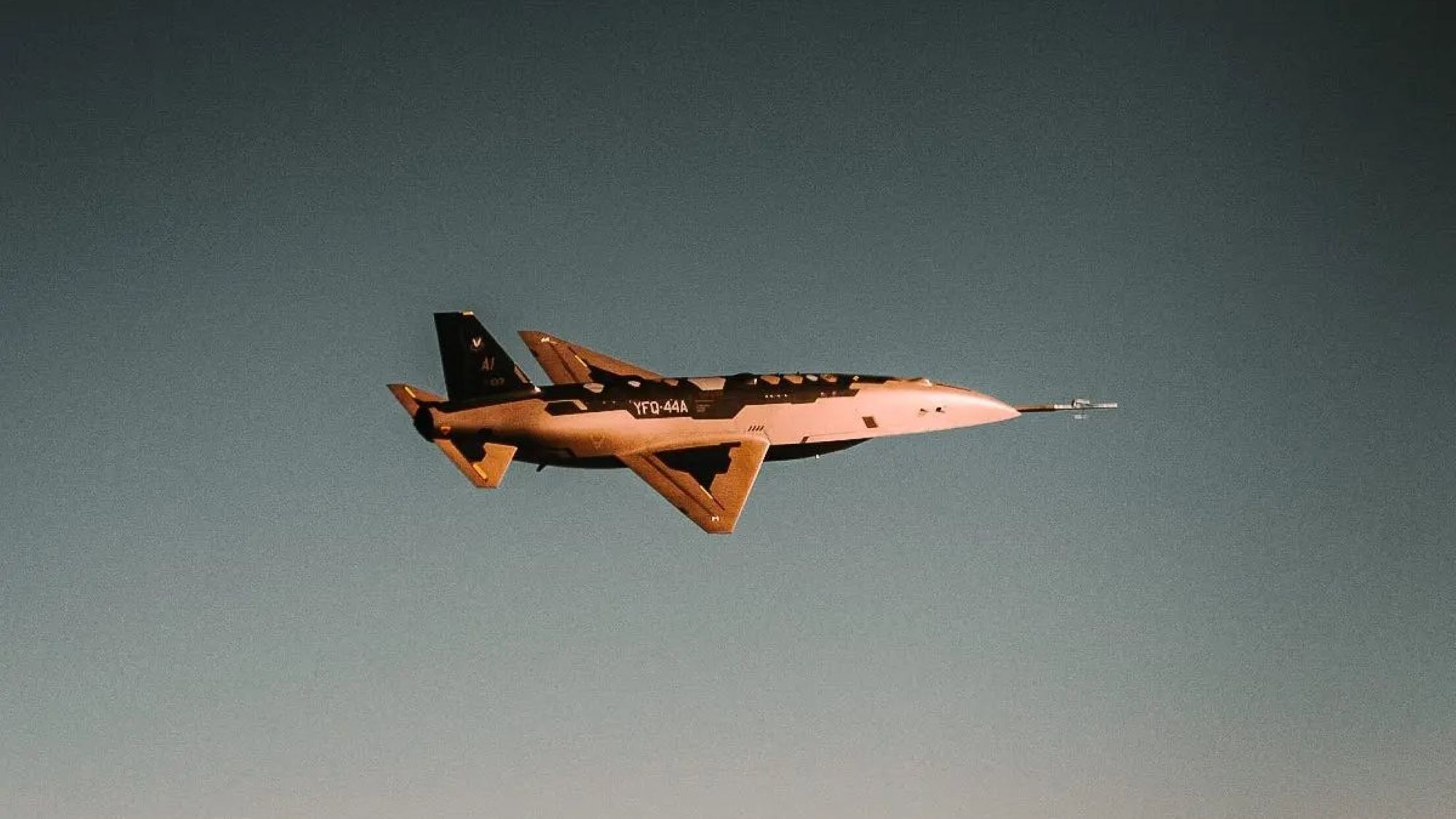
The Air Force is rapidly advancing the development of CCAs, with plans to begin deploying over 150 units in the next five years. These autonomous systems could take on a range of missions, from surveillance to direct combat, working as force multipliers in collaboration with manned platforms and taking on high-risk missions traditionally performed by manned fighters.
Unlike legacy fighters, CCAs feature modular designs, enabling rapid upgrades and streamlined maintenance. The modular design and open architecture, the latter becoming a staple in the design of modern military aircraft, allows to introduce new capabilities as they become available, allowing in turn to always field the latest technologies to keep an edge over rapidly evolving battlefields.
In early 2024, Anduril Industries and General Atomics were awarded contracts to design and test production-ready CCAs, marking a pivotal step in the program. Both companies are developing these unmanned aircraft to support both the upcoming NGAD fighters, as well as current F-35s and other manned aircraft, by sharing sensor data, executing coordinated maneuvers, and potentially carrying out combat roles.
In early 2025, the U.S. Air Force’s then Chief of Staff, General David Allvin, announced the official designation of the first two CCAs. The two aircraft by General Atomics and Anduril have been named YFQ-42A and YFQ-44A, respectively, marking the first use of the ‘Unmanned Fighter’ designation by the USAF.
The first YFQ-42 in flight. | Source: GA-ASI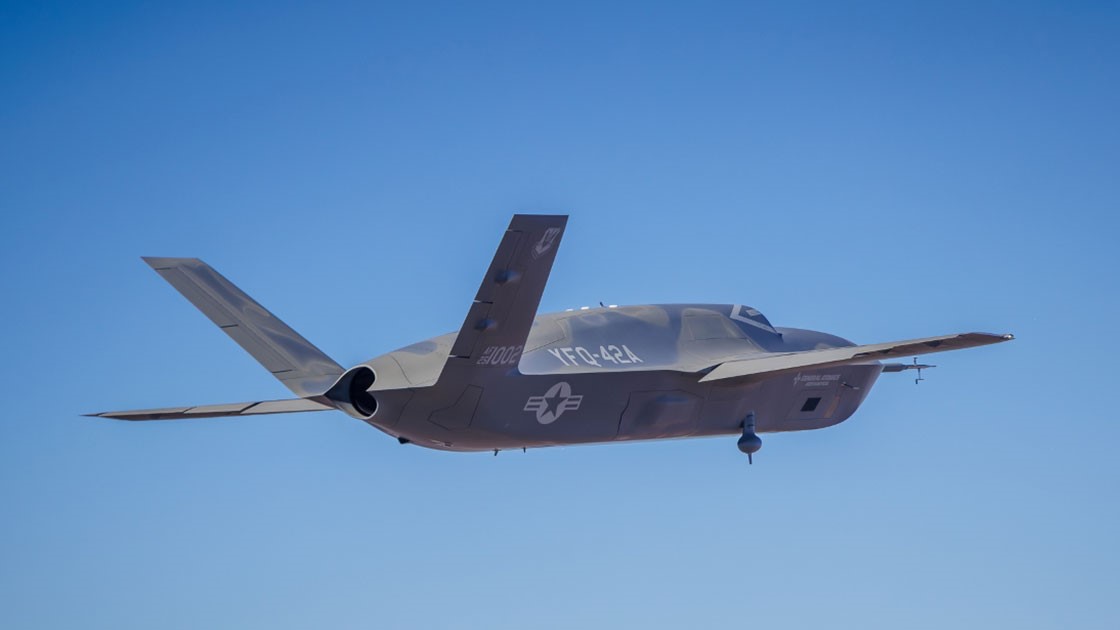
“We have two prototypes of Collaborative Combat Aircraft that were on paper less than a couple of years ago,” Allvin said. “For the first time in our history, we have a fighter designation in the YFQ-42 Alpha and the YFQ-44 Alpha – maybe just symbolic, but it’s telling the world that we are leaning into a new chapter of aerial warfare.”
These two aircraft flew for the first time in August 2025 and October 2025, respectively. Since then, they have been involved in a series of tests to demonstrate the required capabilities, working in close partnership with the service.
The Air Force is planning to field a diverse fleet of over 1,000 CCAs, designed with modular configurations for weaponry, sensor capabilities, and rapid adaptability to mission needs. One notable advancement in 2024 was the first flight of the XQ-67A, a low-cost drone designed by General Atomics under the Off-Board Sensing Station (OBSS) program, which occurred in February 2024.
This platform, along with the earlier XQ-58A Valkyrie, demonstrates a “common chassis” concept—using shared components for various drone models to streamline production and reduce costs. This approach aims to provide a scalable, cost-effective solution for enhancing combat capacity without relying on high-cost crewed jets, which is essential given the Air Force’s budget constraints and strategic emphasis on distributed, resilient forces.
“A competitive Increment 1 production decision is expected in fiscal year 2026,” says the Air Force, “with development for Increment 2 beginning that same year to expand mission applications and integrate emerging technologies.”
Catégories: Defence`s Feeds
Diezani Alison-Madueke, ancienne ministre du pétrole nigériane, relaxée à Londres au terme d’un procès pour corruption
Après cinq mois d’audience, Diezani Alison-Madueke, ex-présidente de l’OPEP, « a été relaxée de six chefs d’accusation de corruption » par la justice britannique.
Catégories: Afrique, Defence`s Feeds
Cseh támogatással valósulhatnak meg új fejlesztések Kárpátalján
Jelentős támogatásról döntött a csehországi Vysočina régió parlamentje: a képviselők jóváhagyták, hogy 2026-ban több kárpátaljai beruházás megvalósításához nyújtsanak pénzügyi segítséget. A hírről Volodimir Csubirko, a Kárpátaljai Megyei Tanács képviselője számolt be.
A döntés értelmében öt különböző projekt részesül támogatásban, összesen 4,5 millió cseh korona értékben. A fejlesztések társfinanszírozásban valósulnak meg: a költségek felét a cseh fél állja, míg a fennmaradó részt az érintett önkormányzatok vagy intézmények biztosítják.
A program célja, hogy olyan régóta húzódó problémák megoldását segítse elő, amelyekre a helyi közösségek eddig forráshiány miatt nem találtak megoldást. Emellett lehetőség nyílik arra is, hogy a cseh nyelvet tanuló kárpátaljai gyermekek nyári nyelvi táborban vegyenek részt Csehországban.
További támogatásban részesül az ungvári T. G. Masaryk Klub is, amely a jövőben új kulturális programok és kezdeményezések megvalósítására fordíthatja a rendelkezésére álló forrásokat.
Volodimir Csubirko hangsúlyozta, hogy a Csehország és Kárpátalja közötti együttműködés továbbra is élő és eredményes.
A politikus arra biztatja az önkormányzatok vezetőit és a helyi közélet szereplőit, hogy aktívan keressék a nemzetközi partnerségeket és az EU-s programok nyújtotta lehetőségeket.A képviselő egyúttal köszönetet mondott Vysočina régió vezetőinek és lakóinak, akik az elmúlt években következetesen támogatták Ukrajnát, segítették Kárpátalját, valamint hozzájárultak a két ország közötti kapcsolatok erősítéséhez.
Nyitókép: korábbi felvétel, zakarpattya.net.ua
Kapcsolódó:
Cseh humanitárius segély érkezett UngvárraThe post Cseh támogatással valósulhatnak meg új fejlesztések Kárpátalján appeared first on Kárpátalja.ma.
« Fier de toute la douleur et de toute la souffrance que je vais infliger » : le fils du président ougandais se vante d’avoir enlevé un avocat
Connu pour ses propos intempestifs et outrageux sur le réseau social X, le général Muhoozi Kainerugaba s’est vanté de l’enlèvement, le 15 juin, d’Erias Lukwago, avocat et membre de l’opposition.
Catégories: Afrique, Defence`s Feeds
Pages



© 2012-2018 Europa Varietas Foundation © 2015-2018 Europa Varietas Association
www.europavarietas.org | info(@)europavarietas(dot)org | Switzerland




We are looking for sponsors for the English translation of these books, please contact turkeandras(at)gmail(dot)com