
You are here
ELIAMEP


Staying Competitive, Being Vigilant: Digital Cooperation as a New Momentum in EU–Turkey Relations
The following paper has received a distinction in the policy paper competition organized by ELIAMEP’s Turkey Programme, focusing on Turkey’s domestic developments, foreign relations, and socio-political dynamics.
Amidst intensifying global technological rivalry, this paper examines digital cooperation as a vital functional anchor for EU– Turkey relations. It argues that engaging through frameworks like the Digital Europe Program (DEP) allows both actors to navigate the “technosphere trap” by balancing economic competitiveness with strategic vigilance. While acknowledging structural fault lines regarding digital sovereignty and trust, the analysis outlines three pragmatic pathways—market, innovation, and technical-driven cooperation—for fostering a resilient, future-proof partnership despite broader political stagnation.
Read here in pdf the Policy paper by Jacopo Franceschini, Fellow at Centre of Applied Turkish Studies (CATS); Ayhan Gücüyener Evren, Postdoctoral Researcher, TRSIDIPLOM Project and Erman Ermihan, Assistant Professor, Istanbul Nişantaşı University.
IntroductionFrom platform regulation to chip exports, technological domains now lie at the heart of global geopolitical contestation. The “innovation imperative”[1] pushes rising powers to see technology not only as a driver of economic growth, but also as a prerequisite for sustaining their international ascent, generating pressures and spillover effects for the established international order.[2] Furthermore, this rivalry is not dyadic between China and the United States; it is increasingly forcing other countries to position themselves and navigate growing uncertainty under the threat of technological decoupling.[3]
Competitiveness requires greater control over technology use, vibrant industrial ecosystems, and the ability to shape digital standards, while vigilance demands secure infrastructure and the diversification of technological dependencies.
Confronted by the “technosphere trap” dilemma, a condition in which the governance of the digital ecosystem (through standards, infrastructures, platforms, and norms) is dominated by a few actors, regional powers can mitigate the risk of overdependence on a single pole by cooperating in different functional digital domains. In such a context, competitiveness and vigilance become complementary rather than competing imperatives. Competitiveness requires greater control over technology use, vibrant industrial ecosystems, and the ability to shape digital standards, while vigilance demands secure infrastructure and the diversification of technological dependencies. Digital cooperation, in turn, paves the way for regulatory convergence that minimizes compliance costs and prevents market fragmentation, while resilient data governance and infrastructures are sustained through joint innovation frameworks.[4]
In this context, examining the potential promises and pitfalls of a Turkey–EU digital partnership becomes essential for understanding how both actors might escape the technosphere trap shaped by the competition between major technopoles. Therefore, in this article, we argue that alignment between their digital visions through initiatives like the Digital Europe Program (DEP) acts as a potential form of functional integration, particularly at a time when Turkey’s EU accession process remains stalled. In a period of growing instability, the EU and Turkey have already demonstrated the capacity to strengthen their political and economic alignments, as recently seen in the defense sector. Similarly, a closer partnership in the digital field would allow joint efforts to stay competitive and preserve both their strategic digital autonomy in the global tech race. In this way, we argue that the EU and Turkey could forge a more resilient position in the future global digital landscape.
We further assert that, against the backdrop of increasing technological rivalry between the US and China, initiatives like the DEP serve not only as frameworks for technical cooperation but also as strategic (geo)economic tools, providing opportunities for concrete alignments in key sectors such as artificial intelligence (AI), cybersecurity, high-performance computing, and advanced digital skills. In essence, this paper explores how digital cooperation allows Turkey and the EU to pursue both competitiveness and vigilance imperatives simultaneously, advancing common interests through a forward-looking and strategically balanced framework.
The timing of this agenda is particularly critical. As the EU accelerates its comprehensive digital agenda and pursues greater digital autonomy, and as Turkey seeks to enhance its strategic autonomy and diversify technological partnerships, digital cooperation emerges as one of the few policy fields where both sides share an objective sense of urgency. The rollout of the EU’s AI Act and Digital Services Package, and Europe’s broader drive for digital sovereignty, coincides with Turkey’s efforts to modernize its data governance, expand its cybersecurity capacities, and strengthen its digital economy.[5] These parallel trajectories create a unique window for pragmatic and mutually reinforcing engagement.
Digital cooperation can serve as a foundation for high-impact “low politics” capable of rebuilding mutual trust even when political channels remain strained.
This paper first outlines the strategic drivers that make digital cooperation increasingly necessary. Digital cooperation can serve as a foundation for high-impact “low politics” capable of rebuilding mutual trust even when political channels remain strained. Such cooperation has the potential to standardize digital regulations, bolster an innovative ecosystem, and integrate Turkey into the emerging European digital governance framework. The EU is already influencing Turkey’s digital policies, as evidenced by Ankara’s recent legislative processes aligning with the EU Digital Markets and AI Act. Overall, this section examines the cooperation mechanisms already in place and explains how shared economic, societal and political interests make such cooperation sustainable.
The paper then evaluates the principal fault lines. These challenges do not necessarily undermine the possibility of cooperation, but they may shape its depth[6]. As elaborated in the following sections, while the EU and Turkey’s differentiated narratives and strategies on digital sovereignty and strategic autonomy may constitute sources of friction, challenges in establishing trust across domains such as cybersecurity warrant further consideration. Finally, the paper outlines three pathways for EU–Turkey digital cooperation based on approaches driven by markets, innovation, and technical factors. The market-driven pathway prioritises joint efforts on securing digital supply chains, particularly in the AI domain. The innovation-driven pathway focuses on joint innovation initiatives, especially within the framework of the DEP. And t he technically driven pathway emphasizes regulatory rapprochement to sustain resilient and vigilant infrastructures, as both actors become increasingly digitally interconnected.
The Strategic Logic of Digital CooperationThe history of EU–Turkey relations demonstrates that functional, technically driven cooperation often endures, even when political channels falter. The Customs Union, migration management mechanisms, and joint research initiatives such as Horizon Europe have shown that rule-based, depoliticized coordination can sustain and even advance bilateral ties. Digital governance—at once strategic, technocratic, and innovation-oriented—has the potential to replicate this pattern, offering a contemporary functional anchor at a time when broader accession-related dynamics remain uncertain.
By accelerating EU–Turkey joint efforts on innovation and supply chain security, digital cooperation can gradually help both actors reduce their dependencies without requiring intensive engagement in high diplomacy.
From this perspective, digital cooperation fits into a more effective tradition of “functional integration” in EU–Turkey relations. Instead of reopening the politically sensitive debate on accession, cooperation on concrete digital tools—from defining digital standards to adopting similar frameworks for data and digital infrastructure or emerging technologies—allows both actors to deepen their interdependence in a targeted manner. By accelerating EU–Turkey joint efforts on innovation and supply chain security, digital cooperation can gradually help both actors reduce their dependencies without requiring intensive engagement in high diplomacy. Over time, this could help reduce the political, economic and social costs of misalignment and increase the attractiveness of greater integration—not just digital, but also in other EU– Turkey dossiers.
The DEP is emblematic of this logic. Designed to bridge the gap between research and large-scale deployment, the DEP prioritizes investments in high-performance computing, AI, cybersecurity, advanced digital skills, and the dissemination of innovative digital technologies. For Turkey, participation in the DEP offers a structured channel to access European know-how, infrastructure, and project portfolios, while also aligning domestic policy choices with emerging EU priorities. For the EU, engaging with Turkey means extending the reach of its regulatory and technological ecosystem to a key neighboring economy whose digital market is already deeply intertwined with the Single Market.
…the rationale for digital cooperation rests on three core strategic tenets: that cooperation can boost each party’s competitiveness when it follows a win-win and symmetrical logic; that cooperation through convergence on standards can accelerate interoperability and reduce transaction costs; and that cooperation through pooling expertise and resources can sustain and expand innovation capacity.
EU–Turkey cooperation on innovation is already well established, as Turkey has participated in EU research and innovation programmes since 2003, with Turkish entities receiving €362 million in net EU contributions to date.[7] Beyond this, the rationale for digital cooperation rests on three core strategic tenets: that cooperation can boost each party’s competitiveness when it follows a win-win and symmetrical logic; that cooperation through convergence on standards can accelerate interoperability and reduce transaction costs; and that cooperation through pooling expertise and resources can sustain and expand innovation capacity.
First, this cooperation responds to the shared imperative of competitiveness. Both Turkey and the EU risk falling behind the United States and China in key enabling technologies. Against this backdrop, while the EU seeks to address fragmentation within its research and innovation system, Turkey is mobilising its resources around the National Technology Initiative (Milli Teknoloji Hamlesi) and launching programmes such as HIT-30[8] to attract investment in high-technology sectors. Meanwhile, cultivating digital skills has become a priority for both actors: while the EU finances initiatives under the DEP to attract young talent to the ICT field, Turkey is seeking to ease bureaucratic barriers to work permits for international digital talent through programmes such as Talent Transfer (Yetenek Transferi).
Turkish businesses and research institutions have already been given the opportunity to integrate into European value chains in areas such as trustworthy AI, industrial data spaces, or secure cloud services.[9] At the same time, European partners benefit from the rapidly expanding Turkish technology ecosystem. In 2023, Turkey was one of the EU’s leading markets for high-technology exports, accounting for €14 billion.[10] In this landscape, pooling resources through joint projects, within the frameworks like DEP can mitigate structural disadvantages such as a lack of venture capital, market fragmentation, or skills shortages.
By promoting interoperable standards and secure cross-border digital infrastructure, EU– Turkey cooperation can reduce both sides’ vulnerability to value chain disruptions, cyber threats, and extraterritorial pressures exerted by third countries.
Beyond the economic benefits, the aforementioned “technosphere trap” directly links to the quest for resilience. By promoting interoperable standards and secure cross-border digital infrastructure, EU– Turkey cooperation can reduce both sides’ vulnerability to value chain disruptions, cyber threats, and extraterritorial pressures exerted by third countries. Joint investments in cybersecurity centers, threat intelligence sharing mechanisms, and regional early warning systems can help manage cyber risks that do not stop at territorial borders. Similarly, collaboration on data governance and cloud infrastructure can support diversification strategies that mitigate excessive dependence on a single technological hub.
Another driver of digital cooperation lies in the dissemination of regulatory standards and convergence on models. European digital governance, ranging from the General Data Protection Regulation (GDPR) and Cyber Resilience Act (CRA) to the Digital Services and Digital Markets Acts, is more than just a set of technical instruments; it also acts as a technopolitical force, defining what is “trustworthy”, “reliable”, and “secure”[11]. These instruments also exert a real influence on the Turkish regulatory framework. In the field of AI, the Grand National Assembly of Turkey is demonstrating its intention to adopt a European-style regulatory framework, drawing inspiration from the EU AI Act rather than deregulatory models of the American sort, or the centralized control models preferred in China. This alignment in the digital sphere is neither linear nor automatic, but it is certainly a facilitator in the dialogue between the EU and Turkey in areas ranging from trade to data protection where having a common legal approach already makes dialogue easier. Overall, fragmented regulation tends to lock countries into external technospheres; in contrast, regulatory convergence-driven digital cooperation can create strategic leverage, particularly in areas such as AI governance that are still taking shape.
Digital cooperation also has a clear social and political dimension. Collaboration on digital skills, e-government services, and smart city solutions addresses the tangible needs of citizens and local administrations. Joint projects that improve connectivity in underserved regions, digital literacy, or public-sector innovation can yield visible benefits and be less susceptible to the fluctuations of daily political tensions. This “low politics with a high impact” can help revitalize pro-cooperation constituencies in both Turkey and the EU, particularly among younger generations, tech entrepreneurs, and public officials directly involved in implementation.
Finally, the strategic logic of digital cooperation is based on a dense network of existing sectoral and institutional connections. Turkish universities, research centers, municipalities, and business associations have gained experience managing EU-funded digital projects and collaborating with European counterparts through Horizon Europe, Erasmus+, and IPA-supported initiatives. The DEP builds upon these networks and amplifies them, offering a more targeted framework focused on deployment and capacity- building, rather than solely on research. If effectively utilized, this cumulative experience can reduce administrative and political transaction costs, making digital cooperation one of the most realistic and scalable areas for future engagement between the EU and Turkey.
At the same time, the strategic importance of digital technologies implies that cooperation is not without risks. Issues such as the adequacy of the data protection regime, trust in cyber threat intelligence sharing, dependence on critical infrastructure, and differing interpretations of digital sovereignty can quickly politicize what initially appears to be a technocratic agenda.
Fault Lines in the Digital PartnershipDespite a solid strategic rationale, EU– Turkey digital cooperation is developing amid structural barriers and diverging political priorities. These fault lines do not negate the partnership’s potential, but they do define its terms and depth. Understanding them is essential, if the digital agenda is not to be burdened with expectations it cannot meet, as well as making it easier to identify where well-designed tools like the DEP can or cannot contribute to collaborations and alignment between the EU and Turkey.
A first source of friction concerns the differing narratives about digital sovereignty and strategic autonomy.[12] For the EU, digital sovereignty increasingly means the ability to regulate global platforms, protect fundamental rights online, and reduce critical technological dependencies in areas such as cloud computing, semiconductors, and cybersecurity services. A dense EU legal and institutional framework anchors this agenda, presenting it as compatible with an open and rules-based international order. In Turkey, debates about digital sovereignty are closely intertwined with national security concerns, industrial upgrading goals, and a multi-vector foreign policy that keeps channels open to diverse, and often competing, technology providers and partners. This can lead to divergent risk assessments across areas such as 5G, surveillance technologies, data localization, and digital supply chain security, making it more difficult to build compatible, digitally integrated environments in fields such as cross-border data flows and cybersecurity cooperation.
Secondly, regulatory commitments in the digital sphere, from data protection to freedom of expression, are tightly bound up with the EU’s acquis. In Turkey, ongoing debates about internet and social media legislation such as platform liability have raised questions in Brussels about how digital regulatory tools intersect with broader governance priorities. Furthermore, while Turkey has increasingly consolidated its institutional framework, particularly through the establishment of the Cybersecurity Directorate, the European Commission’s 2025 Enlargement Report calls for further alignment with EU initiatives, notably the NIS2 Directive and the 5G Cybersecurity Toolbox. These concerns do not necessarily block technical projects under the DEP or other instruments, but they may limit Turkey’s engagement with more advanced agreements in the long run.
A further fault line concerns differences in digital governance and their implications for regulatory trust. The European digital acquis is not solely a technical rulebook, as instruments such as the GDPR, the Digital Services Act, and the AI Act combine regulatory requirements with safeguards concerning fundamental rights, oversight, transparency, and proportionality. Meaningful convergence therefore requires not only the formal approximation of legislation but also compatible administrative practices.
In the case of Turkey, cooperation is complicated by differences in content moderation, data governance, and institutional oversight. Requirements concerning local representation, platform compliance, content removal, and restrictions on access have generated recurring debates. These debates do not preclude cooperation, but they increase the importance of confidence-building, regulatory dialogue, and clearer procedural safeguards. This is particularly relevant in areas such as platform governance and AI oversight, where legal alignment alone may be insufficient without mutual confidence in how rules are interpreted and applied.
At the same time, Turkey has taken part in the DEP as an associated country since 2023, and a draft AI law reflecting the principles of the EU AI Act is currently under parliamentary consideration.[13] These signals of openness coexist, however, with a strong official emphasis on digital and data sovereignty. The willingness to converge on European norms has thus been articulated more clearly at the level of principle than demonstrated in the governance of the cyber and data domains, where the practical divergence remains greatest, and it is precisely there that declared intent will need to be matched by verifiable practice.
A persistent lack of mutual trust in the most security-sensitive domains constitutes a third point of contention.[14] Cybersecurity cooperation requires sharing information on vulnerabilities, incidents, and potential threats—areas that overlap with intelligence practices and military planning. Past crises in EU–Turkey relations have reinforced the perception that sensitive data can be instrumentalized within the framework of a broader geopolitical standoff. In this context, initiating joint cybersecurity exercises or shared situational awareness platforms can be challenging, especially in the absence of clear governance structures. The result is a tendency to confine cooperation to relatively low-sensitivity areas, limiting the transformative potential of the partnership. It remains indicative that, within the six DEP Clusters, the only one that was never formally activated by the EU, and from which Turkey officially withdrew, is the Cybersecurity and Trust Cluster (Table 1).
Table 1. DEP Clusters & Turkish Participation
DEP Cluster Turkish Participation Notes HPC ✓ Strong alignment AI ✓ Sandbox possibilities Cybersecurity ✗ (withdrawn) Political sensitivityInstitutional fragmentation and variation due to the rapid pace of the technological change and emerging security challenges pose an additional challenge. For instance, in Turkey, agencies designated to coordinate national cybersecurity efforts have changed rapidly in recent years. The frequent reorganizations, overlapping competencies, and high staff turnover in some institutions make a coherent national position difficult for external actors to discern. Meanwhile, European cyber policy is also complex, with various institutional bodies tasked with coordination. While a vibrant cooperation necessitates predictability and sustainable efforts on both sides, this challenge can be mitigated; indeed, Turkey has consolidated its cybersecurity policymaking under the recently established Cybersecurity Directorate, while the EU is increasingly shifting toward a more robust and integrated cyber policy landscape.
Similarly, both sides tend to approach digital cooperation in a short-term manner rather than as part of a long-term strategic framework. Geopolitical pressures from the outside further complicate the situation, forcing both actors to prioritize short-term arrangements over longer-term strategic planning. On the EU side, engagement with Turkey is often channeled through temporary funding windows and ad hoc calls for proposals, which can incentivize competition among Turkish stakeholders without providing a stable vision for the future of the digital partnership. On the Turkish side, political attention dedicated to the European digital agenda oscillates between intensifying digital cooperation with the EU and benefiting from regulatory know-how. This combination of short-term pragmatism and a lack of binding long-term commitments can create a cycle of inflated expectations followed by disappointments, progressively eroding the sustainability of the digital partnership.
Finally, there are significant asymmetries in the EU–Turkey digital interdependence. The EU sets the rules for the Single Market, which Turkish digital operators largely have to comply with to remain competitive, while Turkey has a more limited scope to influence these rules from the outside. This structural imbalance can reinforce the perception in Turkey that digital cooperation simply extends the scope of European regulation without adequately reflecting Turkish perspectives. While countries such as China have introduced specialised visa schemes for science and technology talent, visa-related constraints continue to feature as a persistent issue in the EU–Turkey context. On the other hand, Turkey’s recent commitment to digital sovereignty, combined with its increasingly centralized digital governance structure, enables rapid policy action that may outpace the EU’s comparatively slower regulatory processes. Managing these asymmetries requires carefully designed governance mechanisms capable of balancing flexibility and predictability and integrating political dialogue on contentious issues. Indeed, while the perception of digital cooperation as a solely technical environment has fostered genuine dialogue and rapid understanding between Brussels and Ankara, the lack of a political entente to accompany it risks undermining a necessary and lasting collaboration, despite the promising starting points.
Overall, the path toward a meaningful digital partnership between the EU and Turkey is constrained by a complex interplay of regulatory, political, institutional, and geopolitical fault lines. Digital cooperation between the EU and Turkey should therefore transcend specific sectors or international crisis moments, and be accompanied by a political mechanism and mutual understanding framework to secure the continuity and resilience of the partnership, leaving no room for ambiguity. Acknowledging this does not mean questioning the cooperation; on the contrary, it is a prerequisite for identifying realistic entry points and for designing tools capable of withstanding political turbulence. Below, we outline three policy visions, exploring concrete pathways through which programs like the DEP, along with complementary policy initiatives, can contribute to translating strategic intent into a future-proof digital cooperation framework.
Pathways towards a Future-Proof Digital PartnershipA future EU–Turkey digital partnership must rest on a set of pragmatic frameworks for cooperation visions that balance strategic ambition with political and institutional realism. We therefore propose three pathways, each of which relies on a different strategic focus; the pathways are not necessarily mutually exclusive.
The first pathway is market- and, more specifically, supply-chain- driven cooperation. As both sides seek to secure their position in increasingly fragile digital value chains, joint efforts in areas such as the development of trusted cloud infrastructure, secure data flows, semiconductor-adjacent manufacturing, and digital services certification can strengthen mutual resilience. In recent years, Turkish stakeholders have shown a strong interest in attracting European companies seeking to relocate their activities and supply chains to Turkey through nearshoring,[15] particularly in response to emerging geopolitical fault lines. In this context, digital nearshoring would enable both sides to collaborate in critical digital industries, delivering scale and speed advantages without necessarily undermining strategic autonomy considerations. Turkey’s large digital market, entrepreneurial ecosystem, and emerging regulatory alignment provide a natural complement to the EU’s need for diversified, proximate, and standards-compatible partners. Strengthening digital supply-chain security can thus create tangible interdependence without requiring deeper political alignment.
A second pathway follows innovation-driven and human- skills-centric collaboration. The EU’s structural innovation gap and severe digital skills shortage contrast with Turkey’s young talent pool, dynamic start-up environment, and growing interest in AI, cybersecurity, and advanced computing. Joint testbeds for trustworthy AI, high-performance computing access schemes, cross-border digital skills academies, and sandbox environments for SMEs represent low-cost, high-impact cooperation mechanisms. Human-centric cooperation has the added advantage of generating visible social returns, digital inclusion, enhanced employability, and local innovation capacity, which makes it less vulnerable to political turbulence and more likely to mobilize constituencies that favor stable relations.
The third pathway, accelerated technical cooperation, offers a realistic foundation for long-term convergence, particularly from the regulatory point of view. Turkey’s ongoing efforts to reform data protection, align its AI governance with the EU’s risk-based approach and AI Act, and in tention to align with the CRA provide fertile ground for deeper regulatory and technical synchronization. Furthermore, alignment with CRA-like instruments has generated positive spillover effects within Turkey’s domestic digital ecosystem, as the Ministry of Industry and Technology is currently introducing mandatory cybersecurity standards for the design, development, production, and market placement of digital and industrial products. Beyond these practices, cooperation between municipalities, research and innovation institutions, and public administrations, particularly through DEP clusters, can further incrementally internalize European practices. Overall, horizontal standards on data governance, interoperability, and secure digital services constitute areas where alignment is both feasible and mutually beneficial.
These three frameworks for cooperation operate within clear boundaries, however. Political volatility, normative divergence, and potential mistrust in sensitive domains such as cybersecurity limit how far and how fast this functional cooperation can advance. Furthermore, the predominance of short-term pragmatism on both sides further constrains strategic depth. A future-proof digital partnership therefore requires not only technical tools but also a governance framework capable of managing asymmetries, buffering political shocks, and sustaining long-term commitment. Within such a calibrated architecture, programs like the DEP or regulatory rapprochement can serve as both catalyst and stabilizer, allowing EU–Turkey digital cooperation to progress incrementally while preserving strategic flexibility for both parties.
Finally, the cooperation frameworks outlined in this article should also address the institutional and rights-related dimensions. In practice, cooperation instruments and any structured cyber dialogue could provide space for discussion on data-protection oversight, proportionality, transparency, and relevant legal safeguards. The purpose would not be to introduce additional political conditionality, but rather to bolster mutual confidence to the level required for cooperation in sensitive areas. Greater clarity regarding how security objectives, regulatory powers, and fundamental rights are balanced would support the development of trusted infrastructures and closer coordination on AI and platform governance. Framed in this way, the political dimension of digital cooperation becomes a building block for a more predictable, resilient, and mutually credible EU–Turkey digital partnership.
ConclusionIn the current geopolitical landscape of increasingly polarized technological competition between the United States and China, EU–Turkey digital cooperation should be understood as a form of functional integration. Thus, while it does not replace structural political nodes, it can produce measurable benefits even when “high-level” channels remain constrained. The resumption and multiplication of sectoral dialogues in 2024–2025 confirms that there is mutual interest in maintaining spaces for collaboration on innovative and high-impact dossiers, even while the relationship between the EU and Turkey remains selective and being restrictive to certain areas.[16]
Table 2. Drivers – Fault Lines – Pathways
Drivers Fault Lines Pathways Digital sovereignty Normative clashes Market-driven cooperation Data governance convergence Lack of trust Innovation-driven Shared competitiveness Institutional fragmentation Technical-driven
Ultimately, EU–Turkey digital cooperation should be seen not as a political shortcut, but as a practical framework for strengthening digital capabilities, reducing critical technological dependencies, and advancing regulatory interoperability through three complementary pathways: market-driven, innovation-driven, and technical cooperation. From this perspective, the goal is not a “total” and immediate convergence, but rather a modular path that builds interoperability and capacity through incentives, standards, and verifiable policy outcomes.
The first driver, digital sovereignty, is pushing both sides to reduce critical dependencies and maintain options in supply chains and standards. The main disagreement lies in normative clashes: while the EU tends to connect digital trust and predictability with accountability and guarantees, Turkey links digital sovereignty with security concerns and industrial development. To prevent this divergence from disrupting the agenda, the most effective short-term approach lies in market-driven cooperation: shared standards, reliability requirements for services and infrastructure, and risk management across supply chains. This need is made more urgent by the decision cycle on networks: Turkey held a 5G tender for mid-October 2025, and commercial services were launched on 1 April 2026. Additionally, the presence of both European and Chinese vendors in the network market shows that, without a more unified interoperability and assurance framework, industrial choices could lead to hard-to-reverse technological lock-in.
The second driver, the convergence of data governance, is vital for reducing compliance costs and enabling cooperation on AI and digital services. The main obstacle is the lack of trust, which limits the most ambitious efforts where high level guarantees and regulatory stability are needed. The most practical approach in this area is innovation-driven cooperation that builds trust through results: testbeds, sandboxes, and programs focused on skills and deployment. EU initiatives like the DEP are key because they provide a structured and relatively “depoliticized” channel for collaboration on capabilities and implementation. At the same time, the way participation is structured highlights the selectivity of trust: Turkey is involved in the DEP with regard to objectives 1, 2, 4, and 5; it is not involved with regard to objective 3, which focuses on Cybersecurity & Trust. However, the expansion of the European Digital Innovation Hubs network to include enlargement countries, including hubs in Turkey starting January 1, 2025, has enhanced technology transfer and deployment capacity—a necessary step for turning regulatory convergence into real-world administrative and industrial practices.
The third driver, shared competitiveness, reflects a structural fact: neither the EU nor Turkey can replicate the scale of large tech hubs on their own, but they can both gain resilience and negotiating power if they converge on standards, interoperability, and skills. The main fault line is institutional fragmentation, which tends to produce misalignments between strategic objectives and implementation. Hence the importance of the third pathway: technical- driven cooperation between administrations, regulators, innovation ecosystems, and deployment actors to reduce coordination costs and make convergence “executable” over time.
All of this remains constrained by the macroeconomic context, which necessitates pragmatic instrument selection. In the EU, forecasts indicate moderate growth in 2025–2026 and a policy framework where the selectivity of public investment becomes stricter. In parallel, increasing spending needs (particularly on defense) continue to exacerbate budget trade-offs, making scalable interventions in skills, standards, and deployment more credible than in highly capital-intensive infrastructure. In Turkey, the disinflation and macro adjustment path is underway but remains exposed to financial constraints and a high cost of capital—factors that make capacity building and applied innovation-oriented instruments more politically and economically sustainable.
Ultimately, EU–Turkey digital cooperation should be seen not as a political shortcut, but as a governance framework capable of supporting a “third way” of standards, rules, and capabilities between dominant models via three related pathways focused respectively on the market (supply chain and interoperability), innovation (DEP and deployment), and technical expertise (regulations, education, training, and implementation consistency). The key to the partnership’s long-term viability lies in mutual benefits: for the EU, expanding digital trust toward an interconnected partner; for Turkey, translating European engagement into tangible strategic advantages (access to capabilities, development of local industry, lower compliance costs, and integration into more diverse supply chains). It is this mutuality, more than mere declarative convergence, that can turn digital cooperation into a stable, innovative channel that is less vulnerable to the ups and downs of daily politics.
ReferencesAyhan Gücüyener Evren and Jacopo Franceschini, “Between Sovereignty and Solidarity: EU–Türkiye Cybersecurity Relations in Turbulent Times,” in Türkiye, the EU, and the Double-Edged Sword of Security Discourses and Populism: Turbulence and Ties, ed. Veli Özdemir and Fatmanur Kaçar Aşcı (Routledge, forthcoming 2026).
Bradford, Anu. 2020. The Brussels Effect: How the European Union Rules the World. Oxford: Oxford University Press.
Delegation of the European Union to Türkiye. “EU and Türkiye Deepen Cooperation in Industrial Decarbonisation and Innovation Policy.” European External Action Service, November 27, 2025. https://www.eeas.europa.eu/delegations/turkiye/eu-and-turkiye-deepen-cooperation-industrial-decarbonisation-and-innovation-policy_en?s=230.
Dunn Cavelty, Myriam. 2008. Cyber-Security and Threat Politics: US Efforts to Secure the Information Age. London: Routledge.
European Commission. 2020. Shaping Europe’s Digital Future. Brussels: European Commission.
Eurostat. “EU High-Tech Trade: Exports Up in 2023.” European Commission. October 4, 2024. https://ec.europa.eu/eurostat/web/products-eurostat-news/w/ddn-20241004-1.
Farrell, Henry, and Abraham L. Newman. 2019. “Weaponized Interdependence: How Global Economic Networks Shape State Coercion.” International Security 44 (1): 42–79. https://doi.org/10.1162/isec_a_00351
Floridi, Luciano, Josh Cowls, Monica Beltrametti, Raja Chatila, Patrice Chazerand, Virginia Dignum, Christoph Luetge, et al. 2018. “AI4People—An Ethical Framework for a Good AI Society.” Minds and Machines 28 (4): 689–707. https://doi.org/10.1007/s11023-018-9482-5
Kennedy, Andrew B., and Darren J. Lim. “The Innovation Imperative: Technology and US–China Rivalry in the Twenty-First Century.” International Affairs 94, no. 3 (May 2018): 553–572. https://doi.org/10.1093/ia/iiy044
Pohle, Julia, and Thorsten Thiel. “Digital sovereignty.” Internet Policy Review 9, no. 4 (2020). https://doi.org/10.14763/2020.4.1532
Republic of Türkiye Ministry of Industry and Technology. “HIT-30 High Tech Türkiye.” Accessed January 16, 2026. https://hit30.sanayi.gov.tr.
Yaşar Aydın, “Turkey’s Industrial and Supply Chain Policy Goals and Prospects for German-Turkish Economic Cooperation and Bilateral Relations”, SWP. (2025). Turkey’s Industrial and Supply Chain Policy – Stiftung Wissenschaft und Politik
[1] Andrew B. Kennedy and Darren J. Lim, “The Innovation Imperative: Technology and US–China Rivalry in the Twenty-First Century,” International Affairs 94, no. 3 (May 2018): 553–572.
[2] Andrew B. Kennedy and Darren J. Lim, “The Innovation Imperative: Technology and US–China Rivalry in the Twenty-First Century,” International Affairs 94, no. 3 (May 2018): 553–572.
[3] Henry Farrell and Abraham L. Newman, “Weaponized Interdependence: How Global Economic Networks Shape State Coercion,” International Security 44, no. 1 (2019): 42–79.launching programmes such as HIT-30
[4] Henry Farrell and Abraham L. Newman, “Weaponized Interdependence: How Global Economic Networks Shape State Coercion,” International Security 44, no. 1 (2019): 42–79.
[5] European Commission, Shaping Europe’s Digital Future (Brussels: European Commission, 2020).
[6] Ayhan Gücüyener Evren and Jacopo Franceschini, “Between Sovereignty and Solidarity: EU–Türkiye Cybersecurity Relations in Turbulent Times,” in Türkiye, the EU, and the Double-Edged Sword of Security Discourses and Populism: Turbulence and Ties, ed. Veli Özdemir and Fatmanur Kaçar Aşcı (Routledge, forthcoming 2026).
[7] Delegation of the European Union to Türkiye, “EU and Türkiye Deepen Cooperation in Industrial Decarbonisation and Innovation Policy,” European External Action Service, November 27, 2025, https://www.eeas.europa.eu/delegations/turkiye/eu-and-turkiye-deepen-cooperation-industrial-decarbonisation-and-innovation-policy_en?s=230.
[8] Republic of Türkiye Ministry of Industry and Technology, “HIT-30 High Tech Türkiye,” accessed January 16, 2026, https://hit30.sanayi.gov.tr.
[9] Luciano Floridi et al., “AI4People—An Ethical Framework for a Good AI Society,” Minds and Machines 28, no. 4 (2018): 689–707.
[10] Eurostat, “EU High-Tech Trade: Exports Up in 2023,” European Commission, October 4, 2024, https://ec.europa.eu/eurostat/web/products-eurostat-news/w/ddn-20241004-1.
[11] Claudia Emilie Aanonsen., “The power of standards in European Union digital governance”. Norwegian Institute of International Affairs (NUPI). (2025), https://www.jstor.org/stable/resrep76862.
[12] Julia Pohle and Thorsten Thiel, “Digital sovereignty,” Internet Policy Review 9, no. 4 (2020), https://doi.org/10.14763/2020.4.1532.
[13] Republic of Türkiye, Directorate for EU Affairs, “Digital Europe Programme,” https://www.ab.gov.tr/dijital-avrupa-programi-digital-europe-_53088.html. Turkey has participated in the programme as an associated country since 2023, but does not take part in its cybersecurity component owing to security restrictions. On the draft artificial intelligence law reflecting the principles of the EU AI Act, see the Law of Tomorrow policy tracker (status as of mid-2026); its legislative status should be re-confirmed at publication.
[14] Myriam Dunn Cavelty, Cyber-Security and Threat Politics: US Efforts to Secure the Information Age (London: Routledge, 2008).
[15] Yaşar Aydın, “Turkey’s Industrial and Supply Chain Policy Goals and Prospects for German-Turkish Economic Cooperation and Bilateral Relations”, SWP. (2025). https://www.swp-berlin.org/en/publication/turkeys-industrial-and-supply-chain-policy#:~:text=Turkey%E2%80%99s%20geopolitically%20motivated%20industrial%20and%20supply%20chain%20policy,and%20establish%20a%20green%20high-tech%20and%20services%20economy.
[16] Delegation of the European Union to Türkiye, “EU and Türkiye Deepen Cooperation in Industrial Decarbonisation and Innovation Policy,” European External Action Service, November 27, 2025, https://www.eeas.europa.eu/delegations/turkiye/eu-and-turkiye-deepen-cooperation-industrial-decarbonisation-and-innovation-policy_en?s=230.
Categories: Diplomacy & Defense Think Tank News
Preparing the EU for Enlargement Means Investing in Strategic Autonomy. And integrating the Western Balkans is key
Following the publication of the long-awaited pre-enlargement policy reviews by the European Commission and just in time for the October Council Summit, Dr. Frauke Seebass (Research Fellow, Wider Europe Programme – ELIAMEP & think nea – New Narratives of EU Integration) and Ioannis Alexandris (Research Fellow, Wider Europe Programme – ELIAMEP & think nea – New Narratives of EU Integration) co-authored the policy brief “Preparing the EU for Enlargement Means Investing in Strategic Autonomy. And integrating the Western Balkans is key” in the framework of ELIAMEP’s initiative think nea – New Narratives of EU Integration which is supported by OSF-WB.
Originally hailed as a possible “Helsinki Moment” for enlargement, this week’s Council Summit is unlikely to focus much on the issue. Work will continue in the Council and capitals in the coming months based on the long-awaited pre-enlargement policy reviews presented by the EU Commission on 6 October 2026 acknowledge the inherent connection between a bigger and a stronger Union. It will not be up to the Council to translate into practice suggestions for closer integration before accession and to prepare the EU itself.
European strategic autonomy risks remaining a buzzword if European leaders fail to understand it as a continent-wide strategic vision and not merely another EU-level policy and the Western Balkans as a key asset to include in their deliberations beyond the accession process. Locking the region into the EU is neither luxury nor charity – it is essential to the Union’s geopolitical actorness.
As can be seen in the current practice, candidates – with the possible exception of Ukraine in EU deliberations on common defence – are included in new initiatives most often as an afterthought rather than seeing their inclusion as a (geo-)strategic imperative. This is true for the Critical Raw Materials Act (CRMA), the Security Action for Europe (SAFE) instrument, as well as for the Democracy Shield. In the meantime, geopolitical competitors and adversaries are securing mining and defence contracts in countries like Serbia, Bosnia- Herzegovina, and North Macedonia while deepening strategic dependencies contrary to EU interests. This is a geopolitical lose-lose situation for the EU as it continues to miss opportunities to strengthen its strategic autonomy while its competitors increase their footprint on the continent. The more these trends persist and the longer Western Balkan countries remain outside the EU’s vision and policy debates, the more entrenched strategic dependencies will become and more difficult to reverse course. Evidently, anticipating enlargement strategically requires consultations beyond the EU to accomplish its purpose of European strategic autonomy.
You can read the policy brief here.
Categories: Diplomacy & Defense Think Tank News
Artificial intelligence and inequality
This study examines the relationship between artificial intelligence and income and wealth inequality, combining theoretical analysis with empirical investigation. It focuses on skill demand, wage polarization, capital and market concentration, the digital divide and financial applications. The findings show that AI accelerates existing inequality when its adoption combines with unequal distributions of skills and economic power. This relationship depends on the institutional framework. Digital inclusion, social protection, skill development and economic policy interventions can help distribute the benefits of technological change more broadly and fairly.
Read here (in Greek) the Working paper by Manthos Delis, Professor; Audencia Business School; Sofia Anyfantaki, Senior Economist, European Central Bank; Maria Iosifidi, Associate Professor, Montpellier Business School and Nikolaos Mylonidis, Professor, University of Ioannina.
Categories: Diplomacy & Defense Think Tank News
5+1 changes for infrastructure financing under the new proposal for an EU Public Procurement Act
On 9 September 2026, the European Commission proposed an EU Public Procurement Act. When it comes to infrastructure, harmonised rules, and a once-only eligibility system would cut the cost of bidding across borders. Award decisions would weigh quality and origin alongside price, and a cap on turnover requirements would widen access for smaller firms. Security-of-supply obligations would move resilience from strategy papers into contracts that lenders can underwrite, while tighter concession rules would close grey areas in operating risk and contract modifications. Equal treatment for candidate countries would extend the EU’s reach into the Western Balkans. The text of the Regulation still has to pass through Parliament, the Council, and trilogue negotiations, so it may change substantially. Even so, it shows where the EU wants to go: the roughly €600 billion a year spent under EU-wide procurement rules is re-thought as a lever for advancing the EU’s long-sought goals of strategic autonomy and economic sovereignty. But that ambition comes at a cost: European preference and diversified supply chains typically mean higher bids, which will need to be priced into project debt and—ultimately—recovered from taxpayers.
Read here in pdf the Policy Paper by Vasiliki Poula, DPhil candidate, Department of International Development, University of Oxford; Editorial director, 1830 lab.
ON THE 9TH OF SEPTEMBER, THE EUROPEAN COMMISSION PROPOSED a new EU Public Procurement Act. Envisioned as a Regulation, if adopted, the framework would apply directly and identically across every Member State, with no national transposition required. But getting there means passing through the EU’s ordinary legislative procedure first: the text will need to go simultaneously to the European Parliament and the Council of the EU, each of which can amend it substantially. Once each side has its own negotiating position, informal three-way talks between Parliament, Council and the Commission – trilogues – thrash out a compromise text, which is typically where the most consequential changes happen: provisions in a Commission proposal are routinely watered down, tightened, or dropped altogether by the time trilogues conclude. Only once negotiators agree do Parliament and Council formally adopt the final text. For a Regulation this size, a year or more between proposal and final adoption would be a realistic expectation. And the proposal itself specifies that the Regulation would only start applying two years after that. In other words: it is highly unlikely that anything below will take effect within the next three years, and none of it is guaranteed to survive the long legislative journey in its current form. Still, the first proposal sets the tone for everything that follows, and for a proposal that affects such a key part of the EU economy, it is worth taking the time to decode the direction of the key changes it could bring.
Public procurement accounts for roughly 15% of EU GDP – around €2.5 trillion a year, spent by more than 250,000 public authorities across the bloc.
Public procurement accounts for roughly 15% of EU GDP – around €2.5 trillion a year, spent by more than 250,000 public authorities across the bloc, in sectors as varied as energy, transport, healthcare, education, waste management, and social protection. Most of that spending is governed by national rules. EU-wide procurement law, i.e. the law that the new Act wants to change, only kicks in once a contract crosses a specific value threshold: €5.4 million for works contracts and concessions, and lower thresholds ranging from roughly €140,000 to €432,000 for supply and service contracts, depending on the type of buyer. The Commission’s own estimates put what actually falls above those thresholds, and therefore under EU-wide rules, at around a quarter of total public spending – an average of roughly €600 billion a year.
Infrastructure is only one slice of that €600 billion covered by EU-wide rules, but it’s a very consequential one: infrastructure deals are long-lived and capital-intensive.
Infrastructure is only one slice of that €600 billion covered by EU-wide rules, but it’s a very consequential one: infrastructure deals are long-lived and capital-intensive. Buying office supplies or a batch of vaccines is usually a straightforward transaction – money changes hands, the goods get delivered, the contract closes. Building a motorway or a water-treatment plant doesn’t work that way because the upfront cost is too large. As such, debt plays a key role in infrastructure procurement – be it the state that needs to borrow to fund a contractor directly, or the contractor that builds first and recoups the cost slowly, over decades, through concessions. Public procurement for infrastructure, more than almost any other category of public spending, is really an exercise in managing debt – and how a contract is designed, what risk it assigns and to whom, is what determines how that debt gets priced. This piece examines the proposed Public Procurement Act through a specific lens: six ways it could reshape how EU infrastructure actually gets financed.
One set of rules, one place to find themIt is proposed that the 2014 works, services, utilities, and concessions Directives are collapsed into a single, directly-applicable Regulation. This is important because a directive sets an objective and leaves each Member State to write its own national law to achieve it; a regulation is binding word-for-word across all 27 countries from the moment it applies. For a lender structuring debt that will be syndicated across several jurisdictions, or a contractor bidding in multiple national markets, that divergence bears significant cost as legal opinions have to be obtained country by country, given that an arrangement that works cleanly in one Member State can’t simply be assumed to work the same way in the next.
…a common digital ecosystem built on an interoperability network and shared semantic standards lets public buyers and companies using different national systems to communicate through the same digital infrastructure.
A Commission-run eProcurement platform consolidates this harmonisation operationally: a common digital ecosystem built on an interoperability network and shared semantic standards lets public buyers and companies using different national systems to communicate through the same digital infrastructure, rather than each country running its own disconnected version of the process. Part of this ecosystem is an ‘electronic eligibility service’ built around the once-only principle: in practice, this means a company uploads its core credentials (proof of financial standing, tax and social security compliance, professional registration, and so on) a single time, into a verified digital profile, rather than re-assembling and resubmitting that same paperwork for every tender it enters. Right now, a contractor bidding on ten concessions across five countries effectively has to prove it is a legitimate, solvent, compliant company ten separate times, often in ten slightly different formats. Under the once-only principle, that verification happens once, and every public buyer across the EU can draw on the same underlying record, turning a repeated administrative burden into a one-time step.
…it is worth resisting the temptation to read this as simply a win for smaller players against larger ones, because the more interesting fault line here probably isn’t size per se but whether a company is oriented outward or inward to begin with.
This favours smaller firms specifically, since a fixed compliance cost weighs more heavily on a company with no in-house legal team than on a large multinational contractor for whom it’s a rounding error. And there’s a second potential beneficiary: the internal market itself, extended to a part of it that has always lagged behind, as cross-border participation in EU infrastructure procurement has stayed stubbornly low. This is largely because infrastructure work depends on a home-field advantage: relationships with local subcontractors, familiarity with a country’s planning and permitting culture, political capital with regional authorities who often control the pipeline of future work. A shared eligibility system and a common data layer might dent that home bias by removing one of the costs of finding out what’s out there and proving you’re fit to bid on it. But it is worth resisting the temptation to read this as simply a win for smaller players against larger ones, because the more interesting fault line here probably isn’t size per se but whether a company is oriented outward or inward to begin with. A mid-sized Portuguese contractor that has never looked past its own borders doesn’t suddenly start bidding in Romania because the paperwork got easier; the paperwork was never really what was stopping it. The firms best placed to benefit from lower administrative friction are the ones that already had cross-border ambitions but were held back by exactly this kind of fixed cost – and, in practice, this category may include large, well-capitalised players expanding into new markets just as easily as it includes small ones. It will be worth watching which of the two effects turns out to dominate: already-outward-looking large contractors adding a sixth or seventh country to their list, or inward-looking small firms trying for their first cross-border contract.
Winning a tender now depends on more than the lowest priceContracts would now be awarded on ‘best price-quality ratio’ as the default method, with a mandatory minimum quality weighting – 30% of the score, rising to 50% for labour-intensive contracts. Examples of criteria span several different areas: technical merit, aesthetic and functional characteristics, accessibility, and production methods; environmental and climate considerations, social considerations, and innovation objectives; the qualifications and experience of the staff actually assigned to the contract; and after-sales service, technical assistance, and delivery timing.
…when price alone decides a tender, the winner is often whoever made the most optimistic assumptions, not whoever can actually deliver.
The problem this targets is straightforward: when price alone decides a tender, the winner is often whoever made the most optimistic assumptions, not whoever can actually deliver – and on an infrastructure contract running twenty or thirty years, that gap between the winning bid and reality tends to surface only after the ink is dry. But a quality score is a judgement call in a way a price comparison never is, and judgement calls are easier to steer. Some of the quality criteria, like staff qualifications, technical merit, delivery timelines, are close to objectively verifiable: you can check a CV, confirm a delivery date was met on a past project, compare a technical specification against a standard. Others – aesthetic characteristics, ‘production methods’, broadly framed sustainability considerations – are closer to matters of taste or policy preference.
The proposal attaches two safeguards to manage that risk of bias. The first separates the price and quality assessments procedurally, so evaluators score technical merit before they know – or before that knowledge can colour their scoring – what a bidder has charged for it; in theory this stops a favoured bidder’s higher price from being retrofitted into a higher quality score to make the numbers work out in its favour. The second is a ‘four-eyes’ requirement: no single evaluator’s judgement stands alone – a second reviewer has to sign off. Both are reasonable, standard-issue anti-corruption tools.
The procedural separation of price and quality scoring faces the same limitation: it stops a bidder’s price from contaminating the quality score, but it does nothing to verify that the quality score was actually right.
But with infrastructure, corruption may not be the largest source of scoring error at all – an honest, technically wrong judgement might matter more, and neither safeguard is really built to catch that. A four-eyes rule assumes the second evaluator brings something the first one lacks. That assumption holds well against corruption, because a bribe or a conflict of interest is, by definition, private to one person; a second reviewer with no stake in the outcome is genuinely likely to notice what the first one missed. It mitigates much less well against a technical misjudgment, because the two evaluators scoring a motorway’s structural design, or a water-treatment plant’s long-term maintenance plan, are typically drawn from the same professional pool, trained in the same standards, exposed to the same industry assumptions about what ‘resilient’ or ‘durable’ looks like. The procedural separation of price and quality scoring faces the same limitation: it stops a bidder’s price from contaminating the quality score, but it does nothing to verify that the quality score was actually right.
Origin is another feature that now weighs more critically on winning a tender – though this isn’t entirely new territory. A narrower version already existed under Article 85 of the old utilities directive: buyers in water, energy, transport, and postal services could already reject a supply tender where non-EU content exceeded 50% of its value, and could already give preference to an EU bid over a non-EU one, provided the price gap was within 3%. What the proposed Act does is take that mechanism out of its corner.
In practice, public buyers get three separate tools for factoring origin into the competition. They can fold it directly into the quality track: awarding extra points for EU or ‘covered’ origin (meaning operators from the EU, or from a country whose trade agreement or GPA membership specifically extends EU procurement rights to it). These points sit inside the same 30-to-50% weighting as technical merit and staff experience. Or they can apply the preference on the price side instead. A public buyer might set a discount percentage in advance – for example, specifying that EU or covered-origin bids will be treated, for scoring purposes only, as if they cost 10% less than they actually do. Bidders then submit their real prices as normal. Picture two bidders on a motorway concession: Bidder A, fully EU-sourced, quotes €100 million; Bidder B, with less than half its content from covered sources, quotes a cheaper €95 million. When the authority compares the bids, it doesn’t use A’s real €100 million – it uses the discounted figure, €90 million, purely to rank the two against each other. That’s enough to put A ahead of B in the price comparison, even though A’s actual quote was higher. But if A wins the contract, it gets paid the €100 million it actually quoted, as the discounted €90 million never appears anywhere outside the scoring exercise. Crucially, too, this doesn’t stop a non-covered bid from competing. Had B quoted €85 million instead of €95 million, that 10% discount on A’s price would not have closed that gap, and B would have won.
Or the buyer can skip scoring altogether and set a hard gate unrelated to either of the above: they might stipulate, for instance, that tenders whose covered content falls below 50% of the total value can be rejected outright, before price or quality even come into it. Unlike the discount, this isn’t something a strong bid can offset: a tender that would have won easily on price can still be thrown out.
Tilting the scales toward EU or covered-origin bidders is a response to a real concern that critical infrastructure should not quietly become dependent on capital the EU has limited leverage over.
Tilting the scales toward EU or covered-origin bidders is a response to a real concern that critical infrastructure should not quietly become dependent on capital the EU has limited leverage over, especially in sectors where a disruption years down the line would be expensive or dangerous. But the same tilt raises the price of that protection, and infrastructure is precisely the sector where that price compounds over time. Whether that trade is worth making depends on how aggressively individual public buyers actually use these tools, sector by sector, contract by contract.
A cap on how much financial capacity a public buyer can demandPublic buyers can still ask bidders to prove financial standing through, for example, a minimum annual turnover, a minimum turnover in the specific area the contract covers, an acceptable ratio between assets and liabilities, or professional indemnity insurance. What’s new is a ceiling: the minimum turnover requirement can no longer exceed 50% of the estimated annual contract value, except in specifically justified cases tied to unusual risk.
A turnover requirement set disproportionately high relative to a contract’s actual value is one of the more straightforward, and most easily fixable, reasons a smaller firm never makes it to the bidding stage.
That ceiling is a direct response to a problem the Commission’s own evaluation of the current rules has already documented. Competition has declined over the past decade or so, with the share of tenders attracting only a single bid rising and the average number of bidders falling. Cross-border participation specifically has remained persistently limited. SMEs, for their part, actually win a healthy share of contracts by number – around 71% –, but a much smaller share by value – at 55%. This means they compete well for smaller work and remain largely absent from the biggest, highest-value tenders – which is precisely the category most large infrastructure deals fall into. A turnover requirement set disproportionately high relative to a contract’s actual value is one of the more straightforward, and most easily fixable, reasons a smaller firm never makes it to the bidding stage.
This matters more in infrastructure than almost anywhere else in procurement, because of how these projects are actually delivered. A large motorway or water-treatment concession is never built by a single prime contractor working alone, but by a pyramid of subcontractors several layers deep, many of them small, specialised, and regionally rooted. A turnover bar set arbitrarily high at the top of the tender doesn’t just filter the prime bidder, it indirectly constrains how far down that pyramid the eventual winner can afford to reach, and how many of those smaller firms can access the working capital needed to participate at all. Capping the bar at 50% doesn’t hand an SME the capital it always needs, nor does it change the fact that a firm still has to be creditworthy enough to get bonded in the first place. But this new rule does remove one specific, avoidable barrier: a turnover bar set well above what the actual contract risk justifies.
Security of supply now has a price tagFor contracts touching upon entities a Member State has formally identified as critical – under the EU’s existing Critical Entities Resilience Directive across sectors the proposal names explicitly: energy, transport, health, digital infrastructure, water, food and agriculture, financial-market infrastructure – public buyers are now expected to write resilience and security-of-supply requirements directly into the contract itself. The text is specific about what that can mean in practice: diversification of the supply chain, a multi-source sourcing approach, geographic diversification of production, explicit limits on dependency on a single third country or a single third-country operator, certification demonstrating that a tenderer’s supply chain can actually maintain continuity under stress.
Under the new rules, the public buyer can require the winning bidder to show, in writing, a multi-source plan or a certified continuity arrangement, turning the policy concern into a specific, auditable obligation sitting inside the contract itself.
Picture what this looks like on an actual project – say, a grid operator awarding a contract to upgrade transmission infrastructure, where a large share of the specialised transformers and components available on the market come from a small number of suppliers concentrated in one non-EU country. Before this provision, a public buyer evaluating that tender had no specific legal hook requiring the bidder to document how it would keep the project running if that supplier relationship broke down due to a trade dispute, an export restriction, or a company going under. The concern existed, but it lived in strategy documents such as the EU Economic Security Strategy and sector-specific white papers: material a credit analyst might read for context, but would not find among the actual legal terms of the deal being financed. Under the new rules, the public buyer can require the winning bidder to show, in writing, a multi-source plan or a certified continuity arrangement, turning the policy concern into a specific, auditable obligation sitting inside the contract itself.
That distinction matters financially in a very direct way: a lender doesn’t underwrite a strategy document, it underwrites a contract. Once a documented sourcing-diversification obligation sits inside the legal terms, a bank evaluating the deal has something concrete to check against – proof of a second supplier, a certified continuity plan – rather than having to independently assess supply-chain risk itself and price in uncertainty. A concession carrying that documentation is, in credit terms, a genuinely different instrument from one that doesn’t, holding the underlying demand and cost risk equal.
A diversified supply chain – a second, more expensive supplier kept on standby, components sourced from a costlier but less concentrated market – typically costs more upfront than the cheapest available option.
None of this is free, however, and the trade-off runs in the same direction as it does with European preference. A diversified supply chain – a second, more expensive supplier kept on standby, components sourced from a costlier but less concentrated market – typically costs more upfront than the cheapest available option, as the cheapest option is often cheapest precisely because it is concentrated in one place. That additional cost doesn’t disappear once it is written into the contract; it gets financed like everything else in this piece – priced into the debt and ultimately recovered from whoever pays for the project over its lifetime.
Fewer blind spots in concession public contractsWhen a public authority – a national, regional or local government, or a public body like a water utility – wants, let’s say, to build a motorway, there are two main ways it can pay for it: The public authority can pay the constructor a fee, like it does when it buys anything else – straightforward, but it means the public authority carries the full risk if the project goes wrong. Or the public authority can let a private company build it, and that private company then collects money directly from the people who use it – in the form of tolls, water bills, parking fees etc. – for years or decades, keeping that revenue for itself. This second arrangement is called a concession and it’s how a huge share of Europe’s infrastructure actually gets financed. For this to work, someone has to decide who absorbs the loss if the revenue collected doesn’t end up covering the costs of building and running the infrastructure. This is what EU law calls ‘operating risk’, and whether a deal carries enough of it is what makes it a concession rather than an ordinary contract.
The current rule, written into a 2014 EU law, says a deal only counts as a concession if there is a real possibility the private company might not get its money back. The law’s own wording is that the company must not be ‘guaranteed to recoup the investments made […] under normal operating conditions’, and that any possible loss must be real, ‘not merely nominal or negligible’. Obviously, infrastructure deals are too varied for a single numeric threshold to capture what ‘enough risk’ looks like across all of them, and EU law has always left the test deliberately flexible. The new Public Procurement Act keeps that flexibility, but closes a few gaps courts have been arguing over.
First, the 2014 text limits its definition of risk to precisely two categories: ‘demand’ and ‘supply’ risk. This bites in practice because not every infrastructure deal’s risk looks like classic demand risk (e.g. will enough drivers use the road?) or supply risk (e.g. will inputs cost more than expected?). Some concessions are structured so the operator’s payment depends on whether the asset is actually available and usable, regardless of how many people use it. Others turn on whether the operator hit contracted quality or service standards, or on whether equipment and systems performed as specified. None of that maps cleanly onto ‘demand’ or ‘supply’. The new text replaces this binary wording with an open list of risks, explicitly framed as non-exhaustive but illustrative: demand, revenue, cost, availability, technical conditions, performance. This sharpens the definition of what counts as risk in the first place, but it leaves the separate question – how much of it is enough – untouched, and this is exactly where the following change comes in.
This prevents the public buyer dressing up a contract to look risk-heavy through clauses unrelated to the actual infrastructure, in order to qualify for concession treatment without genuinely transferring the operational risk that concession status is supposed to reflect.
Second, the Act adds a threshold with no equivalent in the 2014 text: the risk transferred must be one ‘to which the public buyer would be exposed if it was to execute the works or perform the services itself’. That is, a risk only counts as genuine operating risk if it’s the kind of exposure inherent to actually running the infrastructure; the kind the state itself would face if it did the job directly. That would filter out risks a contract assigns to the concessionaire that have nothing to do with running the service itself – a currency-risk clause, say, tied to how the private operator chose to finance its own participation, rather than to anything about operating a toll road or a water utility. This prevents the public buyer dressing up a contract to look risk-heavy through clauses unrelated to the actual infrastructure, in order to qualify for concession treatment without genuinely transferring the operational risk that concession status is supposed to reflect.
A documented risk assessment means that if a competitor challenges the award, or if an auditor asks whether public money was handled properly, the authority has a paper trail showing how it reached its decision.
Third, a risk assessment is now required before the contract is awarded. Public authorities must identify the main risks and record how they’re split between the parties, rather than leaving that question to be worked out later if a dispute arises. A documented risk assessment means that if a competitor challenges the award, or if an auditor asks whether public money was handled properly, the authority has a paper trail showing how it reached its decision. And from the side of the private sector, a documented risk assessment gives a lender an actual reference point for how risk was allocated, so they no longer have to infer it from the contract’s wording and hope a court will read it the same way later – which is exactly the kind of uncertainty that gets built into the interest rate as a margin of safety.
By banning hidden backstops outright, the rule also creates a level playing field: a company expecting a tacit bailout can bid more aggressively than one which prices in real risk, and win the contract for reasons that have nothing to do with who would actually build or run the road better.
The idea that a concession’s length should roughly coincide with the time needed to recover the investment already existed, with durationestimated up front on the basis of expected demand, costs, and a reasonable return. What’s new is an explicit statement that this estimate cannot come with a built-in safety net (e.g. an automatic extension or a revenue top-up) ‘result[ing] in a guarantee that the concessionaire will obtain a predetermined or minimum return’, closing off the workaround where a ‘concession’ behaves like a government-backed loan. As such, off-balance-sheet liabilities that only surface years later as a fiscal problem are more adequately prevented. By banning hidden backstops outright, the rule also creates a level playing field: a company expecting a tacit bailout can bid more aggressively than one which prices in real risk, and win the contract for reasons that have nothing to do with who would actually build or run the road better.
This makes it harder for a contract to be gradually rewritten in ways that would have looked bad, or been challenged, if the changes were made all at once and out in the open.
The cap on how much a contract can be modified without a fresh competitive process – 50% of the initial value – already existed. But a new rule is introduced: once the cumulative value of modifications (even when they individually amount to less than 50%) crosses 50% of the original contract, the authority must publish a justification for the total change. This doesn’t reopen competition in itself, but it is aimed at catching contracts that get rebuilt on the quiet through a series of small, technically legal steps, where no single step is big enough to require a new procedure but the sum of them substantively is. This makes it harder for a contract to be gradually rewritten in ways that would have looked bad, or been challenged, if the changes were made all at once and out in the open. Through this archive, companies that want to do business with the state can also see how similar contracts have actually been renegotiated after award and decide accordingly, instead of tendering into a market where specific players manage to subtly expand their deals well beyond what they originally won.
Candidate countries get a seat at the tableThe Act extends the same ‘covered economic operator’ status that determines who gets EU procurement rights to candidate countries that have concluded the relevant agreement with the Union – meaning operators, goods, services, and works from those countries would be treated as covered, on the same footing as GPA parties or free-trade-agreement partners, rather than facing the exclusion the Act applies elsewhere to non-covered third countries. As of today, that’s a list of nine: Albania, Bosnia and Herzegovina, Georgia, Moldova, Montenegro, North Macedonia, Serbia, Türkiye, and Ukraine. Kosovo isn’t on that list; it remains the only ‘potential candidate’, one formal rung below candidate status. A footnote buried in the proposal’s financial-impact annex extends the same general framing to ‘candidate countries and, where applicable, potential candidates from the Western Balkans’. Recital 32 frames the broader move explicitly as a tool of enlargement policy, stating that the approach reflects ‘the perspective of enlargement and the gradual integration of candidate countries into the Union’s internal market’, intended to support closer economic integration, encourage regulatory alignment, and strengthen the application of EU rules and standards in its immediate neighbourhood.
Here, the infrastructure angle gets genuinely interesting, because procurement access for candidate countries wins points for the EU in the race to finance and build infrastructure in the Western Balkans. Estimates of China’s regional footprint vary by source and methodology, but they consistently run into the tens of billions. Montenegro’s Bar-Boljare highway remains the sharpest single case study: an €800-million-plus loan from China’s Exim Bank financed 85% of the project’s first phase, and by the time repayments came due, Montenegro’s public debt had climbed above 100% of GDP; this is precisely the kind of dependency and fiscal exposure this Act’s security-of-supply provisions are explicitly designed to guard against. Serbia’s ties run in a similar direction, with Chinese financing and construction embedded across rail links, mining, and industrial assets – over €10 billion in investment and a comparable amount in loans and grants since 2009 – layered on top of a long-standing reliance on Russian gas that has repeatedly complicated Belgrade’s balancing act between Brussels and Moscow. It is worth keeping a sense of proportion with regard to the EU’s own position, too: across the region as a whole, the EU remains by far the larger economic partner, accounting for 70% or more of trade and foreign investment even in Serbia, the country most exposed to Chinese capital. But dominance in aggregate hasn’t stopped China from becoming the financier of choice for precisely those high-visibility, politically salient infrastructure projects that shape how a government’s population experiences EU versus non-EU partnership day to day. Extending genuine EU procurement rights to candidate-country firms and, eventually, opening EU-financed infrastructure tenders to their participation, is one of the more concrete tools available for shifting that calculus.
This is yet another preview of EU membership itself – a tangible, working demonstration, years before accession is likely to conclude, of the kind of access that’s supposed to make joining worth the long and often frustrating road to get there.
It’s worth being precise about what ‘winning points’ actually means, because this framework pulls in two different directions. One direction is about dependency at home: whether a Balkan government’s next highway or power plant gets built by a Chinese state-owned contractor on an opaque Exim Bank loan, or through an EU-governed procurement process instead. Covered status doesn’t decide that outcome on its own – Belgrade and Podgorica still choose their own financiers – but it does make it easier and more attractive for local firms to bid into the EU’s own financed pipeline rather than defaulting to whichever financier shows up first with cash and no due-diligence strings attached – which has historically been China more often than the EU. The other direction is about market access outwards: covered status gives a Bosnian or Albanian construction firm the same formal right to bid on infrastructure tenders inside the EU-27 that a French or German firm already has, opening a far larger addressable market to companies that have been confined to small domestic economies. This is yet another preview of EU membership itself – a tangible, working demonstration, years before accession is likely to conclude, of the kind of access that’s supposed to make joining worth the long and often frustrating road to get there.
Categories: Diplomacy & Defense Think Tank News
Turkey and the geopolitics of regional electricity interconnections
The following paper has received a distinction in the policy paper competition organized by ELIAMEP’s Turkey Programme, focusing on Turkey’s domestic developments, foreign relations, and socio-political dynamics.
Turkey has long sought to position itself as a regional energy hub through gas infrastructure, exploiting its geographical position between eastern supply and western demand. As decarbonisation and electrification accelerate, this hub agenda is expanding beyond hydrocarbons. This paper assesses Turkey’s emerging ambition to become an “electricity hub” by analysing two relevant projects, asking whether Ankara is extending its corridor-to-hub approach to cross-border electricity corridors, and what this implies for EU-backed corridor priorities. Empirically, it traces two strands of policy: “hub-building” measures that deepen Turkey-centred connectivity and market interfaces, and “hub-defending” measures that challenge bypass routes and political and regulatory risk. It argues that Turkey is seeking to shape the region’s evolving electricity map through a mix of selective cooperation and competitive obstruction, bolstering its strategic relevance while complicating EU efforts to diversify routes and de-risk priority interconnections.
Read here in pdf the Policy Paper by Ioannis Voskidis, Master’s student, Sciences Po (Paris School of International Affairs), Paris.
Ioannis Voskidis is a Master’s student at Sciences Po (PSIA), focusing on energy geopolitics. He holds an MA in European studies from the College of Europe (Tirana campus), and a BA in international Affairs from Panteion University.
IntroductionThe energy transition is changing the landscape of energy geopolitics. As electrification accelerates, cross-border electricity infrastructure such as HVDC links, interconnector corridors, converter stations and market interfaces are becoming a central variable rather than a set of purely technical assets, rivalling the importance of hydrocarbon infrastructure.[1] For the EU, this also means that strategic autonomy is no longer only about fuel suppliers, but it increasingly involves critical raw materials, clean-tech supply chains, and the digital infrastructures that operate modern grids. In Europe’s neighbourhood, this shift is already producing corridor competition, with rival routes for exporting “green” power, politically contested maritime spaces, and EU-backed projects whose success depends as much on bankability and geopolitics as on engineering. Interconnectors are increasingly the “arteries” of an electrifying region, and the actor that shapes their interfaces determines which corridors become the default. This makes them a growing focus of attention and contestation between geopolitical actors.[2]
Ankara’s long-standing ambition to be an “energy hub” has traditionally been pursued through natural gas and pipeline corridors connecting producers in the Caspian, Russia and the Middle East to European demand.
Turkey occupies a central position in this emerging regional geography. Ankara’s long-standing ambition to be an “energy hub” has traditionally been pursued through natural gas and pipeline corridors connecting producers in the Caspian, Russia and the Middle East to European demand.[3] This paper asks whether Turkey is now adapting that corridor-to-hub playbook to electricity, and what this means for the EU’s external electricity corridor strategy. It argues that electricity cannot replicate the classic gas-hub model of storage-enabled arbitrage and benchmark price formation, but it can reproduce the core geopolitical logic of routed energy through corridor power: shaping where interconnections are built, under what operational and market rules trade becomes routine, and which gateways become structurally central. Two short case studies highlight why the EU must treat Ankara’s external interconnections as geopolitical corridor choices and design response options accordingly.
Redefining hub leverageEnergy geopolitics is often less about who owns molecules and more about who shapes the routes and interfaces through which energy moves. In hydrocarbons, this logic is amplified by capital-intensive networks with high fixed costs and sunk investments.[4] Once infrastructure is built, pipelines and terminals lock in corridors, create dependence, and can confer bargaining power on states that host or control key infrastructure. As Europe’s energy transition accelerates electrification, a similar question arises for the emerging geography of cross-border electricity: what does it mean to be “central” in this new context.
…it conveys “corridor power”, meaning the ability to influence where interconnection is built, how cross-border capacity is governed, and under which market and regulatory arrangements trade becomes investable, reliable, and routinely usable.
In this paper, an “electricity hub” is defined in an operational, political-economy sense. It does not denote a single benchmark pricing point akin to TTF, nor does it imply control over point-to-point flows comparable to pipeline operations. Rather, it conveys “corridor power”, meaning the ability to influence where interconnection is built, how cross-border capacity is governed, and under which market and regulatory arrangements trade becomes investable, reliable, and routinely usable.[5] In electricity, centrality is therefore less about “owning” electrons than about shaping the geography and functioning of interconnector routes and landing points, as well as the rules that monetise and allocate access, including capacity allocation, congestion management and balancing arrangements.
Electricity interconnections differ fundamentally from hydrocarbon transport, so pipeline-style “corridor” analogies can only go so far.
Electricity interconnections differ fundamentally from hydrocarbon transport, so pipeline-style “corridor” analogies can only go so far. Power flows follow the physics of the grid (loop flows), meaning a transaction on one interconnector can load multiple lines across domestic and third-country networks.[6] As a result, congestion and access are system-wide and state-dependent, and cross-border trades can be curtailed on security grounds even under open access. Moreover, electricity lacks gas-style buy–store–resell dynamics at scale: with storage still limited and costly, trade is constrained by continuous real-time balancing and typically requires deeper operational integration and compatible market rules.[7] Gains from cross-border exchange often accrue primarily to a low-cost origin rather than the “corridor”, and value capture stems less from transit-style fees than from regulated access and scarcity pricing of constrained capacity (e.g., congestion rents). These distinctions are summarised in the table below:
Table 1. Why hydrocarbon hub logic doesn’t map onto electricity interconnections.
Dimension Electricity interconnection
Implication Flow structure Loop flows: transactions spread across parallel lines Effects spill into internal/third-country grids Access under stress System-wide, state-dependent congestion “Open access” is bounded by reliability Intertemporal economics No large-scale buy–store–resell, storage limited/costly Arbitrage logic is weak compared to hydrocarbons Operational discipline Real-time balancing: supply = demand continuously Usable trade needs tight operational coordination Monetisation No transit fee by default, value via regulated access + congestion rents Rents come from scarcity, not per-unit tolls
Compiled by author. Source: Subhes C. Bhattacharyya, Energy Economics: Concepts, Issues, Markets and Governance
Yet the strategic logic of corridors still travels. Interconnectors are high-value, long-lived assets whose location reshapes regional dependence patterns as institutional and infrastructural leverage.[8] They can generate material gains such as cost savings, and renewable integration by expanding balancing options, as well as strategic gains by making a state a necessary partner for trade and long-term planning. These effects are magnified in contested environments where cable landing points, converter stations, and operational interfaces intersect with sovereignty claims and jurisdictional boundaries. In this adapted sense, transit and especially corridor remain analytically useful categories for electricity, while hub should be understood cautiously as shorthand for corridor power rather than as a claim to benchmark price-setting.
Applied to Turkey, the lens translates into two observable policy modes:
- Hub-building: promoting corridor architectures that route new cross-border power exchange through Turkey and embedding them in workable interfaces (interconnection choices, plus governance that makes exchange usable).
- Hub-defending: resisting bypass corridors that would consolidate alternative routes and reduce Turkey’s relevance in the emerging regional electricity map—especially where permitting, survey stages, landing points, and operational interfaces intersect with sovereignty claims.
The next section applies this diagnostic to two cases in order to test whether Turkey’s actions amount to corridor power in practice.
Turkey’s electricity hub strategy: a two-track approachThis section examines how effectively Turkey is translating its long-standing “corridor-to-hub” playbook from hydrocarbons into electricity through the two-track framework of hub-building and hub-defending.
This section examines how effectively Turkey is translating its long-standing “corridor-to-hub” playbook from hydrocarbons into electricity through the two-track framework of hub-building and hub-defending. Two cases operationalise the framework: the Great Sea Interconnector (Greece-Cyprus-Israel), which is the clearest illustration of (mainly) hub-defending dynamics, and the competing “green electricity corridor” agenda in the South Caucasus–Black Sea space, which illustrates hub-building dynamics. Both logics can coexist in practice, but each case foregrounds one mechanism more clearly than the other.
Great Sea Interconnector
The Great Sea Interconnector (GSI) is a planned HVDC submarine interconnector linking Greece (and thus the European grid) to Cyprus and Israel.[9] It has been framed at EU level as a Project of Common Interest (PCI) under the TEN-E framework, reflecting its role in a core EU objective: ending Cyprus’ electricity isolation and enabling the island’s fuller participation in the internal electricity market.[10] From a decarbonisation perspective, interconnection expands the menu of flexibility options for an island system, supporting renewable integration, adequacy and (in principle) lower system costs through trade and diversification. The EU has backed up this prioritisation with substantial support, including a reported €657 million CEF grant for construction and additional EU-backed financing instruments associated with project development.[11] Despite its advantages, the project faces significant domestic resistance in Cyprus. Beyond formal concerns over cost and viability,[12] parts of the electricity-sector debate have reflected opposition from actors worried about the impact of interconnection on the existing market structure, electricity prices and incumbent positions. Incumbents in an oligopolistic electricity market can have incentives to resist reforms that would come with deeper interconnection and competition, which would put downward pressure on prices over time.[13]
Figure 1. The Great Sea Interconnector

Source: https://tyndp2024.entsoe.eu/projects-map/transmission/219
From Turkey’s perspective, GSI is not merely an infrastructure project; it is a corridor choice that reconfigures an Eastern Mediterranean electricity route outside Turkish territory and provides no role for the Turkish Cypriot entity. In corridor terms, it reduces Turkey’s prospective centrality as a gateway between the Eastern Mediterranean and the European system by establishing a direct EU-backed route that shifts incentives of connectivity southwards.
From Turkey’s perspective, GSI is not merely an infrastructure project; it is a corridor choice that reconfigures an Eastern Mediterranean electricity route outside Turkish territory and provides no role for the Turkish Cypriot entity.[14] In corridor terms, it reduces Turkey’s prospective centrality as a gateway between the Eastern Mediterranean and the European system by establishing a direct EU-backed route that shifts incentives of connectivity southwards. Turkey’s hub-defending behaviour in the case of GSI is expressed through two mutually reinforcing mechanisms: First, Ankara is advancing a jurisdiction/consent argument, whereby the project cannot lawfully proceed without Turkish approval at those points where the route intersects maritime areas Turkey claims as part of its continental shelf or jurisdictional entitlement.[15] This is embedded in the wider Eastern Mediterranean delimitation dispute and is presented politically as a rejection of regional infrastructure planning that “excludes” Turkey and Turkish Cypriots. Second, Turkey’s posture generates a credible operational disruption risk during some of the most vulnerable phases of project execution (route surveying, permitting, and seabed works), where delays and uncertainty can rapidly translate into higher costs and contract instability. The 2024 Kasos incident in which Turkish naval assets reportedly moved to impede survey activity illustrates this point.[16] Even limited coercive signalling can interrupt technical work and increase the perceived probability of repetition.
Even in this primarily defensive case, a hub-building element is also visible. Turkey has promoted alternative interconnection concepts oriented toward Turkey-centred connectivity for Cyprus (or the island’s northern part).
The key effect is not necessarily permanent prevention but bankability erosion. Where investors, contractors and insurers anticipate recurring contestation, they account for political risk through higher contingencies, tighter contractual protections and longer implementation timelines. This can delay procurement, postpone construction milestones and, in practice, produce a gap between EU “priority” designation and deliverability. Reporting around GSI has linked geopolitical uncertainty to stoppages in surveying and to interruptions in project momentum, including pauses affecting key contractors and payment flows. From an EU perspective, this is a material risk because the Union’s objective depends on a corridor being buildable and operable under stress. Even in this primarily defensive case, a hub-building element is also visible. Turkey has promoted alternative interconnection concepts oriented toward Turkey-centred connectivity for Cyprus (or the island’s northern part).[17] The strategic logic is consistent: delay or complicate a bypass route, while keeping open (or advertising) an alternative architecture that would preserve Turkey’s corridor relevance.
The GSI shows what “hub-defending” looks like in an electricity context. No toll is extracted or price set, but corridor outcomes are shaped by raising execution risk and thereby influencing the feasibility, timing and bankability of a competing interconnection map.
Black Sea interconnector
The Black Sea Connectivity project (often referred to as the Black Sea Submarine Cable) is a proposed HVDC interconnector intended to link Georgia and Romania (Anaklia-Constanța) across the Black Sea.[18] For the participating and associated states (most prominently Azerbaijan, Georgia, Romania and Hungary) the initiative is framed as a platform for exporting renewable electricity from the South Caucasus/Caspian basin, strengthening regional energy security, diversifying supply options, and anchoring a broader package of infrastructure investment and regulatory coordination around the corridor. Institutionally, the project has been formalised through intergovernmental arrangements and the creation of a dedicated project company to advance development. However, the initiative remains less mature than GSI, with delivery horizons commonly placed in the early 2030s; this matters, because projects with long lead times are particularly exposed to substitution by faster or more controllable alternatives.
Figure 2. The Black Sea Interconnector

For the EU, the project is a strategic connectivity route serving two primary goals: decarbonisation and—in a post-2022 context—energy security, as future plans would incorporate Moldova and Ukraine. It creates a direct channel for renewable electricity into the Union via Romania and onward toward Central and Eastern Europe.[19] The Commission has embedded the project within the Global Gateway narrative and linked it to regulatory approximation with EU electricity market rules—an explicit attempt to ensure that physical connectivity is paired with market governance compatible with the internal energy market.[20] In EU procedural terms, the project’s promoters have sought Project of Mutual Interest (PMI) status under TEN-E, which would facilitate cross-border governance and prioritisation for corridors that connect the EU with neighbouring regions.[21]
…the Black Sea cable would cement a Romania–Black Sea gateway for South Caucasus electricity into the EU, thereby reducing the strategic logic of routing those same flows through a Turkey-centred corridor.
Turkey has been less publicly confrontational on this file than on GSI, largely because it does not intersect directly with the Eastern Mediterranean sovereignty dispute. Yet the corridor implications are structurally similar: if implemented, the Black Sea cable would cement a Romania–Black Sea gateway for South Caucasus electricity into the EU, thereby reducing the strategic logic of routing those same flows through a Turkey-centred corridor. In corridor terms, the project would “set the map” around a direct maritime interface between the South Caucasus and the EU, rather than a land-based corridor in which Turkey acts as the main operational and political gateway.
Ankara is advancing a competing corridor architecture that seeks to make Turkey the preferred transit interface for South Caucasus electricity into Europe.
Ankara’s response in this case is therefore best understood as hub-building rather than hub-defending. Instead of relying on legal contestation or operational disruption to block a bypass route, Ankara is advancing a competing corridor architecture that seeks to make Turkey the preferred transit interface for South Caucasus electricity into Europe. Concretely, Turkey has promoted a framework with Azerbaijan, Georgia and Bulgaria which is oriented toward upgrading interconnections and developing the operational/trading arrangements needed to move electricity into the Turkish system and onward through Turkey–Bulgaria—and potentially extending across the Balkans and toward other EU markets.[22] The strategic value of this approach is twofold: it expands Turkey’s role as a regional gateway in a decarbonising neighbourhood, and it embeds prospective export flows within the Turkish network and its associated governance interface.
The competition between these routes is commercial and institutional. A credible Turkey-mediated corridor can weaken the Commission-backed Black Sea gateway by
- offering investors and offtakers a substitute route that reduces expected utilisation and revenue certainty for the submarine-cable project, and
- shifting planning momentum and regulatory cooperation toward a Turkey-facing interface. In this sense, Turkey’s hub-building strategy can indirectly shift the region’s centre of gravity and increase EU exposure to a corridor whose operability and access conditions are shaped by a non-EU actor.
The Black Sea case highlights a distinct mechanism of outcompeting by advancing a corridor that appears more implementable, more politically controllable, or faster to deliver, thereby influencing which corridor becomes the default route for South Caucasus–EU electricity exchange.
Putting the cases together
The broader implication of these two case studies is that several core logics associated with hydrocarbon route geopolitics are already visible in electricity. What changes in electricity is the leverage mechanism. Thus, influence is exercised less through controllable, point-to-point shipment and the collection of transit tariffs and more through the ability to shape the feasibility and bankability of projects (by affecting political and economic risk), their timing (by accelerating preferred routes or delaying rivals), and the governance conditions under which interconnection becomes routinised (operational interfaces, security rules, access under scarcity, and the market arrangements that convert a cable into a functioning corridor). This also determines the ways through which contestation is achieved:
Increase of perceived disruption risk → higher contingencies → delayed surveys/procurement → weaker bankability.
In a system of capital-intensive, path-dependent interconnectors, these mechanisms matter because they determine which corridors become “default” and which are crowded out before they ever materialise.
In a system of capital-intensive, path-dependent interconnectors, these mechanisms matter because they determine which corridors become “default” and which are crowded out before they ever materialise. In this context the EU must assess its external electricity corridors and design response options.
EU implications & policy recommendationsThe preceding analysis implies that the EU should treat cross-border electricity interconnectors not only as decarbonisation infrastructure, but also as geopolitical corridor choices that shape the region’s long-run connectivity map. In this setting, the key vulnerability is not simply “dependence on imports”; it is dependence on the political, legal and institutional conditions that make a corridor bankable, buildable and operable. This also fits the EU’s broader resilience agenda, which is shifting from managing single-supplier fuel dependence to monitoring and mitigating strategic dependencies across the technologies and infrastructures of electrification.[23] Given interconnectors’ technical and financial traits, even modest increases in perceived uncertainty can harden financing terms, slow procurement, disrupt construction schedules and redirect system planning towards alternative routes. Where routes are politically contested or where there is a credible risk of disruption, contractors, lenders and insurers price in geopolitical risk through higher contingencies and longer timelines. The EU therefore faces a recurring gap between formal priority designations and practical deliverability. This matters because EU-backed interconnectors involve sunk costs well before any power flows (as the GSI makes clear). Repeated pauses, rerouting or rescoping can strand preparatory expenditure and consume time in a decade where grid bottlenecks are already a binding constraint on decarbonisation.[24] In parallel, corridor competition can reallocate regional centrality away from EU-preferred gateways, pushing Brussels away from designing connectivity on its own terms towards having to adapt to corridors whose operational interface and political conditions are shaped by non-EU actors.
Brussels is already building an industrial and screening toolkit relevant to this corridor challenge, with instruments ranging from the Net-Zero Industry Act and Critical Raw Materials Act to FDI screening and the Foreign Subsidies Regulation aimed at limiting strategic vulnerabilities in the electrified economy. However, measures specifically targeting the project-level risks that determine whether priority corridors are delivered, seem to be missing. In fact, recent disputes over other energy projects in sensitive areas, including the buffer zone in Cyprus,[25] illustrate that geopolitical implementation bottlenecks are not taken into sufficient consideration and often hinder project deliverability.
Against this backdrop, the EU’s response should be framed less as a binary choice between “confronting” or “accommodating” Turkey (and other actors) and more as corridor governance under contestation, which could be useful in other areas as well. Key policy recommendations include:
- a) Financially de-risking the delivery of EU-priority corridors (making “bankability” a funded deliverable). Where the EU has already designated projects as strategic (TEN-E/PCI) and committed grant money (CEF/RRF), it should establish concrete disbursement milestones. By employing stage-gated sequencing (survey → permitting → procurement → construction) with milestone-based disbursement and procurement terms that explicitly price disruption, the EU can ensure that disruption does not automatically fatally undermine bankability. This approach would provide EU instruments with the confidence required to sustain financial support through extended development cycles.
- b) Coalition-building around shared corridor benefits. To reduce corridor vulnerability, the Commission should widen the set of actors who pay a reputational and financial cost if implementation stalls. Operationalise this through implementation compacts that bind third beneficiary states, TSOs, regulators and financiers to a shared timetable, defined escalation channels, and pre-agreed responses to permitting or maritime disruption.
- c) Pursuing managed interoperability with Turkey on EU terms. Given the geography and existing links, Turkey will remain relevant for regional flows. The question is whether that relevance is predictable or discretionary. The EU should focus cooperation on a narrow set of operational rules that make cross-border exchange routine and contestation-resistant. Concretely, this means working through TSOs/regulators so that day-to-day operability cannot be turned into political leverage. A separate EU–Turkey technical dialogue on Eastern Mediterranean electricity connectivity could also help reduce escalation risks. Such a channel could focus on practical issues without giving Ankara a veto over the GSI route or reopening the discussion on the project’s legal basis, while keeping the Crete–Cyprus section as an EU-backed priority and avoiding any implication of recognition of Cyprus’s occupied north.
- e) Providing maritime assurance for lawful survey and maintenance (reducing the security premium). For (mainly) offshore corridors, bankability hinges on whether surveys, cable-laying and maintenance can proceed predictably. The EU and participating member states should therefore complement efforts with maritime security measures. A coordinated presence to ensure the safety of civilian vessels conducting lawful works is necessary.
In sum, the EU’s best defence is to convert emerging corridor politics into a rules-based connectivity strategy: de-risk delivery, broaden coalitions, engage Turkey pragmatically on operability, and preserve route optionality so that interconnection remains feasible, bankable and governable even in contested geopolitical environments.
ConclusionFor the EU, the implication is that “priority” labels and funding are necessary but insufficient. External interconnectors should be treated as geopolitical corridor choices whose deliverability depends on geopolitical conditions, too. EU strategy therefore needs to develop a corridor governance that is reliable under contestation.
As electrification becomes central to the EU’s strategic energy autonomy, the politics of interconnection will increasingly determine whether decarbonisation reduces vulnerability or simply shifts it to new chokepoints and dependencies. Where interconnectors are built, how quickly they become deliverable, and under what governance arrangements cross-border exchange is organised will increasingly shape the region’s strategic landscape and become a focal point of geopolitical competition.[26] Accordingly, Turkey’s long-standing effort to translate geography into energy centrality is already extending beyond hydrocarbons, with electricity corridors now being incorporated into Ankara’s strategic calculus. The two cases show how Turkey is adapting a familiar corridor-to-hub goal to electricity. In the Eastern Mediterranean, GSI illustrates corridor-defending via jurisdictional contestation and credible disruption risk, while in the Black Sea, the competition is more about corridor-building and outcompeting. For the EU, the implication is that “priority” labels and funding are necessary but insufficient. External interconnectors should be treated as geopolitical corridor choices whose deliverability depends on geopolitical conditions, too. EU strategy therefore needs to develop a corridor governance that is reliable under contestation.
The geopolitical implications of electricity-corridor politics remain largely underexplored. Future research should therefore examine the concrete forms of leverage that attach to controlling interconnection infrastructure, identify which market-design instruments most effectively “operationalise” corridors in practice, and assess how expanding storage and hybrid system assets could reshape corridor competition as the next decades unfold.
BibliographyCleaver, Tom. “Buffer zone solar farm plans hit buffers, both sides silent as to why”. Cyprus Mail. April 3, 2025. https://cyprus-mail.com/2025/04/03/buffer-zone-solar-farm-plans-hit-buffers-both-sides-silent-as-to-why
EnergyPress. “Καλώδιο Ελλάδας-Κύπρου: Τα συμφέροντα που δεν θέλουν το έργο”. October 13, 2025. https://energypress.gr/news/kalodio-elladas-kyproy-ta-symferonta-poy-den-theloyn-ergo
European Commission, Commission Staff Working Document, Strategic Dependencies and Capacities, SWD(2021) 352 final (Brussels, May 5, 2021), PDF.
European Commission, Directorate-General for International Partnerships, “Black Sea Connectivity Submarine Electricity Cable”, International Partnerships (Global Gateway), accessed January 25, 2026, https://international-partnerships.ec.europa.eu/policies/global-gateway/black-sea-connectivity-submarine-electricity-cable_en
Harry Aposporis, “Uncertain Future of Greece-Cyprus Great Sea Interconnector Project”, Balkan Green Energy News, September 9, 2025, https://balkangreenenergynews.com/uncertain-future-of-greece-cyprus-great-sea-interconnector-project/
IEA, Grid congestion is posing challenges for energy security and transitions, IEA, Paris https://www.iea.org/commentaries/grid-congestion-is-posing-challenges-for-energy-security-and-transitions Licence: CC BY 4.0
IEA, World Energy Outlook 2025. Paris: International Energy Agency, 2025, 19. https://www.iea.org/reports/world-energy-outlook-2025. License: CC BY 4.0 (report); CC BY-NC-SA 4.0 (Annex A).
Igor Todorović, “Turkey promoting its alternative to Greece-Cyprus power cable”, Balkan Green Energy News, August 12, 2024, https://balkangreenenergynews.com/turkey-promoting-its-alternative-to-greece-cyprus-power-cable/
Igor Todorović, “Turkey Pushing against Rivals for Transmission of Green Electricity to EU”, Balkan Green Energy News, April 7, 2025, https://balkangreenenergynews.com/turkey-pushing-against-rivals-for-transmission-of-green-electricity-to-eu/
Jermalavičius, Tomas, ed. The Ties That Bind: Energy Connectivity in the Age of Geopolitical Turbulence. Tallinn: International Centre for Defence and Security, April 2026. https://icds.ee/en/the-ties-that-bind-energy-connectivity-in-the-age-of-geopolitical-turbulence/
Keep Talking Greece, “Ankara Threatens the Electricity Interconnection Greece-Cyprus Project (GSI)”, April 10, 2025, https://www.keeptalkinggreece.com/2025/04/10/turkey-gsi-interconnection-greece-cyprus-threats/
Kirsten Westphal, Maria Pastukhova, and Jacopo Maria Pepe, Geopolitics of Electricity: Grids, Space and (Political) Power, SWP Research Paper 2022/RP 06 (Berlin: Stiftung Wissenschaft und Politik, March 15, 2022), https://www.swp-berlin.org/10.18449/2022RP06/, https://doi.org/10.18449/2022RP06
Mahmoud A., Hammad, Sara Elgazzar, Matevž Obrecht, and Marjan Sternad. “Compatibility about the Concept of Energy Hub: A Strict and Visual Review”. International Journal of Energy Sector Management 16, no. 1 (2022): 4. https://doi.org/10.1108/IJESM-06-2020-0022
Menelaos Hadjicostis, “EU Irked by Turkish Warnings against Greece-Cyprus-Israel Electricity Cable Link, Cyprus Says”, AP News (Associated Press), April 11, 2025, https://apnews.com/article/cyprus-turkey-greece-undersea-electricity-cable-interconnector-ccce85737cbf99cddd7cf1fa72678771
Subhes C. Bhattacharyya, Energy Economics: Concepts, Issues, Markets and Governance (London: Springer, 2011), 237. https://doi.org/10.1007/978-0-85729-268-1
Vladimir Spasić, “Azerbaijan, Georgia, Hungary, Romania Establish Firm for Black Sea Interconnector”, Balkan Green Energy News, September 5, 2024, https://balkangreenenergynews.com/azerbaijan-georgia-hungary-romania-establish-firm-for-black-sea-interconnector/
Βασίλης Νάνης, “Great Sea Interconnector: Η σημασία και η δύσκολη συγκυρία του εμβληματικού έργου”, Το Βήμα, 4 Σεπτεμβρίου 2025, https://www.tovima.gr/2025/09/04/explainers/kalodio-elladas-kyprou-i-simasia-kai-i-dyskoli-sygkyria-tou-emvlimatikou-ergou/
Λυσάνδρου Μιράντα. “Ευλογία ή κατάρα ο GSI για την Κύπρο; Ιστορία, παρασκήνιο, αβεβαιότητες και αναπάντητα ερωτήματα για το μεγαλόπνοο έργο”. Politis. n.d. https://www.politis.com.cy/politis-news/oikonomia/964727/efloghia-i-katara-o-gsi-ghia-tin-kypro-istoria-paraskinio-avevaiotites-kai-anapantita-erotimata-ghia-to-meghalepivolo-ergho
[1] IEA. World Energy Outlook 2025. Paris: International Energy Agency, 2025, 19. https://www.iea.org/reports/world-energy-outlook-2025 License: CC BY 4.0 (report); CC BY-NC-SA 4.0 (Annex A).
[2] Tomas Jermalavičius, ed., The Ties That Bind: Energy Connectivity in the Age of Geopolitical Turbulence (Tallinn: International Centre for Defence and Security, April 2026), https://icds.ee/en/the-ties-that-bind-energy-connectivity-in-the-age-of-geopolitical-turbulence/
[3]Mahmoud A. Hammad, Sara Elgazzar, Matevž Obrecht, and Marjan Sternad. “Compatibility about the Concept of Energy Hub: A Strict and Visual Review”. International Journal of Energy Sector Management 16, no. 1 (2022): 4. https://doi.org/10.1108/IJESM-06-2020-0022
[4] Subhes C. Bhattacharyya, Energy Economics: Concepts, Issues, Markets and Governance (London: Springer, 2011), 237. https://doi.org/10.1007/978-0-85729-268-1
[5]Mahmoud A. Hammad, Sara Elgazzar, Matevž Obrecht, and Marjan Sternad. “Compatibility about the Concept of Energy Hub: A Strict and Visual Review”. International Journal of Energy Sector Management 16, no. 1 (2022): 5. https://doi.org/10.1108/IJESM-06-2020-0022
[6] Subhes C. Bhattacharyya, Energy Economics: Concepts, Issues, Markets and Governance (London: Springer, 2011), 409. https://doi.org/10.1007/978-0-85729-268-1
[7] Ibid. 228
[8] Mia Beams, “The U.S. Interconnection Challenge: Why Renewables Are Stuck in Line”, Council on Foreign Relations, October 2, 2025, https://www.cfr.org/articles/us-interconnection-challenge-why-renewables-are-stuck-line
[9] Βασίλης Νάνης, “Great Sea Interconnector: Η σημασία και η δύσκολη συγκυρία του εμβληματικού έργου”, Το Βήμα, 4 Σεπτεμβρίου 2025, https://www.tovima.gr/2025/09/04/explainers/kalodio-elladas-kyprou-i-simasia-kai-i-dyskoli-sygkyria-tou-emvlimatikou-ergou/
[10] Ιbid.
[11] Ιbid.
[12] Lysandrou Miranda, “Ευλογία ή κατάρα ο GSI για την Κύπρο; Ιστορία, παρασκήνιο, αβεβαιότητες και αναπάντητα ερωτήματα για το μεγαλόπνοο έργο”, Politis, n.d., https://www.politis.com.cy/politis-news/oikonomia/964727/efloghia-i-katara-o-gsi-ghia-tin-kypro-istoria-paraskinio-avevaiotites-kai-anapantita-erotimata-ghia-to-meghalepivolo-ergho
[13] EnergyPress, “Καλώδιο Ελλάδας-Κύπρου: Τα συμφέροντα που δεν θέλουν το έργο”, October 13, 2025, https://energypress.gr/news/kalodio-elladas-kyproy-ta-symferonta-poy-den-theloyn-ergo
[14] Keep Talking Greece, “Ankara Threatens the Electricity Interconnection Greece-Cyprus Project (GSI)”, April 10, 2025, https://www.keeptalkinggreece.com/2025/04/10/turkey-gsi-interconnection-greece-cyprus-threats/
[15] Menelaos Hadjicostis, “EU Irked by Turkish Warnings against Greece-Cyprus-Israel Electricity Cable Link, Cyprus Says”, AP News (Associated Press), April 11, 2025, https://apnews.com/article/cyprus-turkey-greece-undersea-electricity-cable-interconnector-ccce85737cbf99cddd7cf1fa72678771
[16] Harry Aposporis, “Uncertain Future of Greece-Cyprus Great Sea Interconnector Project”, Balkan Green Energy News, September 9, 2025, https://balkangreenenergynews.com/uncertain-future-of-greece-cyprus-great-sea-interconnector-project/
[17] Igor Todorović, “Turkey promoting its alternative to Greece-Cyprus power cable”, Balkan Green Energy News, August 12, 2024, https://balkangreenenergynews.com/turkey-promoting-its-alternative-to-greece-cyprus-power-cable/
[18] Vladimir Spasić, “Azerbaijan, Georgia, Hungary, Romania Establish Firm for Black Sea Interconnector”, Balkan Green Energy News, September 5, 2024, https://balkangreenenergynews.com/azerbaijan-georgia-hungary-romania-establish-firm-for-black-sea-interconnector/
[19] Ibid.
[20] Thijs Van de Graaf, “Corridors of Power: the Black Sea Cable between Azerbaijan and Europe”, Brussels Institute for Geopolitics, October 30, 2024, https://big-europe.eu/publications/2024-10-30-corridors-of-power-the-black-sea-cable-between-azerbaijan-and-europe/
[21] European Commission, Directorate-General for International Partnerships, “Black Sea Connectivity Submarine Electricity Cable”, International Partnerships (Global Gateway), accessed January 25, 2026, https://international-partnerships.ec.europa.eu/policies/global-gateway/black-sea-connectivity-submarine-electricity-cable_en
[22] Igor Todorović, “Turkey Pushing against Rivals for Transmission of Green Electricity to EU”, Balkan Green Energy News, April 7, 2025, https://balkangreenenergynews.com/turkey-pushing-against-rivals-for-transmission-of-green-electricity-to-eu/
[23] European Commission, Commission Staff Working Document, Strategic Dependencies and Capacities, SWD(2021) 352 final (Brussels, May 5, 2021), 35, PDF.
[24] IEA (2025), Grid congestion is posing challenges for energy security and transitions, IEA, Paris https://www.iea.org/commentaries/grid-congestion-is-posing-challenges-for-energy-security-and-transitions Licence: CC BY 4.0
[25] Cleaver Tom, “Buffer zone solar farm plans hit buffers, both sides silent as to why”, Cyprus Mail, April 3, 2025, https://cyprus-mail.com/2025/04/03/buffer-zone-solar-farm-plans-hit-buffers-both-sides-silent-as-to-why
[26] Kirsten Westphal, Maria Pastukhova, and Jacopo Maria Pepe, Geopolitics of Electricity: Grids, Space and (Political) Power, SWP Research Paper 2022/RP 06 (Berlin: Stiftung Wissenschaft und Politik, March 15, 2022), https://www.swp-berlin.org/10.18449/2022RP06/ ; https://doi.org/10.18449/2022RP06
Categories: Diplomacy & Defense Think Tank News
SOTEU 2026 – What Did Ursula von der Leyen say and what did she leave out? – ELIAMEP experts’ views
In a changing Europe, ELIAMEP analysts assess the priorities highlighted by European Commission President Ursula von der Leyen and what was missing from her agenda. (in Greek)
Categories: Diplomacy & Defense Think Tank News
Building a coherent and efficient European Security Strategy (ESS)
- The ESS should provide a common strategic direction across defence, resilience, economic security, critical infrastructure and external partnerships, with greater emphasis on faster decision-making and implementation.
- A 360-degree approach should be combined with a differentiated assessment of threats, reflecting their immediacy, severity and systemic effects.
- The ESS should strengthen coordination across existing security instruments through faster response mechanisms, stronger preparedness and improved intelligence coordination.
- The paper proposes a Security and Defence Union with a ministerial Security and Defence Council to strengthen political coordination and shorten decision cycles.
- Maritime security should become a more explicit part of the ESS, with particular attention to the Eastern Mediterranean, maritime domain awareness and the protection of critical maritime and seabed infrastructure.
- Further priorities include Western Balkan defence integration, climate preparedness, external resilience to hybrid threats and sustained support for Ukraine.
The Policy paper was edited by: Elena Lazarou, Director General, ELIAMEP; Panayotis Tsakonas, Senior Research Fellow, Head, Foreign Policy & Security Programme, ELIAMEP; Professor, University of Athens; Αpostolos Samaras, Research Fellow at the European Programme ‘Ariane Condellis’, ELIAMEP; Athina Fatsea, Research Assistant to the Director General; European Programme Manager, ELIAMEP and Panos Politis Lamprou, Research Fellow, Defence Hub, ELIAMEP.
Contributions were made by (in alphabetical order): Ino Afentouli, Ioannis Armakolas, Spyros Blavoukos, Constantine Capsaskis, Athina Fatsea, Dimitris Gavalas, Ioannis N. Grigoriadis, Triantafyllos Karatrantos, Mihalis Kritikos, Elena Lazarou, Michalis Mathioulakis, Panos Politis Lamprou, Apostolos Samaras and Dimitris Tsarouhas.
Categories: Diplomacy & Defense Think Tank News
The European Conservatives and Reformists (ECR) in the European Parliament (2024-29)
The European Conservatives and Reformists (ECR) is currently the fourth largest group in the European Parliament, jockeying for the third position capitalizing on the appeal of the Italian Prime Minister, Giorgia Meloni, whose national party, Fratelli d’Italia, is one of the two main pillars of ECR. In this policy analysis, we examine the political trajectory of ECR, its current level of cohesion as well as its ideological proximity and positioning vis-à-vis the other political groups of the EP. Voting data place the group between the ‘governing majority’ (EPP, S&D, Renew and often the Greens) on one side and the sovereignist cluster (ESN, Patriots for Europe) on the other. When the ‘governing majority’ does not act in unison, the ECR can contribute to the formation of ad hoc and issue-specific alternative coalitions. However, at the same time, its relatively loose internal cohesion highlights its internal fragility, as parties that consistently diverge from the group’s political centre may be lured by other political groups, changing the political balance of the EP.
Read here in pdf the Working paper by Antonis Papakostas, former EU official; Research Associate, ELIAMEP; Spyros Blavoukos, Professor, Athens University of Economics and Business; Senior Research Fellow and Head of the ‘Ariane Condellis’ European Program, ELIAMEP and Georgios Matsoukas, Junior Research Fellow, ELIAMEP.
Categories: Diplomacy & Defense Think Tank News
Geoeconomic ramifications of EU maritime transport decarbonization policy initiatives
Amid the increasing urgency to address climate change, the European Union (EU) has assumed a leading role in establishing regulatory measures aimed at decarbonization through the implementation of a series of stringent measures. This policy paper analyzes the implications of the EU’s maritime decarbonization framework, with particular emphasis on the expansion of the EU Emissions Trading System to maritime transport (EU ETS Maritime) and the adoption of the Regulation on the Use of Renewable and Low-Carbon Fuels in Maritime Transport (FuelEU Maritime). While these initiatives are intended to reduce GHG emissions, promote cleaner fuels, and extend the EU’s climate policies to the shipping sector –positioning the EU at the forefront of decarbonization– they also trigger complex economic and geopolitical effects that transcend environmental considerations. Specifically, the paper argues that the extraterritorial scope of these regulations may elevate compliance costs for shipping companies, ports, and exporters, thereby incentivizing route diversion, carbon leakage, and the relocation of transshipment activities to nearby non-EEA ports. To address these challenges, the paper proposes targeted policy measures and concludes that the success of the EU’s maritime climate framework will rely on its ability to harmonize decarbonization objectives with competitiveness, market access, and geopolitical resilience.
Read here in pdf the Policy paper by George Dikaios, Senior Research Fellow, ELIAMEP; Marie Skłodowska-Curie Postdoctoral Fellow, Leiden University; Dimitris Gavalas, Senior Research Associate, ELIAMEP; Associate Professor, Department of Port Management and Shipping National and Kapodistrian University of Athens and Marianna Terezaki, Junior Research Fellow, ELIAMEP.
Introduction…within Europe, shipping serves as a fundamental pillar of the European economy.
Global shipping accounts for 80% of the world’s trade, underscoring the significance of maritime transport to seaborne commerce and economic development. Similarly, within Europe, shipping serves as a fundamental pillar of the European economy. In recent years, it has experienced robust and steady growth, playing a crucial role in sustaining trade, economic advancement, connectivity, and access, with 74% of EU imports and exports relying on shipping.[1] In particular, the European shipping industry has seen a significant increase since the pandemic, as measured by total turnover, i.e., the direct and indirect impact of the shipping industry, recording an added value of approximately €241.4 billion in 2023, in line with robust demand for maritime transport services. This underscores the pivotal role of shipping in supporting European trade and supply chain activities during the post-pandemic recovery period. Simultaneously, the maritime sector of the EU assumes a crucial function within the broader global fleet, with the scope of the European-controlled fleet surpassing European waters and operating on a global scale, facilitating international trade across various regions and reinforcing Europe’s prominent position in global trade.[2]
Furthermore, in addition to economic growth and ongoing trade activities, the European shipping sector holds a strategically significant position. Notably, European shipowners possess nearly 50% of the world’s container ship capacity, 34% of oil tankers, 32% of LNG carriers, 28% of bulk carriers, and 28% of vehicle carriers, thereby facilitating the movement of the EU’s energy imports, transporting raw materials essential for the energy transition, and lastly linking European exporters to international markets.[3] Nonetheless, as the importance of the maritime sector continues to increase, so does the demand for its services, accompanied by additional environmental impacts.[4]
To mitigate the environmental impact of shipping, the EU has developed one of the most comprehensive climate policy frameworks, including measures targeting the maritime sector.
To mitigate the environmental impact of shipping, particularly greenhouse gas (GHG) emissions, which account for approximately 3% of global GHG emissions, the EU has developed one of the most comprehensive climate policy frameworks, including measures targeting the maritime sector.[5] Efforts to approach maritime decarbonization more systematically began as early as March 2011, when the European Commission released a white paper on transportation, proposing a 50% reduction in carbon emissions from maritime transport by 2050 compared to 2008 levels.[6] Moreover, four years later, the EU issued the regulation referred to as the “MRV Regulation” for the purpose of monitoring, reporting, and verifying GHG emissions from shipping. This regulation mandated annual reporting for shipping companies and independent verification of CO2 emissions from large ships calling at EEA ports.[7] These efforts reached a peak in 2019 with the European Green Deal and its interim plan, the Fit for 55 package, adopted in 2021 to achieve a 55% reduction in emissions by 2030. Important steps in maritime decarbonization include expanding the EU Emissions Trading System to maritime sector, hereafter referred to as EU ETS Maritime, and implementing Regulation 2023/1805, which promotes the use of renewable and low-carbon fuels, hereafter referred to as FuelEU Maritime.[8]
…shipping is a latecomer sector to be included within the framework of EU climate policy.
This policy paper aims to explore the impact of the newly introduced policy developments for the shipping sector by the EU that are directly connected to the broader European efforts to decarbonize the economy. It has to be noted, as already implied, that these efforts have been in place for over 20 years, and shipping is a latecomer sector to be included within the framework of EU climate policy.[9] The policy paper will focus on how stringent emissions standards and enhanced mitigation requirements are likely to affect the shipping industry and trade activities, with particular emphasis on the geopolitical and economic ripple effects. In the following section, a brief presentation of such standards and requirements will be provided, followed by a discussion of the potential geopolitical ramifications for different aspects of the maritime transport economy. The examples of China and Greece are also discussed, as they can shed light on the implementation of the said policies. Subsequently, several policy proposals for addressing the potential implications of such geopolitical/geoeconomic changes are sketched, while a concluding section summarizes the main points of the paper.
EU ETS, EU ETS Maritime, FuelEU MaritimeThe EU ETS, established in 2005, constitutes the world’s first carbon market. This system mandates that polluters compensate for their GHG emissions, thereby reducing overall EU emissions and generating revenue to support the transition to cleaner energy sources. It operates on the principle of “cap and trade”: the “cap” limits the total GHG emissions, which are progressively decreased each year to align with the EU’s climate objectives, ensuring a consistent decline in emissions over time. The cap is structured through emission allowances, each authorizing the emission of one tonne of CO2; these allowances are auctioned and exchangeable, hence the designation “cap and trade”. As the cap is progressively tightened, the supply of allowances within the EU carbon market correspondingly diminishes (European Union, 2026). Since January 2024, the EU ETS has been expanded to encompass the maritime transport sector. This expansion involves the progressive inclusion of emissions from all large ships, i.e., exceeding 5,000 gross tons (GT), entering EEA ports, irrespective of their flag, with full implementation anticipated by 2027. At that point, the EU ETS Maritime will be fully operational, requiring shipping companies to surrender 100% of allowances corresponding to their reported emissions. At the same time, the scope will be extended to incorporate methane (CH4) and nitrous oxide (N2O) emissions, alongside CO2.[10]
While the EU ETS Maritime aims to limit emissions from the shipping sector and financially support the transition to cleaner energy, the FuelEU Maritime also operates as a complementary measure towards this objective.
While the EU ETS Maritime aims to limit emissions from the shipping sector and financially support the transition to cleaner energy, the FuelEU Maritime also operates as a complementary measure towards this objective. Specifically, the latter is a pivotal initiative for EU maritime decarbonization, aiming to promote the consistent use of renewable and low-carbon fuels in the maritime sector across the EU. In particular, FuelEU Maritime, fully enforced since 2025, mandates progressively stringent GHG intensity targets for marine fuels, commencing with a 2% reduction by 2025 and escalating to 80% by 2050. These targets encompass not only CO₂ but also CH4 and N2O emissions.[11] In essence, it establishes a maximum allowable GHG content in the energy used by ships that arrive at, stay in, or depart from ports under a Member State’s jurisdiction and it also encourages the adoption of on-shore power supply (OPS) or zero-emission technologies in these ports.[12] Complementarily, to ensure its effective application, the enforcement mechanism outlined in the regulation entails severe consequences for non-compliance, including financial penalties and potential refusal of port entry or detention of the vessel for persistent violators.[13] Thus, the FuelEU Maritime Regulation aims to incentivize the maritime industry to transition gradually from fossil fuels to sustainable alternatives.[14]
Both measures serve the same overarching objective but employ different approaches to accomplish it. Notably, the EU ETS Maritime utilizes financial incentives and disincentives through a “cap and trade” system, whereas FuelEU Maritime establishes a maximum permissible limit on the annual GHG intensity of energy used by ships and promotes the adoption of cleaner fuels and energy sources.[15] Moreover, apart from their shared purpose, both measures are applicable to large vessels, regardless of their flag, and their mandates encompass not only voyages between Member States but also voyages between the EEA and third countries.[16]
…the implementation of the EU’s maritime decarbonization policies includes voyages between the EEA and third countries, thereby exemplifying the expansion of the EU’s influence beyond its borders.
Overall, the implementation of the EU’s maritime decarbonization policies seeks to diminish emissions from the maritime sector and encourage the adoption of cleaner energy sources. At the same time, the scope of this framework includes voyages between the EEA and third countries, thereby exemplifying the expansion of the EU’s influence beyond its borders. Considering their extraterritorial scope and the fact that the EU is the largest economy and trading bloc globally,[17] these measures are likely to exert pressure on non-EU shipping companies and third countries to adhere to European climate standards to maintain market access, while also increasing costs for shipping companies and ports in their efforts to achieve decarbonization. Nevertheless, the increasing costs faced by shipping companies and ports in their decarbonization initiatives may prompt a search for ports in third countries not governed by these regulations.[18] This could potentially result in a reconfiguration of trade routes, which might be disadvantageous to European ports or could encourage additional non-EU investments in competing trade hubs, such as Chinese investments in strategic ports.
Geoeconomic ramifications Market Access and Compliance as a Trade BarrierGiven the importance of the EU’s external trade, accounting for approximately 77%, and the introduction of increasingly stringent maritime climate regulations, participation in EU-linked maritime trade has become more closely associated with compliance with European environmental standards.[19] Nonetheless, the linkage between EU market access and environmental compliance can exert asymmetric pressures on third countries and shipping companies.
More specifically, a notable implication stemming from the EU’s climate framework for shipping concerns the financial repercussions of compliance, influencing trading partners and transshipment hubs. In particular, direct trading partners of the EU may face escalating carbon costs embedded in their maritime supply chains, with shipping companies operating between non-EU ports and EU destinations bearing 50% of voyage emissions costs. In turn, these costs are systematically passed through as surcharges; Maersk, Hapag-Lloyd, and CMA CGM have announced substantial increases to their environmental surcharges, grouping EU ETS and FuelEU Maritime compliance costs under combined surcharges that will rise by approximately 45% in 2026.[20] Simultaneously, this also effectively raises the cost of trade with the EU, potentially distorting competitive dynamics between exporters and creating inflationary pressures on European consumers.[21]
Transshipment hubs are particularly vulnerable to severe consequences, as well. As Kotzampasakis has argued,[22] the implications extend beyond direct EU traders to countries that rely on EEA ports as transshipment hubs, a category that includes numerous developing economies dependent on European connectivity for global trade integration. Notably, the EU ETS incorporates anti-evasion measures that exclude stops at “neighboring container transshipment ports” located within less than 300 nautical miles of an EU port, provided that these ports have a transshipment share exceeding 65% of total container traffic, and have been in effect since January 2025. Tangier Med in Morocco and East Port Said in Egypt have already been designated under this provision, meaning calls at these ports are not treated as the start or end of a voyage for EU ETS Maritime calculation purposes.[23]
This market access conditionality has been further institutionalized through the adoption of the Global Gateway Green Shipping Corridors (GGGSC) initiative, launched by the European Commission to facilitate the transition towards green shipping. According to the report of the Joint Research Centre (JRC), eight overarching criteria for port inclusion in the GGGSC are identified, including “port interdependencies” and “safeguarding a level playing field for port operators in the EU and partner countries”.[24] Specifically, the report identified 30 ports classified as highly relevant across all three EU industry competitiveness scenarios, forming a “core network” that can ensure critical mass and availability along international shipping networks of interest to the EU. This core network can be complemented by ports important for the development aspect of the GGGSC, balancing competitiveness with sustainable development objectives. Case studies already underway include the Port of Antwerp-Bruges’ support for developing a hydrogen ecosystem in the Port of Walvis Bay (Namibia) through GGGSC funding.[25] Consequently, this creates a tiered system of market access whereby ports and countries aligning with EU standards receive preferential support and connectivity.
The EU’s climate framework has significantly pressured its direct trading partners and key transshipment hubs, strategically enhancing its influence via the GGGSC initiative. Nevertheless, this market-access conditionality, as observed, also introduces cost pressures and market impacts, which may lead to changes in trade routes and competition.
Trade Route Shifts
…increasing costs for shipping companies and ports might drive investments in ports in non-EU countries not subject to these regulations, potentially resulting in what is known as carbon leakage, as well as route diversion.
The compliance costs linked to EU maritime decarbonization initiatives are substantial and experiencing an upward trajectory. In particular, for the EU ETS Maritime alone, the European Community Shipowners’ Associations estimates that this measure generates revenue of approximately €7.65 to €9 billion annually at current carbon pricing levels.[26] Moreover, compliance costs per tonne of fuel have escalated markedly, i.e., from approximately $220 per tonne in 2025 to about $315 per tonne in 2026, representing a 45% increase. These costs are systematically transferred through the global trade network, resulting in notable increases in freight rates on European routes.[27] When considering the comprehensive scope of decarbonization measures, including fuel switching, OPS infrastructure, and alternative fuel adoption, the total cost burden is projected to reach up to €130 billion by 2027, and between €100 billion and €300 billion by 2035.[28] As a result, increasing costs for shipping companies and ports might drive investments in ports in non-EU countries not subject to these regulations, potentially resulting in what is known as carbon leakage, as well as route diversion.
Carbon Leakage and Route Diversion
The financial costs imposed by the EU ETS are already prompting shipping operators to reconfigure their networks to minimize exposure to carbon expenses, a phenomenon termed carbon leakage. According to the cost-benefit analysis conducted by Lagouvardou and Psaraftis,[29] which examines the risk of container vessels substituting EEA transshipment hubs with nearby non-EEA competitors, their case studies concentrated on the Piraeus-Izmir and Algeciras-Tangier Med scenarios. Specifically for Greece, the Piraeus-Izmir comparison is particularly revealing; with a distance of 210 nautical miles between these ports, their analysis demonstrated that for carbon prices beyond 15-23 EUR/CO₂, there is a clear motive for cargo ships to redesign their networks to evade the EU ETS Maritime. Current carbon prices significantly exceed this threshold, suggesting that route diversion is not merely a theoretical possibility but an emerging reality. The hub switch, while reducing the operator’s EU ETS liability, paradoxically results in a rise in overall carbon emissions attributed to the service, as ships may take longer routes or use less efficient operational patterns.[30]
Evidence from European Commission indicates that the full implementation of the EU ETS in 2026 has transformed environmental surcharges from a marginal cost into a “structural cost of maritime transport.” Shipping lines are now reporting that the combined impact of EU ETS and FuelEU Maritime surcharges will increase “substantially” compared to 2025, with one major carrier noting that the rising cost of biofuels and falling cost of fossil fuels make the transition to lower-emission alternatives only more expensive.[31]
It is important to note that there is no observed evidence of carbon leakage attributable to the adoption of the EU’s maritime climate measures. This lack of evidence can primarily be ascribed to the fact that, until approximately 2030, these maritime climate measures will not be fully implemented. Therefore, the actual impact on carbon leakage across shipping routes is more likely to become fully evident in the coming years, as shipping companies consider multiple factors when designing their logistics chains.[32] Nevertheless, a recent economic study conducted by the European Commission et al.[33] assessing the potential for carbon leakage due to maritime mitigation measures, identified the relocation of transshipment operations to nearby non-EEA hubs as the most significant risk of carbon leakage, underscoring the existence of this risk.
Competitive Dynamics and Chinese Investment
…non-EU ports have increasingly gained transshipment traffic that EU ports have not been able to capture; this change is mainly attributed to the implementation of the EU ETS Maritime.
The potential shift of shipping activities from EU ports to competitors outside the EU is already manifesting, supported by evidence indicating that existing regulations have caused a considerable transition of transshipment operations from EU ports to non-EU ports, e.g., Morocco, Egypt, and Jordan.[34] Of particular note concerning the Eastern Mediterranean region is the loss of direct connectivity by EU ports, as the number of deep-sea services directly linking to their facilities diminishes. Concurrently, non-EU ports have increasingly gained transshipment traffic that EU ports have not been able to capture; this change is mainly attributed to the implementation of the EU ETS Maritime. Namely, 76% of route adjustments can be attributed to the EU ETS Maritime, which significantly influences route reconfigurations.[35] This situation not only results in employment reductions at EU ports but also diminishes the EU’s influence over international supply chains. Moreover, Chinese investments in strategic ports via the Belt and Road Initiative (BRI) further intensify this competitive dynamic.
According to the Mercator Institute for China Studies (MERICS), China’s influence on global ports has experienced a net reduction in the number of ports it either owns outright or operates in 2024. Notable instances include a Chinese state-owned enterprise divesting its share in the Port of Melbourne to interests from the United States, and Hong Kong-based Hutchison Port Holdings failing to secure renewal of the contract for King Abdul Aziz Port in Saudi Arabia. However, this slight decline should not distract from the fact that China’s port network remains largely coordinated from Beijing. Furthermore, the MERICS analysis emphasizes that most identified Chinese companies are state-owned enterprises (SOEs) directly under Beijing’s control, often required to meet non-commercial strategic goals set at the center of the party-state. As one analyst notes, “Chinese container shipper COSCO might be smaller than European giants MSC or Maersk, but it is more usefully viewed as part of a network of SOEs coordinated by the State-owned Assets Supervision and Administration Commission (SASAC), which is itself directly under the supervision of the State Council, China’s cabinet”.[36]
The growing concern about China’s influence in countries with Chinese-run ports appears to be an important factor in Beijing’s changing fortunes. Chinese investments are becoming increasingly controversial amid some Chinese-led projects that have gone awry, efforts to “de-risk” economies from overt dependence on China, and growing fears about national security risks. However, Beijing’s first-mover advantage means its influence on global shipping remains secure for now. In the coming years, Beijing is expected to shift its focus from creating demand in traditional industrial sectors to green and digital projects, as these are expected not only to increase Beijing’s influence but also to create demand for China’s key high-tech companies and technology.[37]
China’s port investments, despite experiencing some recent setbacks and facing growing international resistance, remain strategically important.
Thus, EU’s climate policy for shipping is observed to contribute in certain instances to a shift of transshipment activities from EU ports to nearby non-EU competitors, thereby undermining EU port connectivity, employment, and influence within supply chains. At the same time, China’s port investments, despite experiencing some recent setbacks and facing growing international resistance, remain strategically important due to their coordination through state-linked enterprises and their increasing alignment with Beijing’s broader ambitions.
Aside from route reconfigurations and investments in competing trade hubs, it is also crucial to examine specific case studies and the following implications of the EU’s maritime climate measures. In particular, the next section will analyze Greece as an EU Member State with substantial maritime reliance, where increased compliance and infrastructure costs could cause economic disruptions and shift competitive dynamics.
Implications for Greece
The Greek government has articulated significant concerns regarding the practicality of certain decarbonization initiatives.
Greece has long held a central position in global shipping industry. A 2024 McKinsey & Company study reports that the Greek merchant fleet comprises more than 5,000 vessels, making Greece the largest ship-owning country, with approximately 20% of global seagoing cargo capacity. Greece also controls the world’s largest tanker and liquefied natural gas fleets by capacity, as well as the second-largest dry bulk and liquefied petroleum gas fleets. In economic terms, the Greek shipping sector contributes approximately $14 billion and supports around 150,000 jibs, reinforcing Greece’s importance to global trade and economic stability.[38] Against this background, Greece as an EU Member State heavily reliant on maritime activities is especially exposed to disproportionately adverse effects from the EU ETS Maritime and its associated measures. The Greek government has articulated significant concerns regarding the practicality of certain decarbonization initiatives, with Minister of Maritime Affairs and Insular Policy, Vassilis Kikilias, cautioning that:
Many of these measures are not feasible. Europe is already being tested by rising costs, conflicts, and the energy crisis. Such an additional burden cannot be placed on societies.[39]
What is practically emphasized is the necessity of balancing ambition with realism.
What is practically emphasized is the necessity of balancing ambition with realism; imposing broad-based taxation to attain zero emissions entails substantial risks to the economy, with the resultant costs ultimately transferred to charterers and subsequently to the broader economy, thereby elevating prices and exacerbating inflationary pressures.
Specific vulnerabilities for Greece include:
- Piraeus Port’s particular vulnerability: The analysis by Lagouvardou & Psaraftis[40] demonstrates the potential transshipment diversion to Izmir, threatening the port’s economic activity and development.
- Greek Shipping Cluster’s Strategic Positioning: As a major global shipping nation, Greece must balance the EU’s climate ambition with the commercial interests of its shipowners. This tension has manifested in Greece’s recent abstention at the International Maritime Organization (IMO) on the Net-Zero Framework, joining Cyprus in breaking ranks with the EU position. The Union of Greek Shipowners has explicitly called on the EU to scrap the EU ETS Maritime and FuelEU Maritime as soon as a global carbon tax takes effect, arguing that “measures at regional levels undermine shipping’s competitiveness and disrupt global trade”.[41]
- Geopolitical Alignment Concerns: Greece has been accused of aligning with the US and Saudi Arabia to undermine the EU’s climate laws, with Lloyd’s List[42] warning that Greece risks becoming Trump’s Trojan horse in the fight to decarbonize shipping. The Greek Minister for Environment and Energy, Stavros Papastavrou, has defended this position, emphasizing that Greece is “a voice of realism in Europe, when it comes to energy”.[43]
- Regional Disparities: Higher compliance and infrastructure costs may alter competitive dynamics within the Mediterranean, potentially benefiting non-EU ports at the expense of Greek and other European ports. The GGGSC initiative’s focus on ensuring a level playing field for ship and port operators suggests recognition of this risk,[44] but the EU’s ongoing designation of additional transshipment ports under the anti-evasion provisions will be crucial for Greek ports’ competitiveness.[45]
Therefore, the implications of EU’s maritime decarbonization policy framework are particularly significant given the country’s central position in global shipping and its dependence on maritime activity for economic growth and trade. While decarbonization represents a necessary long-term objective, the Greek case illustrates that climate measures ought to be designed with careful attention to competitiveness, port diversion risks, and geopolitical realities. For Greece, the challenge lies not in whether maritime decarbonization should advance, but in how it can be implemented in a manner that sustains the viability of the shipping sector, safeguards strategic ports such as Piraeus, and ensures that the transition toward zero emissions is both environmentally ambitious and economically sustainable. In this context, Greece publicly maintains a particularly cautious stance on the efforts being made, as well as strongly criticizing the EU for its lack of flexibility and promotion of a climate agenda that does not take into account reality.[46] This stance, of course, seems to contradict the European Climate Law and its broader implications, as well as all European climate policies and to contribute to an increasing effort to water down climate targets.
Essential Steps to Address ImplicationsAlthough the European Commission works closely with Member States to identify industries at high risk of carbon leakage,[47] further action is needed to ensure effective mitigation.
The extension of EU regulatory authority via the EU ETS and FuelEU Maritime positions the EU as a global standard-setter, compelling third countries and shipping operators to adopt European standards to preserve market access. Nevertheless, this projection of regulatory power engenders asymmetric pressures on other countries and shipping companies, potential carbon leakage through route diversion, while conferring competitive advantages upon ports and shipping operators equipped with advanced infrastructure. Simultaneously, these implications may also be transmitted, significantly impacting Member States heavily engaged in maritime activities, as exemplified by Greece. To address these geoeconomic ramifications, several key initiatives are proposed to be undertaken:
- Avoiding increased costs and loss of EEA’s ports: As identified above, the primary concern is the potential transfer of increased costs via the global trade network, which may result in EEA’s transshipment hub relocation to nearby non-EEA hubs, posing a risk of carbon leakage and loss of competitiveness of EEA ports. Although the European Commission works closely with Member States to identify industries at high risk of carbon leakage,[47] further action is needed to ensure effective mitigation. In particular, the EU can utilize the revenues from the EU ETS to offset additional costs associated with this transition by formulating transparent allocation strategies that support green technologies and the energy transition for shipping companies, ports, and other stakeholders across the logistics chain.[48]
- Mitigating carbon leakage: Introducing a specific “Carbon Leakage Factor” for deep-sea routes, as suggested in Puertos del Estado’s Report,[49] could be an effective step in reducing the risk of carbon leakage and route diversion. This mechanism would reduce incentives for route splitting by adjusting the volume of emissions subject to the surrender of allowances for each container-vessel voyage. The factor should be calibrated according to voyage distance, ensuring that longer routes are regulated in a way that discourages avoidance strategies while maintaining the environmental integrity of the EU ETS Maritime.
- Preventing reconfigurations of transshipment activities outside the EEA: While the current framework seeks to prevent the relocation of transshipment activities outside the EEA, important gaps remain, especially where neighboring container transshipment ports compete directly with European ports without formally meeting the existing anti-evasion measures, introduced by the EU’s maritime climate framework, i.e., FuelEU & EU ETS Maritime. Evidence suggests that European maritime trade may continue to be affected despite these provisions, potentially weakening EEA port competitiveness and increasing the influence of external actors, including China, over global supply chains. Therefore, there is an imperative need to revise the criteria for identifying neighboring container transshipment ports by broadening the scope to include ports that, despite not presently meeting the 65% transshipment threshold or being more than 300 nautical miles from a European port, might serve as direct competitors, e.g. ports in Africa, the eastern Mediterranean, and the United Kingdom.[50]
- Ensuring port competitiveness: To accelerate maritime decarbonization whilst maintaining the competitiveness of EEA ports, the EU is utilizing the GGGSC initiative as a strategic policy tool. In particular, by linking EU ports with key international partners, the GGGSC can improve access to sustainable, renewable, and low-carbon maritime fuels, expand fuel import capacity, and strengthen the resilience of EU maritime transport.[51] However, the EU must ensure that these partnerships remain inclusive and do not create a hierarchy in which only EU-aligned ports benefit from preferential connectivity, investment, and market access. To prevent market distortion and geopolitical fragmentation, particularly for Member States reliant on the maritime partnerships, such as Greece, the GGGSC should be accompanied by transparent participation criteria, targeted support for third-country partners, and safeguards that ensure equitable access to maritime trade.
- Addressing the interconnected ramifications: Οur analysis indicates that compliance costs increase the cost of trade with the EU, and these costs are then transmitted through the global trade network. This contributes to the relocation of transshipment operations, heightens the risk of carbon leakage, and accelerates route reconfigurations. Consistent with Adjei et al.,[52] who identify the structural and institutional barriers of maritime transport governance as interconnected, policy measures should not address these changes in isolation. Instead, targeted action on one barrier can generate positive spillover effects across others. In this context, effective management of carbon leakage could also help reduce incentives for route reconfigurations and support a more coherent transition toward sustainable maritime transport.
Overall, the EU’s maritime decarbonization framework represents a transformative regulatory initiative with implications extending beyond the EU’s borders. By linking access to European maritime trade with compliance with European climate standards, it introduces significant geoeconomic implications. Namely, as identified from our research, this entails increased compliance costs for shipping companies, ports, exporters, and consumers, while also incentivizing route diversion, the relocation of transshipment activities from EU ports to nearby non-EEA competitors, and carbon leakage. These are all interconnected barriers which can potentially emerge from the implementation of the EU’s maritime climate framework.
Particular attention is drawn to EU (Eastern) Mediterranean ports, which are especially vulnerable; non-EU hubs such as ports in North Africa, Turkey, Egypt, Morocco, and Jordan could potentially gain a competitive advantage as shipping operators seek to avoid EU carbon costs. Simultaneously, declining competitiveness among EU ports may create opportunities for Chinese investment in strategic port markets. The case of Greece, as an EU Member State highly dependent on shipping, illustrates the broader tension between EU climate ambition and maritime competitiveness.
To address these challenges, this policy paper suggests several measures, i.e., improving the measurement of carbon leakage, strengthening existing anti-investment policies, strategically reallocating revenues from the EU ETS Maritime, and leveraging the GGGSC initiative to promote both decarbonization and competitiveness.
…the European Commission introduced two strategic initiatives in 2026: the EU Industrial Maritime Strategy and the EU Ports Strategy. Together, these signify a shift away from addressing the competitive effects of individual climate measures in isolation.
Looking ahead, the European Commission introduced two strategic initiatives in 2026: the EU Industrial Maritime Strategy and the EU Ports Strategy. Together, these signify a shift away from addressing the competitive effects of individual climate measures in isolation and towards integrating maritime decarbonization within a broader industrial, energy, and infrastructure policy framework.[53] Specifically, the EU Industrial Maritime Strategy, if successfully implemented, may serve as a solution to several challenges, including the energy transition, competitiveness, and Europe’s reliance on non-EU supplies. For instance, it proposes support for the adoption of renewable and low-carbon fuels through the Renewable and Low Carbon Fuel Alliance, which will convene shipowners, sustainable fuel producers, and financial institutions to enhance production capacity and supply chains.[54]
The EU Ports Strategy complements these targets by focusing more directly on port competitiveness and resilience. Its objectives include (a) providing greater regulatory clarity, (b) fostering fairer competition, and (c) ensuring investment certainty across EEA ports, while acknowledging the strategic role of ports as facilitators of energy. To achieve these goals, the Commission has proposed leveraging the opportunities offered by the Trans-Mediterranean Renewable Energy and Clean Tech Cooperation (T-MED) to strengthen sustainable energy connectivity among Mediterranean ports and to promote closer cooperation among ports, energy companies, grid operators, and local authorities. In addition, the Strategy envisions more consistent emissions measurement and reporting protocols within port areas to improve the availability of sustainable fuels. Lastly, the European Commission encourages Member States to allocate a portion of their revenues from the EU ETS to investments in maritime decarbonization across the maritime spectrum of the EEA.[55]
The effectiveness of the EU’s maritime climate framework will depend on its ability to balance decarbonization, competitiveness, market access, and geopolitical resilience without jeopardizing the EU’s trade power.
Although these strategies collectively lay the foundation for addressing several existing gaps and provide a significant framework for aligning decarbonization, infrastructure development, and competitiveness, their practical impact remains uncertain. Currently, both strategies, i.e., the EU Industrial Maritime Strategy and the EU Ports Strategy, function primarily as policy roadmaps rather than instruments that create legally binding obligations, thereby leaving some critical issues unresolved and necessitating further attention. Notably, the anticipated rise in compliance costs may continue to influence the competitiveness of EEA ports, especially those situated near non-EEA alternatives, where shipping operators may seek to mitigate exposure to EU carbon pricing. This could further incentivize the reorganization of transshipment activities outside the EEA, potentially undermining the competitiveness of European ports within regional and global maritime networks. Towards a similar direction acts the 2026 ETS Revision Proposal for maritime transport, with its provisions attempting to alleviate (some of) the criticized aspects of today’s system. For example, it suggests a change to the transshipment threshold from 65% to 50%, it promotes specific requirements for the use of sustainable maritime fuels and incentivizes the use of green shipping corridors. The critique of that, which can also explain the stance of Member States like Greece, is that the above revision favors liner over bulk/tramp trade, leading to an increase of the already existing distributional consequences that would assist the decarbonization of shipping segments that can be decarbonized more easily, instead of developing a policy framework that would cover the entire maritime sector in a (more) equal manner.
The effectiveness of the EU’s maritime climate framework will depend on its ability to balance decarbonization, competitiveness, market access, and geopolitical resilience without jeopardizing the EU’s trade power.
[1] European Environmental Agency-European Maritime Safety Agency Joint Report. (2025). “European Maritime Transport Environmental Report 2025”. https://www.eea.europa.eu/en/analysis/publications/maritime-transport-2025 (20/08/2026).
[2] European Community Shipowners’ Association (2026). “The economic value of European shipping”. https://ecsa.eu/wp-content/uploads/2026/05/2026_05_04-ES-ECSA-The-economic-value-of-European-Shipping-FINAL.pdf (3/09/2026).
[3] Ibid.; Fratila, A., Gavril, I. A., Nita, S. C., and Hrebenciuc, A. (2021). “The Importance of Maritime Transport for Economic Growth in the European Union: A Panel Data Analysis”. Sustainability, 13(14), no. 7961.
[4] European Environmental Agency-European Maritime Safety Agency Joint Report. (2025), op. cit.
[5] Dikaios, G., Terezaki, M., and Gavalas, D. (2026). “Geopolitical Upheaval Through Climate Measures: IMO and EU Decisions for International Shipping”. Ocean and Society, 3, no 11894. https://www.cogitatiopress.com/oceanandsociety/article/view/11894/5168 (3/09/2026); UN Trade and Development (2023). “Review of maritime transport 2023”. https://digitallibrary.un.org/record/4042151?ln=en&v=pdf (20/08/2026).
[6] Dong J., Zeng J., Yang Y. and Wang H. (2022). “A review of law and policy on decarbonization of shipping”. Frontiers Marine Science, 9, no 1076352.
[7] European Maritime Safety Agency (2026). “EU ETS Extension to maritime”. https://www.emsa.europa.eu/reducing-emissions/extension-ets.html (20/08/2026); Wang, S., Zhen, L., Psaraftis, N.H. and Yan, R. (2021). “Implications of the EU’s Inclusion of Maritime Transport in the Emissions Trading System for Shipping Companies”. Engineering, 7(5), 554-557.
[8] Regulation (EU) 2023/1805 of the European Parliament and of the Council of 13 September 2023 on the use of renewable and low‐carbon fuels in maritime transport (2023). Official Journal of the European Union, L 234; European Commission (2026). Questions and answers on the EU Industrial Maritime and Ports Strategies. Brussels, 4 March. https://transport.ec.europa.eu/document/download/90cd648d-4a76-4f1e-9123-6bd6fb6d913a_en?filename=Questions_and_answers_on_the_EU_Industrial_Maritime_and_Ports_Strategies.pdf (25/08/2026).
[9] E.g., Dikaios, G. (2024). EU Climate Diplomacy towards the IMO and ICAO (Palgrave Macmillan). https://link.springer.com/book/10.1007/978-3-031-51123-3 (3/09/2026).
[10] European Maritime Safety Agency (2026). “EU ETS Extension to maritime”. https://www.emsa.europa.eu/reducing-emissions/extension-ets.html (20/08/2026); European Union (2026). “About the EU ETS”. https://climate.ec.europa.eu/areas-action/carbon-markets/about-eu-ets_en (20/08/2026).
[11] European Commission (2025). “Decarbonising maritime transport – FuelEU Maritime”. https://transport.ec.europa.eu/transport-modes/maritime/decarbonising-maritime-transport-fueleu-maritime_en (27/07/2026).
[12] Regulation (EU) 2023/1805 of the European Parliament and of the Council of 13 September 2023 on the use of renewable and low‐carbon fuels in maritime transport (2023). Official Journal of the European Union, L 234, Article 1.
[13] European Maritime Safety Agency (2025). “FuelEU Maritime: full application 1 January 2025”. https://www.emsa.europa.eu/newsroom/latest-news/item/5385-fueleu-maritime-full-application-1-january-2025.html (28/07/2026).
[14] Solakivi, T., Paimander, A., and Ojala, L. (2022). “Cost competitiveness of alternative maritime fuels in the new regulatory framework”. Transportation Research Part D: Transport and Environment, 113, no 103500.
[15] European Maritime Safety Agency (2026). “FuelEU Maritime Regulation”. https://www.emsa.europa.eu/reducing-emissions/fuel-eu-maritime-regulation.html (20/08/2026).
[16] European Maritime Safety Agency (2026). “EU ETS Extension to maritime”. https://www.emsa.europa.eu/reducing-emissions/extension-ets.html(20/08/2026); Kotzampasakis, M. (2023). “Intercontinental shipping in the European Union Emissions Trading System: A ‘fifty–fifty’ alignment with the law of the sea and international climate law?”. RECIEL, 32(1), 29-43; Regulation (EU) 2023/1805 of the European Parliament and of the Council of 13 September 2023 on the use of renewable and low‐carbon fuels in maritime transport (2023). Official Journal of the European Union, L 234.
[17] European Union (2026). “EU position in world trade”. https://policy.trade.ec.europa.eu/eu-trade-relationships-country-and-region/eu-position-world-trade_en (20/08/2026).
[18] Vaca-Cabrero, J., González-Cancelas, N., Camarero-Orive, A., Corral, M. M. E.-I., and Ricci, S. (2024). “Economic Impact of the Application of the ETS to European Ports: Analysis of Different Scenarios”. Sustainability, 16(23), no 10433.
[19] European Commission (2024). “EU trade policy and maritime transport”. https://trade.ec.europa.eu (18/07/2026).
[20] Journal of Commerce (2025). “Ocean carriers unveil hefty increases in Europe emissions surcharges”. https://www.joc.com/article/ocean-carriers-unveil-hefty-increases-in-europe-emissions-surcharges-6126958 (2/08/2026).
[21] Financial Times (2026). “Ships to pay higher EU carbon fees as Brussels seeks to close loophole”. 8 July. https://www.ft.com/content/9f2dafd6-a628-4d8d-9b84-b926f1f152b3?syn-25a6b1a6=1 (29/07/2026).
[22] Kotzampasakis, M. (2025). “Maritime emissions trading in the EU: Systematic literature review and policy assessment”. Transport Policy, 165, 28-41.
[23] Commission Implementing Regulation (EU) 2025/1127 of 6 June 2025 laying down rules for the application of Regulation (EU) 2023/1805 of the European Parliament and of the Council as regards of identifying neighbouring container transshipment ports. https://eur-lex.europa.eu/legal-content/EN/TXT/?uri=CELEX:32025R1127 (22/07/2026); Regulation (EU) 2023/1805 of the European Parliament and of the Council of 13 September 2023 on the use of renewable and low‐carbon fuels in maritime transport (2023). Official Journal of the European Union, L 234, Article 2.
[24] Christidis, P., Mendoza Villafuerte, P., Oliete Josa, S., Jimenez Espadafor Sardon, E., Hidalgo Gonzalez, I., Dolci, F., Grosso, M., Suarez Bertoa, R., Fontaras, G., Krause, J., Grigoriadis, A., Bellos, A., and Olariaga Guardiola, M. (2024). “Global gateway green shipping corridors: Scoping study for port identification. European Commission”. https://hellenicaid.mfa.gr/wp‐contentuploads/2025/01/Global‐Gateway‐Green‐Shipping‐Corridors.pdf (20/08/2026); European Commission, Joint Research Centre (2024). “Energy and Industry Geography Lab”. https://joint-research-centre.ec.europa.eu/scientific-tools-and-databases/energy-and-industry-geography-lab-0_en (16/07/2026).
[25] European Commission (2024). “Global Gateway: building sustainable and trusted connections that work for people and the planet”. https://international-partnerships.ec.europa.eu/policies/global-gateway_en (15/07/2026).
[26] Financial Times (2026), op. cit.
[27] Journal of Commerce (2025), op. cit.
[28] Financial Times (2026), op. cit.
[29] Lagouvardou, S., and Psaraftis, H.N. (2022). Implications of the EU Emissions Trading System (ETS) on European container routes: A carbon leakage case study. Maritime Transport Research, 3, no 100059.
[30] Ibid.
[31] European Commission (2025). “Commission adopts two new reports on the implementation of EU ETS in maritime transport and the maritime Monitoring, Reporting and Verification review”. https://climate.ec.europa.eu/news-other-reads/news/commission-adopts-two-new-reports-implementation-eu-ets-maritime-transport-and-maritime-monitoring-2025-03-19_en (25/07/2026).
[32] Vaca-Cabrero, J. et al., op. cit.
[33] European Commission: Directorate-General for Mobility and Transport, TISPT, Panteia, Oeko-Institut and Würzburg University (2026). “Economic study for an assessment of potential carbon leakage in the aviation and maritime sectors and mitigating measures: maritime sector: final report”. Publications Office of the European Union. https://data.europa.eu/doi/10.2832/3480829 (20/08/2026).
[34] Financial Times (2026), op. cit.; Vaca-Cabrero, J. et al., op. cit.
[35] Puertos del Estado’s Report (2026). “ETS Observatory Report 2”. https://www.puertos.es/system/files/2026-07/ETS%20OBSERVATORY%20REPORT%20MAR-2026%20EN.pdf (20/08/2026).
[36] Mercator Institute for China Studies (2024). Mapping China’s global port network: on the backfoot in 2024, but still well entrenched. https://merics.org/en/comment/mapping-chinas-global-port-network-backfoot-2024-still-well-entrenched (12/07/2026).
[37] Ibid.
[38] Koundouri, P., Alamanos, A., Deranian, C., Garcia, J., and Ni, O. (2025). “Too hard to decarbonize: insights from a decision support tool for the Greek maritime operations”. Environmental Research Letters, 20; McKinsey & Company (2024). “Greek shipping: Success factors and opportunities”. 30 July. https://www.mckinsey.com/industries/logistics/our-insights/greek-shipping-success-factors-and-opportunities#/ (28/08/2026).
[39] Delphi Economic Forum (2026). Delphi Economic Forum 2026: Minister Vassilis Kikilias speech on maritime decarbonisation. https://www.delphiforum.gr (10/07/2026).
[40] Lagouvardou, S., and Psaraftis, H.N. (2022), op. cit.
[41] Union of Greek Shipowners (2025). “UGS Annual Report 2024-2025”. https://ugs.gr/en/press-releases/2025/press-release-20250801/ (30/07/2026).
[42] Lloyd’s List (2025). “Furious officials consider legal action after Greece and Cyprus break EU unity at IMO”. Lloyd’s List, 23 October. https://www.lloydslist.com/LL1155198/Furious-officials-consider-legal-action-after-Greece-and-Cyprus-break-EU-unity-at-IMO (16/07/2026).
[43] Devaux, F. (2026). “Greece risks becoming Trump’s Trojan horse in the fight to decarbonise shipping”. Transport and Environment, 18 February. https://www.transportenvironment.org/articles/greece-risks-becoming-trumps-trojan-horse-in-the-fight-to-decarbonise-shipping (25/08/2026).
[44] Christidis, P. et al., op. cit.
[45] Financial Times (2026), op. cit.
[46] iefimerida (2026). “Kikilias: Concern about the European stance ahead of IMO negotiations on the decarbonization of shipping”. 1 September. https://www.iefimerida.gr/politiki/kikilias-anisyhia-diapragmateyseis-apanthrakopoiisi-naytilias (1/09/2026).
[47] European Union (2026). “Carbon leakage”. https://climate.ec.europa.eu/areas-action/carbon-markets/eu-emissions-trading-system-eu-ets/free-allocation/carbon-leakage_en (20/08/2026).
[48] Vaca-Cabrero, J. et al., op. cit.
[49] Puertos del Estado’s Report (2026), op. cit.
[50] Financial Times (2026), op. cit.; Mercator Institute for China Studies (2024), op. cit.; Vaca-Cabrero, J. et al., op. cit.
[51] Christidis, P. et al., op. cit.; European Commission (2024). “Global Gateway: building sustainable and trusted connections that work for people and the planet”. https://international-partnerships.ec.europa.eu/policies/global-gateway_en (15/07/2026).
[52] Adjei, M., Van Leeuwen, J. and Pereira, H. (2026). “Towards decarbonising shipping: Governance challenges and barriers to the implementation of EU emission trading system (ETS)”. Maritime Studies, 25, no 23.
[53] European Commission (2026). Questions and answers on the EU Industrial Maritime and Ports Strategies. Brussels, 4 March. https://transport.ec.europa.eu/document/download/90cd648d-4a76-4f1e-9123-6bd6fb6d913a_en?filename=Questions_and_answers_on_the_EU_Industrial_Maritime_and_Ports_Strategies.pdf (25/08/2026).
[54] European Commission (2026). Communication from the Commission to the European Parliament, the Council, the European Economic and Social Committee and the Committee of the Regions on the EU Industrial Maritime Strategy, COM (2026)111 final.
[55] European Commission (2026). Communication from the Commission to the European Parliament, the Council, the European Economic and Social Committee and the Committee of the Regions: EU Ports Strategy, COM (2026)112 final.
Categories: Diplomacy & Defense Think Tank News
Artificial Intelligence as Turkey’s New Strategic Tool: Defence, Energy and Middle-Power Competition
- Turkey aspires to emerge as an AI-enabled middle power. Its main advantage is the ability to add selected AI tools to areas where it is already strong, especially defence manufacturing, unmanned systems and regional security cooperation.
- Turkey’s position in AI is uneven. It is stronger in applications and systems integration than in advanced chips, computing infrastructure, cloud capacity or specialised talent. For Ankara, strategic autonomy is therefore less about becoming self-sufficient and more about managing dependence.
- Defence offers Turkey the clearest way to turn AI into geopolitical influence. As military systems become more software-driven, defence exports can create longer relationships through training, software updates, data management and cybersecurity.
- At the same time, AI creates a new dependency problem. More advanced systems require more energy, better chips, greater computing capacity and continued access to trusted NATO and European technology networks. Strategic autonomy may therefore depend as much on reliable partnerships as on domestic production.
- Turkey’s biggest limits may be political and institutional rather than technical. Brain drain weakens the talent base, economic instability makes long-term investment harder, and an unpredictable foreign policy can reduce the trust needed for sensitive cooperation in AI, defence and data.
Read here in pdf the Policy paper by Ahmet Erdi Öztürk, Non-Resident Senior Scholar, Turkey Programme.
ARTIFICIAL INTELLIGENCE IS BECOMING part of international power, not simply another technology sector. Much of the debate still focuses on which states can build frontier models, produce advanced chips or command huge computing resources. That makes sense when discussing the United States and China, while the European Union has tried to shape the field through regulation and standards (Landwehr-Matlé, Oppermann and Lambach, 2026). But this framework is less useful for middle powers. Turkey does not need to reproduce the whole AI ecosystem of the leading powers. The more relevant question is whether it can acquire and use selected technologies in areas where it already has an advantage. For this reason, Turkey is better understood as a possible AI-enabled middle power: a state that can turn selective technological capabilities into military, economic and diplomatic leverage.
This argument fits closely with the debate on strategic autonomy. In Turkish foreign policy, the term usually describes Ankara’s efforts to gain more room for manoeuvre while remaining inside Western security and economic structures. Öniş and Kutlay (2021) situate this strategy in the context of a more post-Western international order, where Turkey tries to diversify its partnerships and reduce excessive dependence on traditional centres of power. AI makes this harder. It relies on advanced chips, computing power, cloud services, electricity, data, software and highly skilled people. For Turkey, technological autonomy cannot realistically mean self-sufficiency; it means retaining access to critical technologies, limiting vulnerability and preventing outside actors from using technological bottlenecks as political pressure.
Recent work on digital sovereignty points in the same direction. Weymouth (2025) argues that competition over AI infrastructure is encouraging the formation of techno-blocs, as states try to secure key resources and reduce dependence on foreign suppliers. Brown and Ozluk (2026) make a similar point about Turkey. They describe its AI strategy as a search for sovereignty that still requires cooperation with larger regulatory and technological systems. The key point is simple: technological sovereignty is not a choice between dependence and independence. For a middle power, it is about controlling some critical areas while managing dependence in others.
The recent report by the National Intelligence Academy (Milli İstihbarat Akademisi, MİA) shows that this way of thinking is also emerging inside Turkey’s strategic community. The report does not reduce AI competition to software and algorithms; it also highlights chips, critical minerals, energy, data infrastructure and robotics (Milli İstihbarat Akademisi, 2026). This is useful, but the next question is how Turkey’s strengths and weaknesses are distributed across these areas. One way to see this is as an AI power stack. At the top of the supply chain are semiconductors, high-performance computing, energy and cloud infrastructure. In the middle are data, software and AI models. At the downstream end are sector-specific applications, systems integration and the ability to turn technology into practical results.
Turkey’s position is highly uneven. Its main weaknesses are upstream. It does not have a globally competitive advanced-chip industry, it does not control major cloud or GPU infrastructure, and it remains dependent on international supply chains. Talent is another problem.
Seen this way, Turkey’s position is highly uneven. Its main weaknesses are upstream. It does not have a globally competitive advanced-chip industry, it does not control major cloud or GPU infrastructure, and it remains dependent on international supply chains. Talent is another problem. AI requires specialised researchers, data scientists and technical managers who can connect research with industrial and military use. Brown and Ozluk (2026) are therefore right to stress human capital and institutional capacity. These weaknesses matter even more as access to critical technologies becomes increasingly political.
Strategic technological power does not come only from producing the best algorithm. It also stems from connecting software to platforms, sensors, communications, doctrine and operational practice.
Turkey looks stronger further downstream. Over the past two decades it has built a substantial defence-industrial ecosystem linking state procurement, large defence firms, newer technology companies and export markets. AI can be added to this existing base in areas such as unmanned systems, intelligence processing, sensors, radar, electronic warfare and command-and-control. The key distinction is between invention and integration. Strategic technological power does not come only from producing the best algorithm. It also stems from connecting software to platforms, sensors, communications, doctrine and operational practice. Gormus (2025) shows this in the Turkish case, arguing that while AI-enabled military capabilities may support strategic autonomy, they can also create new interoperability problems within NATO.
This broader viewpoint also explains why Turkey should not be judged against the global technology leaders alone. Regional powers have very different strengths. Israel has a deeper research, cybersecurity and high-tech ecosystem. Saudi Arabia and the UAE have more capital, abundant energy and strong partnerships with major technology companies. Turkey’s advantage is different: it combines a sizeable defence industry, manufacturing capacity, operational experience with unmanned systems and a broad export network. Technological sophistication and strategic effect do not always move together. A state can remain dependent on advanced inputs while still producing major strategic effects, if it can successfully integrate imported and domestic components into usable systems.
This dynamic fits a wider debate on middle-power agency. Middle powers are often described as states that hedge between larger powers. Mishra (2026), however, uses the idea of positional power to show how they can benefit from rivalry and institutional competition. Viewed through this lens, Turkey’s technological position does depend in part on this kind of networked position: NATO membership, economic links with Europe, partnerships in the Gulf, ties with Asian suppliers and a widening defence-export geography. Now AI is poised to make these connections more valuable; unlike one-off hardware sales, modern military systems require ongoing relationships around software, training, data, cybersecurity, and interoperability.
An AI-enabled middle power can therefore be defined as a state that does not control the whole AI ecosystem, but has enough industrial and institutional capacity to turn selected technologies into strategic effects. For Turkey, three questions matter most. First, how exposed is it to external restrictions? Second, how well can it integrate AI into sectors where it already has advantages? Third, do these capabilities improve Ankara’s bargaining power with allies, rivals and customers?
More AI may strengthen Turkey’s defence and security autonomy, but it may also deepen dependence on foreign chips, computing infrastructure and specialised software.
This leads to a central paradox. More AI may strengthen Turkey’s defence and security autonomy, but it may also deepen dependence on foreign chips, computing infrastructure and specialised software. Strategic autonomy in the AI era is therefore not about escaping interdependence; it is about organising it. The MİA report is right to focus on the material foundations of technological competition (Milli İstihbarat Akademisi, 2026). The middle-power perspective adds another point: these capabilities matter geopolitically only when they create leverage. The challenge facing Turkey is to reduce upstream vulnerability while using its downstream strengths to improve military capacity and foreign-policy influence.
From Drones to Algorithms: Defence, Regional Competition and Foreign-Policy LeverageTurkey is not building military AI from scratch; it is adding new functions to an existing network of drones, sensors, electronic warfare, communications and command systems.
If Turkey is to become an AI-enabled middle power, defence is the most obvious space in which to test the idea. Because Turkey’s defence transformation began well before the current AI boom, AI is entering a sector that already has experience of localisation, procurement reform, battlefield use and exports. This matters. Turkey is not building military AI from scratch; it is adding new functions to an existing network of drones, sensors, electronic warfare, communications and command systems. The shift from heavy import dependence towards greater domestic production has already tied industrial policy more closely to foreign policy (Ciftci, 2023; Baysal, 2025). AI may deepen this link, because success increasingly depends on connecting sensors, data, software and weapons into faster and more effective systems.Turkey
Automation, autonomy and AI should not be treated as the same thing. An automated system follows predefined rules. An autonomous system can respond to its environment and carry out some tasks with less human input. An AI-enabled military system uses tools such as machine learning, computer vision or predictive analytics to process information and support decisions. This distinction matters because drones are often described as AI systems, when many are mainly automated or remotely controlled. The more important military uses of AI are likely to be in sensor fusion, intelligence analysis, target recognition, mission planning, electronic warfare, logistics and human-machine cooperation (Johnson, 2026; Omer, 2026). The main advantage may not be removing humans from the process, but helping them make sense of large amounts of battlefield information more quickly.
Turkey’s defence sector is already moving in this direction. Baykar receives most of the international attention, but the picture is much broader. TUSAŞ produces larger unmanned systems including ANKA, AKSUNGUR and ANKA III. ASELSAN provides much of the radar, electro-optics, communications, electronic warfare and command infrastructure needed for networked operations. HAVELSAN focuses heavily on software, simulation and command systems, while STM works on tactical UAVs, loitering munitions, maritime systems, swarms and AI-supported decision tools. STM, for example, has highlighted deep-learning image processing, sensor fusion and autonomous mission allocation, and in May 2026 demonstrated a 20-unit KARGU swarm with live ammunition during EFES-2026. None of this proves that Turkey has achieved military AI superiority. What it does show is that AI-related functions are spreading across several firms and operational areas, rather than being confined to one flagship project.
Turkey’s earlier drone experience helps explain why this matters. Turkish UAVs had effects well beyond their cost in Syria, Libya and the 2020 Nagorno-Karabakh war, although drones alone did not determine the outcomes of hose conflicts. Rossiter and Cannon (2022) show how Turkey learned and adapted after early operational use, while Hwang and Song (2022) link drones to Ankara’s ability to intervene at relatively low political and financial cost and then convert military visibility into diplomatic influence. More recent work also warns against technological determinism: drones matter because of how they interact with doctrine, other military capabilities and enemy weaknesses (Hutto and Rogers, 2026). The same caution applies to AI. Turkey’s next advantage is unlikely to come from a single autonomous platform; it will depend on whether AI improves the way intelligence, electronic warfare, targeting, communications and command systems work together.
These capabilities also matter for foreign policy. Defence exports can create influence that goes beyond battlefield performance. Boyle and Wolfe (2026) show that drone exporters use sales not only to achieve commercial reasons, but also to build political relationships and longer-term dependencies. Turkish deals may include training, joint production, technology transfer, end-use arrangements and continued software support. AI can make these links deeper: as systems become more software-dependent, suppliers and customers remain connected through updates, data management, cybersecurity, maintenance and interoperability. Defence diplomacy can therefore become less about selling a platform and more about providing an ecosystem. This does not guarantee political alignment, but it can make the relationship longer and more difficult to replace.
Turkey is also part of broader regional competition over military technology. Israel remains ahead in advanced research, cybersecurity, sensors and military-technological integration. Saudi Arabia and the UAE are following a different model, using capital, energy and partnerships with global firms to develop their AI and defence sectors. The UAE’s EDGE and Saudi Arabia’s SAMI are examples of this state-backed approach, although both still rely heavily on foreign technology and partnerships (Rózsa, 2025). Iran follows another path, one shaped by sanctions and pressure for self-reliance but constrained by limited resources. Atwood (2025) shows the gap between Iran’s official claims of AI sovereignty and the more fragmented reality of its computing infrastructure, data centres and digital labour. These differences make a simple regional ranking misleading. Israel’s model is research-intensive, the Gulf model capital-intensive, Iran’s sanction-driven, and Turkey’s more focused on integration and manufacturing.
Turkey’s potential advantage is therefore not that it has the region’s most advanced AI ecosystem; it is that it may be able to combine sufficient technological sophistication with defence products that are scalable, relatively affordable and operationally tested.
Turkey’s potential advantage is therefore not that it has the region’s most advanced AI ecosystem; it is that it may be able to combine sufficient technological sophistication with defence products that are scalable, relatively affordable and operationally tested. This matters because strategic utility is not the same as technological quality. Turkish drones expanded partly because they filled a market gap between advanced but tightly restricted Western systems and cheaper alternatives with different capabilities. AI-enabled systems could follow a similar path if Turkey can improve intelligence processing, autonomy and electronic warfare without making its products too expensive for existing customers. The wider growth of the defence sector has already become part of Ankara’s more assertive foreign-policy toolkit (Ciftci, 2023; Baysal, 2025).
The regional effects will be broad but uneven. In the Gulf, AI-related defence cooperation could support Turkey’s rapprochement with Saudi Arabia and the UAE, but Turkish firms will also face strong local competitors. In North Africa, defence ties can reinforce Ankara’s political and security presence, especially where affordable unmanned and electronic systems are attractive. The South Caucasus offers the clearest example of defence technology creating political visibility, while Central Asia connects defence cooperation with wider Turkic and connectivity agendas. The Black Sea is more constrained by Russia, NATO and the war in Ukraine. The Middle East is also highly competitive, with Israel, Iran, Gulf states and outside powers all active there. Turkey’s technological reach should therefore not be confused with regional dominance. Its value lies in giving Ankara more ways to enter security relationships, strengthen partnership and remain part of regional strategic calculations.
The broader point is that AI may change the political economy of Turkish defence influence before it changes the regional military balance. Turkey’s drone experience showed that a middle power could turn a specialised technology into operational reputation, exports and diplomatic access (Rossiter and Cannon, 2022; Soyaltin-Colella and Demiryol, 2023). AI could deepen this leverage because it ties hardware to software, data and continuing technical support. But the opportunity is conditional: it depends on reliable integration, affordability, battlefield performance and continued access to the advanced technologies on which these systems rely. AI does not replace Turkey’s defence-industrial model; it makes that model both more valuable and more vulnerable.
The New Dependency ParadoxTurkey’s growing use of AI in defence creates a problem that is easy to miss in discussions about localisation. Because, while more domestic production may reduce dependence on imported weapons, it may also increase dependence on the infrastructure needed to run advanced systems. AI requires much more than software. It needs advanced chips, computing power, cloud infrastructure, data centres, reliable electricity, cooling, skilled people and secure networks. Weymouth (2025) argues that control over these concentrated supply chains is becoming a source of geopolitical power. For Turkey, the question is therefore not only how much AI it can put into defence systems, but whether it can retain access to the infrastructure those systems need during periods of geopolitical tension.
Energy is central to this problem because AI is highly electricity-intensive. Indeed, the International Energy Agency estimates that global data-centre electricity use could rise from about 485 TWh in 2025 to roughly 950 TWh by 2030, with AI-focused facilities growing even faster (IEA, 2026). While Turkey does not need to copy the huge computing centres being built in the United States or the Gulf, the price, availability and reliability of electricity will nonetheless increasingly shape its technological capacity. Consequently, the advent of AI inextricably links energy security with technology policy. Expanding domestic computing requires generation capacity, stable grids, storage, cooling and some protection from imported-energy shocks. Turkey’s investment in renewables and nuclear power may therefore have a direct technological value. The relationship also works both ways: AI can help with forecasting, grid management and infrastructure efficiency (IEA, 2025).
A further issue is that Turkey’s energy position is itself uneven. The country has expanded its renewable capacity and is adding nuclear power, but it still depends heavily on imported energy.
A further issue is that Turkey’s energy position is itself uneven. The country has expanded its renewable capacity and is adding nuclear power, but it still depends heavily on imported energy. This matters because AI infrastructure needs a stable and predictable supply of electricity. A sudden rise in energy prices, pressure on gas imports or problems with the grid would not only affect households and industry; it could also limit the expansion of data centres and high-performance computing. In that sense, energy dependence can become a technological dependence as well. The more Turkey wants to build domestic AI capacity, the more important it becomes to reduce exposure to external energy shocks and strengthen the resilience of the electricity system.
There is also a regional dimension. Gulf states have an obvious advantage in their ability to combine cheap energy, capital and large-scale investment in data centres and computing infrastructure. Turkey is unlikely to be able to compete with them on scale alone. Its advantage may instead come from combining a relatively diversified energy mix with industrial capacity, proximity to European markets and existing links to NATO and EU technological networks. This could make Turkey more attractive as a regional location for selected AI- and defence-related infrastructure, particularly if it can improve grid reliability and regulatory predictability. Energy policy therefore becomes part of a wider strategic question: not simply how much electricity Turkey can produce, but whether it can provide the stable, secure and internationally connected infrastructure needed for an AI-intensive economy.
This creates a second layer of dependence. Reducing reliance on imported defence platforms can simply move the vulnerability further upstream, to chips and computing capacity in particular. Advanced semiconductors are particularly sensitive because production is concentrated in a small number of countries and depends on highly specialised equipment and supply chains. Rone (2025) shows how semiconductor policy in Europe has become closely linked to national security. Export controls make the issue even more important. Weymouth (2025) argues that controls on chips and digital infrastructure are helping to reorganise technological interdependence into competing blocs. For Turkey, which has tried to maintain room for manoeuvre between Western institutions and a wider set of partners, this could make technological hedging more difficult. In other words, greater technological sophistication may actually make strategic autonomy harder to sustain.
This is why Turkey’s NATO membership and its links to European technology networks can also be assets. NATO’s revised AI strategy places interoperability, good-quality data, testing, responsible use and an AI-ready workforce at the centre of allied planning. It also recognises the energy demands of AI and the need to protect systems from adversarial interference (NATO, 2024). Participation can give Turkey access to standards, testing networks, DIANA centres, industry links and shared practices that would be expensive to build alone. The paradox is that deeper participation in allied technology networks may increase Turkey’s practical autonomy. In this sense, autonomy can come through institutional embeddedness rather than separation.
That embeddedness also creates obligations, however. NATO interoperability is no longer only about whether systems can communicate; it increasingly involves shared standards for testing, data quality, explainability, accountability and human control. NATO’s Principles of Responsible Use stress lawfulness, accountability, traceability, reliability, governability and bias mitigation (NATO, 2024). EU regulation adds a further layer by linking access to markets and technological networks to risk management and technical standards (Kilian, Jäck and Ebel, 2025). Turkey could therefore face difficulties if military AI develops more rapidly than its systems for verification, accountability and regulation. Governance is not simply a normative issue here; it can directly affect interoperability, procurement and access to trusted technology networks.
Turkey has long struggled to retain its most highly skilled professionals. Research on brain drain shows how institutional and labour-market conditions shape the decision of skilled workers to leave or return.
Human capital is another possible bottleneck. Defence AI requires people who combine machine-learning skills with engineering, cybersecurity and an understanding of military systems. Turkey has long struggled to retain its most highly skilled professionals. Research on brain drain shows how institutional and labour-market conditions shape the decision of skilled workers to leave or return (Elveren and Toksöz, 2019). This matters even more in AI, where specialists can find highly paid jobs in the United States, Europe and increasingly the Gulf. Investment in hardware will not be enough if Turkey cannot retain the people needed to develop, maintain and improve these systems.
AI also creates new security risks that cannot be measured simply by looking at industrial capacity. Machine-learning systems can be manipulated through bad data or adversarial inputs. More networked military platforms create more cyber vulnerabilities. Faster decision-support systems may also reduce the time available for human judgement in a crisis. NATO therefore treats adversarial AI, system protection and testing as core aspects of military AI readiness (NATO, 2024). There is also a domestic issue: technologies developed for defence and security can expand state surveillance, making questions of accountability and proportionality increasingly important.
Turkey’s AI position is therefore shaped by a dependency paradox: the more successfully Ankara adds AI to domestic defence and security systems, the more important resources it does not fully control become: energy, chips, computing capacity, software, skilled labour and international standards. This does not make technological autonomy impossible, but it changes what autonomy should mean. The realistic goal is resilience, in the form more diverse supply chains, reliable energy, secure computing, access to allied innovation networks and credible governance. Turkey’s AI power will depend as much on how it manages these dependencies as on the technologies it develops.
The Political Limits of Turkey’s AI AmbitionsTurkey already has several of the ingredients it needs to become an AI-enabled middle power: a large defence industry, experience with unmanned systems, manufacturing capacity, NATO membership and a growing network of defence partners. But technology alone will not decide whether these advantages produce lasting geopolitical influence. The biggest obstacles may lie in the political, economic and institutional environment surrounding innovation.
The first problem is human capital. Advanced AI depends on strong universities, scientific freedom, international research links and the ability to attract and keep skilled people. Turkey’s authoritarian turn makes this more difficult. Pressure on universities, weaker institutional autonomy and doubts about meritocracy can encourage researchers, engineers and other highly educated professionals to leave (Aydin, 2021; Elveren and Toksöz, 2019). Recent research also finds that brain drain has had a measurable negative effect on technological progress in Turkey, where it has weakened both the domestic talent pool and the R&D capacity (Mike et al., 2025). This creates a basic contradiction: a state seeking technological sovereignty may be losing one of the resources it needs most.
Though Turkey’s defence industry shows that concentrated state support can produce strong results in selected areas, AI requires a much wider and more expensive ecosystem. With macroeconomic instability and competing public spending priorities, sustaining investment across the whole chain will be difficult.
A second problem is economic capacity. Competitive AI requires long-term spending on computing infrastructure, data centres, energy, research and specialised staff. Though Turkey’s defence industry shows that concentrated state support can produce strong results in selected areas, AI requires a much wider and more expensive ecosystem. With macroeconomic instability and competing public spending priorities, sustaining investment across the whole chain will be difficult. Turkey may therefore develop pockets of advanced capability, especially in defence, without building the wider infrastructure needed to support them over time.
Foreign policy creates a third constraint. Turkey is geopolitically important because of its location, NATO membership and military capabilities. That makes Ankara difficult for both allies and rivals to ignore. But being indispensable is not the same as being trusted. Transactional diplomacy, changing alignments and repeated disputes with Western partners can create short-term bargaining power while also making Turkey look unpredictable. This matters in an AI environment that is increasingly built around trusted networks, sensitive data, interoperability and controlled access to advanced technology. Positional power is useful only if partners believe that cooperation with Ankara will remain sufficiently predictable.
Turkey’s AI future therefore depends on much more than successful defence platforms. The key question is whether technological ambition can be matched by institutional quality, economic resilience and international trust.
Turkey’s AI future therefore depends on much more than successful defence platforms. The key question is whether technological ambition can be matched by institutional quality, economic resilience and international trust. AI could strengthen strategic autonomy and increase Turkey’s middle-power influence, but authoritarianism, brain drain, economic weakness and declining trust could also place a clear ceiling on those ambitions. The real competition is not only over technology; it is also over the political and institutional capacity to sustain it.
ReferencesAtwood, B. (2025) ‘Artificial intelligence in Iran: National narratives and material realities’, Iranian Studies, 58(4), pp. 680–697.
Aydin, B. (2021) ‘Politically motivated precarization of academic and journalistic lives under authoritarian neoliberalism: The case of Turkey’, Globalizations, 19(5), pp. 677–695.
Baysal, B. (2025) ‘Evaluating the advances and challenges in Turkey’s defence industry: A comparative analysis’, Southeast European and Black Sea Studies, 25(1), pp. 31–52.
Boyle, M.J. and Wolfe, W. (2026) ‘Diplomatic drones? How states exploit drone exports for leverage’, European Journal of International Security, 11(2).
Brown, R.D. and Ozluk, D. (2026) ‘Regulatory autonomy and AI sovereignty: Türkiye at a crossroad’, Asian Journal of Law and Society, First View, pp. 1–27.
Ciftci, S. (2023) ‘Military might: A domestic economy explanation of Turkish foreign policy’, Turkish Studies, 24(5), pp. 764–787.
Elveren, A.Y. and Toksöz, G. (2019) ‘Hidden gender dimensions of the brain drain: The case of Turkey’, New Perspectives on Turkey, 60, pp. 33–59.
Gormus, E. (2025) ‘NATO’s artificial intelligence strategy and interoperability challenges: The case of Turkey’, Journal of Balkan and Near Eastern Studies, 27(4), pp. 513–529.
Hutto, J.W. and Rogers, J.P. (2026) ‘The drone revolution: Towards a synthesis in the drone debate’, European Journal of International Security, 11(2), pp. 145–165.
Hwang, W.-J. and Song, S.-H. (2022) ‘The extension of Turkish influence and the use of drones’, Comparative Strategy, 41(5), pp. 439–458.
IEA (2025) Energy and AI. Paris: International Energy Agency.
IEA (2026) Key Questions on Energy and AI. Paris: International Energy Agency.
Johnson, J. (2026) Artificial Intelligence and the Future of Warfare: The USA, China, and Strategic Stability. Manchester: Manchester University Press.
Kilian, R., Jäck, L. and Ebel, D. (2025) ‘European AI standards – Technical standardisation and implementation challenges under the EU AI Act’, European Journal of Risk Regulation.
Landwehr-Matlé, J., Oppermann, K. and Lambach, D. (2026) ‘Great power competition for global leadership in artificial intelligence (AI): Reconstructing AI narratives of the United States, China, and the European Union’, Review of International Studies, First View, pp. 1–19.
Mike, F., Akyıldız, İ.E., Doğanlar, M. and Kızılkaya, O. (2025) ‘The innovation exodus: How Türkiye’s brain drain challenges technological progress’, Economics of Innovation and New Technology.
Milli İstihbarat Akademisi (2026) Dünya Siyasetinde Teknopolitik Düzen Tartışmaları ve Türkiye. Ankara: Milli İstihbarat Akademisi.
Mishra, A. (2026) ‘Positional power: Middle power strategies in an era of institutional rivalry’, International Affairs, 102(4), pp. 1287–1315.
NATO (2024) Summary of NATO’s Revised Artificial Intelligence (AI) Strategy. Brussels: North Atlantic Treaty Organization.
Omer, N. (2026) ‘The AI kill chain in the defense sector: Strategic, ethical, and governance implications in the Middle East’, in Hacker, P. (ed.) Oxford Intersections: AI in Society. Oxford: Oxford University Press.
Öniş, Z. and Kutlay, M. (2021) ‘Turkish foreign policy in a post-Western order: Strategic autonomy or new forms of dependence?’, International Affairs, 97(4), pp. 1085–1104.
Rone, J. (2025) ‘The economy–security nexus: Risk, strategic autonomy and the regulation of the semiconductor supply chain’, European Journal of Risk Regulation, 16(1), pp. 279–293.
Rossiter, A. and Cannon, B.J. (2022) ‘Turkey’s rise as a drone power: Trial by fire’, Defense & Security Analysis, 38(2), pp. 210–229.
Rózsa, E.N. (2025) ‘Great power competition in defence technology – What can the Asia-Pacific offer for the Gulf?’, Asian Journal of Middle Eastern and Islamic Studies, 19(3), pp. 285–302.
Soyaltin-Colella, D. and Demiryol, T. (2023) ‘Unusual middle power activism and regime survival: Turkey’s drone warfare and its regime-boosting effects’, Third World Quarterly, 44(4), pp. 724–743.
Weymouth, S. (2025) ‘Digital disintegration: Techno-blocs and strategic sovereignty in the AI era’, International Organization, 79(S1), pp. 57–S70.
Categories: Diplomacy & Defense Think Tank News
ELIAMEP Explainer – E pur si muove? An Explainer of Recent Developments in the Modus Operandi of the EU CFSP
Spyros Blavoukos, Head, EU Institutions & Policies Programme, ELIAMEP; Head of the ‘Ariane Condellis’ European Programme; Professor, Athens University of Economics & Business; Apostolos Samaras, Research Fellow, European Programme ‘Ariane Condellis’ and Panos Politis Lamprou, Research Fellow, Defence Hub, ELIAMEP examine the recent debate over the future of the EU’s Common Foreign and Security Policy (CFSP), focusing on two developments that have brought questions about the Union’s foreign-policy architecture back to the forefront: proposals to reform the European External Action Service (EEAS) and renewed discussions on the use of qualified majority voting in CFSP decision-making. It places these developments in their broader institutional and historical context, exploring what is genuinely new in the current debate and what they could mean for the way the EU organises and conducts its external action.
Read the ELIAMEP Explainer here.
Categories: Diplomacy & Defense Think Tank News
Which development do you think will dominate the European agenda in the coming period and have the greatest geopolitical significance? – ELIAMEP experts’ views
Which development will be at the centre of the European agenda in the coming months? The war in Ukraine, geopolitical shifts in the Eastern Mediterranean and the wider region, as well as the remarkable rise of the far right across Europe, are contributing to an increasingly complex environment. Which of these developments will have the greatest geopolitical significance and have the strongest impact on Europe’s future? ELIAMEP Analysts share their assessments. (the post in available only in Greek)
Categories: Diplomacy & Defense Think Tank News
Climate change is already at our doorstep. Heatwaves, wildfires, floods: how prepared are we for the new reality? – ELIAMEP experts’ views
Climate change is no longer a distant threat, it is already affecting our homes, communities and daily lives. ELIAMEP’s analysts examine how prepared we are to face a reality increasingly shaped by heatwaves, wildfires and floods.
The article is available in Greek.
Categories: Diplomacy & Defense Think Tank News
Generations at the Crossroads The EU Strategy on Intergenerational Fairness: Implications for Greece
In March 2026, the European Union adopted its first-ever Strategy on Intergenerational Fairness, placing the balance of interests between present and future generations at the centre of EU policy and law-making. The Strategy is a soft-law framework—it sets direction, vocabulary and a measurement architecture, rather than binding obligations—and its real value will therefore be determined at Member State level. This policy brief argues that Greece is one of the EU’s clearest test cases for the Strategy. The convergence of demographic decline, persistent youth insecurity, a structural housing crisis, large-scale emigration and a pension system in transition has placed a disproportionate share of the costs of the past fifteen years on the young, fraying the implicit contract between generations. Drawing on EU and Greek data and on the emerging international literature on intergenerational governance, the brief sets out what a coherent Greek response would require: translating the European framework into a National Plan for Intergenerational Renewal with measurable targets, an intergenerational impact test, a standing institutional anchor and transparent monitoring. Greece’s Council of the EU Presidency in the second half of 2027 offers a natural and consequential moment to begin.
Read here in pdf the Policy paper by Katerina Eirini Lambrinou, Research Associate, ELIAMEP; Member of the Network of Institutions and Leaders for Future Generations (NiFG).
.
Categories: Diplomacy & Defense Think Tank News
Iran and the United States are once again at the center of global security. Is this just another crisis, or is it the beginning of a new geopolitical era in the Middle East? – ELIAMEP experts’ views
ELIAMEP’s analysts assess the latest developments and examine possible scenarios for the future of Iran–US relations, as well as their implications for the Middle East and international security.
Read it here (in Greek).
Categories: Diplomacy & Defense Think Tank News, Nyugat-Balkán
Digital Authoritarianism in Turkey: The Erosion of Press Freedom and the Weaponization of Technology
The following paper was awarded first prize in the policy paper competition organized by ELIAMEP’s Turkey Programme, focusing on Turkey’s domestic developments, foreign relations, and socio-political dynamics.
The policy paper examines the systematic erosion of press freedom and digital rights in Turkey, focusing particularly on events following the arrest of Istanbul Metropolitan Mayor Ekrem İmamoğlu on March 19, 2025. The Saraçhane protests that erupted in response revealed the full dimensions of the Turkish government’s digital censorship apparatus: bandwidth throttling, mass social media account suspensions, and the systematic suppression of citizen journalism. Through an analysis of recent policy developments, legal frameworks, and the relationship between the Erdoğan regime and Big Tech companies, this report documents how authoritarian governments leverage digital platforms to silence dissent.
The analysis shows that with 90% of traditional media under state control, journalists have migrated to YouTube and social media platforms only to face expensive licensing requirements, threats of arrest, and platform-level censorship. The report argues that İmamoğlu’s case represents a dangerous precedent: his social media accounts remain suspended, despite his legal case maintaining the presumption of innocence, which effectively prevents him from campaigning as a presidential candidate. This systematic destruction of information infrastructure has implications not only for Turkey, but for democratic movements worldwide.
Read here in pdf the Policy paper by Ezgi Daryurek, Master’s Program in Media and Migration Flows, National and Kapodistrian University of Athens.
Categories: Diplomacy & Defense Think Tank News
Can There Be a “European NATO”? An Assessment of the Ankara Summit – ELIAMEP experts’ views
Sorry, this entry is only available in Greek.
Categories: Diplomacy & Defense Think Tank News, Europäische Union
Influence without Power: Rethinking Greek-African relations
This policy brief argues that Greece should rethink its engagement with Sub-Saharan Africa through selective partnerships, education, religion, diaspora networks and civil society. Instead of competing financially with larger powers, Greece can generate long-term influence by concentrating resources where it has comparative advantages. A policy aligned with EU priorities that will focus on practical, low-cost initiatives can produce significant diplomatic dividends.
Read here in pdf the Policy brief by Asterios Huliaras, Professor in the Department of Political Science and International Relations, University of the Peloponnese and member of ELIAMEP’s Advisory Committee.
IntroductionAfrica[1] is emerging as one of the most strategically important regions of the twenty-first century. Despite armed conflicts, democratic backsliding, debt crises, and persistent poverty, the continent is characterized by rapid demographic growth, increasing urbanization, expanding markets, and rising geopolitical significance. Global actors such as China, Russia, Turkey, India, the United Arab Emirates, and Brazil have significantly expanded their political and economic engagement with African countries. Greece, by contrast, has traditionally maintained weak and fragmented relations with Sub-Saharan Africa. However, recent European developments, particularly the European Union’s Global Gateway strategy and the African Continental Free Trade Area agreement (AfCFTA), create an opportunity for a strategic rethinking of Greek policy.
The challenge for Greece is not whether it should engage with Africa, but how it can do so with limited diplomatic, financial, and administrative resources. Rather than attempting to imitate larger powers, Greece should adopt a selective strategy emphasizing concentrated partnerships, network diplomacy, educational links, and societal actors.
The Policy ChallengeThe starting point of Greek engagement with Africa is structurally weak. Although geographically close to the continent, Greece maintains only eight embassies across forty-nine countries of Sub-Saharan Africa serving a population of approximately 1.2 billion people (in comparison, Turkey maintains thirty-two embassies in the region). Furthermore, only the Greek embassy in South Africa has a commercial attaché, while official high-level political visits have been extremely rare (an exception was Foreign Minister Nikos Dendias official visits to several Sub-Saharan African countries, looking mainly for support for Greece’s candidature for the UN Security Council). No Greek Prime Minister has visited a Sub-Saharan African country during the last three decades. Greek exports to Africa represent only approximately 0.3 percent of total exports, while investment remains minimal.
The weakness of institutional engagement contrasts sharply with the continent’s growing significance. Africa currently hosts some of the fastest-growing economies in the world and the African Continental Free Trade Area aims to create a market of approximately 1.5 billion consumers. In addition, under the European Union’s Global Gateway initiative, €150 billion out of the overall €300 billion package are directed toward Africa.
At the same time, Greece possesses assets that remain largely underutilized.
Existing Greek Assets and Untapped OpportunitiesThe Orthodox Church represents one of Greece’s most important but often neglected channels of influence in Africa. The Patriarchate of Alexandria maintains bishoprics in twelve African countries with an estimated flock of approximately 1.2 million faithful. Historically, religious diplomacy has often operated as an informal channel for strengthening relations and promoting social initiatives in education, health, and community development.
The Church could therefore function as an instrument of soft power by supporting educational programmes, scholarships, local partnerships, and social services. For example, cooperation between Greek universities and schools connected to the Patriarchate of Alexandria could create educational networks extending from Egypt and Kenya to countries of Central and Southern Africa. Such initiatives would be relatively inexpensive while generating long-term influence. However, the Russian Orthodox Church has increasingly attempted to expand its presence in Africa, potentially weakening the historical position of the Patriarchate of Alexandria (numerous African Greek Orthodox priests have joined the Russian Church in recent years). Consequently, supporting the activities of the Patriarchate also acquires broader geopolitical significance, especially in the current context.
Diaspora communities constitute another important but largely underexploited resource. Although the Greek diaspora in Africa has declined dramatically—from approximately 150,000 individuals in 1960s to only a few tens of thousands today—it still provides networks and contacts across various sectors. At the same time, the African diaspora in Greece, including entrepreneurs, artists, athletes, and community organizations, has become more influential and can function as an important bridge.
Civil society organizations have already demonstrated the potential of such engagement. Organizations including the Greek-African Chamber of Commerce, several consultancies, but also NGOs like Doctors Without Borders–Greece, Lalibella, YouthmakersHub, and ELIX already undertake projects across African countries, often financed through European and private resources. University initiatives such as the AfriquEurope programme of the University of the Peloponnese illustrate that society has often moved ahead of the state and ELIAMEP’s agreement with Pretoria University.
Policy RecommendationsGiven its limited resources, Greece should avoid a continent-wide strategy and instead focus on one or two strategic partner countries that can function as anchor states. Kenya, for example, combines strong economic growth, regional influence, and importance in logistics and maritime activities. Ethiopia represents another possible case because of historical links and religious connections. Concentrating resources would allow Greece to build expertise and create visibility at manageable cost.
Second, Greece should strengthen educational and digital partnerships. Universities could expand English-language and French-language programmes specifically targeting African students. Visa procedures should also be simplified. It is inefficient for prospective African students to wait five or six months for visa appointments.
Third, Greece should establish a national volunteer programme inspired by international examples such as the Peace Corps in the US or similar programmes in Europe. Young Greeks could participate in educational, environmental, or healthcare projects in African countries. Such a programme could seek financial support from the Greek Public Employment Service (DYPA) and the EU, create networks and simultaneously improve Greece’s currently limited development profile.
Moreover, Greece should create a digital platform on Greek–African relations that could serve as an innovative mechanism for strengthening coordination, visibility, and interaction among the multiple actors involved in the relationship. The platform could function as a shared digital ecosystem bringing together public institutions, private enterprises, civil society organizations, academic institutions, diaspora networks, and cultural actors from Greece and African countries. It could include databases of ongoing initiatives and partnerships, funding opportunities, business and educational collaborations, cultural exchanges, and development projects, while also providing interactive tools such as discussion forums, thematic working groups, and networking spaces. Beyond its informational role, such a platform could facilitate dialogue and the co-production of ideas, reduce fragmentation among existing initiatives, and create synergies between actors who currently operate in isolation. In this way, it could strengthen relational ties and transform dispersed activities into a more coherent framework of engagement, enhancing Greece’s visibility and influence through networking, participation, and sustained interaction rather than through traditional forms of state power.
Finally, Greece should adopt a broader understanding of migration and mobility by creating more legal pathways for seasonal workers in agriculture, construction, and care services. Bilateral agreements with countries such as Ethiopia could address labour shortages while strengthening long-term partnerships.
ConclusionGreece cannot compete with larger powers in Africa through financial resources or extensive diplomatic infrastructures. However, it can develop influence through networks, education, religion, and societal links. Rather than perceiving Africa as a distant periphery, Greece should view the continent as an emerging strategic space where modest but carefully designed interventions can generate substantial diplomatic dividends.
[1] In this paper, the term “Africa” refers specifically to Sub-Saharan Africa, unless otherwise indicated. North Africa is treated separately due to its distinct historical, political, economic, and socio-cultural dynamics.
Categories: Diplomacy & Defense Think Tank News
A European NATO: Strategic Autonomy, Defence Union and the Future of Transatlantic Relations
Russia’s full-scale invasion of Ukraine in 2022 and the return of Donald Trump to the White House in 2025 have produced the most consequential geopolitical jolt to European security since the end of the Cold War. Three questions have since been raised. How much should Europeans rely on the United States for their own defence? What does it mean to build a ‘European NATO’? Can the EU develop credible autonomous defence structures without fracturing the transatlantic alliance? This policy brief aims to define the concept of a ‘European NATO’, showing that “limited” European strategic autonomy is achievable within 5-10 years; full-spectrum collective defence without the United States remains difficult. The most viable near-term path is a strengthened European pillar within NATO — not decoupling from it.
- Strategic shock: Russia’s 2022 invasion of Ukraine and Trump’s 2025 return to office jointly forced Europe to confront long-deferred questions about defence dependence on the US, prompting a surge in spending (€864 billion in 2025, up 14% in one year) even as US spending fell.
- US doctrine shift: Secretary Hegseth (Feb 2025) and Under Secretary Colby (Feb 2026) delivered the clearest official US statements yet that Europe must assume primary responsibility for its own conventional defence, with Colby’s “NATO 1.0/2.0/3.0” framework describing a return to burden-sharing realism while the US retains nuclear deterrence and select capabilities.
- Defining “European NATO”: Not a formal category but a shorthand for Europeanising command, capability, and decision-making within the Alliance — distinct from replacing NATO with an EU army. It represents “de-risking, not decoupling.”
- Inside vs. alongside NATO: European allies can rebalance burden-sharing and command roles (e.g., SACEUR) within NATO, while the EU plays a complementary role through CSDP crisis missions, defence industrial policy (EDF, EDIS, EDIP, SAFE), and cyber/hybrid/space resilience.
- Post-Cold War drift: From 1991–2014 Europe cut forces sharply (Germany’s military nearly halved) chasing a “peace dividend”; repeated shocks (Yugoslavia, Iraq, Libya) failed to trigger sustained rearmament until 2022.
- Institutional track record: PESCO (2017), the Helsinki Headline Goal, and EU Battlegroups all show a pattern of ambitious commitments and underwhelming delivery, though the Rapid Deployment Capacity reached initial operational capability in 2025.
- Strategic autonomy defined: A spectrum from achievable near-term operational autonomy (crisis management) to a multi-decade goal of full-spectrum collective defence — with the “Trump paradox” being that a transactional US administration is simultaneously pushing Europe toward the autonomy it fears.
- EU Defence Union gaps: Juncker’s 2016 call for a Defence Union by 2025 remains unmet; PESCO, EDF, and EDIP show real but partial progress, blocked mainly by member states’ reluctance to pool sovereignty.
- Command and control debate: The MPCC is the EU’s only permanent military HQ but is small and limited to crisis management; expanding it toward a full EU “SHAPE-equivalent” is contested, with a moderately expanded MPCC seen as the realistic middle path.
- Five policy scenarios and recommendations: The report outlines pathways from a “Reinforced European Pillar” (most feasible, near-term) to a “Transatlantic Grand Bargain,” concluding that strengthening Europe’s role within NATO—not decoupling—is the most viable near-term route, alongside recommendations to consolidate procurement, expand the MPCC, and Europeanise command positions.
Read here in pdf the Policy Paper by Angelos Athanasopoulos, Geopolitics and Security Expert, Hellenic Foundation for European and Foreign Policy (ELIAMEP).
SummaryRussia’s full-scale invasion of Ukraine on 24 February 2022 and the return of Donald Trump to the White House in January 2025 have together produced the most consequential geopolitical jolt to European security since the end of the Cold War. The combination of a revisionist power at war on European soil and a transactional American administration openly questioning the unconditional nature of NATO’s Article 5 has finally forced Europe to confront questions it has deferred for three decades: How much should Europeans rely on the United States for their own defence? What does it mean to build a ‘European NATO’? And can the European Union develop credible autonomous defence structures without fracturing the transatlantic alliance?
This report aims to provide a comprehensive analysis of these questions. It defines the concept of a ‘European NATO’ — meaning the progressive Europeanisation of command, capability, and strategic decision-making within and alongside the Alliance — and distinguishes it from the more radical notion of replacing NATO with an EU defence organisation. It also probes the acute question of whether the EU needs its own independent command and control structure — and how far it has come toward that goal. Finally, it presents five differentiated policy scenarios with a comparative table.
The report’s central findings are as follows: European strategic autonomy is achievable in limited, operational domains within a timeframe of five to ten years; full-spectrum collective defence without the United States remains a multi-decade project at best. The most viable near-term path is a strengthened European pillar within NATO — not decoupling from it. The EU has made genuine but insufficient progress on command structures; the Military Planning and Conduct Capability (MPCC) requires significant expansion to serve as a credible autonomous headquarters. European defence spending has surged dramatically — reaching €864 billion in 2025 — but quantity does not automatically convert into usable military power without procurement consolidation, industrial integration, and political coherence. Above all, the report argues that Europe faces a structural, not cyclical, moment of strategic necessity.
Introduction: The New Strategic ContextRussia’s Return to Imperial War
Russia’s full-scale invasion of Ukraine shattered three decades of post-Cold War assumptions about the European security order. The invasion was not merely a regional conflict: it was a direct assault on the principles of sovereignty, territorial integrity, and the rules-based international system that Europe’s post-1945 order rested upon. For European NATO members, the invasion produced an immediate strategic shock. Defence spending, long stagnant across most of the Alliance, began to surge. Finland and Sweden abandoned their historic neutrality and joined NATO in 2023 and 2024 respectively, adding to the Alliance’s northern flank. The NATO Strategic Concept adopted at the Madrid Summit in June 2022 named Russia as ‘the most significant and direct threat to Allies’ security and to peace and stability in the Euro-Atlantic area’ — the clearest formulation of the Russian threat in Alliance history.
Beyond the immediate military reality, Russia’s war accelerated a broader reorientation of European strategic thinking. The invasion made tangible what analysts had argued for years: that European security could not be taken for granted, that the security dividend of the post-Cold War era had been spent, and that Europe would need to invest substantially in its own defence if it wished to maintain credible deterrence. The EU’s Strategic Compass, adopted in March 2022 just weeks after the invasion began, represented the most significant strategic document in EU defence history, committing member states to developing a Rapid Deployment Capacity (RDC) of up to 5,000 troops, expanding the MPCC, and deepening cooperation through Permanent Structured Cooperation (PESCO) and the European Defence Fund (EDF).
The Return of Donald Trump and the Transatlantic Rupture
If Russia’s invasion provided the external shock, the return of Donald Trump to the American presidency in January 2025 provided the internal one. Trump’s second administration moved rapidly to signal a strategic reorientation toward the Indo-Pacific, openly questioning the unconditional nature of America’s Article 5 commitment and demanding European allies spend up to 5% of GDP on defence. Secretary of Defence Pete Hegseth stated bluntly in February 2025 that ‘strategic realities prevent the US from taking primary responsibility for European conventional deterrence’ — a formulation without precedent in NATO’s history.[1]
The impact of this political earthquake on European capitals was immediate and profound. The Munich Security Conference of February 2025 was marked by open anxiety about American reliability. European leaders responded with a series of unprecedented commitments: the ReArm Europe plan, the Security Action for Europe (SAFE) instrument of €150 billion, activation of fiscal escape clauses for 15 EU member states, and the NATO Hague Summit of June 2025 establishing a binding 3.5% GDP defence spending target by 2035, plus 1,5% GDP for wider security-related expenditure. European defence spending — already on a sharp upward trajectory since 2022 — reached €864 billion in 2025, growing at 14% in a single year, the fastest rate of any region in the world, even as US defence spending declined by 7.5%.[2]
Yet spending increases, however dramatic, do not automatically translate into strategic capability. Europe still depends critically on the United States for intelligence, surveillance and reconnaissance (ISR), strategic airlift, air-to-air refuelling, ballistic missile defence, space-based assets, and above all nuclear deterrence. Filling these gaps — the so-called ‘strategic enablers’ — is the central challenge of European strategic autonomy and the defining question of this report.
The U.S. Policy Position: Secretary Hegseth and Under Secretary Colby
The strategic reorientation demanded of European NATO allies has been articulated with exceptional clarity and directness by two key figures in the Trump administration’s defence leadership: Secretary of War Pete Hegseth and Under Secretary of War for Policy Elbridge Colby. Their statements at successive NATO ministerial meetings — Hegseth in Brussels in February 2025 and Colby in Brussels in February 2026 — represent the most explicit official U.S. articulation of a new transatlantic burden – shifting doctrine since the Alliance’s founding. Taken together, they constitute a coherent and mutually reinforcing framework: Europe must assume primary responsibility for its own conventional defence, the era of American strategic subsidy is ending, and the Alliance’s future credibility depends on European willingness to match that rhetorical commitment with real military investment and capability. Press coverage of both interventions confirmed that their impact on European capitals was immediate and profound.
Secretary Hegseth at the NATO Ministerial, Brussels (February 2025)
Secretary Hegseth’s press conference following the February 2025 NATO Ministers of Defence Meeting in Brussels was the new administration’s opening statement on transatlantic burden-sharing. Hegseth was blunt: European leaders must take primary responsibility for the defence of the continent. He called not just for the 2% GDP target long established by NATO, but for spending of approximately 5% of GDP — a figure he described as reflecting the genuine strategic requirements of the moment: “2 percent is a start, as President Trump has said, but it’s not enough, nor is 3 percent, nor is 4 percent. More like 5 percent. Real investment. Real urgency.”[3]
Hegseth grounded his demand in a frank assessment of strategic reality, invoking the limits of hard power and the lessons of recent history: “We can talk all we want about values. Values are important. But you can’t shoot values. You can’t shoot flags and you can’t shoot strong speeches. There is no replacement for hard power.” He was equally direct about the historical precedent, invoking President Eisenhower’s warning that Europe risked making “a sucker out of Uncle Sam” and stating unequivocally: “President Trump will not allow anyone to turn Uncle Sam into Uncle Sucker.” This invocation of Eisenhower was historically and rhetorically significant: it framed the current U.S. demand not as a Trumpian aberration but as a structural concern that has defined the burden-sharing debate since the Alliance’s earliest years.[4]
On the question of European ownership, Hegseth was categorical: “Leaders of our European allies should take primary responsibility for defence of the continent, which means security ownership by all allies guided by a clear understanding of strategic realities.” This formulation — primary responsibility resting with European allies, not shared between Europe and the United States — was without precedent in the public statements of a sitting U.S. Secretary of Defence. Hegseth also tied defence industrial reform directly to the burden-shifting imperative, warning that the war in Ukraine had exposed Europe’s chronic underinvestment in production capacity, and demanding rapid expansion of the transatlantic defence industrial base on both sides of the Atlantic. He called on NATO to prioritise “reviving the transatlantic defence industrial base, rapidly fielding emerging technologies, prioritizing readiness and lethality, and establishing real deterrence.”
On the question of U.S. troop presence in Europe and the geographical rebalancing of American strategic attention toward the Indo-Pacific, Hegseth offered a forthright explanation of comparative strategic logic: “It makes a lot of sense, just in a commonsense way, to use our comparative advantages. European countries spending here in defence of this continent, in defence of allies here against an aggressor on this continent with ambitions.” He nonetheless denied that this represented abandonment: “We are committed to that NATO alliance. We understand the importance of that partnership, but it can’t endure on the status quo forever in light of the threats we face and fiscal realities. Europe has to spend more. NATO has to spend more.”[5]
Under Secretary Colby and the NATO 1.0 / 2.0 / 3.0 Framework (February 2026)
One year later, Under Secretary Colby’s address to the NATO Defence Ministerial on 12 February 2026 provided the most intellectually systematic and historically grounded articulation of the U.S. burden-shifting doctrine to date. Where Hegseth had emphasised political will and financial commitment, Colby offered a conceptual framework for understanding the Alliance’s trajectory through the categories of NATO 1.0, NATO 2.0, and NATO 3.0 — a framework that has since become a reference point in Alliance debates and academic commentary.[6]
NATO 1.0 refers, in Colby’s framework, to the Cold War Alliance in its original and most demanding form: a hard-nosed, realistic, clear-eyed approach to deterrence and defence in which all allies were expected to carry their weight from the outset. Colby traced this ethos to Article III of the Washington Treaty and the Lisbon Commitments of 1951, noting that burden-sharing debates were a constant feature of the Cold War relationship — under Johnson, Nixon, Carter, and Reagan — and that President Eisenhower himself, “one of the men most responsible for Allied victory in the Second World War and the first SACEUR,” was clear that NATO’s success depended on allies stepping up to lead their own defence. Colby explicitly credited this demanding model with the Alliance’s fundamental Cold War achievement: “It made sure that the USSR never saw military aggression against the Western Alliance as a viable strategy. It thus saw us through the Cold War with peace in Europe — an incredible achievement for which we must all be grateful.”
NATO 2.0, in Colby’s account, emerged with the collapse of the Soviet Union and dominated the post-Cold War era for approximately three decades. It was characterised by a shift away from Europe’s defence toward “out of area” operations, “substantial disarmament on the continent,” and a reorientation of the Alliance’s conceptual framework “from the hard-nosed, flexible realism of the Cold War ‘NATO 1.0’ to much more of a liberal internationalist mindset of the ‘rules-based international order.’” Colby’s assessment of this phase was direct: “It is clear, however, that this approach of ‘NATO 2.0’ is no longer fit for purpose — certainly not for the United States and, we would submit, not for our allies either.” Crucially, Colby argued that continuing to proclaim the commitments of NATO 2.0 without the capability to back them would not merely be inadequate but actively harmful: “Continuing to proclaim the shibboleths of ‘NATO 2.0’ without a credible strategy for how to meet them would not help Europe — it would hurt it, by perpetuating expectations that cannot realistically be met.”
NATO 3.0, as Colby defined it, represents the necessary return to the logic of NATO 1.0 adapted to contemporary strategic realities: a model in which Europe assumes primary responsibility for the conventional defence of the European theatre, backed by American strategic power and nuclear deterrence, and in which the transatlantic relationship is defined not by European dependency on American resources but by “common strength and a shared grammar rooted in flexible realism.” This vision is explicitly framed not as anti-European, but as an expression of confidence in Europe’s capacity: “There is nothing anti-European about this vision. To the contrary, it reflects hope and indeed confidence in Europe’s capacity to act substantially and vigorously.” Colby acknowledged that signs of movement were already visible — increased spending across several allies, reformed procurement systems, a more demanding NATO defence planning process — but insisted that the pace must accelerate. He was categorical about what the Alliance’s future should look like: “The promise of 2026 and the years beyond is this: a NATO in which Europe is the primary conventional defender of the European theatre, backed by American strategic power and global reach; an Alliance that is militarily credible, politically durable, and strategically realistic.”[7]
The core strategic logic of Colby’s speech was grounded in a clear-eyed analysis of what the United States can and cannot do simultaneously across multiple theatres. He argued that “a strategy that pretends the United States can indefinitely serve as the primary conventional defender of Europe while also carrying the decisive burden everywhere else is neither sustainable nor prudent. It is an aspiration divorced from resources.” The prioritisation of the Indo-Pacific — where “only American power can play a decisive role” — was presented not as an abandonment of Europe but as the logical corollary of European allies’ undeniable capability to field the forces required for their own conventional defence. On the U.S. commitment, Colby was explicit about what would remain: “We will continue to provide the U.S. extended nuclear deterrent. And we will also continue, in a more limited and focused fashion, to provide conventional capabilities that contribute to NATO’s defence.” Colby also stressed the imperative of moving beyond spending commitments to actual operational outputs: “For Europe, it means moving beyond inputs and intentions toward outputs and capabilities. Defence spending levels matter, and there is no substitute for it. But what matters at the end of the day is what those resources produce: ready forces, usable munitions, resilient logistics, and integrated command structures that work at scale under stress.”
The reaction to both statements in European capitals and the press was significant. NPR reported that the Hegseth press conference left allies “confused and wondering what exactly lies in store” following U.S. signals that it had initiated Ukraine peace talks without European coordination. PBS noted that EU foreign policy chief Kaja Kallas expressed surprise that the administration appeared to be listing concessions to Russia before negotiations had even formally begun. The Colby speech, described by the Small Wars Journal as “one of the clearest official articulations to date on the strategic rebalancing within NATO,” was assessed by the SSRN working paper by Breitenbauch as creating a “structural dual-contingency planning requirement” for the Alliance, forcing NATO planners to test scenarios both with and without substantial U.S. conventional participation. NATO Secretary General Mark Rutte, for his part, explicitly welcomed Colby’s presence at the ministerial, describing him as “a consistent force over the years for Europe and Canada to really step up, when it comes to defence spending, when it comes to defence industrial production.”[8]
Defining ‘European NATO’: Concepts and DistinctionsWhat Is ‘European NATO’?
The concept of a ‘European NATO’ is not a formal Alliance category but rather an analytical and political shorthand for a structural shift within the Alliance in which European allies progressively assume greater responsibility for strategic decision-making, military command, capability development, and industrial production. It refers to the Europeanisation of NATO — not its replacement or dissolution — and encompasses several interrelated dimensions:
- A stronger European pillar within NATO: European allies taking the lead in conventional deterrence on the continent, with the United States providing strategic enablers (nuclear deterrence, ISR, long-range precision strike) rather than serving as the primary conventional force.
- Redistribution of command roles: More European officers in key NATO command positions, including potentially the Supreme Allied Commander Europe (SACEUR), traditionally a US appointment since 1950.
- European-driven capability development: A shift away from dependence on US-manufactured systems toward domestically developed European platforms, driven by Permanent Structured Cooperation (PESCO), the European Defence Fund (EDF), the European Defence Industry Program (EDIP) and the forthcoming programme for agile and rapid defence innovation (AGILE) for disruptive tech and SMEs.
- A European strategic culture: A shared European approach to risk assessment, threat identification, and willingness to use military force, which has historically been fragmented across member states.
- An EU defence dimension: Development of EU-specific instruments for crisis management, industrial policy, procurement coordination, and potentially collective territorial defence that operate in parallel to and complementary with NATO.
Crucially, ‘European NATO’ does not mean a European army, a European nuclear alliance, or a European security organisation that replaces NATO. As NATO Secretary General Mark Rutte warned the European Parliament in January 2026, anyone who believes Europe can defend itself without the United States in the near term is ‘dreaming.’[9] The concept is better understood as a grand strategy of de-risking rather than decoupling — reducing European vulnerability to American volatility while preserving the fundamental transatlantic bond.
Key Terminological Distinctions
Key Concepts in European Security and Defence European Strategic Autonomy (ESA): The EU’s capacity to assess, decide, and act militarily without requiring permission from a third party. It exists on a spectrum from limited operational autonomy (crisis management) to full-spectrum collective defence. European Pillar of NATO: A strengthened bloc of European NATO members which collectively carry primary responsibility for conventional deterrence in Europe, while the Alliance’s integrated command structure, including Article 5, remains intact. Common Security and Defence Policy (CSDP): The EU’s institutional framework for crisis management, peacekeeping, and security sector reform operations outside EU territory, established under the Treaty of Lisbon. This is something different from collective territorial defence. European Defence Union (EDU): An aspirational concept — not yet achieved — for deep EU defence integration including common capability development, shared procurement, European-owned command structures, and potentially a mutual defence guarantee rooted in the EU Treaty (Article 42.7). Strategic Enablers: Critical military capabilities — intelligence, reconnaissance, strategic airlift, ballistic missile defence, nuclear deterrence — currently dominated by the United States and representing Europe’s most acute gap. Berlin Plus Arrangements (2003): The formal framework under which the EU can access NATO planning assets and capabilities for EU-led operations. The Role of European Allies: Within and Alongside the AllianceInside NATO: Rebalancing Command and Burden-Sharing
The most immediate and practically achievable dimension of European NATO concerns the redistribution of roles and responsibilities within the existing Alliance structure. This involves three interconnected areas: spending and capability, command positions, and strategic planning.
Defence Spending and Investment
The original NATO target of 2% of GDP on defence, agreed at the Wales Summit in 2014, was long met by only a handful of allies. By 2025, the landscape had transformed dramatically. The NATO Hague Summit of June 2025 adopted a new binding commitment of 3.5% of GDP on core defence by 2035, with an additional 1.5% for defence-related expenditure including infrastructure, cyber, and resilience — an effective target of 5% of GDP, matching the Trump administration’s longstanding demand. Poland has led the way, committing 4.7% of GDP in 2025, while Estonia and the Baltic states have exceeded 3%. However, Spain expressed its disagreement and received an opt-out from this arrangement. Germany overhauled its constitutional ‘debt brake’ to fund a massive multi-year rearmament programme. EU-27 defence expenditure reached €343 billion in 2024 — a 57% increase from €218 billion in 2021 — and is projected to rise further. However, increased spending alone is insufficient. Europe’s defence industry, with an annual turnover of approximately €183 billion and some 600,000 jobs, remains smaller and less efficient than its American counterpart. Three decades of underinvestment have created structural weaknesses: outdated production lines, limited surge capacity, fragmented procurement across 27 national markets, and heavy reliance on US-manufactured platforms. US Foreign Military Sales represented 51% of European NATO countries’ equipment spending between 2022 and 2024, up from 28% in the previous three-year period.[10] Correcting these structural imbalances — through EDIP, SAFE, and a consolidated European defence industrial market — is a prerequisite for genuine strategic autonomy.
Command and Leadership
The question of command distribution within NATO is politically sensitive but strategically central. The tradition of a US SACEUR — maintained since General Dwight Eisenhower in 1950 — reflects the Alliance’s historical dependence on American military primacy. If Europeans are to assume greater strategic responsibility, a fundamental debate about the structure of NATO’s command architecture becomes inevitable. Several proposals have been advanced: an empowered ‘European’ Deputy SACEUR who assumes operational command of the European theatre while the US retains strategic command; rotating the SACEUR between US and European officers; or creating a European Operational Command within NATO’s existing structure.
Any significant change to NATO’s command architecture would require consensus among all 32 members and would face strong resistance from those — particularly in Eastern Europe — who believe US leadership of NATO commands is essential to the credibility of Article 5. Nevertheless, the question of Europeanising NATO’s command positions is certain to gain political momentum as European spending rises, and the expectation of a genuine European contribution grows.
Alongside NATO: The EU’s Parallel RoleCrisis Management and the CSDP
The EU’s distinctive contribution to European security lies not in territorial collective defence — which remains NATO’s exclusive domain — but in the broader spectrum of crisis management, security sector reform, stabilisation, and hybrid threat response. The CSDP has deployed over 40 military and civilian missions since 2003, operating in the Balkans, Africa, the Middle East, and the Eastern neighbourhood. These missions represent a unique EU capability: the ability to combine military crisis management with rule of law programmes, border assistance, training, and development instruments in a single integrated response.
Since February 2022, the EU member-states have also assumed an unprecedented role in supporting Ukraine — not through direct military intervention under NATO’s Article 5 framework, but through the European Peace Facility (EPF), providing over €11 billion in military assistance to Ukrainian forces, and the EU Military Assistance Mission Ukraine (EUMAM UA) training Ukrainian soldiers on EU territory.
Defence Industrial Policy
A genuinely new EU role has emerged in defence industrial policy. The European Defence Fund (EDF), endowed with €7.95 billion for 2021–2027, has co-funded collaborative research and capability development across member states. The European Defence Industrial Strategy (EDIS, 2024) and the European Defence Industry Programme (EDIP, 2025) go further: they establish binding targets for intra-European procurement (50% of procurement within the EU by 2030; 35% collaboratively). Additionally, the SAFE instrument was created, — a €150 billion loan programme to fund joint European defence investment. The ReArm Europe/Readiness 2030 framework may mobilise up to €800 billion through a combination of these instruments, fiscal flexibility, and member state spending increases.
Hybrid Threats, Cyber, and Space
The EU has developed strength in domains that do not fall neatly within NATO’s traditional hard-power focus: cyber security, hybrid threat response, resilience and civil preparedness, election security, and space. The EU Cyber Solidarity Act, the European Cyber Resilience Act, and the Space Strategy for Security and Defence represent areas where EU regulatory and financial instruments can complement NATO’s operational focus. The Niinistö Report (2024) on EU-wide civil preparedness pointed to the need for a ‘whole of society’ approach to resilience that goes beyond what NATO alone can deliver.
European Efforts for Autonomous Security Since 1991The Post-Cold War Illusion of a Peace Dividend
The end of the Cold War in 1991 produced a broad assumption across European capitals that the era of great power conflict was over and that defence spending could be safely reduced in pursuit of a ‘peace dividend.’ Between 1991 and 2014, European NATO members consistently cut their armed forces, reduced defence budgets, and downsized military industrial capacity. Germany’s armed forces shrank from 333,000 in 1998 to approximately 185,000 by 2014. France, the UK, Italy, and Spain all followed similar trajectories.[11] By 2014, only four of NATO’s then-28 European members met the 2% GDP spending target, and the Alliance’s European military capacity had been substantially hollowed out.
This strategic holiday was periodically interrupted by sobering operational experiences. The Yugoslav wars demonstrated European military dependence on the United States. The 2003 Iraq War exposed deep transatlantic divisions over the use of force. The 2011 Libyan intervention — in which the US, after initially leading, deliberately ‘led from behind,’ exposing European allies’ lack of precision munitions, ISR, and aerial refuelling — laid bare the capability gaps in stark operational terms. Yet none of these shocks produced sustained European rearmament or institutional reform.
PESCO: Promise and Underperformance
The Permanent Structured Cooperation (PESCO), launched in December 2017 following the Brexit vote and Trump’s first term, represented the most ambitious attempt at institutionalised EU defence cooperation. With 26 participating member states and more than 70 collaborative projects across land, air, maritime, cyber, and space domains, PESCO has created a new framework for binding commitments on capability development, spending, and interoperability. However, implementation has been hampered by inadequate financial planning, divergent national priorities, the fundamental reluctance of member states to genuinely pool sovereignty in defence, and limited political ownership at the highest levels.[12]
The Helsinki Headline Goal and Battle Groups: Repeated Disappointments
Europe’s track record on rapid reaction force development is one of persistent ambition and disappointing delivery. The Helsinki Headline Goal (1999) — 60,000 troops deployable within 60 days — was never achieved. The EU Battlegroup concept (2004) created two standby battlegroups of approximately 1,500 troops each on a rotating basis; despite decades of maintenance, no EU Battlegroup has ever been deployed operationally [13], a fact that starkly illustrates the political constraints on EU military action. The 2007 Lisbon Treaty’s introduction of a mutual defence clause (Article 42.7 TEU) remained largely symbolic; when France invoked it after the November 2015 Paris terrorist attacks, the response was bilateral rather than genuinely collective.
The EU Strategic Compass of 2022 attempted to correct this pattern by establishing a Rapid Deployment Capacity (RDC) of up to 5,000 troops and strategic enablers, such as strategic airlift, ISR capabilities and space-based communications — significantly larger than the battlegroup concept — and by assigning the MPCC as its preferred headquarters. The RDC achieved initial operational capability in 2025, though its actual deployment readiness and the political will to activate it remain untested.
The French Tradition of Strategic Autonomy
France has been the most consistent advocate of European strategic autonomy; a position rooted in Gaullist strategic culture and France’s unique status as the only European nuclear power within NATO’s integrated command. France rejoined NATO’s integrated military command structure in 2009 after a 43-year absence but has simultaneously insisted on the EU’s right and duty to develop independent military capacity. President Macron has been the most vocal European proponent of a genuine European defence identity, famously declaring NATO ‘brain dead’ in 2019 and calling for a ‘European Sovereign’ capable of acting autonomously in its strategic neighbourhood.[14]
Macron’s April 2024 Sorbonne speech called for a ‘European Defence Initiative,’ including a rapid reaction force, European air defence, and a European long-range strike capability. His 2025 proposals regarding the extension of France’s nuclear deterrence to European partners[15] — discussed with Germany, Poland, and other allies — represented perhaps the most dramatic development in European nuclear doctrine since the Cold War, though the practical implications and French political willingness to genuinely multilateralise the deterrent remains deeply uncertain.
The EU and Strategic AutonomyConceptual Clarification
The concept of ‘European Strategic Autonomy’ (ESA) has been simultaneously one of the most debated and least precisely defined concepts in European security discourse. Its meaning has evolved continuously since it gained currency in the EU Global Strategy of 2016 — from an initial focus on defence to encompass economic sovereignty, technological independence, supply chain resilience, cyber capacity, and space capabilities. Some scholars and policymakers prefer the term ‘strategic sovereignty,’ others ‘capacity to act,’ arguing that ‘autonomy’ unnecessarily implies confrontation with the United States.
For the purposes of this report, European strategic autonomy in the defence domain is understood as the EU’s and its member states’ collective capacity to assess threats, make strategic decisions, and conduct military operations at a meaningful scale without requiring prior authorisation or enabling support from a third party — particularly the United States — when vital European interests are at stake. This is explicitly understood as a spectrum, not a binary. At one end lies operational autonomy for limited crisis management missions (evacuations, peace enforcement, maritime security) — achievable in the near term. At the other lies full-spectrum collective defence against a major military power — a multi-decade project involving massive capability investment and political integration far beyond what is currently envisaged.
American Perceptions: From the ‘3 Ds’ to the Trump Paradox
American attitudes toward European strategic autonomy have oscillated between cautious support and active suspicion over the past three decades. The Clinton administration’s Secretary of State Madeleine Albright famously set out the ‘3 Ds’ framework in 1998 — European defence should not Decouple from the Alliance, not Duplicate existing NATO capabilities, and not Discriminate against non-EU NATO members. This framework effectively constrained European ambitions for a generation, as any EU defence initiative could be criticised on one or more of these grounds.
The Trump paradox is historically notable: an American administration whose unilateralism and transactionalism have done more than any previous administration to convince Europeans that they must develop autonomous capacity is simultaneously one of the most assertive in demanding that Europe shoulder its own defence burden. This paradox resolves itself only if one accepts that Trump’s objective is not to weaken European defence but to make it financially and operationally less dependent on American resources — which is precisely what strategic autonomy advocates have argued for. The danger lies in the mismatch of timescales: Trump demands rapid burden-shifting that Europeans cannot responsibly achieve without years of capability development.
The Strategic Compass and Readiness 2030
The EU Strategic Compass, adopted in March 2022, was the most ambitious European strategic document since Saint-Malo (1998). It identified four operational priorities: acting (crisis management), securing (protecting EU and its partners), investing (building capabilities), and partnering (deepening cooperation). On capability development, it committed EU member states to PESCO fulfilment by 2025, MPCC expansion, the Rapid Deployment Capacity, enhanced cyber posture, and joint exercises. On the EU-NATO relationship, it affirmed complementarity while asserting the EU’s right to autonomous action.
The March 2025 White Paper for European Defence — Readiness 2030 built further on this foundation[16], presenting the ReArm Europe/Readiness 2030 framework with its Security Action for Europe (SAFE) pillar — a €150 billion EU-backed loan instrument for joint defence procurement — alongside the European Defence Industry Programme (EDIP) with €1.5 billion allocated for 2026–2027 and European Defence Projects of Common Interests (EDPCIs). The combined financial mobilisation of up to €800 billion through SAFE and the activation of the national escape clause to allow increased defence spending by member-states represents an unprecedented EU commitment to defence investment, though the conversion of financial commitments into actual deployable military capability remains the central challenge.
The EU Defence Union: Progress and GapsThe Vision of a European Defence Union
The concept of a European Defence Union (EDU) was first given prominent articulation by European Commission President Jean-Claude Juncker, who called in 2016 for a ‘fully-fledged European Defence Union by 2025.’ Juncker’s vision envisaged the progressive convergence of European defence capabilities, industrial bases, and ultimately command structures into a genuinely unified defence entity — supplementary to NATO but institutionally distinct from it, rooted in EU treaty law, and accountable to EU democratic institutions.
By 2026, this vision has not been achieved. The EU has made significant progress in specific domains — capability development frameworks (EDF, PESCO, CARD), defence industrial policy (EDIS, EDIP, SAFE), operational coordination (MPCC), and cyber/space — but a European Defence Union in the full sense remains aspirational. The fundamental obstacles are political: member states remain deeply reluctant to pool sovereignty over defence, the most jealously guarded domain of national prerogative; NATO’s integrated command structure provides a ready alternative; and the heterogeneity of European strategic cultures — ranging from the Gaullist tradition of French strategic independence to the Atlanticist orthodoxy of Poland and the Baltic states — makes genuine political convergence enormously difficult.
PESCO: The Engine of Defence Cooperation
PESCO, launched in December 2017 under Articles 42.6 and 46 of the Treaty on European Union and the Protocol No. 10, involves 26 participating member states (all except Malta) in more than 70 collaborative projects spanning all operational domains. Participating states undertake binding commitments on spending increases, collaborative procurement (35% target), PESCO project participation, and interoperability. PESCO has demonstrated genuine utility as a political forum for harmonising requirements and launching joint development programmes. Notable projects include the Eurodrone (MALE RPAS), the Cyber Ranges, the European Medical Command, the Multinational CBRN Battalion, the Military Mobility infrastructure programme, frequently mentioned as a “model PESCO project” as it fosters EU-NATO cooperation in a field of mutual interest[17] and TWISTER (space-based ballistic missile detection).
However, implementation has lagged seriously behind ambition. The second PESCO Strategic Review (2024) confirmed that commitments need to be made more measurable, that the link to EDF funding needs to be formalised, and that the operational dimension — PESCO forces actually deploying together — remains underdeveloped. Political ownership at the ministerial and head of government level has been insufficient, with PESCO largely relegated to defence ministry technocratic processes. As of 2025, a small number of the ongoing projects have been completed, and many of the most strategically significant projects remain in development phases. However, it should not be underestimated that the majority of the ongoing PESCO projects have seen progress.
The EDF and EDIP
The European Defence Fund (EDF, 2021–2027) with its €7.95 billion budget represents a historic breakthrough: the first time EU common funds have been used to co-finance collaborative defence research and capability development. EDF projects are selected based on collaborative criteria — they must involve, in principle, at least three entities from at least three member states and/or associated countries — creating financial incentives for the kind of cross-border cooperation that EU defence has historically lacked.
The European Defence Industry Programme (EDIP), approved in December 2025 with a €1.5 billion work programme for 2026–2027, goes further: it funds not just research but actual production ramp-up, ammunition stockpiling, and common procurement. EDIP also includes the Ukraine Support Instrument (€300 million), reflecting the EU’s commitment to sustaining Kyiv’s defence capacity. Together with SAFE, these instruments aim to stimulate a consolidated European defence industrial market that can support the surge in defence spending with European-manufactured products rather than continuing the trend of large-scale US arms purchases.
The European Commission is also planning a massive boost in defence spending in the upcoming 7-year Multiannual Financial Framework (MFF). According to the initial Commission’s proposal, 131 billion euros ar scheduled to be allocated for defence purposes under the European Competitiveness Fund (ECF) – a significant increase compared to the current MFF aiming to to end years of underinvestment by the EU.
Capability Gaps: The Strategic Enablers Problem
Despite this institutional and financial progress, Europe’s fundamental capability gap lies not in infantry or armoured vehicles but in the strategic enablers that multiply the effectiveness of all other forces. These include: intelligence, surveillance and reconnaissance (ISR) systems including persistent airborne surveillance and space-based imagery; strategic airlift and aerial refuelling capabilities that allow European forces to deploy rapidly at scale; ballistic missile defence, where Europe depends on US PATRIOT and THAAD systems for upper-tier intercepts; advanced command, control, communications and intelligence (C3I) integration, which at its highest classification levels depends on US systems and architecture; and nuclear deterrence, where Europe relies entirely on the American extended deterrent except for France’s independently commanded force de frappe.
Closing these gaps would require sustained investment over decades, deep political agreement on sharing sensitive capabilities across national boundaries, and willingness to accept significant US supply chain risk while European alternatives are developed. The European Union Institute for Strategic Studies (EUISS) assessment of June 2025 warned that even with the Trump administration’s anticipated European Command (EUCOM) force reductions, European allies could not absorb the loss of US strategic enablers in the near term without significant degradation of the Alliance’s deterrence posture.
Command and Control: Should the EU Develop Independent C2?The Case for EU Command Structures
The question of whether the EU should develop its own independent command and control (C2) architecture is among the most practically significant — and politically contentious — in the European security debate. The argument for an autonomous EU C2 rests on three pillars.
First, operational necessity: if the EU is to conduct crisis management operations — including potentially more demanding executive operations involving combat elements — it cannot rely indefinitely on ad hoc national headquarters offered by willing member states, nor on Berlin Plus access to NATO’s SHAPE (which is unavailable for EU operations where NATO as a whole is engaged or where political conditions prevent Alliance consensus). The EU needs a permanent, capable, and exercised planning and command structure.
Second, strategic credibility: a credible European security actor cannot depend on another organisation’s command infrastructure. If European strategic autonomy means anything operationally, it must include the capacity to plan, direct, and terminate military operations through European-controlled channels.
Third, industrial and technological sovereignty: command and control systems are not merely operational tools — they are expressions of technological sovereignty. Dependence on US command architecture entails dependence on US communication protocols, encryption standards, satellite systems, and intelligence assessments. Building European C2 systems — from battlefield networks to the strategic level — is integral to genuine strategic autonomy.
The Military Planning and Conduct Capability (MPCC)
The Military Planning and Conduct Capability (MPCC), established by the EU Council on 8 June 2017, is the EU’s first and so far, only permanent military strategic headquarters. Located in Brussels and integrated within the EU Military Staff (EUMS), the MPCC initially assumed command of the three EU non-executive training missions in Somalia, Mali, and the Central African Republic. Its scope was expanded in November 2018 to include executive missions (operations with combat elements), and it subsequently assumed command of the EU Military Assistance Mission Ukraine (EUMAM UA).
The EU Strategic Compass designated the MPCC as the preferred military strategic-level C2 structure for the new Rapid Deployment Capacity (RDC) and for EU live exercises by 2025. The MPCC achieved a significant milestone in 2024’s MILEX 24 exercise[18], successfully acting as the Operation HQ (OHQ), while Eurocorps functioned as the Force Headquarters (FHQ). As of 2025, the MPCC has reached its declared full operational capability (FOC), with the capacity to plan and conduct two small-scale or one medium-scale executive operation simultaneously, plus non-executive missions and live exercises.
The MPCC Director is double-hatted as the Director General of the EU Military Staff — a pragmatic arrangement that creates unity of direction but limits institutional depth. The MPCC has a maximum of approximately 200 personnel in its expanded configuration, compared to the thousands of staff at SHAPE. It relies partly on the Multinational Joint Headquarters Ulm (Germany) for planning support in exercises. Despite these constraints, the MPCC represents a genuine institutional achievement — the EU has, for the first time, a permanent command authority that can direct military operations through European political channels.
The Limits of the MPCC
The MPCC’s limitations reflect deeper structural realities. It lacks the depth of staff expertise and the volume of personnel to plan and conduct large-scale operations — particularly high-intensity combat operations against a peer adversary. It has no dedicated communications infrastructure and depends on member state contributions for exercise support. It is not structured to provide the full range of NATO’s planning functions: detailed contingency planning, force generation processes, logistics coordination, and the classified intelligence architecture that underpins NATO’s operational planning. The MPCC is a crisis management headquarters, not a collective defence command. For NATO-level territorial defence, the EU would need fundamentally different — and far more extensive — command structures.
The Debate on a Full European Operational HQ
An emerging debate concerns whether the MPCC should be expanded into a full European Operational Headquarters — an EU equivalent of SHAPE — capable of planning and commanding operations across the full spectrum of military tasks, including territorial defence. Advocates argue that such a headquarters is the logical endpoint of the European Defence Union and a prerequisite for genuine strategic autonomy. They point to the progressive development of the MPCC, the Eurocorps (a multinational corps headquarters available to both NATO and the EU), and the emerging EU RDC as building blocks that could be consolidated into a permanent European command structure.
Sceptics counter that a full EU operational headquarters would be ruinously expensive, would duplicate NATO’s existing command structure, would require a level of political integration — including agreement on command authority, rules of engagement, and strategic direction — that EU member states have consistently refused to contemplate, and would undermine NATO cohesion by creating a parallel command system. NATO Secretary General Rutte’s January 2026 warning against European defence structures that would replicate or substitute for American-provided capabilities is relevant here: building a European SHAPE-equivalent would be a multi-decade and multi-trillion-euro undertaking.
The most practical near-term pathway lies between these poles: a significantly expanded MPCC with greater staff depth, dedicated intelligence capabilities, permanent communications infrastructure, and the capacity to plan not only crisis management but also the higher end of the operational spectrum — without attempting to replicate NATO’s collective defence planning functions. This expanded MPCC should have a direct link to the EU Political and Security Committee and should exercise regularly with EU member state forces, Eurocorps, and national operational headquarters.
Command Structures in the Nuclear Domain
The nuclear dimension of EU command is the most sensitive and least developed aspect of European strategic autonomy. France’s ‘force de frappe’ remains strictly under national command — the French President alone holds the decision to use nuclear weapons, and France has historically refused to place its deterrent under any collective authority. The Franco-British nuclear relationship, codified in the 2010 Lancaster House Treaties, provides a bilateral framework for some cooperation in nuclear capabilities, but without a political commitment to extend deterrence.
Macron’s 2025 proposals to open a structured dialogue on France’s nuclear deterrence in the European context — potentially extending some form of French deterrence guarantee to EU partners — represent an unprecedented development. The practical modalities remain deeply unclear: France cannot credibly extend a nuclear guarantee without establishing some form of joint consultation and crisis management procedure, but any such procedure would begin to multilateralise a deterrent that French strategic culture has always insisted must remain sovereign. The debate is beginning, however, and it will inevitably involve questions of C2 — specifically, what consultation procedures, warning systems, and potentially delivery systems a European nuclear dimension would require.
Policy Scenarios: Five Pathways for European NATOThe following five scenarios represent analytically distinct pathways for the development of European NATO. They are not mutually exclusive — elements of several may co-exist — and they are presented in roughly ascending order of institutional ambition and political difficulty.
Scenario Label Key Features Risks & Challenges Feasibility 1 Reinforced European Pillar Within NATO Europeans assume primary role in conventional deterrence; US retains nuclear umbrella and strategic enablers; EU defence spending reaches 3.5% GDP; command and planning roles redistributed within NATO structures toward European officers Risk of weakening transatlantic bond if perceived as internal fragmentation; US may reduce commitments faster than Europeans can fill gap; requires unprecedented coordination among 32 allies HIGH Near-term (2025-2030) 2 EU Defence Union (Complementary to NATO) Full activation of PESCO, EDF, EDIP; MPCC upgraded to full operational headquarters; European Defence Union progressively institutionalised; EU acquires autonomous planning for crisis management; SAFE/ReArm deployed strategically Possible institutional duplication with NATO; sovereignty concerns from member states; non-EU NATO members (UK, Turkey) excluded from EU structures MEDIUM Medium-term (2027-2032) 3 Nuclear Strategic Dimension France extends nuclear deterrence framework to EU partners; structured dialogue on nuclear burden-sharing; possible revision of Franco-British nuclear cooperation post-Brexit; European deterrence dialogue formalized at EU/NATO level France’s strategic culture resists multilateralisation of its deterrent; UK outside EU creates complications; US may object to reducing reliance on extended deterrence; legal and political hurdles immense LOW-MEDIUM Long-term (2030+) 4 Differentiated Defence Integration / European Security Council (proposed by Commissioner of Defence and Space Andrius Kubilius as an intergovernmental structure) Core group of willing and capable states (France, Germany, Poland, Nordics, Baltics) forge vanguard defence arrangement within EU/PESCO framework; others join progressively; functional sovereignty pooling in specific domains Risk of two-tier Europe; smaller states may feel excluded from key decisions; institutional complexity; difficult to maintain political cohesion across a differentiated structure MEDIUM-HIGH Medium-term (2026-2031) 5 Transatlantic Grand Bargain Formal new burden-sharing compact between US and European NATO; Europeans commit to 3.5% GDP; US commits to maintaining Article 5; joint procurement frameworks; EU-NATO institutional reform to formalise European pillar with treaty basis Dependent on US political will; Congressional approval required; Trump administration’s transactionalism makes binding commitments uncertain; requires sustained diplomatic effort over multiple election cycles MEDIUM Medium-term (2026-2030)Analysis of Scenario Feasibility
Scenario 1 — the Reinforced European Pillar — represents the path of least institutional resistance and greatest near-term feasibility. It requires no new EU treaties, no new organisations, and no fundamental change to NATO’s command structure. It relies on increased spending, capability development, and political agreement among European allies to take primary responsibility for conventional deterrence. Its principal risk is that Europe cannot fill the gap quickly enough if the United States reduces commitments before European capacity is ready.
Scenario 2 — the EU Defence Union — is more institutionally ambitious and requires sustained political will across 27 member states over multiple election cycles. PESCO must be fundamentally strengthened, the MPCC significantly expanded, and the EU’s common defence provisions under Article 42 TEU meaningfully activated. This scenario is achievable over a 5–10 year horizon but requires breaking the political log-jam that has prevented genuine sovereignty pooling in defence.
Scenario 3 — the Nuclear Dimension — is the most uncertain and the longest-horizon scenario. It depends entirely on France’s political decisions about its deterrent, which remain sovereign prerogatives. The Macron initiative of 2025 has opened the debate, but translation from rhetorical opening to operational arrangements would require years of classified negotiation and potentially treaty revision.
Scenario 4 — Differentiated Integration — may be the most politically realistic pathway for genuine capability development. A smaller group of capable states with aligned strategic cultures — France, Germany, Poland, the Nordics, and potentially the Baltics — can move faster in building shared command, procurement, and operational structures than all 27 EU members acting collectively. The risk is further fragmentation of European solidarity.
Scenario 5 — the Transatlantic Grand Bargain — represents the most favourable outcome for long-term Alliance stability but depends on variables beyond European control, primarily the US political cycle and Congressional disposition. It is the scenario that European diplomacy should work toward while building autonomous capacity as insurance.
Policy RecommendationsFor European Governments
- Convert defence spending into deployable power: Create a dedicated European Defence Procurement Cell within EDA to channel increased national budgets toward jointly agreed capability priorities and avoid uncoordinated national purchases that perpetuate fragmentation.
- Enhance and deepen PESCO: Reform PESCO’s governance to provide political-level ownership, establish a formal link to the EDF and EDIP, and focus on 10 to 15 high-priority flagship projects with clear delivery milestones and financial commitments.
- Invest in European strategic enablers: Prioritise collaborative development of ISR, aerial refuelling, precision strike, and cyber capabilities through EDF-funded programmes. Accelerate the Eurodrone, TWISTER space-based missile detection, and European communication satellite programmes.
- Preserve the transatlantic link: Pursue European capability development explicitly as a contribution to NATO burden-sharing, not as an alternative to it. Engage Washington as partners in the transition, offering concrete burden-sharing compacts that formalise European commitments.
- Develop a European nuclear dialogue: Support President Macron’s invitation for a structured European nuclear discussion and develop a common European position on extended deterrence, consultation mechanisms, and burden-sharing in the nuclear domain.
For the EU Institutions
- Expand the MPCC significantly: Double the MPCC’s planning staff, develop dedicated intelligence assessment capabilities, establish permanent communication infrastructure, and exercise the MPCC regularly in scenarios beyond crisis management — including resilience and civil-military support to allies.
- Implement SAFE strategically: Ensure the €150 billion SAFE instrument is deployed primarily to fund European-manufactured capabilities, with criteria that give priority to projects that fill identified strategic enablers’ gaps and strengthen PESCO’s operational dimension.
- Develop a European defence industrial market: Accelerate the implementation of EDIS targets (50% EU procurement by 2030), reduce national industrial protectionism, and create regulatory frameworks that enable cross-border mergers in the European defence industry.
- Resolve the NATO-EU institutional deadlock: Work diplomatically to address the Turkey-Cyprus participation issue by ensuring that the Republic of Cyprus can fully exercise its legitimate right as an EU member-state.
For NATO
- Reform the Defence Planning Process: Update NATO’s defence planning methodology to account for variable US force availability, enabling the Alliance to plan contingencies in which European forces must carry primary operational responsibility with US support in strategic enabler domains only.
- Europeanise key command positions: Begin a structured discussion on rotating the SACEUR between US and European officers over an agreed multi-year timeline, while possibly offering more operational authority to DSCACEUR.
- Formalise the European pillar: Develop a formal European Pillar within NATO’s institutional structure — not a new organisation but a recognised bloc of European allies with coordinated positions, shared planning processes, and common capability targets. However, a serious and in-depth discussion should take place on the possible inclusion of non-EU member-states such as the United Kingdom in such a format.
Academic and Policy References in English
No. Reference 1 Albright, M. K. (1998). ‘The Right Balance Will Secure NATO’s Future.’ Financial Times, 7 December 1998. 2 Biscop, S. (2019). European Defence: Give PESCO a Chance. Survival, 61(3), 161–180. IISS/Taylor & Francis. 3 Biscop, S. (2022). War in Europe and the Future of European Defence. Egmont Institute, Brussels. 4 Biscop, S. (2023). The European Union and Nuclear Deterrence. Egmont Paper 120. Brussels: Egmont Institute. 5 Blockmans, S. & Koutrakos, P. (eds.) (2018). Research Handbook on the EU’s Common Foreign and Security Policy. Edward Elgar. 6 Brattberg, E. & Valasek, T. (2019). EU Defence Cooperation: Progress Amid Challenges. Carnegie Europe, Brussels. 7 Brooks, S. G. & Wohlforth, W. C. (2008). World Out of Balance: International Relations and the Challenge of American Primacy. Princeton University Press. 8 CEPS (2025). Roadmap Towards a Common Defence for Europe. Brussels: Centre for European Policy Studies. 9 DGAP (2025). Beyond Burden Sharing: Conceptualizing the European Pillar of NATO. Berlin: German Council on Foreign Relations. 10 Dorman, A. (2024). European Security after Brexit: Policy Implications. Palgrave Macmillan. 11 Duke, S. (2017). EU–NATO Relations: Running on the Fumes of Informed Deconfliction. European Foreign Affairs Review, 22(1). 12 European Commission (2025). White Paper for European Defence – Readiness 2030. Brussels: European Commission (March 2025). 13 European Defence Agency (2025). Defence Data 2024 Results. Brussels: EDA. 14 European External Action Service (2022). EU Strategic Compass for Security and Defence. Brussels: EEAS (March 2022). 15 European Union Institute for Security Studies [EUISS] (2025). Fit for Purpose? Reforming NATO in the Age of Trump 2.0. Paris: EUISS (June 2025). 16 Fiott, D. (2018). Strategic Autonomy: Towards ‘European Sovereignty’ in Defence? EUISS Brief, 12/2018. Paris. 17 Fiott, D., Missiroli, A. & Tardy, T. (2021). EU Global Strategy—5 Years On: Reshaping the EU’s World. Paris: EUISS. 18 Flanagan, S. J. et al. (2021). European Strategic Autonomy in Defence: Transatlantic Visions. Santa Monica: RAND Corporation. 19 Graegor, N. (2017). NATO Standardization: Intertextual Relations and Organizational Practices. Journal of International Relations and Development. 20 Helwig, N. (2021). EU Strategic Autonomy: A Reality Check for Europe’s Global Role. FIIA Working Paper 117. Helsinki. 21 Hofmann, S. C. (2021). European Security in NATO’s Shadow: Party Ideologies and Institution Building. Cambridge University Press. 22 Howorth, J. (2014). Security and Defence Policy in the European Union (2nd ed.). Palgrave Macmillan. 23 Howorth, J. (2019). Strategic Autonomy and EU–NATO Cooperation: A Win-Win Approach? L’Europe en Formation, 2019(2), 85–114. Cairn. 24 Howorth, J. (2025). The Europeanization of NATO: Implications for the Transatlantic Alliance. International Affairs, 101(1). 25 ICDS (2025). EU Defence Series: PESCO Must Step Up. Tallinn: International Centre for Defence and Security (October 2025). 26 Kempin, R. & Kunz, B. (2017). France, Germany and the Quest for European Strategic Autonomy. SWP Comment 2017/48. Berlin. 27 Koops, J. (2017). Theorising Inter-Organisational Relations: The ‘Inverse Logic’ of NATO and EU Institutional Development. Journal of European Integration, 33(4). 28 Kramer, F. D. & Agachi, A. (2024). The Case for a Stronger European Pillar in NATO. Atlantic Council Report. Washington DC. 29 Lippert, B., Ondarza, N. & Perthes, V. (2019). European Strategic Autonomy: Actors, Issues, Conflicts of Interests. SWP Research Paper 4. Berlin. 30 Major, C. & Molling, C. (2020). European Strategic Autonomy: What It Is, Why We Need It, How to Achieve It. SWP Comment 2020/22. Berlin. 31 Manners, I. (2002). Normative Power Europe: A Contradiction in Terms? Journal of Common Market Studies, 40(2), 235–258. 32 Martin, L. & Sinkkonen, E. (2022). Europe’s Strategic Ambiguity: Security Partnerships in a Multipolar World. Routledge. 33 Meijer, H. & Brooks, S. G. (2021). Illusions of Autonomy: Why Europe Cannot Provide for Its Own Security. International Security, 45(4). 34 Michaels, J. & Sus, M. (2024). European Strategic Autonomy: Rhetoric and Reality. European Journal of International Security, 9(1). 35 Munich Security Conference (2025). Munich Security Report 2025: ‘Turning Point.’ Munich: MSC. 36 NATO (2022). NATO 2022 Strategic Concept. Brussels: NATO Public Diplomacy Division. 37 NATO (2025). NATO 2025 Hague Summit Declaration. Brussels: NATO. 38 O’Hanlon, M. (2024). The Art of War in an Age of Peace: U.S. Grand Strategy and Resolute Restraint. Yale University Press. 39 Retter, L. et al. (2021). European Strategic Autonomy in Defence: Transatlantic Visions and Implications for NATO, US and EU Relations. RAND Research Report RRA1319-1. Santa Monica. 40 SIPRI (2026). SIPRI Yearbook 2025: Armaments, Disarmament and International Security. Stockholm: Stockholm International Peace Research Institute. 41 Tardy, T. (2018). EU–NATO: Cooperation in a Changing Context. European Security, 27(2), 160–175. 42 Taylor, P. (2024). Europe’s Defence Dilemma: Why the EU Is Finally Getting Serious. Policy Review. Brookings Institution. 43 Vanhoonacker, S. & Jacobs, A. (2023). The EU’s Quest for Strategic Autonomy: From Rhetoric to Action? Journal of European Public Policy. 44 Yost, D. S. (2007). NATO and International Organizations. NATO Defense College Forum Paper 3. Rome.Academic and Policy References in French
No. Reference 1 Balfour, R. (2025). ‘L’Europe à la croisée des chemins: autonomie stratégique ou vassalité transatlantique?’ Politique étrangère, 90(1), 45–60. 2 Bélanger, L. (2025). ‘L’Europe de la défense à l’épreuve du retour de Trump.’ Revue internationale et stratégique, 137, 21–36. 3 Biscop, S. (2023). ‘Dissuasion nucléaire européenne: utopie ou nécessité?’ Politique étrangère, 88(2), 57–70. Paris: IFRI. 4 de Brichambaut, M. P. & Wauthier, J.-F. (2021). ‘L’autonomie stratégique européenne: concept, enjeux et perspectives.’ Annuaire français de droit international, 67, 17–46. 5 Grand, C. (2024). ‘L’Europe nucléaire: entre dépendance et émancipation.’ Revue Défense Nationale, hors-série, 2024. 6 IFRI (2024). L’Europe de la défense en 2024: bilan et perspectives. Paris: Institut français des relations internationales. 7 Kauffmann, P. (2025). ‘OTAN: le pilier européen en construction.’ Revue Défense Nationale, 878, 10–22. 8 Kempf, O. (2023). ‘La boussole stratégique de l’Union européenne: ambitions et limites.’ Stratégique, 128, 71–88. 9 Lagneau, L. (2025). ‘L’autonomie stratégique européenne à l’épreuve des faits: les lacunes capacitaires.’ Opex360.com (analyses). 10 Macron, E. (2024). Discours sur l’Europe de la défense. Sorbonne, 25 avril 2024. Élysée / Documentation française. 11 Masson, H. (2024). ‘La Base industrielle et technologique de défense européenne: vers une véritable intégration?’ Annuaire stratégique et militaire 2024. Paris: Odile Jacob / FRS. 12 Maulny, J.-P. (2024). ‘PESCO, FEO, Boussole stratégique: quel bilan pour l’Europe de la défense?’ Note de l’IRIS. Paris: Institut de Relations Internationales et Stratégiques. 13 Missiroli, A. (2023). ‘De la politique étrangère commune à la défense commune: l’évolution de la PSDC.’ Cahiers de la sécurité et de la justice, 42, 12–25. 14 Pezard, S. (2024). ‘La dissuasion élargie en Europe et l’avenir du parapluie nucléaire américain.’ Revue Défense Nationale, 876, 44–57. 15 Rapport Draghi (2024). L’avenir de la compétitivité européenne. Rapport au Président du Conseil européen. Bruxelles: Commission européenne. 16 Rizzo, M. & Benhamou, Y. (2024). ‘L’européanisation de l’OTAN: entre volonté politique et réalités capacitaires.’ Questions internationales, 124, 38–52. 17 Santopinto, F. (2022). ‘La Boussole stratégique de l’UE: un pas en avant pour l’autonomie stratégique?’ Note d’analyse du GRIP. Bruxelles. 18 Tardy, T. (2023). ‘Coopération UE-OTAN: vers un partenariat stratégique équilibré?’ Politique étrangère, 88(3), 67–80. 19 Védrine, H. (2024). ‘L’Europe de la défense: réalité ou fiction?’ Le Débat, 231, 3–18. Paris: Gallimard. 20 von der Leyen, U. (2025). Livre blanc pour la défense européenne — Bâtir l’Europe 2030. Bruxelles: Commission européenne (mars 2025) [version française].Academic and Policy References in Greek
No. Reference 1 Αλεξόπουλος, Ν. (2023). «Η ευρωπαϊκή αμυντική ολοκλήρωση και η ΚΠΑΑ: προκλήσεις και προοπτικές», Διεθνής και Ευρωπαϊκή Πολιτική, 47, 15–38. 2 Αρβανιτόπουλος, Κ. & Μπαλτάς, Γ. (2022). «ΝΑΤΟ και ΕΕ σε περίοδο κρίσης: η ελληνική οπτική», Ελληνική Επιθεώρηση Πολιτικής Επιστήμης, 60, 5–30. 3 Βαληνάκης, Γ. (2021). Η Ευρωπαϊκή Ασφάλεια σε Μεταβατική Περίοδο, Αθήνα: Παπαζήση. 4 Δαλακούρας, Θ. (2024). «Η στρατηγική αυτονομία της ΕΕ και οι σχέσεις ΕΕ-ΝΑΤΟ: μία ελληνική αποτίμηση», Διεθνές και Ευρωπαϊκό Δίκαιο, 18(2), 123–148. 5 ΕΛΙΑΜΕΠ (2023). Έκθεση για την Ευρωπαϊκή Άμυνα και Ασφάλεια 2023, Αθήνα: Ελληνικό Ίδρυμα Ευρωπαϊκής και Εξωτερικής Πολιτικής. 6 ΕΛΙΑΜΕΠ (2025). Η Ελλάδα στη Νέα Αμυντική Αρχιτεκτονική της Ευρώπης, Policy Brief 142. Αθήνα. 7 Ηφαίστου-Ψαλλίδα, Π. (2019). Η Κοινή Πολιτική Ασφάλειας και Άμυνας της ΕΕ: Θεωρία και Πράξη, Αθήνα: Παπαζήση. 8 Θεοφάνους, Α. (2022). «Γεωπολιτικές διαστάσεις της ρωσικής εισβολής στην Ουκρανία και επιπτώσεις στην ευρωπαϊκή ασφάλεια», Διεθνείς Σχέσεις, 32, 7–29. 9 Κεντρωτής, Γ. (2024). «Ευρωπαϊκό ΝΑΤΟ: ορισμός, περιεχόμενο και προοπτικές», Στρατηγική Ανάλυση (ΙΔΙΣ), 12, 45–67. 10 Κουσκουβέλης, Η. (2018). Θεωρία Διεθνών Σχέσεων: Ισχύς, Ασφάλεια, Στρατηγική (4η έκδ.). Αθήνα: Παπαζήση. 11 Κουσκουβέλης, Η. & Ξαντόπουλος, Γ. (2023). «Μετά τη Μαδρίτη: ΝΑΤΟ, Ευρώπη και η ρωσική πρόκληση», Θέσεις, 162, 12–35. 12 Λυγερός, Σ. (2024). «Η Ευρώπη της Άμυνας απέναντι στη ρωσική απειλή: στρατηγικά διδάγματα», Επίκαιρα Θέματα Εξωτερικής Πολιτικής (ΕΛΙΑΜΕΠ). 13 Νικολαΐδης, Κ. (2023). «Ευρωπαϊκή κυριαρχία ή αυτονομία; Διαφορές έννοιας και πολιτικής», Εξωτερική Πολιτική, 9(1), 22–41. 14 Παπαδόπουλος, Α. (2024). «Ελλάδα, ΝΑΤΟ και Ευρωπαϊκή Αμυντική Ολοκλήρωση: Συμφέροντα και Θέσεις», ΙΔΙΣ Ανάλυση 2024/7. Αθήνα. 15 Παπασωτηρίου, Χ. (2019). Αμερικανική Εξωτερική Πολιτική: Ιστορία, Θεωρία και Πράξη. Αθήνα: Ποιότητα. 16 Σαρηγιαννίδης, Μ. (2023). «Η νομική βάση της ΚΠΑΑ: από τη Λισαβόνα στη Στρατηγική Πυξίδα», Επιστήμη & Κοινωνία, 41, 5–27. 17 Τζιφάκης, Ν. (2022). «Τα όρια της ΚΠΑΑ: θεσμοί, δυνατότητες και εθνικά συμφέροντα», Ελληνική Επιθεώρηση Πολιτικής Επιστήμης, 58, 33–60. 18 Φίλης, Κ. (2025). «ΝΑΤΟ 2025: η μεγαλύτερη πρόκληση από την ίδρυσή του», Εθνικό Συμβούλιο Εξωτερικής Πολιτικής (ΕΣΕΠ), Αθήνα. 19 Χρυσοχόου, Δ. Ν. (2021). Θεωρία Ευρωπαϊκής Ολοκλήρωσης. Αθήνα: Σάκκουλας. 20 Χρυσοχόου, Δ. Ν. & Μαυρομμάτης, Γ. (2024). «Η ευρωπαϊκή αμυντική ενοποίηση ως πολιτική διαδικασία: παράγοντες, δυναμικές, παράδοξα.» Διεθνής και Ευρωπαϊκή Πολιτική, 51, 3–26.Primary Source Documents: Hegseth and Colby
Hegseth, P., Secretary of Defense, Press Conference Following NATO Ministers of Defense Meeting in Brussels, Belgium, 13 February 2025. U.S. Department of War Official Transcript. Available at: https://www.war.gov/News/Transcripts/Transcript/Article/4066734/secretary-of-defense-pete-hegseth-press-conference-following-nato-ministers-of/ [Accessed May 2026]. Also archived at: GlobalSecurity.org, https://www.globalsecurity.org/military/library/news/2025/02/mil-250213-dod01.htm
Colby, E. A., Under Secretary of Defense for Policy, Remarks at the NATO Defense Ministerial (As Prepared), 12 February 2026. U.S. Department of War Official Speech. Available at: https://www.war.gov/News/Speeches/Speech/Article/4404801/remarks-by-under-secretary-of-war-for-policy-elbridge-colby-at-the-nato-defense/ [Accessed May 2026]. Also archived at: GlobalSecurity.org, https://www.globalsecurity.org/military/library/news/2026/02/mil-260212-dod02.htm, and Public Technologies, https://ebs.publicnow.com/view/164ABF4B01465DAE5F8A83FD9DCB6008A6BF78B3
Colby, E. A., Remarks by NATO Secretary General Mark Rutte and US Under Secretary of War, Elbridge A.
Colby. NATO Official Transcript, 12 February 2026. Available at: https://www.nato.int/en/news-and-events/events/transcripts/2026/02/12/remarks-by-nato-secretary-general-mark-rutte-with-us-under-secretary-of-war [Accessed May 2026].
Colby, E. A., ‘A Conversation With Elbridge Colby.’ Council on Foreign Relations Event Transcript, 4 March 2026. Available at: https://www.cfr.org/event/conversation-elbridge-colby [Accessed May 2026].
Hegseth, P., and Rutte, M., Joint Statement at the NATO Defense Ministerial Meeting in Brussels, Belgium. U.S. Mission to NATO, 13 February 2025. Available at: https://nato.usmission.gov/secretary-of-defense-pete-hegseth-and-secretary-general-mark-rutte-joint-statement-at-the-nato-defense-ministerial-meeting-in-brussels-belgium/ [Accessed May 2026].
Press References in English
Agrawal, R., ‘Elbridge Colby: NATO Is Actually Stronger Than Ever.’ Foreign Policy Live, 14 February 2026 (transcript published 25 February 2026). Available at: https://foreignpolicy.com/2026/02/14/elbridge-colby-us-russia-nato-america-first/ [Accessed May 2026].
Breitenbauch, H., ‘European contingency: NATO’s defence plans after Colby.’ SSRN Working Paper, submitted for review, 9 April 2026. Available at: https://papers.ssrn.com/sol3/papers.cfm?abstract_id=6587301 [Accessed May 2026].
Defense News, ‘Hegseth to Europe: You Must Take Primary Responsibility for Your Own Conventional Defense,’ 12 February 2025. Available at: www.defensenews.com [Accessed May 2026].
Jozwiak, R., ‘What To Expect From Pete Hegseth’s First Meeting At NATO.’ Radio Free Europe/Radio Liberty, 11 February 2025. Available at: https://www.rferl.org/a/pete-hegseth-nato-defense-spending/33309792.html [Accessed May 2026].
PBS NewsHour, ‘Hegseth denies U.S. is betraying Ukraine at meeting of NATO defense ministers,’ 13 February 2025. Available at: https://www.pbs.org/newshour/politics/watch-live-hegseth-holds-news-conference-at-nato-defense-ministerial-meeting-in-brussels [Accessed May 2026].
Schultz, T., ‘Defence Secretary Pete Hegseth addresses NATO for the first time.’ NPR, 13 February 2025. Available at: https://www.npr.org/2025/02/13/nx-s1-5293160/defense-secretary-pete-hegseth-addresses-nato-for-the-first-time [Accessed May 2026].
Small Wars Journal, ‘Colby NATO Speech: Rebalancing’ [staff commentary on Colby’s NATO Defence Ministerial remarks], 12 February 2026. Available at: https://smallwarsjournal.com/2026/02/12/colby-nato-speech-rebalancing/ [Accessed May 2026].
U.S. Mission to NATO, ‘Hegseth Tells NATO Hard Power Provides Deterrence, Defense.’ Available at: https://nato.usmission.gov/hegseth-tells-nato-hard-power-provides-deterrence-defense/ [Accessed May 2026].
Financial Times, ‘Pentagon Chief Signals US Strategic Pivot Away from European Defence,’ 13 February 2025.
The Guardian, ‘Europe’s Defence Spending: Historic Turning Point or Too Little Too Late?’ 28 March 2026.
Defense News, ‘Can Europe’s Defence Industry Close the Gap?’ 7 May 2026. Available at: www.defensenews.com [Accessed May 2026].
McKinsey & Company, ‘NATO Defense Spending: Tracking the Numbers,’ February 2026. Available at: www.mckinsey.com [Accessed May 2026].
NATO, ‘Secretary General’s Annual Report 2025,’ Brussels, 26 March 2026. Available at: www.nato.int [Accessed May 2026].
Références de presse en français
Le Monde, ‘Macron et l’autonomie stratégique européenne: du discours aux actes,’ 26 avril 2024.
Le Figaro, ‘Macron à la Sorbonne: l’Europe de la défense face à ses contradictions,’ 26 avril 2024.
Les Échos, ‘Défense européenne: le Livre blanc, acte fondateur ou vœu pieux?’ 20 mars 2025.
Touteleurope.eu, ‘Défense: comment l’UE et l’OTAN travaillent ensemble pour la sécurité européenne,’ septembre 2025. Disponible sur: www.touteleurope.eu [Consulté mai 2026].
RTBF, ‘OTAN: les chiffres édifiants des dépenses de défense en 2025,’ 27 mars 2026. Disponible sur: www.rtbf.be [Consulté mai 2026].
Παραπομπές από τον Ελληνικό Тύπο
Το Βήμα (της Κυριακής), πρωτοσέλιδο — τεύχος 4 Μαΐου 2025: “Οι 55 μέρες που κρίνουν την Άμυνα”. Διαθέσιμο στο: www.tovima.gr [Επισκόπηση Μαΐος 2026].
Capital.gr, “Σχέδια για ένα πιο ευρωπαΐκό ΝΑΤΟ”, 15 Απριλίου 2026. Διαθέσιμο στο: www.capital.gr [Επισκόπηση Μαΐος 2026].
Capital.gr, “Πρώην επικεφαλής ΝΑΤΟ: Βιώνουμε την ‘αποσύνθεση’ της Συμμαχίας”, 8 Μαΐου 2026. Διαθέσιμο στο: www.capital.gr [Επισκόπηση Μαΐος 2026].
Euronews ελληνικά, “Πώς θα επιταχυνθεί η ευρωπαΐκή άμυνα: καινοτομία, ΝΑΤΟ και προκλήσεις,” 7 Μαΐου 2026. Διαθέσιμο στο: gr.euronews.com [Επισκόπηση Μαΐος 2026].
[1] Defence News, ‘Hegseth to Europe: You Must Take Primary Responsibility for Your Own Conventional Defence,’ 12 February 2025. The Financial Times similarly reported that Hegseth’s statement ‘represented the most explicit US disavowal of European conventional defence responsibility since NATO’s founding.’ See: Financial Times, ‘Pentagon Chief Signals US Strategic Pivot Away from European Defence,’ 13/2/2025.
[2] NATO Secretary General Annual Report 2025, NATO HQ Brussels, 26 March 2026; McKinsey & Company, ‘NATO Defence Spending: Tracking the Numbers,’ February 2026, which noted that European defence equities had delivered a 401% total shareholder return since 2022. The Guardian reported that ‘the surge in European military budgets represents the most dramatic peacetime rearmament since the 1930s.’ The Guardian, ‘Europe’s Defence Spending: Historic Turning Point or Too Little Too Late?’ 28/3/2026.
[3] Secretary of Defence Pete Hegseth, Press Conference Following NATO Ministers of Defence Meeting in Brussels, Belgium, 13/2/2025. U.S. Department of War Transcript. Available at: https://www.war.gov/News/Transcripts/Transcript/Article/4066734/ [Accessed May 2026]. See also: U.S. Mission to NATO, ‘Hegseth Tells NATO Hard Power Provides Deterrence, Defence,’ available at: https://nato.usmission.gov/hegseth-tells-nato-hard-power-provides-deterrence-defense/ PBS NewsHour reported live on the press conference: ‘Hegseth denies U.S. is betraying Ukraine at meeting of NATO defence ministers,’ 13/2/2025, available at: https://www.pbs.org/newshour/politics/watch-live-hegseth-holds-news-conference-at-nato-defense-ministerial-meeting-in-brussels
[4] Hegseth, Press Conference, 13/2/2025, op. cit. The Eisenhower reference is drawn directly from Hegseth’s prepared remarks. NPR reported on allied reactions: Schultz, T., ‘Defence Secretary Pete Hegseth addresses NATO for the first time,’ NPR, 13/2/2025, available at: https://www.npr.org/2025/02/13/nx-s1-5293160/defense-secretary-pete-hegseth-addresses-nato-for-the-first-time. The RFE/RL preview of the ministerial noted that Hegseth had previously described NATO as ‘a defence arrangement for Europe, paid for and underwritten by the United States’: Jozwiak, R., ‘What To Expect From Pete Hegseth’s First Meeting At NATO,’ RFE/RL, 11/2/2025, available at: https://www.rferl.org/a/pete-hegseth-nato-defence-spending/33309792.html
[5] Hegseth, Press Conference, 13/2/2025, op. cit. On European reactions, PBS reported the EU’s Kaja Kallas expressing concern that pre-negotiation concessions ‘play to Russia’s court’. French Defence Minister Sébastien Lecornu warned that ‘the real question is will that still be the case in 10 or 15 years,’ describing U.S. demands as ‘a false debate.’ See: PBS NewsHour, 13/2/2025, op. cit. The joint statement of Secretary General Rutte and Secretary Hegseth is available via U.S. Mission to NATO: ‘Secretary of Defence Pete Hegseth and Secretary General Mark Rutte Joint Statement at the NATO Defence Ministerial Meeting in Brussels, Belgium,’ available at: https://nato.usmission.gov/secretary-of-defense-pete-hegseth-and-secretary-general-mark-rutte-joint-statement-at-the-nato-defense-ministerial-meeting-in-brussels-belgium/
[6] Under Secretary of Defence for Policy Elbridge Colby, ‘Remarks at the NATO Defence Ministerial (As Prepared),’ 12/2/2026. U.S. Department of War Speech. Available at: https://www.war.gov/News/Speeches/Speech/Article/4404801/remarks-by-under-secretary-of-war-for-policy-elbridge-colby-at-the-nato-defense/ [Accessed May 2026]. The speech was also distributed by GlobalSecurity.org (https://www.globalsecurity.org/military/library/news/2026/02/mil-260212-dod02.htm ) and Public Technologies. The Small Wars Journal assessed the speech as ‘one of the clearest official articulations to date on the strategic rebalancing within NATO,’ noting that Colby argued ‘Europe must assume primary responsibility for its own conventional defence’: Small Wars Journal, 12/2/2026, available at: https://smallwarsjournal.com/2026/02/12/colby-nato-speech-rebalancing/
[7] Colby, Remarks at the NATO Defence Ministerial, 12/2/2026, op. cit. The NATO 1.0 / 2.0 / 3.0 framework was further elaborated by Colby in his subsequent appearance at the Munich Security Conference and in his address to the Council on Foreign Relations on 4/3/2026. At CFR, Colby confirmed: ‘people are now bought into NATO 3.0, and similarly in the Indo-Pacific — the conversation I was having just before I came here with a major European ally is how do we think about syncing industrial production so that we can scale together.’ See: Council on Foreign Relations, ‘A Conversation with Elbridge Colby,’ 4 /3/2026, available at: https://www.cfr.org/event/conversation-elbridge-colby. At the Munich Security Conference, Colby was interviewed by Foreign Policy on Article 5, burden-sharing and the Indo-Pacific: Foreign Policy, ‘Elbridge Colby: NATO Is Actually Stronger Than Ever,’ 14/2/2026 [transcript dated 25/2/2026], available at: https://foreignpolicy.com/2026/02/14/elbridge-colby-us-russia-nato-america-first/.
[8] NPR, ‘Defence Secretary Pete Hegseth addresses NATO for the first time,’ 13 February 2025, op. cit.; PBS NewsHour, 13/2/2025, op. cit.; Small Wars Journal, 12/2/2026, op. cit.; Breitenbauch, H., ‘European contingency: NATO’s defence plans after Colby,’ SSRN Working Paper, 9/4/2026, available at: https://papers.ssrn.com/sol3/papers.cfm?abstract_id=6587301; NATO Transcript, ‘Remarks by NATO Secretary General Mark Rutte and US Under Secretary of War, Elbridge A. Colby,’ 12/2/2026, available at: https://www.nato.int/en/news-and-events/events/transcripts/2026/02/12/remarks-by-nato-secretary-general-mark-rutte-with-us-under-secretary-of-war
[9] According to a report on Greek website Capital.gr, entitled ‘Plans for a more European NATO’ 15 April 2026, NATO Secretary General Mark Rutte mentioned that these discussions concern not only technical issues but also deeper strategic disagreements. Additionally, the Greek newspaper ‘To Vima tis Kyriakis’ said that the Trump administration could be Europe’s chance, ‘To Vima, 4 May 2025.
[10] European Parliament Think Tank, ‘European Defence Industry,’ 9/2/2026. Defence News reported that the shift toward European-manufactured systems remained slow, with EU ammunition production rising from 300,000 rounds per year in 2022 to an estimated 2 million by end-2025 — a pace described by the Financial Times as ‘exceeding peacetime growth rates by a factor of three.’ Defence News, ‘Can Europe’s Defence Industry Close the Gap?’ 7/5/2026.
[11] For the relevant data, see NATO’s factsheets on defence expenditures of its member-states for the years 1998 and 2014.
[12] For more details on PESCO, see below in paragraph 6.2.
[13] For more details on this specific issue, see Spyros Blavoukos and Panos Politis Lamprou,” The ’Magnificent Seven’ of European Defence Integration”, ELIAMEP Policy Paper 73, June 2021.
[14] On Macron’s comments, see Le Monde, ‘Macron et l’autonomie stratégique européenne: du discours aux actes,’ 26/4/2024.
[15] On Macron’s speech concerning the extension of France’s nuclear deterrence, see https://www.elysee.fr/en/emmanuel-macron/2026/03/02/visit-to-the-ile-longue-operational-base
[16] European Commission, White Paper on European Defense — Looking Ahead to 2030, March 2025. The French newspaper ‘Les Échos’ reported that the White Paper “reflects an ambition unprecedented in the history of EU defense policy, while leaving questions of political will entirely unresolved.” Les Échos, “European Defense: The White Paper—A Founding Document or Wishful Thinking?” 20/3/2025. See also: Touteleurope.eu, “Defense: How the EU and NATO Are Working Together for European Security,” 20/9/2025.
[17] For more information on the PESCO Military Mobility project, see https://www.pesco.europa.eu/project/military-mobility/
[18] The Greek edition of Euronews mentioned that in the defence exhibition DEFEA 2026 in Athens it was clearly noted that the efficiency of the European defence efforts depends on EU – NATO coordination,” How can we speed up European defence?’. Euronews Greece, 7 May 2026.
Categories: Diplomacy & Defense Think Tank News
Beyond Fragmentation: Legal Instruments, Capital Markets and the Governance of the EU Single Market
This Policy Paper examines the renewed debate on completing the EU Single Market. It argues that the challenge is not simply to adopt more EU legislation or to choose between regulations and directives, but to turn formal market access into operational market integration. Focusing on capital markets, services and governance, the paper shows that fragmentation persists when legal convergence is not matched by implementation capacity, supervisory alignment and political incentives for compliance. Completing the Single Market means making Europe the natural scale for firms, capital and innovation.
Read here in pdf the Policy Paper by Dr Apostolos Samaras, Research Fellow, European Programme ‘Ariane Condellis’, Hellenic Foundation for European and Foreign Policy (ELIAMEP).
Introduction: From Single Market Completion to European Scale“All those who, in trying to meet the economic challenges set out by the treaty of Rome, neglected the political dimension have failed. As long as [those] challenges will be addressed exclusively in an economic perspective, disregarding their political angle, we will run – I am afraid – into repeated failures”
Paul-Henri Spaak, Discours à la Chambre des Représentants, 14 June 1961.
To date the Single Market is the EU’s most significant economic achievement. However, its relevance depends on its ability to support European competitiveness under rapidly changing global conditions. In January 2025, the European Commission unveiled the so-called “competitiveness compass”, a fresh strategy aimed at revitalising EU’s dynamism (European Commission, 2025a). The Commission views competitiveness as a multifaceted concept, structured around several crucial elements including the functioning of the Single Market, access to capital, innovation, skills and infrastructure (European Commission, 2024). Within this framework, a well-functioning internal market is presented as a central condition for enabling businesses to scale, facilitating investment and supporting productivity growth across the EU.
The European Commission has consistently identified hurdles affecting the functioning of the Single Market, particularly in services and areas requiring administrative coordination (European Commission, 2020a). The aforementioned barriers increase costs for businesses, reduce legal certainty and discourage cross-border activity. Moreover, recent policy reports place these issues in a broader economic context. Draghi (2024) links Europe’s investment gap to structural inefficiencies, including fragmentation within the Single Market. Letta (2024) similarly argues that the Single Market must evolve to support scale, speed and strategic resilience. Institutional policy analysis reinforces this assessment, e.g. the International Monetary Fund (IMF) notes that Europe’s growth potential is restrained by weak productivity and limited scale (IMF, 2024).
The European Council has endorsed a renewed focus on the Single Market as a key driver of competitiveness, emphasising the need to remove barriers and improve its functioning.
These findings are indicated in current EU political priorities. The European Council has endorsed a renewed focus on the Single Market as a key driver of competitiveness, emphasising the need to remove barriers and improve its functioning (European Council, 2026). Market fragmentation is affecting investment decisions, innovation, productivity growth and the global position of European businesses, also having broader strategic implications. As recent policy analysis emphasises, the absence of an integrated internal market limits businesses’ ability to scale and raises capital costs, weakening Europe’s position in an increasingly bloc-based global economy, where size and coordination determine competitiveness (Jacques Delors Institute, 2026).
This paper argues that the next phase of Single Market reform should not be framed simply as a choice between more or less EU legislation. The central question is whether EU legal instruments, enforcement mechanisms and supervisory structures can convert formal market access into operational market integration. Capital markets and services show that fragmentation persists where legal convergence is not matched by administrative capacity, supervisory alignment and political incentives for compliance.
The Problem: What Kind of Fragmentation?Α precise understanding of fragmentation requires distinguishing between its main sources. Two factors are particularly relevant. The first is incomplete regulatory convergence. […] The second is implementation failure. Even where appropriate EU legislation exists, its application may still be uneven.
A precise understanding of fragmentation requires distinguishing between its main sources. Two factors are particularly relevant. The first is incomplete regulatory convergence. In certain areas, EU legislation does not fully eliminate cross-border burdens. Capital markets provide a clear example, where differences in insolvency law, taxation in cross-border investing and market infrastructure continue to create barriers to integration. The second is implementation failure. Even where appropriate EU legislation exists, its application may still be uneven. Although not confined to Single Market law, the persistence of infringement litigation before the Court of Justice of the European Union (CJEU) confirms that uneven application remains a structural problem in EU law enforcement, with 200 infringement actions brought between 2021 and 2025 (Court of Justice of the European Union, 2026). Enforcement mechanisms are often slow and reactive. The Commission has acknowledged the need to strengthen enforcement as part of its broader strategy (European Commission, 2022).
At a deeper level, fragmentation signifies a structural trade-off. Greater market integration entails constraints on national regulatory autonomy, especially in areas such as finance, taxation or supervision.
Moreover, Member States apply EU law within national systems shaped by domestic institutional structures and policy priorities. This can create incentives to preserve regulatory discretion or to delay reforms, particularly in politically sensitive areas, even where legal obligations are clear. At a deeper level, fragmentation signifies a structural trade-off. Greater market integration entails constraints on national regulatory autonomy, especially in areas such as finance, taxation or supervision. The extent to which this trade-off is genuinely accepted varies across Member States and over time, shaping the pace and the depth of integration.
These factors can be interlinked in practice. Regulatory divergence may endure because implementation is weak, whilst domestic political incentives sometimes discourage convergence. The European Commission’s May 2025 Single Market Strategy identifies the “Terrible Ten” barriers disrupting the market, such as restrictive national services rules, long delays in standard-setting and overly complex EU rules (European Commission, 2025b). Evidence from the services sector exemplifies this dynamic. Despite existing EU legislation, barriers remain widespread, reflecting both regulatory and implementation challenges (European Commission, 2020a).
The Digital Single Market provides a useful illustration of this broader pattern. Recent analysis identifies mutually reinforcing bottlenecks: uneven regulatory implementation, nationally siloed infrastructure, barriers to data flows and skills mobility, and insufficient growth-stage finance. This confirms that Single Market reform cannot rely on legal harmonisation alone. Uniform rules must be connected to enforcement capacity, digital infrastructure, public procurement, capital market depth and practical compliance tools if firms are to scale across borders (Aarnio et al., 2026).
IMF staff estimates suggest that persisting internal barriers within Europe may be equivalent to an indicative 110% tariff on services and 44% for manufactured goods […] recent audit evidence finds that only around 20% of services in the EU are provided cross-border, while approximately 60% of barriers identified more than two decades ago remain in place.
IMF staff estimates suggest that persisting internal barriers within Europe may be equivalent to an indicative 110% tariff on services and 44% for manufactured goods (Kammer, 2025). This shows the economic scale of fragmentation. European consumers and businesses face these costs through reduced competition, increased prices and lower productivity. Moreover, recent audit evidence finds that only around 20% of services in the EU are provided cross-border, while approximately 60% of barriers identified more than two decades ago remain in place (European Court of Auditors, 2026). At the same time, weaknesses in prioritisation, enforcement and monitoring suggest that fragmentation persists due to regulatory inconsistencies across the bloc and limited EU strategic capacity to remove the most significant obstacles (European Court of Auditors, 2026).
A competitiveness agenda that creates startups but fails to support scaleups would leave Europe’s structural scale problem unresolved.
Kyriakos Pierrakakis, the President of the Eurogroup, has stressed that Europe faces a pivotal decision: it must swiftly advance toward greater financial integration or face the risk of falling behind in a world that is rapidly changing (ANA-MPA, 2026a). More specifically, Europe’s startup problem is increasingly a scaleup problem. Eurobarometer evidence supports the view that the Single Market should be judged not only by market access, but by its capacity to help firms grow across borders. A competitiveness agenda that creates startups but fails to support scaleups would leave Europe’s structural scale problem unresolved (European Commission, 2025c). EU innovative startups and scaleups continue to face fragmented regulatory regimes, high compliance costs, limited access to late-stage capital, skills shortages and difficulties in using cross-border procurement and institutional markets (Thomadakis & Marcus, 2025).
…EU stock markets have a combined capitalisation of roughly 60% of EU GDP, while the two largest US exchanges alone exceed 200% of US GDP
A credible SIU should therefore be judged by whether it enables firms to scale inside the EU, with institutions such as the European Investment Bank helping to mobilise capital (ANA-MPA, 2026b). It is noteworthy that EU stock markets have a combined capitalisation of roughly 60% of EU GDP, while the two largest US exchanges alone exceed 200% of US GDP (Jacques Delors Institute, 2026). This disparity highlights the structural difficulty of mobilising capital at scale within a fragmented Single Market. The SIU framing places greater emphasis on the role of households and institutional investors, as well as on the integration of savings products and capital markets. Nonetheless, mobilising savings depends on trust in financial systems, consistent regulatory frameworks and efficient cross-border infrastructure.
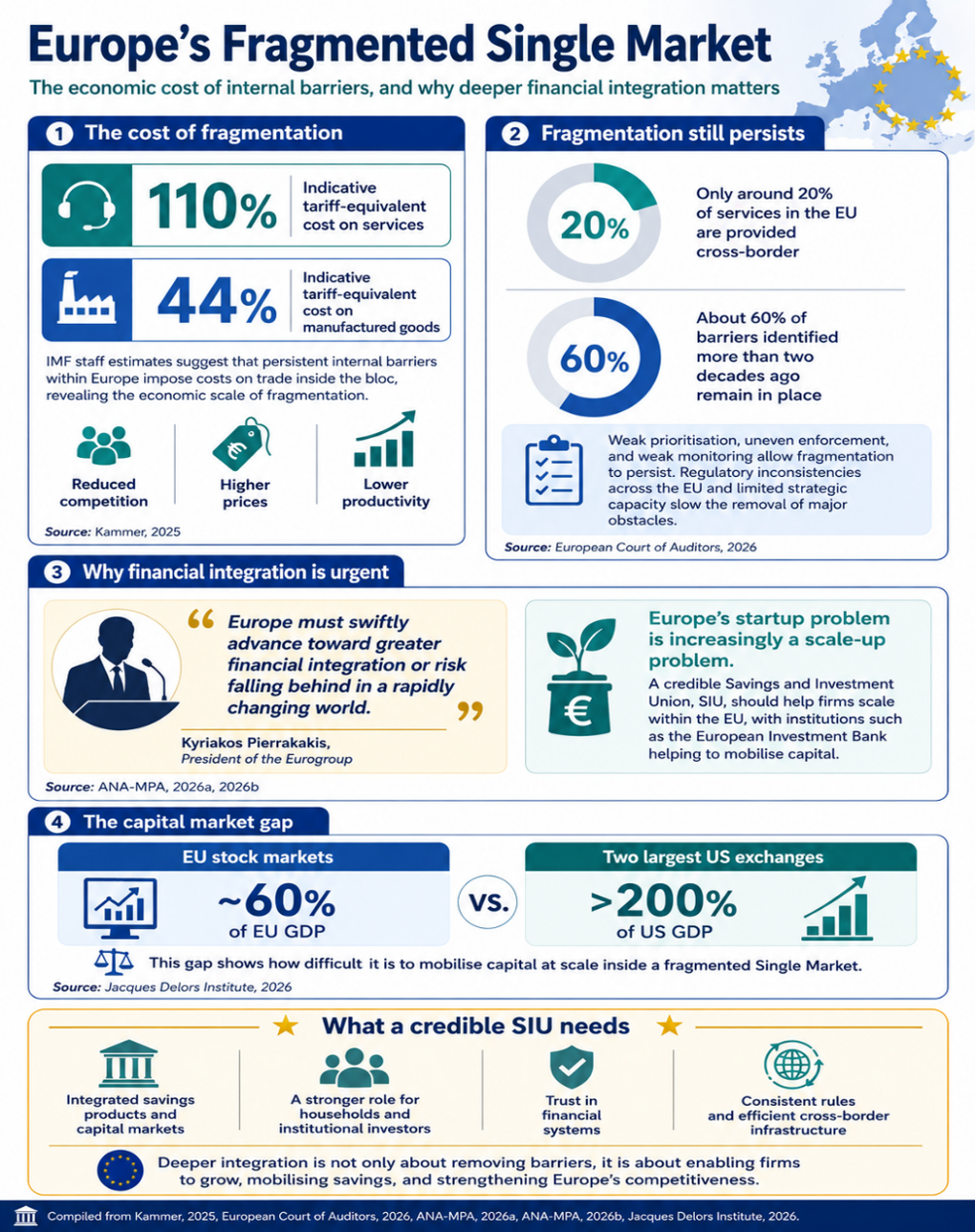
FIGURE 1: Market barriers and the rationale for the SIU
Legal Integration and its Limits
The EU’s legislation governing the Single Market is prima facie comprehensive. It encompasses primary law provisions, specified and complemented by extensive secondary law. This common binding framework establishes directly enforceable rights for economic actors and prohibits a wide array of restrictions on cross-border activities. In that respect, EU law is sound and unavoidable.
Even though it has been established that EU legislation prohibits unjustified restrictions on the free movement of capital, services, goods, and persons, it certainly does not eliminate the conditions under which those restrictions arise.
However, the strength of EU law should not obscure its limits. Even though it has been established that EU legislation prohibits unjustified restrictions on the free movement of capital, services, goods, and persons, it certainly does not eliminate the conditions under which those restrictions arise. Nor does it ensure convergence in administrative practices, regulatory approaches or institutional capacity. These are structural limitations, since the implementation of EU law depends on national authorities that operate within different legal traditions, administrative systems and policy priorities. This leads to the familiar paradox that the same EU legal rule may produce different outcomes across Member States.
…there is increasing support for regulations (Wax & Ionta, 2026), which are binding and directly applicable, reducing the scope for divergence.
Policy debates have focused on this issue, which is also intrinsically correlated to national sovereignty concerns. Directives, as binding legal acts that allow flexibility in national transposition, granting Member States some national discretion to decide how to achieve the set objectives, have often resulted in divergent implementation. In response, there is increasing support for regulations (Wax & Ionta, 2026), which are binding and directly applicable, reducing the scope for divergence. The shift towards regulations is already visible in EU legislative practice: in recent years regulations have become the dominant instrument among legislative acts adopted under the ordinary legislative procedure (Publications Office of the European Union, n.d.). This approach aims to address possible legal confusion among Member States, without being a panacea for every problem, since ultimately all EU rules depend on national enforcement. Legal uniformity, in that sense, mitigates one aspect of market fragmentation, whilst not addressing other disparities in administrative capacity or supervisory practices.
Recent OECD evidence links regulatory compliance costs to weaker productivity and lower business dynamism.
Recent OECD evidence links regulatory compliance costs to weaker productivity and lower business dynamism (Andrews et al., 2026). This matters for the Single Market because firms experience EU law also as compliance tasks, administrative procedures and enforcement practices. Regulations can reduce one important source of fragmentation by limiting divergent national transposition, but they do not remove the practical costs of compliance. Evidence on cumulative compliance costs for SMEs shows that burdens often arise from national interpretation, monitoring and enforcement practices, as well as from the accumulation of obligations over time (European Commission, 2015). These costs may affect firms’ decisions to innovate, enter new markets or expand across borders. The implication is that the choice of legal instrument matters, but it must be accompanied by clear implementation planning, proportionate enforcement and attention to administrative capacity. Otherwise, directly applicable rules may still produce uneven market effects across Member States (European Commission, 2015; Capuano, 2025).
The increasing reliance on regulations should be treated as a governance choice, not as a shortcut to integration.
Even where EU rules are directly binding, Member States remain central to how their effects materialise for businesses and citizens (OECD, 2025). The increasing reliance on regulations should be treated as a governance choice, not as a shortcut to integration. Regulations can limit national divergence, but where they postpone application, rely heavily on implementing acts, or require substantial national administrative adjustment, they may reproduce some of the same practical problems usually associated with directives (Capuano, 2025). The question is therefore not whether regulations are preferable in abstract terms, but under what conditions they can produce uniform market effects without increasing legal complexity or weakening accountability.
Policy discussions have also explored the use of optional EU-wide legal regimes, such as the so-called “28th regime” corporate legal framework, as a means of reducing fragmentation without requiring full harmonization.
Policy discussions have also explored the use of optional EU-wide legal regimes, such as the so-called “28th regime” corporate legal framework, as a means of reducing fragmentation without requiring full harmonization (Hallak, 2026). It would allow businesses to operate under a single set of EU rules across Member States, bypassing divergent national frameworks. This approach is clearly manifesting an attempt to reconcile regulatory uniformity with political limitations on deeper harmonisation. It aims to be a transition towards a legal framework specifically designed to more effectively facilitate cross-border activities in Europe. It goes hand in hand with the argument that before venturing into the global market, European companies should prioritise strengthening their presence within Europe.
Capital Markets as a Stress Test: From Free Movement to SIURegarding the freedom of capital, primary EU law is particularly liberal. Article 63 of the Treaty on the Functioning of the European Union (TFEU) prohibits all restrictions on capital movements within the EU and between Member States and third countries. The CJEU has even interpreted EU law on capital and payments in a dynamic way that reinforces its role as a central pillar of market integration (Samaras, 2022). Even so, further provisions in the TFEU stipulate a number of exceptions to the principle of free movement of capital. Article 65 TFEU stipulates derogations related to taxation, prudential supervision of financial institutions, public policy and public security.
The free movement of capital is enshrined in primary EU law, but in practice it relies largely on trust in banks, institutions, and the country’s economic performance.
Sometimes the implementation of the free movement of capital lacks certainty. As an example, one might cite the experience of “capital controls” in Cyprus (2013-2015) and in Greece (2015-2019) over the past decade, as it provides a picture of the realistic limits of legal integration within the Single Market under conditions of economic turmoil and financial crisis. The free movement of capital is enshrined in primary EU law, but in practice it relies largely on trust in banks, institutions, and the country’s economic performance. When that trust is broken, exceptions become the norm.
Today, although no comparable emergency capital controls are in place in the Member States, the free movement of capital within the EU is still not fully utilised. Capital markets provide a clear test of the limits of the current integration model.
The gradual process of further liberalising the Single Market is not always linear. Naturally, the banking and financial sector’s stability has been prioritised during periods of severe crisis. Exceptional measures have been adopted in the past, in line with EU law. Consequently, the EU’s economic freedoms are not absolutely guaranteed in perpetuity, regardless of the state of the Member States’ domestic economies and the solutions offered by the EU at the time. Even the most liberal Treaty freedom operates within institutional, financial and crisis-management constraints. Today, although no comparable emergency capital controls are in place in the Member States, the free movement of capital within the EU is still not fully utilised.
Capital markets provide a clear test of the limits of the current integration model. Successive CMU initiatives have addressed several layers of capital-market integration, including prospectus rules, securitisation, long-term investment funds, company disclosure through the European Single Access Point (ESAP), trading transparency, listing rules and withholding tax procedures.[1] Yet these measures have not removed deeper structural fragmentation in supervision, insolvency law, taxation, market infrastructure and growth-stage finance.
This means that companies and investors face higher transaction costs and legal uncertainty when operating across borders. The European Commission has identified these frictions as key impediments to the effective functioning of capital markets and to the broader objective of financing growth within the EU (European Commission, 2020b). Recent analysis indicates that the main obstacle to deeper capital market integration lies in the limited centralisation of supervisory powers at EU level, with the European Securities and Markets Authority (ESMA) still lacking the authority required to ensure consistent application of rules across Member States (Gortsos, 2026).
More integrated capital markets support private risk sharing across Member States, improve the allocation of capital and enhance the resilience of the euro area to asymmetric shocks.
The European Central Bank (ECB) has also noted the macroeconomic importance of capital market integration. More integrated capital markets support private risk sharing across Member States, improve the allocation of capital and enhance the resilience of the euro area to asymmetric shocks (European Central Bank, 2024). Fragmentation reduces these benefits, it reinforces reliance on bank-based financing and constrains access to risk capital, particularly for innovative and high-growth businesses. The CMU agenda has addressed some of these issues through targeted legislative initiatives, facilitating cross-border investment and promoting supervisory convergence. Nevertheless, structural differences in national frameworks are still problematic in a cross-border context.
The initiative for a SIU, presented by the European Commission in March 2025, suggests a recalibration into a holistic approach that incorporates the entire EU financial system, attempting to mobilise European savings more effectively and to channel them into productive investment within the EU.
The initiative for a SIU, presented by the European Commission in March 2025, suggests a recalibration into a holistic approach that incorporates the entire EU financial system, attempting to mobilise European savings more effectively and to channel them into productive investment within the EU (European Commission, 2025d). It is designed to transform the foundational work of the two main CMU Action Plans (i.e. the pioneering 2015 CMU Action Plan and the 2020 CMU Action Plan), along with the parallel efforts to develop the Banking Union, into a high-impact, more inclusive and citizen-focused, financial engine. This is closely linked to concerns about the EU’s investment gap and the need to finance large-scale transitions, including digitalisation and decarbonisation (Draghi, 2024).
Towards a results-oriented EU governance approachThe governance of the Single Market is based largely on decentralised implementation.
The governance of the Single Market is based largely on decentralised implementation. Member States are responsible for applying EU law, while the European Commission -acting as the “guardian of the Treaties”- monitors compliance and initiates enforcement when required. It is unavoidable that structural challenges and disputes rise from time to time, since the application of EU law varies in practice across the 27 EU Member States. The infringement procedure against a Member State that fails to implement EU legislation remains a crucial enforcement tool. However, despite its usefulness, it addresses specific Member State breaches of EU law, not systemic patterns of violations. The Commission has framed enforcement as a strategic and preventive function, rather than merely a reactive infringement mechanism, with particular emphasis on own-initiative investigations, incorrect transposition of directives, and infringements that obstruct fundamental freedoms or the effective functioning of the Single Market (European Commission, 2022).
…the main challenge for the EU continues to be ineffective governance.
The completion of the Single Market also requires a credible delivery framework that combines, other than political commitment, a coherent legislative package and clear timelines (Jacques Delors Institute, 2026). Recent EU initiatives point towards a more targeted and measurable enforcement strategy. The “2026 Annual Single Market and Competitiveness” report introduces the first annual “Single Market Enforcement Agenda”, focused on priority barriers such as late payments and obstacles in construction and installation services linked to the green transition, while simplification packages seek to reduce administrative burdens and make Single Market rules easier to apply in practice (European Commission, 2026). Nonetheless, institutional limits hinder enforcement. Coordination mechanisms rely on cooperation and do not always generate strong incentives for compliance. Consequently, the main challenge for the EU continues to be ineffective governance.
A turning point appears to be marked by more recent developments towards a results-oriented EU governance approach. The joint “One Europe, One Market” roadmap, agreed in late April 2026 between the European Parliament, the Council and the Commission, seeks to introduce a structured implementation framework through priority legislative deliverables and clear timelines, as well as regular monitoring through quarterly stocktaking. Europe’s fragmentation was translated into a structured work programme built around five priorities: simplifying rules, deepening Single Market integration, strengthening trade, reducing energy prices while advancing decarbonisation, and driving the digital and AI transformation, supported by more than forty legislative and policy deliverables.
The roadmap shows the political commitment of the EU institutions for setting out concrete steps towards a more operational Single Market governance (Council of the European Union, 2026). It converts a broad competitiveness agenda into a delivery test: capital markets, energy, digital infrastructure and industrial policy are placed within one political framework, with timelines that make delays more visible and politically costly (Letta, 2026a).
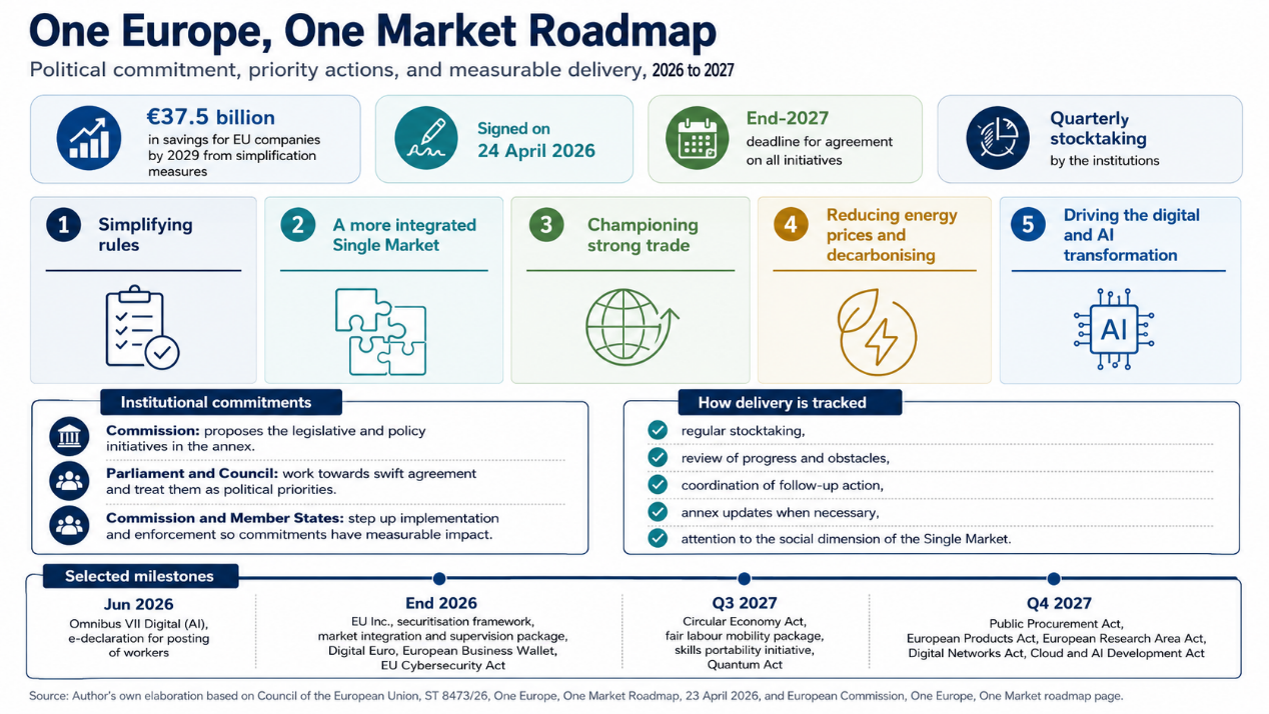
FIGURE 2: “One Europe, One Market” roadmap (April 2026), from political commitment to measurable delivery
The roadmap’s “market integration and supervision package” is particularly relevant in this respect, since the Commission’s December 2025 proposals seek to address capital-market fragmentation through changes to trading, post-trading, asset management and ESMA supervision, confirming that the SIU depends not only on new rules but on a more integrated supervisory architecture (European Commission, 2025e).
Policy RecommendationsCompleting the Single Market requires targeted action. The adoption of these strategic priorities is strongly encouraged:
- Target harmonisation and implementation where fragmentation is structural: EU legislative action should focus on areas such as insolvency, taxation procedures and other market obstacles, where national discrepancies create permanent barriers. Where the Treaty basis allows it, regulations may be more effective than directives, since they reduce transposition delays and limit divergent national implementation. Moreover, the Commission should track the implementation of major Single Market initiatives early, using detailed guidance and reporting to prevent new fragmentation from emerging. Attention should be paid to reducing “gold-plating” (adding extra layers of rules at the national level), which often increases compliance costs without clear policy justification.
- Reinforce supervisory convergence in capital markets: As has been pointed out in the Draghi Report (2024), the EU lacks a single securities market regulator. The ESMA ought to be transformed to serve as the sole common regulator for all securities markets within the EU. The EU should strengthen convergence through the ESMA, reinforcing transparency and technical standards, attaining a more unified supervision of capital markets.
- Constitutional discipline for restrictions on capital movements: Past episodes of capital controls show that EU law can accommodate emergency restrictions on capital movements where they are justified, proportionate and temporary. The unresolved issue is institutional. These safeguards have operated mainly through ad hoc assessment and monitoring, rather than through a permanent framework designed to protect capital-market integration. The EU should therefore develop, first through secondary legislation and eventually through Treaty reform, a stricter constitutional discipline for the use of Article 65 TFEU. Its provisions should not be abolished, since taxation, prudential supervision and public policy/security remain legitimate public interests. Its invocation, however, should be tied to clearer EU-level conditions: notification, time limitation, strict periodic review and consistency with the objective of capital-market integration. The aim would not be to invent new legality criteria, but to make their application more predictable, reviewable and aligned with the completion of the SIU.
Eliminating internal obstacles across the EU is essential for enabling market dynamics to operate effectively on a large scale.
In 2024, the findings and recommendations of the Letta and Draghi reports had been met with widespread enthusiasm (Kritikos, 2024). Eliminating internal obstacles across the EU is essential for enabling market dynamics to operate effectively on a large scale. A true unified market is needed, ensuring that conducting business between Vilnius and Madrid is as seamless as it is between Athens and Thessaloniki. The competitiveness debate is therefore also a debate about scale. The EU’s difficulty is that companies, banks and capital markets are primarily organised around national markets. In a global economy shaped by continental-scale competitors from the United States and China, the relevant benchmark is whether businesses in the EU can achieve sufficient growth to establish themselves as truly European entities, rather than remaining confined to national prominence. This does not alter the fact that slow convergence may be insufficient in sectors where technological cycles and global competition move faster than EU implementation.
A more integrated Single Market needs rules that are clear and sufficiently uniform to support cross-border growth, while avoiding unnecessary procedural burdens that make compliance easier for incumbents than for new entrants.
A more integrated Single Market needs rules that are clear and sufficiently uniform to support cross-border growth, while avoiding unnecessary procedural burdens that make compliance easier for incumbents than for new entrants. National regulatory discretion may protect domestic dominant players and, possibly, reduce unwanted competitive pressure from other Member States. This might explain why many barriers still exist even when their aggregate cost to the EU economy is widely recognised. Completing the Single Market requires confronting the domestic interests that benefit from partial integration.
A functioning SIU should be assessed by whether it enables European firms to grow within Europe, rather than pushing them towards capital markets elsewhere.
Greater scale should not be understood as a goal only for large Member States or large firms. Smaller Member States and SMEs may benefit most from a genuinely integrated Single Market, because domestic scale is structurally limited. Deeper integration can expand their addressable market and create more credible paths from local innovation to European growth. Besides, Europe does not lack startups or entrepreneurial talent, but many firms face a financing and market-size ceiling once they move from creation to scaleup. A functioning SIU should be assessed by whether it enables European firms to grow within Europe, rather than pushing them towards capital markets elsewhere.
Recent EU policy developments set out the way forward regarding greater regulatory uniformity and less economic overreliance on third countries. This direction addresses important aspects of the problem. However, legal convergence does not automatically produce effective integration. The central challenge is mostly operational, since the EU has demonstrated its ability to identify barriers and design policy responses. Ensuring consistent implementation across Member States is more difficult. The long-term political sustainability of the Single Market depends also on ensuring that mobility remains a choice rather than an obligation. As emphasised in recent policy debates, deeper integration must be accompanied by economic and social cohesion in order to remain politically viable (Letta, 2026b).
Completing the Single Market should be understood not only as an economic reform, but as a condition for European resilience and sovereignty.
The link between competitiveness and European security is also central to the Single Market debate. In a global economy, fragmentation weakens the EU’s capacity to invest, innovate and act strategically. Completing the Single Market should be understood not only as an economic reform, but as a condition for European resilience and sovereignty (Letta & Lamy, 2026). It is time for the EU to compete with the dominant players, benefitting from a higher degree of autonomy by boosting its economy. For the EU this requires a decisive shift from agenda-setting to delivery. It implies departing from mediocrity, with stronger enforcement, greater administrative capacity and sustained political commitment.
Completing the Single Market means making Europe the natural scale of economic activity, rather than leaving firms, capital and innovation trapped in national markets.
From the early stages of the internal market, European policymakers recognised that incomplete integration risks reducing the market to a form of managed openness instead of a fully functioning economic space (European Commission, 1985). The struggle over the same strategic choice is still relevant today. The key question is whether Europe can transition from a culture of national protectionism to a European-scale mindset. Completing the Single Market means making Europe the natural scale of economic activity, rather than leaving firms, capital and innovation trapped in national markets.
ReferencesAarnio, R., Bogucki, A., Jorge Ricart, R., Timmers, P., & Vainio, T. (2026). Building One Europe, One Market: Four strategic priorities for the digital single market (Sitra Studies 258). Sitra.
ANA-MPA. (2026a, March 17). Pierrakakis at Euronext: SIU will boost job quality across Europe. https://www.amna.gr/mobile/article/978705/Pierrakakis-at-Euronext-SIU-will-boost-job-quality-across-Europe
ANA-MPA. (2026b, May 13). Pierrakakis: We need greater integration in Europe, bank mergers, larger businesses. https://www.amna.gr/article/992554/pierrakakis-we-need-greater-integration-in-europe–bank-mergers–larger-businesses
Andrews, D., Turban, S., & Tyros, S. (2026). Regulatory compliance costs and productivity: New task-based evidence (OECD Economics Department Working Papers No. 1856). OECD Publishing. https://doi.org/10.1787/1c1da52e-en
Capuano, V. (2025). New legislative approach with old legislative tools: The recent (ab)use of regulations in European Union law. Eurojus, 4, 145–163. https://rivista.eurojus.it/new-legislative-approach-with-old-legislative-tools-the-recent-abuse-of-regulations-in-european-union-law/
Council of the European Union. (2026). One Europe, One Market Roadmap of the European Parliament, the Council of the European Union and the European Commission (ST-8473/26).
https://data.consilium.europa.eu/doc/document/ST-8473-2026-INIT/en/pdf
Court of Justice of the European Union. (2026). Annual report 2025: Statistics concerning the judicial activity of the Court of Justice. https://curia.europa.eu/site/upload/docs/application/pdf/2026-05/ra_en_court_statistiques_25.pdf
Draghi, M. (2024). The future of European competitiveness. European Commission. Part A: https://commission.europa.eu/document/download/97e481fd-2dc3-412d-be4c-f152a8232961_en; Part B: https://commission.europa.eu/document/download/ec1409c1-d4b4-4882-8bdd-3519f86bbb92_en?filename=The%20future%20of%20European%20competitiveness_%20In-depth%20analysis%20and%20recommendations_0.pdf
European Central Bank. (2024). Financial integration and structure in the euro area. https://www.ecb.europa.eu/press/fie/html/ecb.fie202406~c4ca413e65.en.html
European Commission. (1985). Completing the internal market: White paper from the Commission to the European Council (Milan, 28–29 June 1985) (COM(85) 310 final). https://eur-lex.europa.eu/legal-content/EN/TXT/?uri=CELEX:51985DC0310
European Commission [Directorate-General for Internal Market, Industry, Entrepreneurship and SMEs & Centre for Strategy & Evaluation Services]. (2015). Cost of the cumulative effects of compliance with EU law for SMEs: final report. Publications Office. https://data.europa.eu/doi/10.2873/554243
European Commission. (2020a). Identifying and addressing barriers to the Single Market (COM(2020) 93 final).
https://eur-lex.europa.eu/legal-content/EN/TXT/?uri=CELEX:52020DC0093
European Commission. (2020b). A Capital Markets Union for people and businesses: New action plan (COM(2020) 590 final).
https://eur-lex.europa.eu/legal-content/EN/TXT/?uri=CELEX:52020DC0590
European Commission. (2022). Enforcing EU law for a Europe that delivers (COM(2022) 518 final).
https://commission.europa.eu/publications/communication-commission-enforcing-eu-law-europe-delivers_en
European Commission. (2024). The 2024 Annual Single Market and Competitiveness Report (COM(2024) 77 final). https://eur-lex.europa.eu/legal-content/EN/TXT/?uri=CELEX:52024DC0077
European Commission. (2025a). A Competitiveness Compass for the EU (COM(2025) 30 final). https://eur-lex.europa.eu/legal-content/EN/TXT/?uri=celex:52025DC0030
European Commission. (2025b). The Single Market: Our European home market in an uncertain world (COM(2025) 500 final). https://single-market-economy.ec.europa.eu/publications/single-market-our-european-home-market-uncertain-world_en
European Commission. (2025c). Startups, scaleups and entrepreneurship. [Flash Eurobarometer 559]. https://europa.eu/eurobarometer/surveys/detail/3359
European Commission. (2025d). Savings and Investments Union: A strategy to foster citizens’ wealth and economic competitiveness in the EU (COM(2025) 124 final). https://eur-lex.europa.eu/legal-content/EN/TXT/?uri=CELEX:52025DC0124
European Commission. (2025e). Market integration and supervision package. https://finance.ec.europa.eu/publications/market-integration-and-supervision-package_en
European Commission. (2026). The 2026 Annual Single Market and Competitiveness Report (COM(2026) 46 final).
https://eur-lex.europa.eu/legal-content/EN/TXT/?uri=COM:2026:46:FIN
European Council. (2026). European Council conclusions, 19 March 2026.
https://www.consilium.europa.eu/en/meetings/european-council/2026/03/19/
European Court of Auditors. (2026). Single market for services: Commission action to remove barriers to cross-border services still insufficient (Special Report No 13/2026). https://www.eca.europa.eu/en/publications/SR-2026-13
Gortsos, C. (2026). European (EU) capital markets law at (close to) 50: Historical evolution and missing elements (EBI Working Paper No. 207). European Banking Institute. https://papers.ssrn.com/sol3/papers.cfm?abstract_id=6689178
Hallak, I. (2026, April). The 28th regime corporate legal framework (PE 785.710). European Parliamentary Research Service, European Parliament. https://www.europarl.europa.eu/thinktank/en/document/EPRS_BRI(2026)785710
IMF. (2024, October). Regional Economic Outlook for Europe: A Recovery Short of Europe’s Full Potential.
Jacques Delors Institute. (2026). One Europe, One market: Europe’s strongest response to a world in transformation. https://institutdelors.eu/content/uploads/2026/04/One-Europe-One-Market_paper_v3-1.pdf
Kammer, A. (2025, June). Europe’s integration imperative. International Monetary Fund. https://www.imf.org/en/publications/fandd/issues/2025/06/europes-integration-imperative-alfred-kammer
Kritikos, A. (2024). The Letta and Draghi reports: The only way to go, despite the hurdles (European Economy Policy Briefs No. 5/2024). Hellenic Foundation for European and Foreign Policy (ELIAMEP). https://www.eliamep.gr/wp-content/uploads/2024/11/Policy-briefs-special-edition-Leventis-5-EN-.pdf
Letta, E. (2024). Much more than a market. Council of the European Union.
https://www.consilium.europa.eu/media/ny3j24sm/much-more-than-a-market-report-by-enrico-letta.pdf
Letta, E. (2026a, May). One Europe, One Market Roadmap: Building Europe’s capacity to act. Centre for Economic Policy Research. https://cepr.org/system/files/publication-files/299775-one_europe_one_market_roadmap_building_europe_s_capacity_to_act.pdf
Letta, E. (2026b, February 26). One Europe. One market. Time to complete the EU single market. Politico. https://www.politico.eu/article/time-complete-eu-european-single-market-next-step/
Letta, E., & Lamy, P. (2026, March 17). Now more than ever, Europe must complete the Single Market. Project Syndicate. https://www.project-syndicate.org/commentary/eu-completing-single-market-key-to-defense-energy-security-tech-sovereignty-by-enrico-letta-and-pascal-lamy-2026-03
OECD. (2025). Better Regulation Practices across the European Union 2025. OECD Publishing. https://doi.org/10.1787/6f007516-en
Publications Office of the European Union. (n.d.). Legal acts – statistics. EUR-Lex. https://eur-lex.europa.eu/statistics/legislative-acts-statistics.html
Samaras, A. (2022). Οι κεφαλαιακοί περιορισμοί στο σύγχρονο ενωσιακό δίκαιο [Restrictions on the free movement of capital in contemporary EU law]. Nomiki Bibliothiki.
Thomadakis, A., & Marcus, J. S. (2025). Identification of hurdles that companies, especially innovative start-ups, face in the EU justifying the need for a 28th regime (PE 775.947). European Parliament, Policy Department for Justice, Civil Liberties and Institutional Affairs. https://www.europarl.europa.eu/RegData/etudes/STUD/2025/775947/IUST_STU(2025)775947_EN.pdf
Wax, E., & Ionta, N. (2026, April 28). Who killed the directive? Euractiv.
https://www.euractiv.com/news/rapporteur-who-killed-the-directive/
[1] See, indicatively, Regulation (EU) 2017/1129; Regulation (EU) 2017/2402; Regulation (EU) 2023/606; Regulation (EU) 2023/2859; Directive (EU) 2024/790; Regulation (EU) 2024/791; Regulation (EU) 2024/2809; Directive (EU) 2024/2811; Council Directive (EU) 2025/50.
Categories: Diplomacy & Defense Think Tank News
Pages



© 2012-2018 Europa Varietas Foundation © 2015-2018 Europa Varietas Association
www.europavarietas.org | info(@)europavarietas(dot)org | Switzerland




We are looking for sponsors for the English translation of these books, please contact turkeandras(at)gmail(dot)com