
Vous êtes ici
Agrégateur de flux
IA krach ?
Qu'est-ce qu'une bulle ? C'est une croyance collective. Qu'est-ce qu'un krach ? C'est l'effondrement de la croyance qui fit la bulle. Avec l'IA, nous sommes servis : nous avons deux bulles pour le prix d'une. C'est une équation à 5 trillions de dollars, et on commence à se demander si elle a une solution. En fait à redouter qu'elle n'en ait pas.
- La pompe à phynance / Chine, États-Unis, Finance, Informatique, Technologie
Catégories: Défense
Marine Le Pen, une histoire française : aux origines, l’ascension de celle qui n’avait pas été choisie
Propulsée sur le devant de la scène après les débuts contrariés de sa sœur aînée, la benjamine de Jean-Marie Le Pen a fait ses armes en observant son père, avant de se faire une place dans la grande famille nationaliste. Jusqu’à s’imposer à la tête du FN en 2011.
Catégories: France
Included, but on whose terms? Ukrainian identity within Pridnestrovian nation-building after 2022
Blog article adapted from University of Oxford MPhil thesis ‘Imagined Inclusion? Language, Identity, and the Limits of Inclusivity in the Pridnestrovian Nation’ and conference paper by the same name, presented at UACES Graduate Forum Research Conference at Babeș-Bolyai University, Cluj-Napoca on 4 June 2026. The thesis assesses how Ukrainian and Romanian are differentially included within Pridnestrovie’s nation-building process before and after the 2022 Russian full-scale invasion of Ukraine. Will Kingston-Cox is a political researcher and postgraduate in Russian and East European Studies at the University of Oxford, specialising in Moldova, nationalism, and identity politics.
Since attaining de facto independence from Moldova in 1992, the Pridnestrovian Moldavian Republic, or Pridnestrovie, has pursued a sustained nation-building project. In the absence of a titular ethnic majority, Pridnestrovian state institutions have sought to construct a common political community encompassing Moldovans, Russians, and Ukrainians, as well as numerous smaller minorities, such as Bulgarians and Poles. The resulting “Pridnestrovian people” is officially imagined as multinational, multilingual and supraethnic.
Yet formal inclusion does not necessarily translate to practical equivalence. Russian, Ukrainian and Moldovan written in Cyrillic are constitutionally recognised as official languages, but Russian remains overwhelmingly dominant in state administration, education and public life. The Russian full-scale invasion of Ukraine in February 2022 therefore raised a consequential question for Pridnestrovian nation-building: how would a Russian-supported de facto state manage Ukrainian identity when that identity had become increasingly politically sensitive?
One plausible expectation was that Ukrainian would be progressively marginalised because the Pridnestrovian state might have sought to signal alignment with its patron, Russia, over the war in Ukraine. However, my research found a more surprising process. Rather than excluding Ukrainian from the imagined Pridnestrovian nation, the state more actively incorporated it, but on increasingly explicit Pridnestrovian terms. Ukrainian was preserved and, at points, rhetorically protected and activated, whilst being detached from contemporary Ukrainian statehood and subordinated to a Russian-centred, territorially bounded political community.
My research examined presidential speeches, interviews, addresses and press conferences alongside Ministry of Education curricula issued between December 2016 and September 2025. This enabled comparison between the first five years of Vadim Krasnoselsky’s presidency and the period following Russia’s full-scale invasion to assess the positioning and inclusion of Ukrainian (as well as Romanian).
Across both periods, presidential discourse consistently presents Pridnestrovie as a non-titular political community. In 2018, Krasnoselsky declared that the “Pridnestrovian people have been created”, describing a community of different nationalities whose members preserve their languages, cultures and traditions. He added that Pridnestrovie possessed no system of titular nations and that “no nation prevails over another”.
However, the state’s own institutional texts reveal a differentiated hierarchy beneath this language of equivalence. Russian functions as the normative language of public life and as the principal linguistic and civilisational connection to Russia and the Soviet past. Moldovan written in Cyrillic is protected as a purportedly ‘authentic’ Moldovan category, defined partly through its distinction from Romanian and the perceived Romanianisation of Moldova, such as the 2023 renaming of the state language as Romanian. Ukrainian is also recognised as constitutive of the political community, but its inclusion is more conditional and carefully managed.
I characterise this structure as hierarchical multinationalism: a system in which multiple ethnolinguistic identities are formally incorporated into a common political community, but occupy unequal positions within it.
The post-2022 presidential discourse did not reproduce a pattern of Ukrainian exclusion. On the contrary, Krasnoselsky repeatedly affirmed Ukrainian’s official status, defended the continued operation of Ukrainian-language institutions and publicly rejected ethnic antagonism between Russians and Ukrainians. In December 2022, he argued that “destroying a language means destroying a people” and declared himself opposed to the destruction of Russian, Ukrainian or Moldovan. He also threatened to suppress claims that Ukrainians would attack Russians, or Russians would attack Ukrainians, presenting such antagonism as incompatible with Pridnestrovian multinationalism.
The treatment of Ukrainian refugees was especially revealing. Two days after the full-scale invasion, Krasnoselsky emphasised that Ukrainian was an official language, that Ukrainian-language educational institutions continued to operate and that the state would provide assistance to people arriving from Ukraine.
Subsequent statements framed their incorporation more explicitly. In May 2022, Krasnoselsky stated that he could barely describe those arriving as refugees because they were “very similar to us”, invoking the shared historical spaces of the Russian Empire and Soviet Union. He claimed that they had “completely disappeared” into Pridnestrovian society and were “all our people now”. By August 2024, he described Ukrainian refugees as having “merged” with Pridnestrovian society and become “our Pridnestrovian people”.
This discourse is accommodating, but also assimilationist. Ukrainian difference is not portrayed as threatening provided that it is absorbed into the supraethnic Pridnestrovian political community. Ukrainian identity remains culturally recognisable, but is not presented as an autonomous axis of political belonging.
Moreover, state curricula demonstrate a parallel process of activated but subordinated inclusion. A June 2020 Ukrainian language and literature curriculum framed the subject primarily in communicative, cultural and humanistic terms. Its stated objectives included developing linguistic competence, expanding pupils’ knowledge and familiarising them with Ukrainian culture and literature. Pridnestrovian nationhood was not invoked explicitly as the object of political loyalty.
An October 2022 curriculum adopted after the invasion differed markedly. It prescribed the formation of a “Pridnestrovian civic identity”, patriotism, “respect and duty to the Motherland”, and respect for the past and present of the “people of Pridnestrovie”. Ukrainian-language education was thereby connected directly to the reproduction of the state’s political community. This did not amount to the removal of Ukrainian culture. The authorised canon continued to contain major Ukrainian writers, including pre-Soviet national classics and members of the repressed “Executed Renaissance”. Nevertheless, Ukrainian culture was institutionally curated. Contemporary post-Soviet literature, diaspora authors and overtly state-centred Ukrainian narratives remained largely absent.
The unexpected post-2022 development was therefore not the marginalisation of Ukrainian, but the increased activation of its inclusion. The state assigned Ukrainian language education a more explicit nation-building function, using it to reproduce loyalty to Pridnestrovie rather than identification with Ukraine. Ukrainian could remain culturally Ukrainian, but was expected to become politically Pridnestrovian.
Thus, the geopolitical shock of February 2022 did not fundamentally reconstruct the position of Ukrainian within Pridnestrovian nation-building. Rather, it rendered the terms of its inclusion more explicit. Across presidential discourse and state curricula, Ukrainian continued to be recognised, protected and institutionally reproduced, but within a political framework that subordinated ethnolinguistic distinctiveness to loyalty towards the Pridnestrovian state.
This reveals the operation of hierarchical multinationalism in practice. Ukrainian is neither simply excluded nor treated as equivalent to Russian. Instead, it is incorporated as a constituent identity whose cultural expression remains legitimate insofar as it is compatible with a Russian-centred and territorially bounded Pridnestrovian political community. The post-2022 period therefore produced a more active management of inclusion.
These findings also complicate depictions of Pridnestrovie as merely a passive extension of Russian influence. Russian patronage profoundly structures the de facto state, but Pridnestrovian institutions continue to exercise some agency in constructing and reproducing their own imagined political community.
The post Included, but on whose terms? Ukrainian identity within Pridnestrovian nation-building after 2022 appeared first on Ideas on Europe.
Catégories: European Union
Les jeunes de Bukavu invités à transformer les déchets plastiques en opportunités économiques
La gestion des déchets plastiques, particulièrement les bouteilles et les sachets, représente un défi environnemental persistant pour la ville de Bukavu.
Catégories: Afrique
L’Ukraine a signé un accord de 2,2 milliards d’euros avec la Suède pour se procurer seize avions de combat Gripen E
Fin octobre 2025, l’Ukraine signa une lettre d’intention avec la Suède en vue de se procurer entre 100 et 150 avions de combat JAS-39 Gripen E/F auprès de Saab. Puis, le mois suivant, elle en fit autant avec la France pour une centaine de Rafale. Ces acquisitions devaient alors être financées par un prêt de...
Cet article L’Ukraine a signé un accord de 2,2 milliards d’euros avec la Suède pour se procurer seize avions de combat Gripen E est apparu en premier sur Zone Militaire.
Catégories: Défense
Debate: EU: no more protection for Ukrainian men?
The European Commission plans to amend the rules on the admission of Ukrainian war refugees from spring 2027, and has proposed that Ukrainian men of military age who arrive in the EU should no longer be automatically entitled to protection, although they would retain the right to apply for asylum. In Ukraine, military-age men are subject to an exit ban.
Catégories: European Union
Debate: Customs duty on small parcels: good news for Europe's economy?
As of today, customs duties will be levied on parcels of goods from non-EU countries worth less than 150 euros. These will be subject to a fixed fee of three euros per item type. Until now, such parcels had enjoyed an exemption. The tariffs are expected to hit online retailers which sell cheap goods, such as Temu and Shein, particularly hard. Commentators debate whether the measure will strengthen Europe's economy.
Catégories: European Union
Another step towards industrial stagnation | Frankfurter Allgemeine Zeitung - Germany
Catégories: European Union
Debate: Top court thwarts Trump's bid to change citizenship rules
The law stipulating that anyone born in the US is automatically granted citizenship will remain valid. Donald Trump wanted to change this and, in a symbolic move, issued an executive order to that effect on the very first day of his second term as US President. Now a Supreme Court ruling has put a stop to his plan. Europe's press sees this and other decisions by the Supreme Court as a measure of the state of democracy in the US.
Catégories: European Union
Pages


© 2012-2018 Europa Varietas Foundation © 2015-2018 Europa Varietas Association
www.europavarietas.org | info(@)europavarietas(dot)org | Switzerland
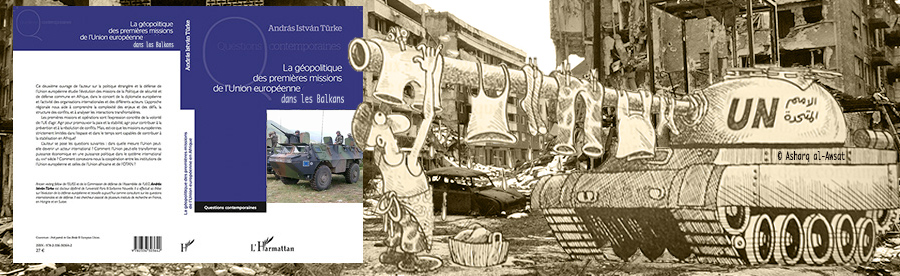
We are looking for sponsors for the English translation of these books, please contact turkeandras(at)gmail(dot)com